Diamond Duel Comparison Worksheet
Visual Investigation Physical Education & Sports Science
PAGE 1 OF 2
Diamond Duel: Baseball vs. Softball
Analyze the visual evidence to contrast equipment specs, dimensions, and diamond layouts.
Name:
Date:
1
Equipment Showcase: Side-by-Side Visual Inspection
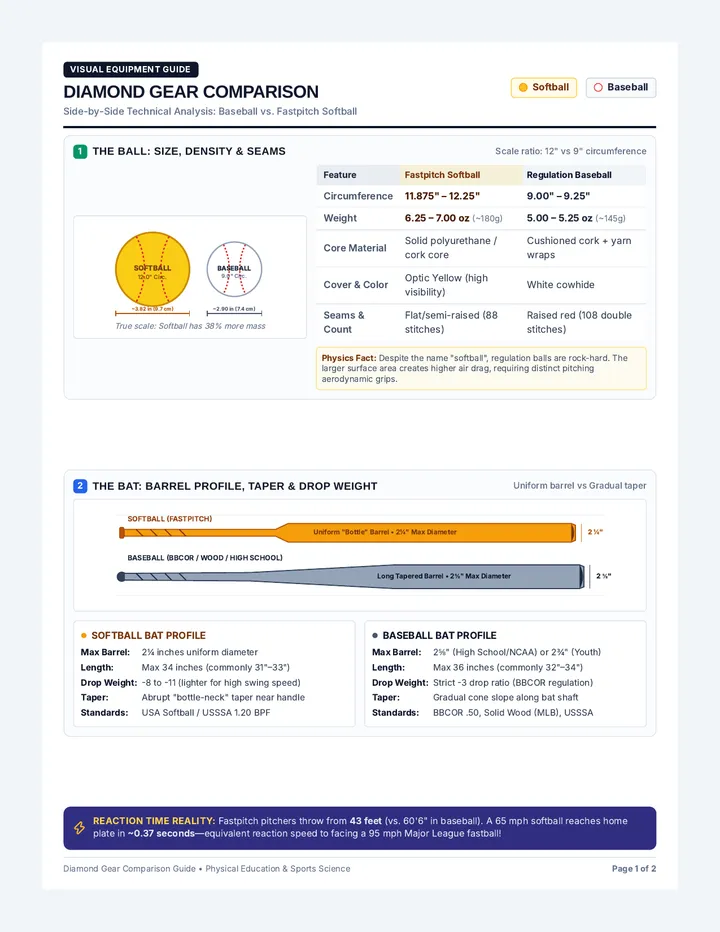
A. The Game Balls
Baseball 9 in · 5.25 oz
Fastpitch Softball 12 in · 7.0 oz
Visual Difference: Identify two physical differences (size, color, weight) and state how this affects fielding:
B. The Bat Profiles
Baseball Bat
2⅝" Barrel
Softball Bat
2¼" Barrel
Notice the softball bat's bottle-neck taper vs. baseball's gradual slope
Design Function: Why does a softball bat have a uniform thinner barrel diameter (2¼") along its length?
C. Glove & Pocket Depth
Baseball Glove 11.5" · Shallow
Softball Glove 13.0" · Deep Pocket
Pocket Science: Why does the softball glove need a significantly deeper pocket and wider web?
2
Diamond Blueprint: Scale Comparison
Baseball Fence (~330-400 ft) Softball Fence (200-220 ft) Home 43' Flat 60'6" Mound Softball: 60' Baseball: 90'
| Dimension Metric | Baseball | Softball |
|---|
| Base Path Distance | 90 feet | 60 feet |
| Pitching Distance | 60 ft 6 in | 43 feet |
| Pitching Surface | Raised 10" Dirt Mound | Flat 16' Chalk Circle |
| Outfield Fence | 320 – 405+ feet | 200 – 220 feet |
Field Math Question: A softball runner sprints 60 ft to 1st base, while a baseball runner runs 90 ft. How does this shorter distance affect infield defensive strategy?
Key Takeaway: Softball has a tighter diamond and larger projectile, drastically compressing fielders' reaction time.
Flip to Page 2 for Rules & Pitching →
Gameplay & Mechanics Physics of Motion & Rulebook
PAGE 2 OF 2
Diamond Duel: Pitching & Rules
Examine the biomechanics of delivery, base-running rules, and competitive strategy.
Scorecard Section
3
Pitching Biomechanics: Overhand vs. Underhand Windmill
Baseball: Overhand Motion Downward Plane
Mound Downward Angle Distance: 60 ft 6 in
Key Characteristic: Delivered from elevated mound; utilizes gravity and arm cocking for high velocity (90-100 mph).
Softball: Windmill Delivery Rise & Flat Plane
Flat Circle Flat or Rising Plane Distance: 43 ft (Release ~37 ft)
Key Characteristic: Full 360° circular arm rotation; released at hip level on flat ground; creates unique "rise ball" effect.
The Reaction Time Paradox: A 95 mph baseball pitch reaches home plate in ~0.40 seconds. A 68 mph softball pitch (from 37 ft release) reaches home plate in ~0.37 seconds. Explain which hitter has LESS time to react and why:
4
Rulebook Spot-Check: Visual Scenarios
A Leading Off Bases
Baseball
Can lead anytime
vs
Softball
Must touch base
When can a softball runner leave base?
B Regulation Length
9
Innings
vs
7
Innings
Why does softball play fewer innings?
C Slap Hitting
Left-handed batter running toward 1st base while swinging at pitch
Why is "slapping" popular in softball?
5
Final Showdown: Head-to-Head Comparison Grid
Fill in the missing details using the visual evidence from both pages
| Feature | Baseball | Softball (Fastpitch) |
|---|
| Ball Circumference & Color | 9 inches; White leather with red stitching | |
| Pitch Delivery Motion | | Underhand windmill full arm circle |
| Pitching Distance to Plate | 60 feet, 6 inches | |
| Base Path Distance | | 60 feet between each base |
| Lead-off Rules | Allowed at any point before pitch | |
Coach's Analysis Question: A common myth is that softball is just "an easier version of baseball." Based on the reaction times, field dimensions, and pitching mechanics you explored today, refute this myth with two specific pieces of visual evidence: