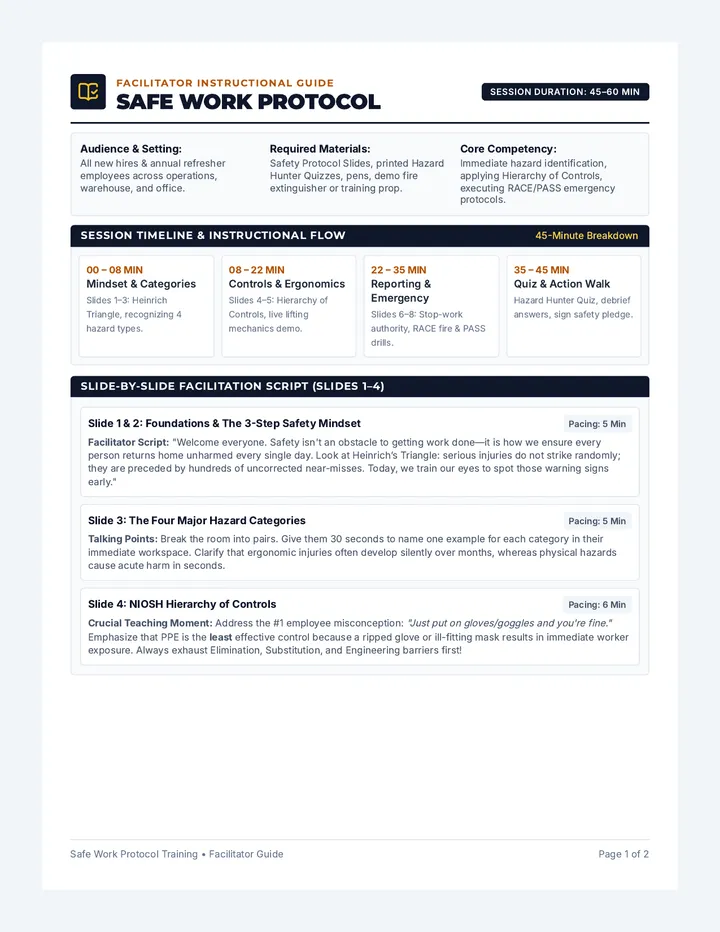
A comprehensive workplace safety lesson covering hazard recognition, the hierarchy of controls, incident reporting procedures, and emergency response protocols.
Scenario: Marcus observes hydraulic fluid dripping from a forklift onto the walking aisle. A coworker steps around it without stopping. Nearby, two 92-lb crates are stacked directly in front of the main electrical shut-off box.
State why blocking is dangerous and the minimum clearance distance required.
11. Moving the 92-lb Crates: Safe lifting method
What control method must be used to relocate crates exceeding the 50-lb single-person limit?
Part 4: Emergency RACE Protocol Sequencing
4 Points (1 pt each)
Number actions from 1 (First Action) to 4 (Final Action):
Contain: Close nearby fire doors/windows.
Alarm: Pull pull station and notify dispatch.
Rescue: Move persons in immediate danger.
Evacuate: Move to designated assembly zone.
Worker Safety Commitment & Attestation
"I commit to conducting daily pre-task hazard scans, utilizing stop-work authority when unsafe conditions are observed, and reporting all near-misses promptly."
Employee Signature:
Printed Name & Date:
Safe Work Protocol Training • Knowledge Check Page 2 of 2
A (Pull, Aim, Squeeze, Sweep). Rationale: Aiming specifically at the base of the flame displaces the oxygen and cools the burning fuel source.
Full Credit Criteria: Must mention stopping to isolate or flag the hazard (e.g., placing caution cone, spill barrier, or standing guard) and promptly notifying maintenance or deploying spill kit absorbent. Walking past without taking action receives 0 pts.
Full Credit Criteria: (1 pt) Recognizes that blockage delays rapid power de-energization during electrical shock or fire; (1 pt) Correctly states the required clearance: 36 inches / 3 feet (OSHA 1910.303(g)).
11. Moving the 92-lb Crates: Heavy Lifting Controls (2 pts)
Full Credit Criteria: Identifies that 92 lbs exceeds the standard 50-lb single-person threshold. Must specify either mechanical lifting aid (pallet jack, hand truck, forklift) or a two-person team lift.
Part 4: Emergency RACE Protocol Order
4 Points (1 pt each)
1
Rescue: Move individuals in danger first.
2
Alarm: Activate pull station and call 911.
3
Contain: Close fire doors to isolate smoke.
4
Evacuate: Move to designated rally zone.
Competency Tier & Facilitator Follow-up
18 - 20 Points (90-100%)
Mastery / Safety Champion. Eligible for department safety committee lead.
16 - 17 Points (80-85%)
Proficient. Certified for general operations. Review missed questions during 1-on-1.
< 16 Points (< 80%)
Requires Remediation. Re-review module slides and re-test within 48 hours.
Safe Work Protocol Training • Facilitator Answer Key Page 2 of 2
Slide 6: Incident & Near-Miss Reporting Pacing: 5 Min
Psychological Safety Emphasis: Remind the group that reporting near-misses is completely non-punitive. Praise the habit of reporting. Reiterate the 3-step sequence: Stop & Secure → Notify Supervisor → Log & Remedy within 60 minutes.
Mnemonic Practice: Have the entire room chant R-A-C-E (Rescue, Alarm, Contain, Evacuate) and P-A-S-S (Pull, Aim, Squeeze, Sweep). Hold up an extinguisher prop and demonstrate sweeping at the base of the fire.
Hands-On Activity: 10-Minute Hazard Hunt Walk
Experiential Learning
Activity Setup: Divide participants into pairs. Direct them to conduct a 5-minute visual sweep of their immediate work zone (or simulated workspace stations). Each pair must identify at least 2 potential hazards (or hypothetical risk points).
Step 1: Spot & Classify Record the item and categorize it as Physical, Ergonomic, Chemical, or Fire/Environmental.
Step 2: Propose Control State which level in the Hierarchy of Controls should be deployed (aim for Engineering or higher).
Step 3: Rapid Debrief Reconvene the group. Have 2 pairs present their findings and immediate corrective solutions.
• Scoring: Review answers using the provided Facilitator Answer Key. 16/20 (80%) is required to certify.
• Remediation: Anyone scoring under 16 points must undergo a 10-minute targeted review with the facilitator focusing on the missed concepts, followed by an immediate oral re-check.
• Record Retention: Archive signed safety commitment pages in the employee compliance safety binder for 3 years.
Safe Work Protocol Training • Facilitator Guide Page 2 of 2