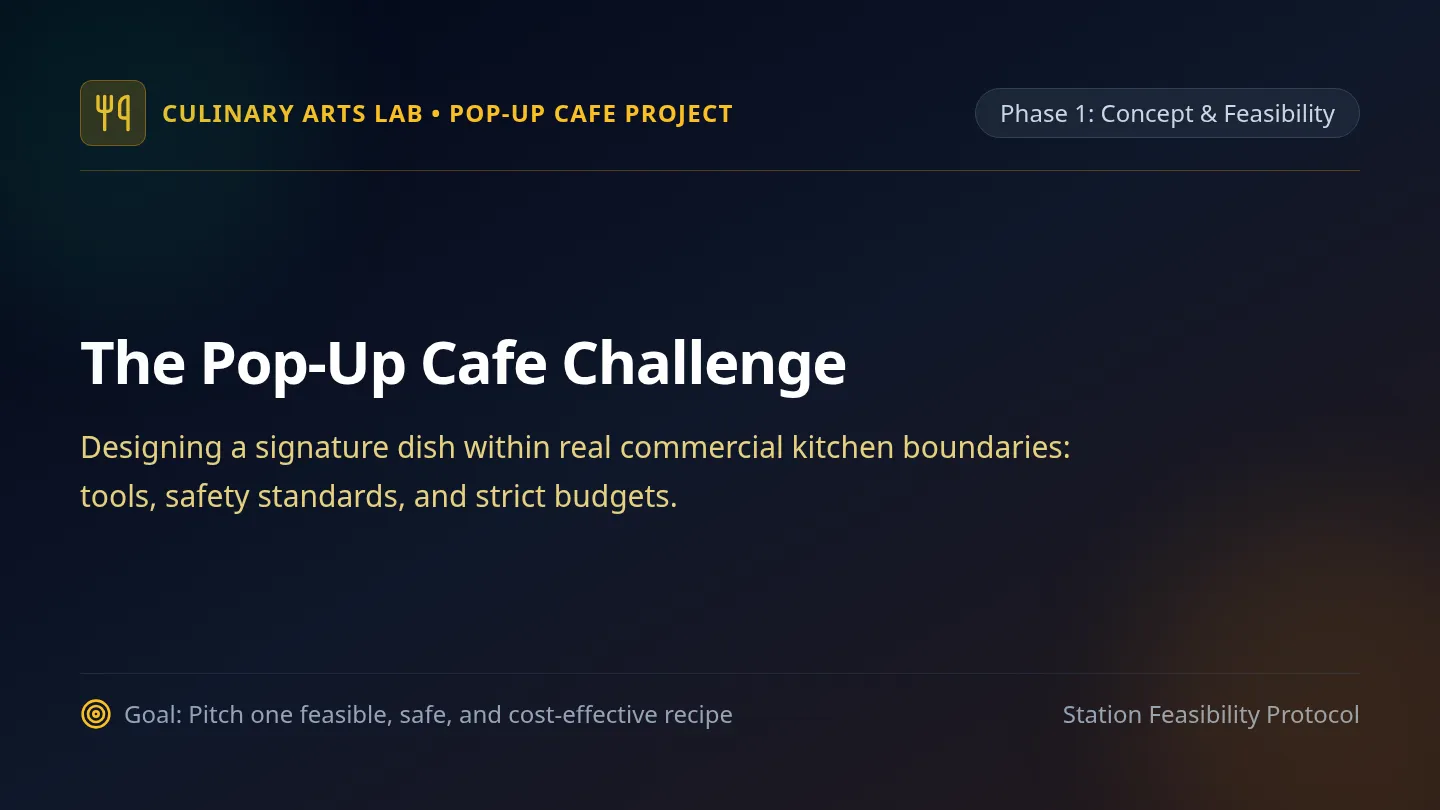
Cafe Launch Slides Culinary Arts Lab • Pop-Up Cafe Project
Phase 1: Concept & Feasibility
The Pop-Up Cafe Challenge
Designing a signature dish within real commercial kitchen boundaries: tools, safety standards, and strict budgets.
Goal: Pitch one feasible, safe, and cost-effective recipe
Station Feasibility Protocol
The Culinary Reality Check
Concept Filter
The Home Cook Trap
• Picking a recipe only because it looks viral or tastes amazing
• Ignoring prep time, equipment traffic jams, and raw ingredient risks
• Overspending on specialty items for tiny garnish portions
The Executive Chef Mindset
• Selecting items tailored to our kitchen's exact appliances and space
• Designing streamlined prep that meets commercial sanitation codes
• Maximizing pantry staples to hit our per-portion budget ceiling
Parameter Checklist: Equipment • Safety • Cost Standard: 100% kitchen feasibility
Parameter 1: Equipment & Station Constraints
Operational Limits
Heat & Cooktops
Each team gets 2 active burners and shared deck oven space.
Avoid recipes needing 3+ simultaneous pans.
Shared Appliances
Food processors, stand mixers, and blenders are shared class equipment .
Plan around bottleneck cleanings and lines.
45-Minute Window
All fabrication, cooking, plating, and sanitizing must fit inside one lab period .
No slow braises or multi-hour marinades.
Question to Answer: Does your team possess every tool required on your station? Zero tool surprises
Parameter 2: Food Safety & Sanitation Rules
Critical Control Points
Temperature Danger Zone
TCS (Time/Temperature Control for Safety) foods must stay out of 41°F - 135°F . If your recipe serves hot, it must hit internal standards (e.g., poultry 165°F, ground meat 155°F).
Rule: Dishes requiring continuous hot-holding require dedicated equipment.
Cross-Contact & Complexity
High-complexity proteins (raw chicken, raw seafood) demand separate cutting boards, rapid sanitation, and frequent glove changes.
Rule: Teams must identify Big 9 allergen risks (nuts, gluten, dairy, eggs, etc.).
If a dish cannot be guaranteed 100% safe within our time limit, it is disqualified. Safety First
Parameter 3: Budget & Ingredient Sourcing
Fiscal Feasibility
$2.50
Portion Cost Ceiling
Your dish cannot exceed $2.50 per serving . Each team produces 4 tasting portions (Max lab budget: $10.00).
Class Pantry
Zero-Cost Staples
Flour, sugar, salt, black pepper, neutral cooking oil, and baking soda/powder are provided free from open lab storage.
Line Items
Purchased Requisitions
Proteins, produce, dairy, and specialty seasonings must be priced from the store requisition sheet and calculated down to exact grams/ounces.
Tip: Gourmet flavor comes from technique and seasoning, not expensive luxury ingredients! Value-Driven Cooking
The Pop-Up Recipe Pitch Protocol
Deliverable
Before Your Recipe is Approved, Prove It:
1 Tool Audit
List every burner, pan, and tool needed. Are all items currently in your team's assigned drawer?
2 Safety Defense
Identify minimum internal cook temperatures and outline allergen sanitation plans.
3 Budget Ledger
Complete unit cost math showing total team spend is under $10 ($2.50 per serving).
Worksheet Deliverable: Complete Pages 1 & 2 with your kitchen brigade
Chef Sign-Off Required
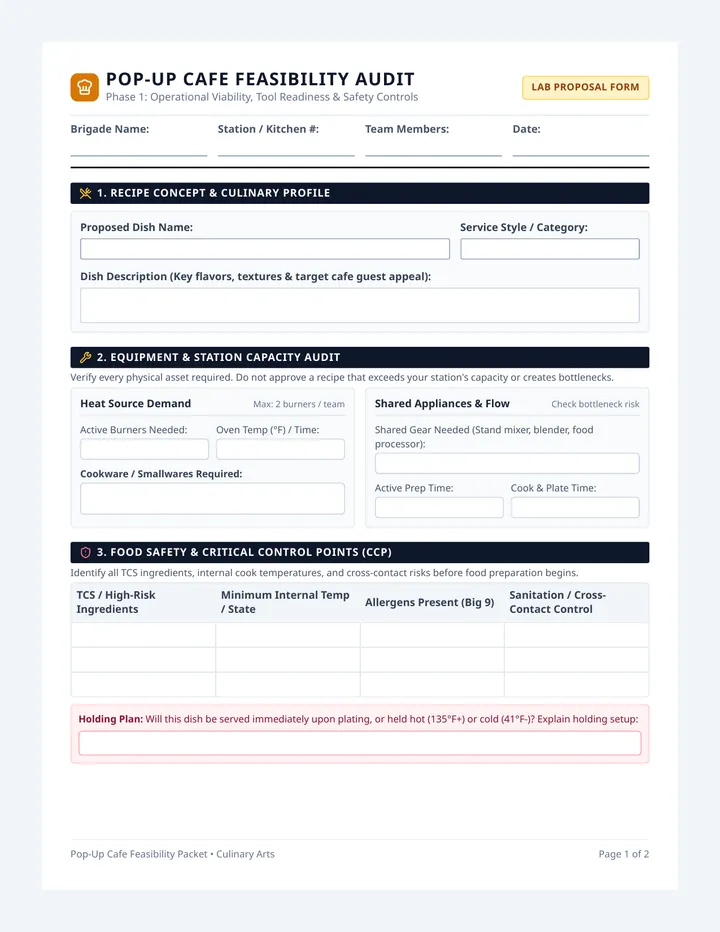
Recipe Feasibility Worksheet Pop-Up Cafe Feasibility Audit
Phase 1: Operational Viability, Tool Readiness & Safety Controls
Lab Proposal Form
Brigade Name:
Station / Kitchen #:
Team Members:
Date:
1. Recipe Concept & Culinary Profile
Proposed Dish Name:
Service Style / Category:
Dish Description (Key flavors, textures & target cafe guest appeal):
2. Equipment & Station Capacity Audit
Verify every physical asset required. Do not approve a recipe that exceeds your station's capacity or creates bottlenecks.
Heat Source Demand Max: 2 burners / team
Active Burners Needed:
Oven Temp (°F) / Time:
Cookware / Smallwares Required:
Shared Appliances & Flow Check bottleneck risk
Shared Gear Needed (Stand mixer, blender, food processor):
Active Prep Time:
Cook & Plate Time:
3. Food Safety & Critical Control Points (CCP)
Identify all TCS ingredients, internal cook temperatures, and cross-contact risks before food preparation begins.
TCS / High-Risk Ingredients
Minimum Internal Temp / State
Allergens Present (Big 9)
Sanitation / Cross-Contact Control
Holding Plan: Will this dish be served immediately upon plating, or held hot (135°F+) or cold (41°F-)? Explain holding setup:
Pop-Up Cafe Feasibility Packet • Culinary Arts Page 1 of 2
Ingredient Budget & Recipe Pitch
Phase 2: Financial Feasibility, Cost per Portion & Brigade Defense
Budget Cap: $2.50 / Portion
4. Ingredient Sourcing & Costing Ledger
Yield Target: 4 Tasting Portions
List all non-staple ingredients. (Class pantry staples: flour, sugar, salt, black pepper, and frying oil are $0.00).
Ingredient & Specification
Source (Pantry vs Store)
Quantity Needed
Unit Rate
Cost ($)
Total Recipe Cost:
Max limit: $10.00 total
Portions Produced:
Standard: 4 portions
Cost Per Serving:
Must be ≤ $2.50
5. Brigade Feasibility Justification
1. Kitchen Efficiency Defense: Why is this recipe realistic to execute, plate, and clean up in our 45-minute lab window?
2. Cost & Value Defense: How does this dish deliver restaurant-quality flavor and presentation while remaining under budget?
3. Contingency Plan: If a primary tool is in use or an ingredient runs short, what is your brigade's immediate backup plan?
Chef Instructor Proposal Evaluation Official Lab Gatekeeper
Approved as Pitched
Conditional Revision
Budget Exceeded
Safety / Tool Conflict
Chef Feedback / Required Modifications:
Chef Signature:
Pop-Up Cafe Feasibility Packet • Culinary Arts Page 2 of 2
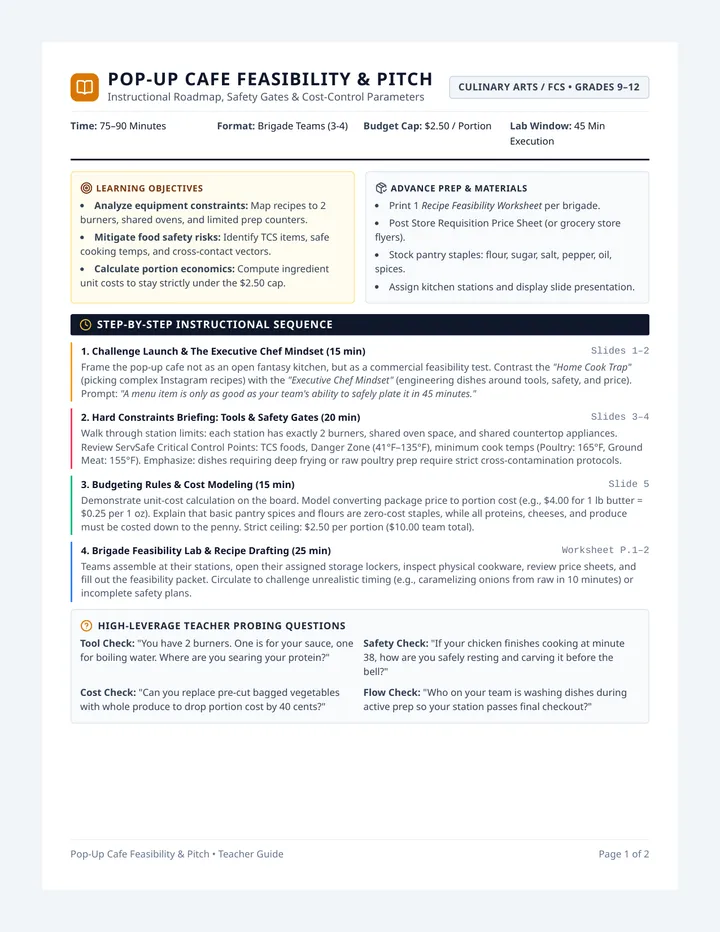
Pop Up Pitch Teacher Guide Pop-Up Cafe Feasibility & Pitch
Instructional Roadmap, Safety Gates & Cost-Control Parameters
Culinary Arts / FCS • Grades 9–12
Time: 75–90 Minutes
Format: Brigade Teams (3-4)
Budget Cap: $2.50 / Portion
Lab Window: 45 Min Execution
Learning Objectives
Analyze equipment constraints: Map recipes to 2 burners, shared ovens, and limited prep counters.Mitigate food safety risks: Identify TCS items, safe cooking temps, and cross-contact vectors.Calculate portion economics: Compute ingredient unit costs to stay strictly under the $2.50 cap.
Advance Prep & Materials
Print 1 Recipe Feasibility Worksheet per brigade.
Post Store Requisition Price Sheet (or grocery store flyers).
Stock pantry staples: flour, sugar, salt, pepper, oil, spices.
Assign kitchen stations and display slide presentation.
Step-by-Step Instructional Sequence
1. Challenge Launch & The Executive Chef Mindset (15 min) Slides 1–2
Frame the pop-up cafe not as an open fantasy kitchen, but as a commercial feasibility test. Contrast the "Home Cook Trap" (picking complex Instagram recipes) with the "Executive Chef Mindset" (engineering dishes around tools, safety, and price). Prompt: "A menu item is only as good as your team's ability to safely plate it in 45 minutes."
2. Hard Constraints Briefing: Tools & Safety Gates (20 min) Slides 3–4
Walk through station limits: each station has exactly 2 burners, shared oven space, and shared countertop appliances. Review ServSafe Critical Control Points: TCS foods, Danger Zone (41°F–135°F), minimum cook temps (Poultry: 165°F, Ground Meat: 155°F). Emphasize: dishes requiring deep frying or raw poultry prep require strict cross-contamination protocols.
3. Budgeting Rules & Cost Modeling (15 min) Slide 5
Demonstrate unit-cost calculation on the board. Model converting package price to portion cost (e.g., $4.00 for 1 lb butter = $0.25 per 1 oz). Explain that basic pantry spices and flours are zero-cost staples, while all proteins, cheeses, and produce must be costed down to the penny. Strict ceiling: $2.50 per portion ($10.00 team total).
4. Brigade Feasibility Lab & Recipe Drafting (25 min) Worksheet P.1–2
Teams assemble at their stations, open their assigned storage lockers, inspect physical cookware, review price sheets, and fill out the feasibility packet. Circulate to challenge unrealistic timing (e.g., caramelizing onions from raw in 10 minutes) or incomplete safety plans.
High-Leverage Teacher Probing Questions
Tool Check: "You have 2 burners. One is for your sauce, one for boiling water. Where are you searing your protein?"
Safety Check: "If your chicken finishes cooking at minute 38, how are you safely resting and carving it before the bell?"
Cost Check: "Can you replace pre-cut bagged vegetables with whole produce to drop portion cost by 40 cents?"
Flow Check: "Who on your team is washing dishes during active prep so your station passes final checkout?"
Pop-Up Cafe Feasibility & Pitch • Teacher Guide Page 1 of 2
Proposal Evaluation & Lab Gatekeeping
Assessment Rubric, Pitfall Interventions & Differentiation
Chef Approval Gate
Recipe Pitfalls & Immediate Teacher Interventions
The "Fryer Craze" Trap
Students want churros, fries, or fried chicken without considering oil heat-up time, smoke points, and hot-oil disposal risks.
Pivot: Direct them to pan-searing, shallow pan-toasting, or baked crisp techniques.
The "Luxury Garnish" Trap
Teams pick dishes needing a $7 package of pine nuts, microgreens, or saffron just to use a pinch on 4 plates.
Pivot: Teach knife cuts: crispy shallots, scallion curls, or herb-infused pantry oils.
The "Appliance Traffic Jam"
Multiple brigades plan smoothies, purees, or whipped creams assuming the 2 class food processors will be open.
Pivot: Require sign-up slots or recommend hand-mashing, whisking, or mortar-and-pestle methods.
Recipe Feasibility & Pitch Scoring Rubric
Criterion
Exemplary (4)
Proficient (3)
Developing (2)
Unacceptable (1)
Equipment & Time Viability
Uses ≤ 2 burners; zero shared gear bottlenecks; flawless 45-min timeline with prep/cleanup.
Uses station gear properly; timing realistic with minor rush during cleanup.
Requires 3+ burners or conflicts with shared gear; timeline exceeds 45 min.
Unrealistic equipment demands; cannot be executed in lab timeframe.
Food Safety & HACCP Controls
All TCS foods identified with exact internal cook temps; robust allergen & sanitizing steps.
TCS temps noted correctly; basic allergen awareness and sanitation plan included.
Vague holding/cooking temperatures; cross-contamination risks not fully addressed.
Ignores Temperature Danger Zone; poses severe food safety hazard.
Budget & Cost Efficiency
Portion cost ≤ $2.50 ($10 total); math verified; smart pantry staple optimization.
Portion cost between $2.00–$2.50; math accurate with minimal calculation errors.
Portion cost slightly over budget ($2.51–$3.00) or unit conversions are missing.
Significantly over budget or costing ledger incomplete/missing.
Feasibility Defense & Pitch
Compelling culinary concept; thorough contingency plan for missing items/equipment delays.
Clear concept with viable contingency plan; team demonstrates collaborative ownership.
Weak justification; superficial contingency plan; hesitant team defense.
No contingency plan; brigade cannot explain or defend their recipe choices.
Scaffolding for Emerging Brigades
Provide a "Curated Recipe Matrix" (e.g., gourmet grilled cheese variations, fresh pasta with pan sauces, street tacos) where ingredient quantities and equipment counts are pre-calculated, allowing them to focus on customization and safety execution.
Extension for Advanced Culinary Teams
Challenge teams to hit a stricter budget ceiling ($1.75/portion) or require a dual-texture plate with a scratch sauce (reduction, emulsion) that tests burner multi-tasking and precision holding temperature controls.
Pop-Up Cafe Feasibility & Pitch • Teacher Guide Page 2 of 2