Liquid Lightning Teacher Guide Liquid Lightning
Sports Drinks vs. Energy Drinks
GRADE 10
Health & Wellness
Duration
60-90 Minutes
Focus
Nutrition & Caffeine Dangers
Standards
NHES & MA CHPE
Essential Questions
When is a sports drink actually beneficial for the body?
How do energy drinks disrupt adolescent physiology?
How can I identify hidden health risks on a drink label?
Learning Objectives
Students will be able to:
Differentiate between the intended purposes of sports drinks and energy drinks.
Analyze drink labels for sugar, caffeine, and electrolyte content.
Identify at least three health risks associated with excessive caffeine consumption in teens.
Standards Alignment
National Health Education Standards (NHES)
Standard 1: Comprehend concepts related to health promotion and disease prevention to enhance health.Standard 3: Demonstrate the ability to access valid information, products, and services.Standard 5: Demonstrate the ability to use decision-making skills to enhance health.
MA CHPE Framework (2023)
1.10.NP.1: Analyze the relationship between nutrition, health, and physical activity.1.10.SU.1: Analyze the effects of caffeine and other stimulants on the body.
Instructional Procedure
Step 1
The Hook: The Buzz Check (10 mins)
Ask students: "What's the difference between Gatorade and Monster?" Conduct a quick "Four Corners" poll based on student usage (Daily, Only for Sports, Occasionally, Never). Briefly discuss their reasons for consumption.
Step 2
Direct Instruction: Energy Equation (15 mins)
Use the Drink Decoder Slides to present key concepts:
Sports Drinks: Electrolytes, glucose, hydration for >60 mins high intensity.Energy Drinks: Stimulants, high caffeine, high sugar, NOT for hydration.Caffeine Dangers: Cardiovascular stress, sleep disruption, anxiety, and the AAP recommendation for teens (no energy drinks).
Step 3
Activity: Drink Detective Lab (30-40 mins)
Students work in small groups using the Label Library Cards and Drink Detective Lab Sheet .
Analysis Tasks:
Calculate total sugar in teaspoons (Total Grams ÷ 4).
Identify total caffeine per container (watch for serving size tricks!).
Look for "The Fine Print" (Warning labels, herbal stimulants like guarana).
Determine if the drink is "Fuel" (Sport), "Fizz" (Energy/Soda), or "Fraud" (Marketing misleading labels).
Step 4
Synthesis & Debate (15 mins)
Regroup to share findings. Challenge students with scenarios: "You have a 2-hour soccer game in 90-degree heat. Which drink do you choose?" or "You stayed up late studying and have a test next period. Is an energy drink the right choice? What's the alternative?"
Step 5
Exit Ticket (5 mins)
Students write one personal "Drink Standard" they will follow moving forward based on what they learned about their physiology.
Teacher Pro-Tips
Misconception Alert
Students often think "Sugar-Free" energy drinks are healthy. Remind them that the caffeine, artificial sweeteners, and herbal stimulants still pose significant cardiovascular risks to adolescents.
The Sugar Math
Show a physical visual of sugar. If a drink has 60g of sugar, measure out 15 teaspoons of white sugar into a cup. The visual impact is much stronger than just reading the number.
Discussion Starters
"Why do you think energy drink companies sponsor extreme sports athletes if their products aren't actually good for performance?"
"How does marketing influence our perception of what 'energy' feels like vs. what true metabolic energy is?"
"If a sports drink is only needed for 60+ minutes of intensity, what should you drink during a normal school day?"
Materials Needed:
Printed Label Library Cards
Drink Detective Lab Sheets (1 per student)
Energy Equation Fact Sheets
Calculators (optional)
Whiteboard/Markers
Visual of sugar teaspoons (recommended)
Drink Decoder Slides LIQUID LIGHTNING
The Truth Behind the Can
FUEL?
FIZZ?
FRAUD?
Sports Drinks: The Fuel
The Purpose
Designed to replace water and electrolytes (salt/potassium) lost during heavy sweat.
The Timing
Only necessary for activity lasting more than 60 minutes at high intensity.
Fact Check:
Water is still
Energy Drinks: The Fizz
The Ingredients
• Mega-doses of Caffeine
• High Sugar or Artificial Sweeteners
• Guarana/Taurine (Stimulants)
The Goal
Marketing a "Buzz"—not providing biological fuel for your cells.
Hydration Warning
Energy drinks can actually DEHYDRATE you because caffeine is a diuretic.
NEVER use these
The Caffeine Crash
High caffeine doses in teenagers are linked to:
Anxiety & Jitters
Feeling "wired but tired"
Sleep Ruin
Disrupting growth & focus
Rapid Heartbeat
Cardiovascular stress
AAP Recommendation: Adolescents should consume ZERO energy drinks.
The Sugar Trap
4 Grams = 1 Teaspoon
If a drink has 60g of sugar, you are drinking 15 TEASPOONS of straight sugar.
The result? A massive insulin spike followed by a "sugar crash" that leaves you more tired than before.
60g
Per Can
🧊
🧊
🧊
Your Mission
DRINK DETECTIVE
Analyze the "Label Library Cards." Hunt for hidden sugar, calculate the caffeine, and decide if the drink is helping or hurting.
Math the Sugar
Spot Stimulants
Check Warnings
Final Verdict
Energy Equation Fact Sheet The Energy Equation
Fuel vs. Fizz Fact Sheet
REF: HS-HLTH-26
Sports Drinks
Primary Goal
To replace water and electrolytes (sodium, potassium, magnesium) lost during intense physical exertion.
What's Inside?
Glucose (Sugar): For fast-acting energy to muscles.Electrolytes: To maintain fluid balance and muscle function.Water: For hydration.
When to use:
During or after high-intensity exercise lasting more than 60 minutes (e.g., a soccer match, long-distance run, intense basketball training).
Energy Drinks
Primary Goal
Marketing a "mental and physical boost" through stimulants . They are NOT for hydration.
What's Inside?
High Caffeine: Often 2-4 times more than a cup of coffee.Guarana: A plant extract containing concentrated caffeine.Taurine: An amino acid that may affect heart function.
When to use:
The American Academy of Pediatrics states: Energy drinks have NO place in the diet of children or adolescents.
CAFFEINE & THE ADOLESCENT BRAIN
The Heart
Caffeine is a stimulant that increases blood pressure and heart rate. High doses can lead to palpitations and, in rare cases, cardiac events in predisposed teens.
The Sleep
Caffeine stays in your system for hours. Consumption in the afternoon ruins "Deep Sleep," which is critical for brain development, memory, and height growth.
Hydration
Caffeine is a diuretic , meaning it makes you urinate more. Drinking an energy drink when you are already dehydrated from sports is dangerous.
The Label Literacy Cheat Sheet
Sugar Rule
4g = 1 tsp
Divide total grams by 4
Serving Trap
Size x Serv
Multiply if more than 1 serving
Caffeine Cap
100mg / day
Teen safe maximum limit
Stimulant List
Look for 'G'
Guarana, Ginseng, Glucuronolactone
Source: National Institutes of Health / American Academy of Pediatrics / Massachusetts CHPE Guidelines
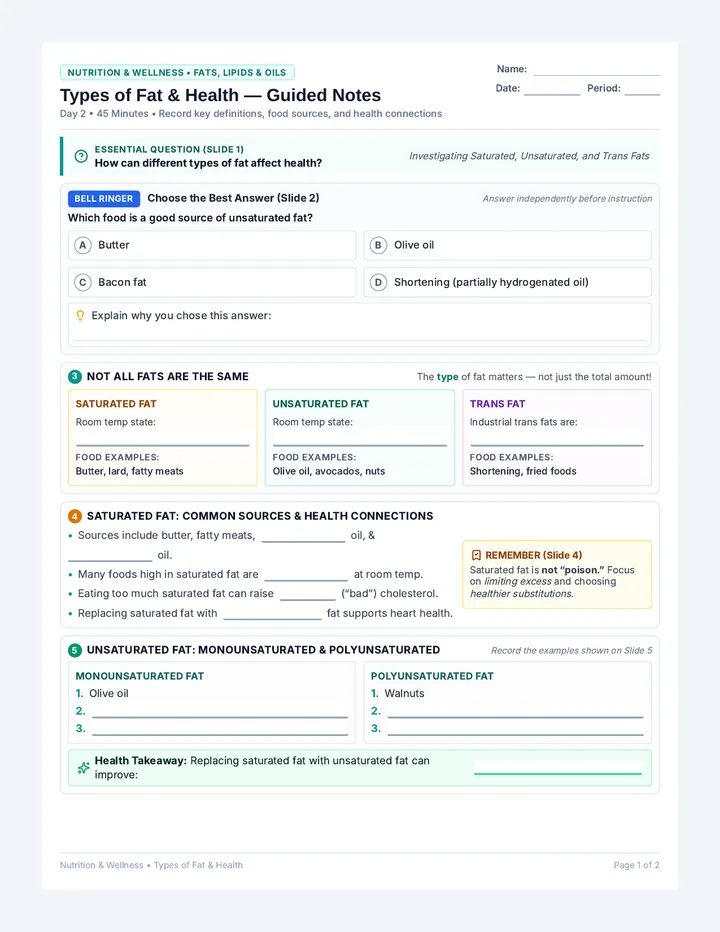
Drink Detective Lab Sheet Drop 2 Drink Detective
Nutritional Analysis Lab
NAME:
DATE:
Instructions: Analyze the nutrition labels provided. Calculate the totals for the entire container . Some bottles contain more than one serving!
Drink Name Full Size Total Sugar (g) Sugar (Tsp) Caffeine (mg) Type (Sport/Energy/Med) Gatorade (Midnight) 28 oz Red Bull Energy 12 oz Yerba Madre (Mate) 15.5 oz Prime Berry Freeze 16.9 oz Liquid I.V. (Stick) 16 oz mix Monster Energy 16 oz C4 Performance 12 oz Ghost Grape 16 oz Pedialyte Sport 33.8 oz BodyArmor Straw/Ban 16 oz Alani Nu Cosmic 12 oz
1. The Multi-Serving Trap
Look at the 28oz Gatorade and 33.8oz Pedialyte . Why might a student accidentally consume too much sugar or sodium from these bottles specifically?
2. Caffeine Comparison
Compare the 12oz Red Bull (114mg) to the 12oz C4 (200mg). Which has more caffeine per ounce? Is either appropriate for a 15-year-old athlete? Why?
3. Natural vs. Synthetic
Analyze the Yerba Madre label. It is marketed as "organic" and "natural." Compare its caffeine and sugar to a standard energy drink like Monster . Does "natural" mean "healthier" for a teen? Explain.
My Hydration Standard
DECISION-MAKING COMMITMENT
Select one of the prompts below to complete your personal health standard:
Brand Name Library Cards Reference Gatorade Midnight Ice
Nutrition Facts
Serving Size: 12 fl oz (355 mL)
Servings Per Container: 2.33 (28oz)
Calories80
Total Carb.22g
Total Sugars21g
Sodium160mg
Potassium45mg
Note: Values above are PER SERVING. Calculate for full bottle (28oz).
Red Bull Energy
Nutrition Facts
Serving Size: 1 can (12 fl oz)
Servings Per Container: 1
Calories160
Total Carb.40g
Total Sugars37g
CAFFEINE: 114mg
Ingredients: Carbonated Water, Sugar, Glucose, Citric Acid, Taurine, Caffeine, Niacinamide, B6, B12.
Yerba Madre (Mate)
Nutrition Facts
Serving Size: 1 can (15.5 fl oz)
Servings Per Container: 1
Calories120
Total Carb.30g
Total Sugars28g
CAFFEINE: 150mg
Organic Yerba Mate Leaf Extract, Organic Cane Sugar.
Prime Berry Freeze
Nutrition Facts
Serving Size: 16.9 fl oz (500 mL)
Servings Per Container: 1
Calories25
Total Carb.6g
Total Sugars2g
Sodium10mg
Potassium700mg
CAFFEINE: 0mg
Liquid I.V. (Popsicle)
Nutrition Facts (Per 1 Stick)
Serving Size: 1 Stick (16 fl oz water)
Servings Per Container: 1
Calories50
Total Carb.11g
Total Sugars11g
Sodium500mg
Potassium370mg
Electrolyte Drink Mix. No Caffeine.
Monster Energy
Nutrition Facts
Serving Size: 16 fl oz (473 mL)
Servings Per Container: 1
Calories210
Total Carb.54g
Total Sugars54g
Caffeine: 160mg
Proprietary Blend: Taurine, Ginseng, L-Carnitine, Guarana, Inositol.
C4 Performance (12oz)
Nutrition Facts
Serving Size: 1 can (12 fl oz)
Servings Per Container: 1
Calories0
Total Sugars0g
Caffeine: 200mg
Contains Beta-Alanine, BetaPower® Betaine, L-Citrulline.
Ghost Welch's Grape
Nutrition Facts
Serving Size: 16 fl oz (473 mL)
Servings Per Container: 1
Liquid Lightning Answer Key Drink Detective: Answer Key
Teacher Reference Only (Updated Brands)
Unit: Health & Wellness
Drink Name Full Size Total Sugar (g) Sugar (Tsp) Caffeine (mg) Correct Type Gatorade (28oz) 28 oz 49g 12.25 tsp 0mg Sport Red Bull (12oz) 12 oz 37g 9.25 tsp 114mg Energy Yerba Madre 15.5 oz 28g 7 tsp 150mg Energy/Natural Prime Berry Freeze 16.9 oz 2g 0.5 tsp 0mg Sport Liquid I.V. Stick 16 oz mix 11g 2.75 tsp 0mg Sport/Med Monster Energy 16 oz 54g 13.5 tsp 160mg Energy C4 Performance 12 oz 0g 0 tsp 200mg Energy Ghost Grape 16 oz 0g 0 tsp 200mg Energy Pedialyte Sport 33.8 oz 25g 6.25 tsp 0mg Medical/Sport BodyArmor Straw/Ban 16 oz 21g 5.25 tsp 0mg Sport Alani Nu Cosmic 12 oz 0g 0 tsp 200mg Energy
1. The Multi-Serving Trap
Both the 28oz Gatorade and 33.8oz Pedialyte are designed for multiple servings or extended consumption. A student might drink the entire bottle in one sitting, consuming nearly 50g of sugar (Gatorade) or over 1000mg of sodium (Pedialyte), which far exceeds the needs of a typical student unless they are engaged in extreme endurance athletics.
2. Caffeine Intensity
The 12oz Red Bull (114mg) has ~9.5mg per oz. The 12oz C4 (200mg) has ~16.6mg per oz. C4 is significantly more concentrated . Neither is recommended for a 15-year-old, as the safe limit for adolescents is generally 100mg/day. Consuming 200mg in one sitting can cause cardiac stress and severe sleep disruption.