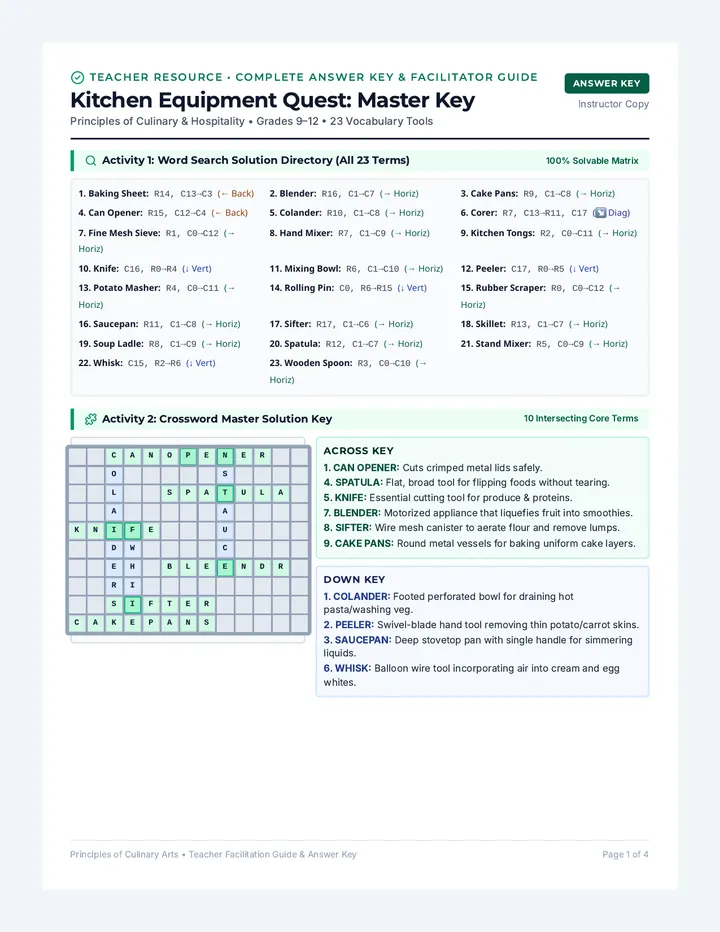
U
D
W
C
E
H
B
L
E
E
N
D
R
R
I
S
I
F
T
E
R
C
A
K
E
P
A
N
S
Principles of Culinary Arts • Teacher Facilitation Guide & Answer Key Page 1 of 4
Criteria for accuracy, acceptable culinary rationale, and student response evaluation.
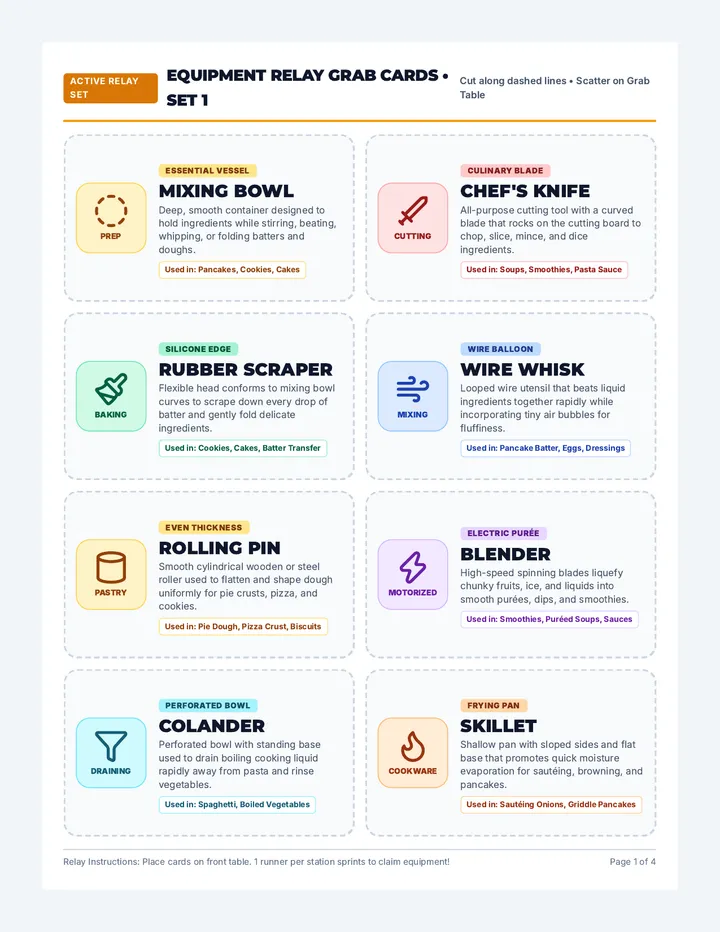
1. Fine Mesh Sieve (Strainer): Tiny mesh catches micro-seeds & curds.
2. Colander: Footed base + large holes for rapid high-volume water exit.
3. Rubber Scraper: Curved flexible silicone blade scrapes bowl contours clean.
4. Spatula (Turner): Flat beveled head slides under hot seared proteins.
5. Kitchen Tongs: Spring-loaded extension of hands for hot line gripping.
6. Rolling Pin: Heavy cylinder applies uniform pressure for thin pastry.
7. Corer: Circular tubular blade punches out tough seed core in apples/pears.
8. Wooden Spoon: Heat-safe, non-conductive, won't scratch delicate nonstick coatings.
9. Potato Masher: Upright handle + grid plate exerts downward crushing leverage.
10. Soup Ladle: Deep angled bowl portions hot liquids cleanly without drips.
Scenario A: Homemade Garlic Mashed Potatoes Key Tools: Peeler, Knife, Saucepan, Colander, Potato Masher
Tasks & Rationale: The Peeler removes skins with minimal flesh waste. The Knife cuts potatoes into uniform 1-inch cubes so they cook at an identical rate. The Saucepan submerges potatoes in salted cold water to boil fork-tender. The Colander safely drains gallons of boiling water in the sink. The Potato Masher exerts manual crushing force to break down starch without activating excessive gluey gluten/amylose (which happens if pureed in a blender/food processor).
Scenario B: Chocolate Chip Cookies Key Tools: Mixing Bowl, Hand/Stand Mixer, Rubber Scraper, Baking Sheet, Spatula
Tasks & Rationale: The Mixing Bowl provides a deep vessel for creaming butter and sugar. The Hand Mixer or Stand Mixer aerates the fat and sugar into a pale emulsion. The Rubber Scraper folds in chocolate chips gently without pulverizing them and cleans bowl sides. The flat, unrimmed/low-rim Baking Sheet allows even hot air circulation in the oven. The Spatula (Turner) lifts hot, delicate cookies from the pan to cooling racks without bending.
Scenario C: Hearty Scratch Vegetable Soup Key Tools: Peeler, Knife, Can Opener, Saucepan, Wooden Spoon, Soup Ladle
Tasks & Rationale: The Peeler and Knife execute mirepoix (celery, carrots, onions) into uniform small dice. The Can Opener cleanly removes can lids without metal shavings. The deep Saucepan contains simmering broth, aromatics, and vegetables with minimal evaporative splatter. The Wooden Spoon stirs ingredients across the bottom to prevent scorching. The Soup Ladle cleanly portions hot 8-ounce servings into bowls without splashing hot liquid on hands.
Scenario D: Fluffy Buttermilk Breakfast Pancakes Key Tools: Mixing Bowl, Whisk, Rubber Scraper, Skillet, Spatula
Tasks & Rationale: The Mixing Bowl holds wet and dry ingredients. The Whisk blends ingredients until just combined (leaving small lumps so gluten does not overdevelop and toughen the pancake). The Rubber Scraper scrapes batter cleanly into ladles or measuring cups. The wide, flat Skillet provides direct conductive heat across a large surface. The thin, flexible Spatula (Turner) slips under hot pancakes to flip them cleanly once surface bubbles burst.
Principles of Culinary Arts • Teacher Facilitation Guide & Answer Key Page 2 of 4
Comparative tool analysis, rationales, and evaluation criteria for tool selection.
Scenario E: Fresh Apple-Pear Tart / Fruit Garnish Tools: Peeler, Corer, Knife, Mixing Bowl
Rationale: Peeler glides along curved fruit to take off only the thin peel without wasting pulp. The Corer punches cleanly down the stem axis to remove fibrous seed chambers while preserving the fruit's circular shape. The Knife cuts uniform 1/8" thin slices required for symmetrical fan arrangement.
Scenario F: Two-Layer Vanilla Birthday Cake Tools: Sifter, Stand Mixer (or Hand Mixer), Rubber Scraper, Cake Pans
Rationale: The Sifter breaks up compacted flour clumps and aerates starch granules for a tender crumb. The Stand Mixer creams butter and sugar with high torque. The Rubber Scraper scrapes down bowl walls and folds in delicate flavors. Two greased Cake Pans hold liquid batter and conduct uniform oven heat for even layer rise.
Scenario G: Italian Fettuccine with Meat Sauce Tools: Saucepan, Skillet, Colander, Wooden Spoon, Kitchen Tongs
Rationale: Deep Saucepan boils water for long pasta; wide Skillet sears ground beef (allowing steam to evaporate for true browning). Colander drains pasta in the sink; Wooden Spoon breaks up meat fond and stirs sauce; Kitchen Tongs grasp, lift, and twirl long fettuccine strands to toss them in sauce without snapping noodles.
Scenario H: High-Protein Berry-Banana Smoothie Tools: Peeler / Knife, Blender, Rubber Scraper
Rationale: The Knife cuts fruit into manageable chunks so motor blades do not stall. The high-speed Blender pulverizes ice, fibrous strawberries, and thick yogurt into a silky emulsion. The Rubber Scraper reaches into the bottom and sides of the blender pitcher to harvest every drop of thick shake into the customer cup.
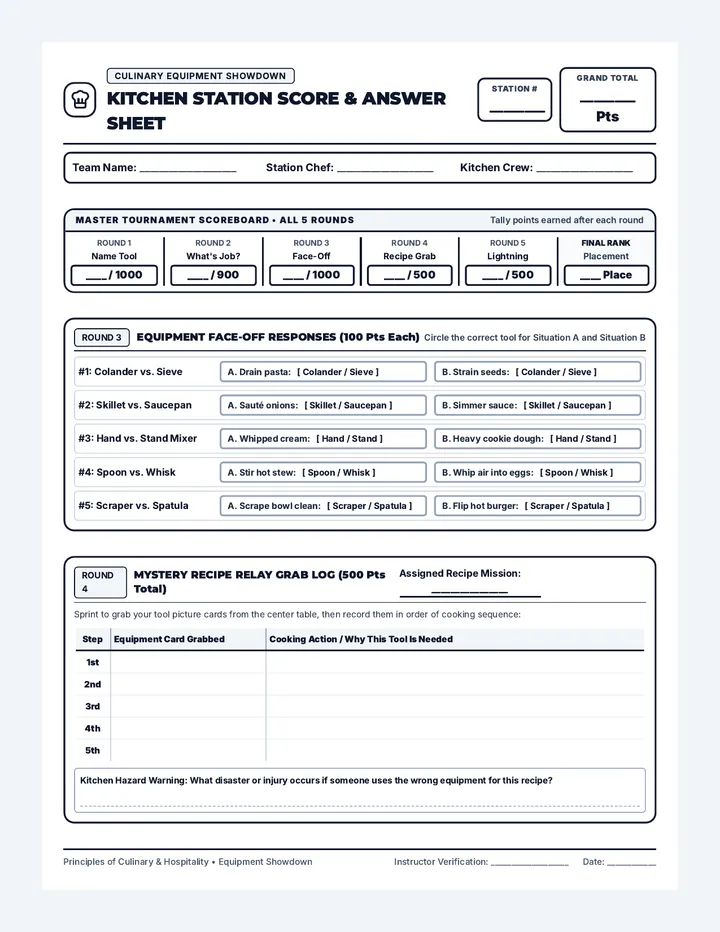
1. Hand Mixer vs. Stand Mixer (Kneading dense bread dough for 10 min) Superior: Stand Mixer
Why Superior: Stand mixer possesses a heavy-duty, high-torque motor and stationary dough hook specifically engineered to handle dense resistance without burning out the motor or fatiguing chef wrists.
When Hand Mixer is Better: Whipping a small batch of 2 egg whites, whipping cream, or creaming a single bowl of frosting where portability, rapid setup, and easy 30-second cleanup outweigh heavy power.
2. Skillet vs. Saucepan (Searing 4 chicken cutlets for golden crust) Superior: Skillet
Why Superior: Wide surface area and shallow flared sides allow escaping moisture to evaporate instantly, enabling dry high-heat contact needed for the Maillard browning reaction (steaming is prevented).
When Saucepan is Better: Simmering marinara, boiling grains, or making reductions where high straight sides contain bubbling liquids and limit evaporation.
3. Colander vs. Fine Mesh Sieve (Straining blackberry seeds from puree) Superior: Fine Mesh Sieve
Why Superior: Microscopic wire mesh openings trap minuscule blackberry seeds and pulp fibers while allowing smooth fruit coulis to pass cleanly.
When Colander is Better: Draining 1 lb of cooked penne pasta or washing whole heads of lettuce where large holes allow rapid water evacuation without clogging.
4. Whisk vs. Wooden Spoon (Beating egg whites to stiff meringue peaks) Superior: Whisk
Why Superior: Multiple flexible wire loops cut through egg albumen thousands of times per minute, incorporating massive air volume to create a stable protein foam structure.
When Wooden Spoon is Better: Stirring a heavy flour-and-butter roux on high stovetop heat, creaming solid cold butter, or scraping caramelized fond off pan bottoms where wires would bend.
5. Rubber Scraper vs. Spatula/Turner (Flipping delicate salmon fillet in 400°F pan) Superior: Spatula (Turner)
Why Superior: Broad, thin, beveled, and rigid blade slips directly under delicate fish skin and supports the entire filet during turning without breaking tender flakes.
When Rubber Scraper is Better: Folding egg whites into chocolate mousse or scraping every ounce of cake batter from curved mixing bowl walls.
Principles of Culinary Arts • Teacher Facilitation Guide & Answer Key Page 3 of 4
Independent assessment model responses, criteria for mastery, and pedagogical grading standards.
1. Tool Identification & Safety (2 pts) Answer: Kitchen Tongs
Culinary & Safety Hazard of Dining Fork: Puncturing searing meat with a fork pierces the outer sear barrier, allowing internal juices and moisture to escape onto the hot pan, resulting in dry meat. Furthermore, dining forks have short handles that place hands within the burn zone of splattering grease, and grease steam can cause severe third-degree burns.
2. Application: Pastry Dough Rolling (2 pts) Tools: Rolling Pin (Appropriate) vs. Stand Mixer (Inappropriate)
Culinary Rationale: A Stand Mixer cannot flatten dough into sheets; its rotary paddle or hook only kneads and incorporates. If dough is left in a stand mixer, friction heat melts the distinct pockets of chilled butter into the flour, and excessive mixing develops tough gluten. The Rolling Pin applies smooth, chilled downward pressure to compress dough into laminated butter-and-flour layers that puff into flaky sheets during baking.
3. Application: Stock Clarity & Consommé (2 pts) Fine Mesh Sieve vs. Colander
Culinary Defect: A Colander's holes are 3–5 mm wide, which allows coagulated protein fragments, herb flecks, and fat droplets to pass right through into the broth, resulting in a cloudy, gritty, murky soup. A Fine Mesh Sieve has wire openings smaller than 0.5 mm that capture all suspended particles, resulting in a luminous, crystal-clear consommé suitable for fine dining.
4. Tool Comparison: Béchamel Sauce Chemistry (2 pts) Whisk vs. Wooden Spoon in Sauce Making
Roles: During the milk addition, the Whisk rapidly cuts and disperses the roux into the cold/warm milk, preventing flour gelatinization from forming gelatinous lumps. Once the liquid is incorporated and thickens on simmering heat, the flat edge of a Wooden Spoon is superior because it reaches into the 90° corner seam of the saucepan to continuously scrape starch off the metal floor, preventing scorched sauce fond.
5. Multi-Step Catering Scenario (2 pts) Minimum 5 Vocabulary Tools + Specific Tasks
Exemplary Station Setup: (1) Knife: dice strawberries and hull bananas. (2) Blender: puree strawberry smoothies to velvety texture. (3) Corer: remove apple seed capsules for fruit cups. (4) Mixing Bowl: blend buttermilk pancake batter. (5) Whisk: aerate dry ingredients into wet batter. (6) Baking Sheet: bake sheet-pan blueberry pancakes evenly for 30 guests. (7) Rubber Scraper: empty blender jars cleanly.
| Performance Level | Equipment Selection | Culinary Rationale & Technical Vocabulary |
|---|---|---|
| Mastery (9–10) | Identifies all optimal tools without confusion. | Uses precise culinary concepts: gluten development, Maillard browning, heat conduction, emulsion, and particle filtration. |
| Proficient (7–8) | Identifies correct tools with minor hesitation. | Explains why tool works practically, but lacks technical food science terminology (e.g., states "so it doesn't stick" instead of "scorching fond"). |
| Developing (<7) | Confuses similar tools (e.g., colander vs. sieve). | Merely restates tool dictionary definition rather than explaining application to the scenario. Requires station intervention. |
Instructor Watchlist: Watch for students mixing up Colander vs. Fine Mesh Sieve on seed purees, or using Rubber Scraper on direct 400°F pan heat instead of a rigid metal/nylon Spatula. Emphasize that tool geometry dictates food texture!
Principles of Culinary Arts • Teacher Facilitation Guide & Answer Key Page 4 of 4