Rationale: Rapidly bypasses highest pathogen growth zone.
STAGE 2: Cold Holding Target
Target Temp: 41°F (or lower)
Time Limit: Within next 4 hours (6 hrs total)
Rationale: Reaches safe walk-in refrigeration temperature.
Kitchen Regulations Answer Key • Module 1.2 Page 1 of 2
Part II Key OSHA Analysis & Inspection Audit Solutions
Grading Scale: A: 36–40 | B: 32–35 | C: 28–31
4 Points per Question
1. Regulatory Scope: OSHA vs. FDA/USDA (4 pts)
Model Answer: OSHA focuses entirely on employee workplace safety (preventing occupational injuries such as burns, cuts, falls, chemical poisoning, and machine accidents), whereas the FDA and USDA focus exclusively on food safety, sanitation, and consumer protection against foodborne illnesses.
2. Lockout/Tagout & Accessible SDS Sheets (4 pts)
Model Answer: Lockout/Tagout requires cutting the electrical power supply and physically tagging/locking the equipment so it cannot accidentally turn on while being cleaned or repaired. SDS sheets must remain freely accessible so any staff member can immediately look up first-aid steps or poison control actions during a chemical exposure without needing a manager's key.
6 Points per Infraction (3 pts hazard, 3 pts action)
Infraction A: Storage Hierarchy Violation (Raw Poultry above Lettuce) 6 Points
Primary Hazard / Pathogen (3 pts):
Cross-contamination via dripping fluids containing Salmonella or Campylobacter onto ready-to-eat produce that will not receive heat treatment.
Mandatory Corrective Action (3 pts):
Immediately relocate raw chicken to the bottom-most shelf of the walk-in. Discard the contaminated lettuce; sanitize storage shelves.
Infraction B: Temperature Danger Zone Abatement (94°F Soup after 4.5 hrs) 6 Points
Primary Hazard / Code Violation (3 pts):
Food held in the Danger Zone (40°F-140°F) for 4.5 hours without active cooling. Extreme risk of toxin-producing bacteria (e.g., Bacillus cereus, C. perfringens).
Mandatory Corrective Action (3 pts):
Immediately condemn and discard the entire pot of soup. Because the 2-hour window below 135°F was violated, the food cannot be safely reheated or consumed.
Rubric Criteria
Key Evaluation Elements (Award up to 4 points):
Kitchen Regulations Answer Key • Module 1.2 Page 2 of 2
| "OSHA writes regulations about food contamination and hairnets." | Clarify: OSHA's mandate is worker safety only (preventing cuts, burns, falls). Food hygiene is governed by the FDA/Health Dept. |
Kitchen Regulations Teacher Guide • Module 1.2 Page 1 of 2
Part II Guide Slide Discussion Prompts & Lab Extensions
Instructional Focus: Socratic Dialogue & Audit Practice
Slides 2–7 Delivery Guide
Slide 2: Federal Food Regulators (FDA vs. USDA) Discussion Prompt
"Why do you think raw produce (like romaine or cantaloupe) often causes deadlier foodborne outbreaks than cooked meat, even though the USDA strictly oversees slaughterhouses?"
Guide: Lead students to realize that produce is consumed raw without a terminal kill step (cooking), making FDA supply chain oversight crucial.
Slide 3 & 7: OSHA Workplace Standards & Kitchen Hazards Discussion Prompt
"When a cook is rushed on a busy Friday night, why are machine guards on slicers the first thing disabled? What is the culinary manager's legal and moral liability under OSHA?"
Guide: Emphasize OSHA's "General Duty Clause" which makes the kitchen operator legally responsible for willful safety violations.
Slide 4: Local Health Department Unannounced Audits Discussion Prompt
"Should restaurant inspection scores be displayed on the front window as a public letter grade? How does this change operational culture behind the kitchen line?"
Guide: Connect operational discipline directly to customer foot traffic and business revenue.
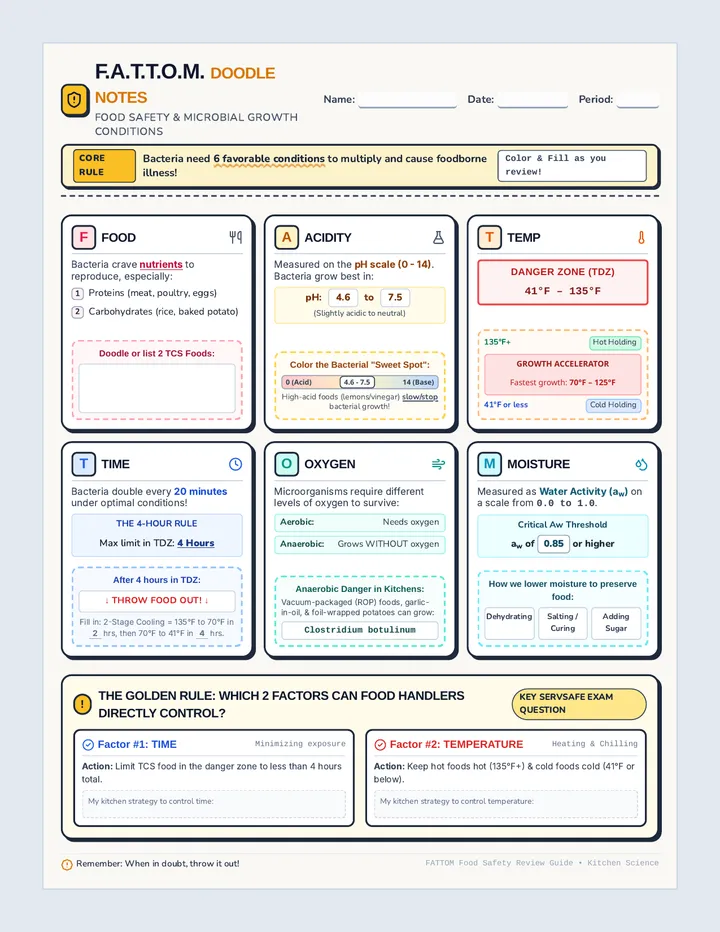
Slide 6: Two-Stage Cooling Curve (FDA Food Code) Discussion Prompt
"Why is the cooling rule divided into two stages (135° to 70°F in 2 hrs; 70° to 41°F in 4 hrs) instead of a steady 6-hour average?"
Guide: Explain bacterial doubling rates between 70°F and 125°F—pathogens multiply exponentially if food lingers here.
Activity Overview: Assign student pairs clipboard audit roles in your culinary arts kitchen. Each pair audits one station and records findings:
1. Walk-in Cooler Verify vertical hierarchy: ready-to-eat on top, whole cuts middle, poultry on bottom shelf. Check ambient temp (≤40°F).
2. Dishwashing & Chemicals Check sanitizer ppm using test strips (Chlorine or Quat). Inspect chemical storage away from food and verify SDS binder location.
3. Handwashing Sinks Verify hot water reaches ≥100°F, single-use soap is stocked, disposable towels available, and waste bin is present.
Support (ELL / Struggling Readers)
Provide visual agency color tags (Green = FDA, Red = USDA, Blue = OSHA, Purple = Health Dept). Allow students to use temperature quick-reference cards for Part 2.
Extension (Advanced / Honors Culinary)
Task students with drafting a HACCP Critical Control Point (CCP) flow sheet for receiving, storing, cooking, and cooling rotisserie chickens.
Kitchen Regulations Teacher Guide • Module 1.2 Page 2 of 2