Veto Power Teacher Guide REFUSAL STRATEGY FIELD MANUAL
Veto Power: Refusal Mastery
Assertive Boundary Setting, Refusal Scripts, & Peer Support • Grades 9-12
LESSON DURATION 45-60 Minutes
LESSON SUMMARY
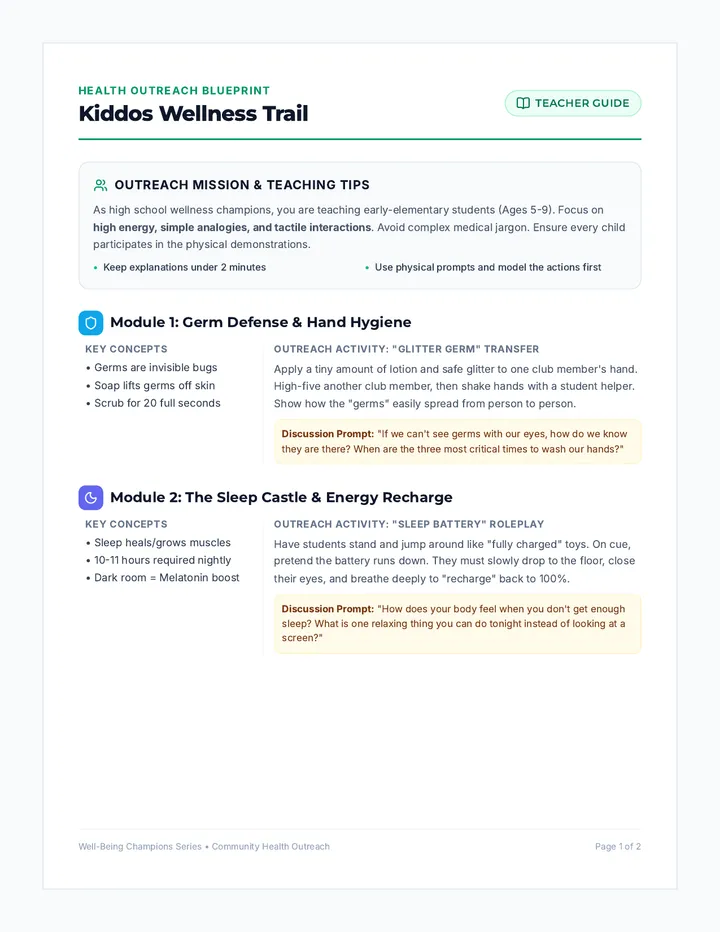
This curriculum focuses on active skill building, arming students with concrete physical and verbal boundary tactics. Rather than passive scientific lectures, students dissect peer pressure mechanics, rehearse refusal scripts, analyze body language, and learn how to maintain social status while staying substance-free.
SKILLS OBJECTIVES
• Analyze peer pressure structures and identify the difference between passive and active manipulation.
• Demonstrate three verbal refusal tactics with consistent non-verbal boundary alignment.
• Construct peer support "lifelines" to assist others in avoiding high-risk settings.
MA CHPE FRAMEWORK
Topic: Communication & Decision-Making
ATD.4 (Grades 9-12): Demonstrate and apply effective refusal, communication, negotiation, and boundary-setting strategies to avoid substance use and vaping.
REQUIRED TOOLS
Veto Power Student Sheets, Refusal Scenario Cue Cards, Role-Play Group Mats, Exit Tickets.
THE VETO POWER REFUSAL TRILOGY
1. The Active Redirect
A quick verbal pivot. Instantly say no, but bypass any awkward pause by offering a completely different, exciting social alternative. "No thanks, let's grab pizza instead."
2. The Strategic Out
Shifting accountability to an unbudgeable external source. Excuses built around strict coaches, parental tracking apps, or upcoming exams. "I can't. My parents track my phone location."
3. Non-Verbal Alignment
Words mean nothing if posture shows hesitation. Teach stable posture: open chest, direct eye contact, horizontal hand gestures, and a steady tone. Relaxed stance + firm "No" = finality.
LESSON HOOK: THE SILENT OFFER (5 MIN)
The Exercise: Stand in front of the class. Hold up a standard whiteboard marker as if offering a vape. Smile, lock eyes with a student, and extend your hand without speaking. Pedagogical Insight: Highlight that peer pressure is rarely a loud, cartoonish bully. It is usually a quiet, smiling, social expectation. Point out how the student reacted. Did they smile back out of awkwardness? Explain that "awkward compliance" is what we must train our brains to defend against.
UNIT: REFUSAL & BOUNDARY MASTERY PAGE 1 OF 2
PRACTICAL TIMELINE
Step-by-Step Training Sequence
How to manage interactive drills, facilitate pairing, and run roleplays
10 MIN SKILL FRAME
Tactical Strategy Briefing
Present slides 1–4. Walk through the psychology of peer influence. Contrast passive influence (seeing vaping on social media) with active influence (a direct verbal offer). Introduce the 3 primary verbal and non-verbal refusal mechanisms.
15 MIN DRILL REHEARSE
The Interactive Mirror Drill
Have students pair up. Distribute the Refusal Script Sheets . In pairs, students take turns reading a direct pressure challenge (provided on scenario cards) while their partner performs one of the refusal scripts. Partners must critique: Were they standing tall? Did they make eye contact? Did they say "no" first before redirecting?
Check for Success: Ensure students aren't whispering or laughing during their exit lines. Force them to speak clearly enough to be heard from 5 feet away. Confident projection builds neurological confidence.
15 MIN TACTICAL WORK
The Pressure Blueprint Exercise
Have students complete Part 3 & 4 of their notes sheets. Working together, pairs map out the social stakes of refusal (e.g., fear of missing out, looking uncool) and draft a proactive "Group Veto Pact"—an agreement on how friends can cover for each other when offered drugs at parties.
5 MIN DEBRIEF
Synthesizing Refusal Autonomy
Conclude by asking: "Why does having a pre-planned script actually give you MORE freedom, not less?" Bring it home: plans remove panic. Distribute the Exit Ticket to verify individual tactical comprehension.
DEBUNKING REFUSAL CLASSROOM MYTHS
Myth: "I can just improvise a refusal in the moment."
The Reality: Under sudden social stress, the emotional brain defaults to keeping peace (compliance). Rehearsing concrete script mechanics beforehand ensures rapid neural retrieval.
Myth: "People will think I'm uncool if I say no."
The Reality: Dissecting peer groups shows that assertive, calm boundary-setting actually elevates a peer's perceived confidence and authority, making them *more* respected, not less.
UNIT: REFUSAL & BOUNDARY MASTERY PAGE 2 OF 2
Veto Power Slides VETO POWER LABS HS ATD PREVENTION
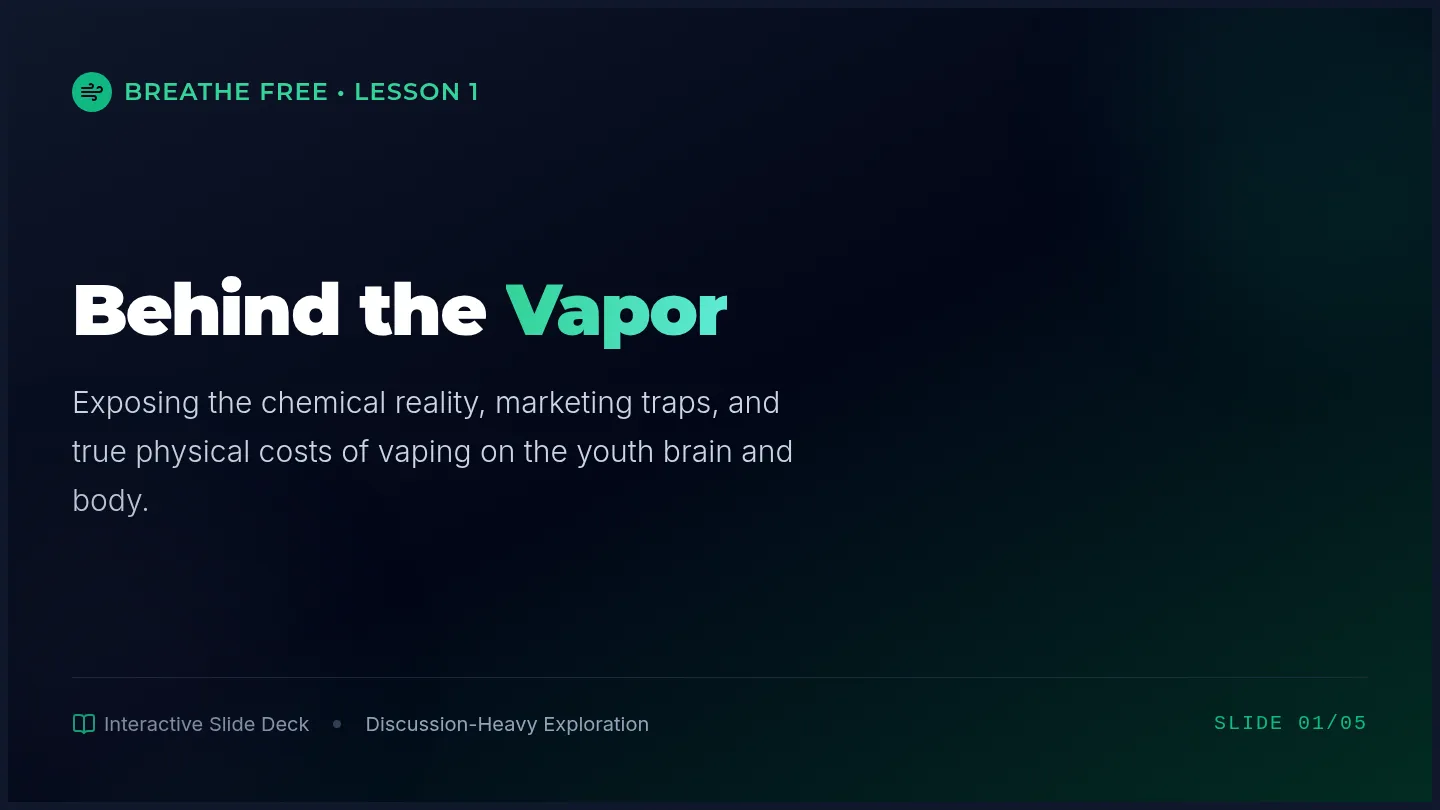
VETO POWER
Mastering peer refusal, assertive boundaries, and high-impact social defense mechanics.
MA CHPE Standard ATD.4 Refusal Skills Focus SLIDE 1/8
Deconstructing Peer Influence
PSYCHOLOGY SURVEY
PASSIVE INFLUENCE
Social Norming
Implicit cues. Seeing vape clouds, reading posts, or watching popular characters. It builds a false belief that "everyone does it."
ACTIVE INFLUENCE
The Direct Offer
Explicit cues. When a friend extends a vape in a restroom or car and says "here, hit this." It triggers a fight-or-flight panic response.
Preparation bypasses panic. Scripts give your brain an immediate exit route. SLIDE 2/8
Strategy 1: The Redirect
THE SOCIAL PIVOT
The best way to minimize an awkward pause is to refuse the offer and instantly transition to a completely different, fun activity.
By shifting focus, you dictate the next social movement and rescue the conversation from tension.
LIVE SCRIPT MECHANICS:
"No thanks, let's head to the court and shoot some free throws instead."
Key Action: Pivot physical space. Walk in the direction of the redirect immediately.
Maintain friendship ties without compromising your safety boundaries SLIDE 3/8
Strategy 2: The Strategic Out
EXTERNAL ACCOUNTABILITY
Blame an unbending outside force. Shifting accountability to parents, athletic rules, or drug screenings is incredibly effective.
Your peers cannot argue with external rules. It preserves your social ties by framing the refusal as a structural barrier.
LIVE SCRIPT MECHANICS:
"I can't. My coach does random hair and urine tests starting this week."
Alternative: "My parents track my screen time and phone location dynamically."
Use unchangeable, real-world structural rules to protect your health SLIDE 4/8
Strategy 3: The Broken Record
ASSERTIVE REPETITION
When people are persistent or pushy, do not debate, lecture, or argue. Repeating a single firm statement establishes an absolute boundary.
By repeating your exact phrase, you deny them any conversational openings to debate or challenge you.
LIVE SCRIPT MECHANICS:
Peer: "Just take a hit, no one's watching."
You: "No thanks, I'm good."
Peer: "C'mon, don't be boring."
You: "No thanks, I'm good."
Veto Power Student Notes REFUSAL TRAINING LOG
STUDENT LOG: Veto Power
STUDENT NAME
DATE
CLASS PERIOD
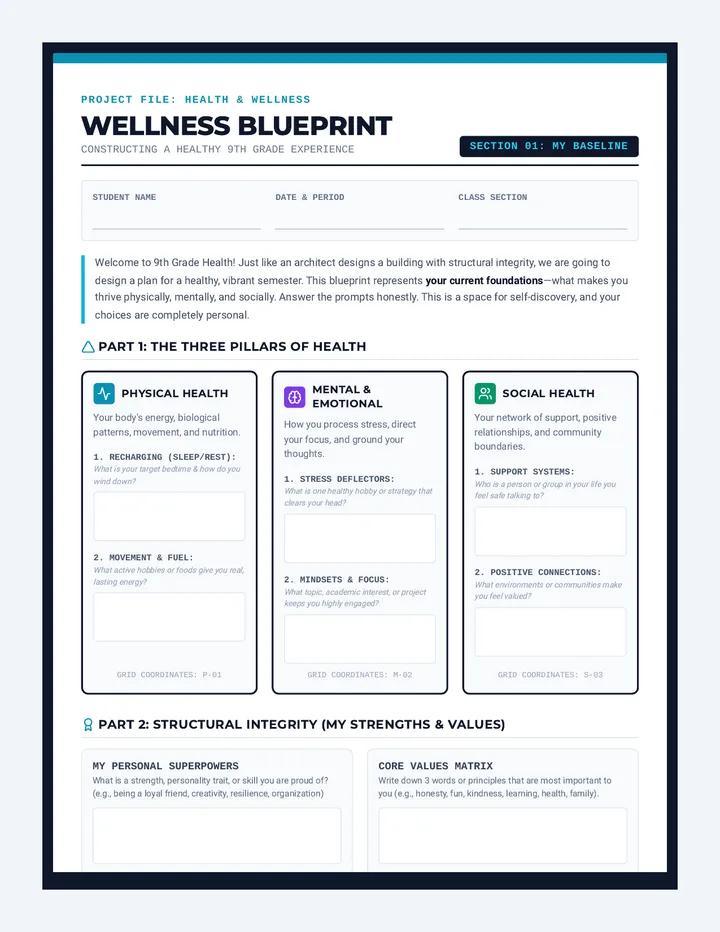
PART 1: DECONSTRUCTING SOCIAL PRESSURE
Identify whether each scenario below represents Passive Pressure (indirect cues, media, observations) or Active Pressure (direct verbal prompts, targeted social pressure):
Scenario A: Vaping on Social Media
Scrolling through TikTok and seeing popular creators using vapes or talking about vapor flavors.
PASSIVE ACTIVE
Scenario B: Restroom Direct Offer
Walking into the locker room, a teammate extends a vape and says: "Hey, try this out, it's mango."
PASSIVE ACTIVE
PART 2: THE REFUSAL TECHNIQUE MATRIX
Complete the scripting prompts below by writing exact, realistic verbal exit scripts that fit your real-world friend groups:
1. THE REDIRECT
Say "no" firmly, then immediately propose a different social plan to steer the conversation away.
YOUR VERBAL EXIT LINE:
2. THE STRATEGIC OUT
Blame an unbending outside standard (athletics, parental location tracking, strict job rules).
YOUR VERBAL EXIT LINE:
3. BROKEN RECORD
State your boundaries simply and repeatedly, refusing to negotiate or explain your decision.
YOUR VERBAL EXIT LINE:
UNIT: REFUSAL & BOUNDARY MASTERY PAGE 1 OF 2
COOPERATIVE DRILLS & COVERS
PART 3: Rehearsal & Support Pacts
PART 3: ACTIVE MIRROR DRILL CHECKLIST
Instructions: Working in pairs, take turns reading pressure prompts. Practice performing your refusal scripts from page 1. Evaluate your partner's non-verbal delivery using the metrics below:
NON-VERBAL METRIC WHAT WE LOOKED FOR PARTNER RATING & NOTES (Write feedback) Eye Contact Did they maintain direct, relaxed eye contact without laughing, looking down, or fidgeting? PASSED: [ ] YES [ ] NO
|
| Body Posture | Were shoulders squared, arms uncrossed, and stance balanced? Did they pivot space when redirecting? |
PASSED: [ ] YES [ ] NO
|
| Vocal Tone | Was the exit line delivered with a flat, clear, audible volume? No mumbling or nervous giggling? |
PASSED: [ ] YES [ ] NO
|
PART 4: FRIEND PACT & HELPLINE MAP
Veto Power Exit Ticket DAILY SKILLS CHECK
EXIT TICKET: Veto Power
STUDENT NAME
DATE
CLASS PERIOD
Answer the following standard-aligned questions independently to demonstrate your mastery of the communication and boundary strategies under MA CHPE ATD.4 .
1 Which of the following scenarios is a direct illustration of ACTIVE peer pressure?
A Seeing classmates vaping in a social media video post.
B Noticing several discarded vape pods on the floor.
C A classmate holding out a vape and asking: "Want a hit?"
D Learning in health class about vaping statistics.
2 Why is body language so important when delivering a refusal script, and what are two physical body language metrics that show confident assertion?
3 A peer offers you a vape at a Friday night gathering and won't take "no" for an answer. Write down:
YOUR VERBAL REFUSAL SCRIPT (Redirect, Excuse, or Broken Record):
ONE SPECIFIC CLINICAL OR SCHOOL RESOURCE TO INTERVENE IF THEY ARE ALREADY ADDICTED:
UNIT: REFUSAL & BOUNDARY MASTERY EXIT TICKET EVALUATION