Badminton Basics Test
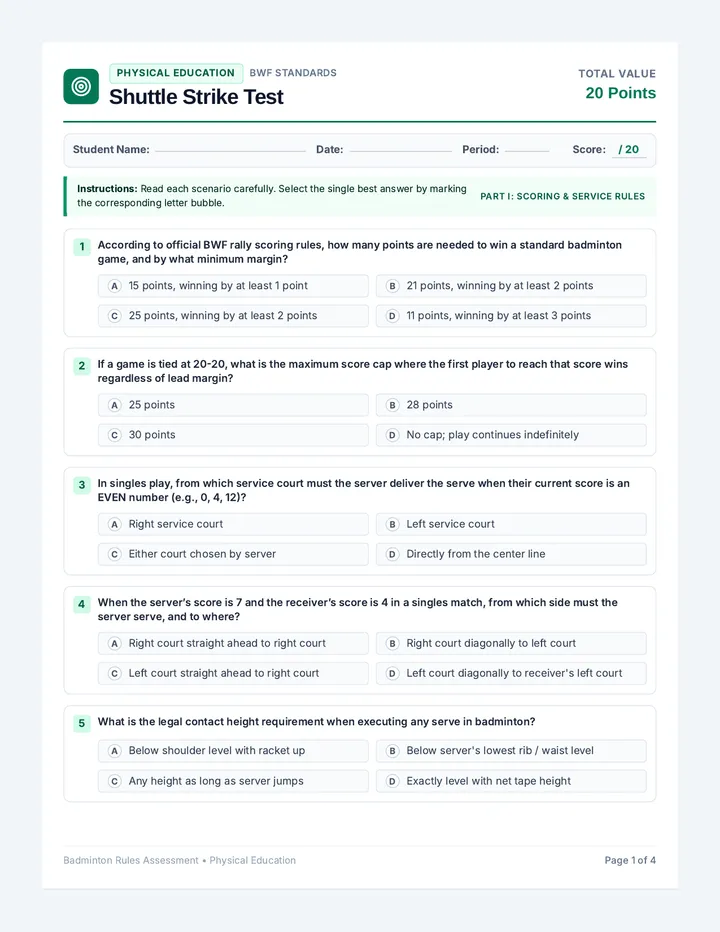
Physical Education • Racket Sports Unit
Badminton Basics Test
Score ____ / 20
Name:
Date:
Period:
Instructions: Read each item carefully. Circle or shade the letter corresponding to the single best answer.
1 Pt Each
1. What is the official projectile used to play badminton called?
A Racket ball
B Shuttlecock / Birdie
C Wiffle disc
D Felt puck
2. According to official rules, how must every serve be hit?
A Overhand with full downward downward swing
B Sidearm from shoulder height
C Underhand, below waist level
D After allowing the birdie to bounce once
3. In what direction must a legal serve travel across the net?
A Straight ahead into the parallel court box
B Diagonally into the opposite service court
C Anywhere inside the opponent's back baseline
D Directly at the receiver's body
4. Under rally scoring, who earns a point at the end of a rally?
A Only the player or team that served
B Only the receiving side
C Whichever side wins the rally
D Both sides if the rally lasted 10+ hits
5. How many points are standardly needed to win a regulation game?
A 11 points (win by 1)
B 15 points (win by 2)
C 25 points (win by 3)
D 21 points (win by 2)
6. If the server's score is an EVEN number (0, 2, 4...), they serve from:
A The right service court
B The left service court
C The center baseline line only
D Any location behind the net
7. If the server's score is an ODD number (1, 3, 5...), they serve from:
A The right service court
B The left service court
C Directly adjacent to the net post
D The opponent's back alley
8. What is the call if the shuttlecock lands directly on a boundary line?
A Out of bounds
B Fault on hitter
C Automatic let
D In bounds (good)
9. Can a player's body or racket contact the net during active play?
A Yes, whenever attempting an overhead block
B Yes, provided the racket frame does not bend
C No, touching the net is always an official fault
D Only if the bird hit the ground first
10. How many consecutive hits is a side allowed before sending it over?
A Only 1 hit
B Up to 2 hits
C Up to 3 hits
D Unlimited hits
Badminton Basics PE Unit Exam Page 1 of 2 • Continue on Page 2
Part II
Badminton Basics Test (Questions 11–20)
Student Name:
11. What shot flies high and deep to force an opponent to their baseline?
A Clear (high clear)
B Drop shot
C Smash
D Net kill
12. What is a fast, powerful, steep downward overhead attack called?
A Drive
B Smash
C Flick serve
D Lob
13. What shot is softly tapped so it drops immediately over the net?
A Drop shot
B High clear
C Drive
D Backhand slice
14. What is a fast, flat, horizontal shot that travels straight and low?
A High clear
B Deep lob
C Lift shot
D Drive
15. During active play, what happens if the shuttlecock hits the ceiling?
A It is a fault (point to opponent)
B Play continues normally without stoppage
C The hitting side earns a bonus point
D The server gets two extra re-serves
16. What occurs if a player hits the birdie twice in one swing attempt?
A Legal if racket motion was one stroke
B A fault called "double hit" (point lost)
C An automatic replay of the rally
D Penalty of 2 points deducted
17. Which side boundary lines are used during a standard SINGLES match?
A The wider outside boundary lines
B The narrower inside boundary lines
C Any boundary line on the gym floor
D The volleyball outer boundary line
18. What line near the net must a legal serve travel completely beyond?
A Short service line
B Rear baseline
C Center dividing line
D Side tramline
19. What is called when unexpected interference occurs and point is replayed?
A A deuce
B A let
C A technical fault
D A walkover
20. In doubles, when do partners switch their right/left service courts?
A After every single rally played
B Only when they lose a point while receiving
C Partners never switch court sides
D Only when their side scores a point while serving
Student Quick-Answer Bubble Grid (Fill in your final choices) 1–20 Self-Check
Q1 A B C D
Q2 A B C D
Q3 A B C D
Q4 A B C D
Q5 A B C D
Q6 A B C D
Q7 A B C D
Q8 A B C D
Q9 A B C D
Q10 A B C D
Q11 A B C D
Q12 A B C D
Q13 A B C D
Q14 A B C D
Q15 A B C D
Q16 A B C D
Q17 A B C D
Q18 A B C D
Q19 A B C D
Q20 A B C D
End of Test • Verify all responses before turning in Page 2 of 2
Badminton Basics Answer Key
Teacher Facilitation Resource • Master Key
Badminton Basics Answer Key
Assessment Details 20 Questions • 1 Pt Each
Unit PE Racket Sports
Grade Levels Grades 6–12 (PE)
Standard SHAPE Standard 2
Pass Rate 14 / 20 (70%+)
Rapid Grading Strip (Compare to Student Response Grid) Answer Distribution: 6A • 7B • 3C • 4D
Q1 B
Q2 C
Q3 B
Q4 C
Q5 D
Q6 A
Q7 B
Q8 D
Q9 C
Q10 A
Q11 A
Q12 B
Q13 A
Q14 D
Q15 A
Q16 B
Q17 B
Q18 A
Q19 B
Q20 D
1. Projectile Name B: Shuttlecock / Birdie
Official BWF term is shuttlecock; also called birdie in PE. Racket ball & puck are distractors.
2. Legal Serving Motion C: Underhand, Below Waist
Racket shaft must point down; bird must be contacted strictly below waist level without bouncing.
3. Service Flight Path B: Diagonally Cross-Court
Serves must travel diagonally across the net and land within the receiver's opposite service box.
4. Rally Point System C: Whichever Side Wins
Under rally scoring, a point is scored on every rally by whoever wins it, regardless of server.
5. Game Winning Score D: 21 Points (Win by 2)
Standard regulation games are played to 21 points. Must win by 2 points (maximum cap at 30).
6. Even Score Service Box A: Right Service Court
Server initiates serve from the right-hand court whenever the server's score is 0 or an even number.
7. Odd Score Service Box B: Left Service Court
Server initiates serve from the left-hand court whenever the server's score is an odd number (1, 3, 5...).
8. Line Call Rule D: In Bounds (Good)
Any birdie striking any part of a boundary line or service line is ruled in bounds and playable.
9. Net Contact Violation C: Fault (No Contact)
Touching the net or support posts with racket, body, or uniform during play is an immediate fault.
10. Hits Allowed Per Side A: Only 1 Hit
Each side is limited to exactly one contact before returning the shuttlecock over the net.
11. Deep Defensive Shot A: Clear (High Clear)
Flies high and deep toward opponent's back baseline; buys recovery time and pushes foe back.
12. Primary Attack Shot B: Smash
Fast, steep downward overhead attack intended to hit the floor before opponent can react.
13. Soft Net Touch A: Drop Shot
Soft, delicate shot hit from mid/rear court that tumbles tightly over net tape into front court.
14. Flat Fast Exchange D: Drive
Rapid, flat horizontal shot traveling shoulder-height across net; staple of fast doubles play.
15. Ceiling Obstruction A: Fault (Point Lost)
Striking gym ceiling, rafters, basketball hoops, or light fixtures is an out-of-bounds fault.
16. Double Contact Error B: Double Hit (Fault)
Hitting the birdie twice in one stroke attempt is an illegal double hit; point goes to opponent.
17. Singles Sideline Lines B: Narrow Inside Lines
Singles uses the "long and narrow" boundaries: inside sidelines and the furthest back baseline.
18. Front Service Boundary A: Short Service Line
Serves must clear the short service line (6.5 ft from net) to be playable; short serves lose point.
19. Interference Call B: A Let (Replay Point)
Called for unexpected interference (stray bird from adjacent court, injury); point is re-served.
20. Doubles Court Rotation D: Only When Scoring on Serve
Partners swap right/left service courts only when their side wins a point while currently serving.
Score Conversion Rubric
18–20 Pts Advanced (A)
14–17 Pts Proficient (B/C)
0–13 Pts Review (D/F)
Key Misconceptions to Review in Class:
- Serving (Q2/Q18): Must be underhand below waist and land beyond short service line.
- Boundary Lines (Q8): Shuttlecock landing on any court line is 100% IN (not out).
- Doubles Switching (Q20): Only the serving side switches boxes after scoring a point.