Body Alarm Teacher Guide Grade 6 Health Education • Mental & Emotional Health 45–50 Minutes
Body Alarm Teacher Guide
Instructional roadmap for guiding students through somatic stress awareness and nervous system regulation.
Essential Questions
How does our brain communicate stress to our physical body?
Why do different people experience unique stress signals?
How can proactive coping strategies down-regulate the nervous system?
Learning Objectives (SWBAT)
Identify at least 3 distinct somatic warning signs of stress in their body.Explain the basic fight-flight-freeze survival response.Select and demonstrate 2 evidence-based coping tools for specific scenarios.
Core Vocabulary
Somatic: Relating to the physical body rather than the mind.
Amygdala: Brain's alarm center detecting perceived threats.
Vagus Nerve: Nerve pathway triggering calm and slowed heart rate.
Instructional Timeline & Procedures
Time Phase Teacher Facilitation & Student Actions
8 min Hook & The Alarm Metaphor Introduce smoke detector analogy. Display Slide 1–2. Ask: "What happens to a car engine when warning lights flash?" Connect to body alerts.
12 min Somatic Scan (Slides 3–4) Guide head-to-toe somatic body scan. Clarify physiological reactions: adrenaline surge, rapid pulse, shallow breathing, muscle clenching.
15 min Body Mapping Activity Distribute Stress Signals Body Worksheet . Students map their personal top 3 physical warning zones and link each to a sensory or breath reset.
10 min Coping Lab Practice (Slide 5) Class rehearsal of 4-7-8 Box Breathing and the 5-4-3-2-1 Sensory Grounding method. Practice discreet classroom-friendly strategies.
5 min Synthesis & Exit Slip Students finalize their Coping Toolkit Exit Ticket with their go-to physical signal and emergency regulation plan.
Included Materials: Body Alarm Slides Stress Signals Body Worksheet Coping Toolkit Exit Ticket
Page 1 of 2
Facilitation Prompts, Support & Answer Key
Body Alarm • Teacher Guide
Guided Discussion Prompts
Prompt 1: "Have you ever felt butterflies before a presentation or sports game? Why does our stomach react to nervous thoughts?"Prompt 2: "Why is it important to notice stress in our shoulders or jaw before our emotions boil over into anger or tears?"Prompt 3: "Can a coping strategy work for someone else but not work for you? Why is personalization crucial?"
Common 6th Grade Misconceptions
Myth: "Stress means something is wrong with me."Reality: Stress is a normal biological survival mechanism trying to keep you safe. Myth: "If I ignore body tension, it goes away."Reality: Unaddressed somatic tension often converts to headaches, exhaustion, or irritability.
Differentiated Instruction & Trauma-Informed Tips
Sensory Sensitivities: Offer seated muscle clenching/releasing or progressive muscle relaxation rather than forced eyes-closed meditation.
ELL / Emergent Readers: Worksheet includes visual anatomical icons and word-bank matching pairing body zones directly with icons.
Trauma Sensitivity: Keep breathwork optional. Allow students to focus on tactile objects (desk surface, grounding stone) instead of deep breaths if breath triggers anxiety.
Worksheet & Exit Ticket Answer Key Exemplars
Body Map Zones & Physiological Symptoms:
Head/Brain: Throbbing headache, racing thoughts, brain fog, clenched teeth/jaw.Throat/Chest: Lump in throat, shallow quick breathing, pounding racing heartbeat.Stomach: "Butterflies", nausea, cramping, loss of appetite or nervous hunger.Hands/Muscles: Clenched fists, fidgeting fingers, tight raised shoulders, shaky knees.
Scenario Matching & Strategy Justifications:
Scenario 1 (Math Pop Quiz): Rapid breathing & racing heart → Box Breathing (4-4-4-4) to trigger parasympathetic calm without leaving desk.Scenario 2 (Hallway Conflict): Clenched fists & flushed face → Progressive Squeeze & Release or physical movement / splash cold water.Scenario 3 (Overwhelmed at Night): Racing thoughts & insomnia → 5-4-3-2-1 Sensory Grounding or brain-dump journaling to unburden working memory.
Middle School Health & Physical Education Curriculum Page 2 of 2
Body Alarm Slides Grade 6 Health Education
Body Alarm
How Stress Speaks to Your Body & How to Take Control
Your body sounds an alarm before your mind even realizes you are stressed. Today, we decode the signals and build your personal reset button.
The Brain's Smoke Detector
The Science of Stress
Meet the Amygdala
A tiny almond-shaped part of your brain scans 24/7 for danger. When it senses a test, an argument, or pressure, it pulls the emergency fire alarm!
The Survival Trio
Your body floods with adrenaline, preparing you for three ancient survival instincts:
FIGHT
FLIGHT
FREEZE
Key Takeaway
Stress is NOT a weakness. It is your body's built-in superhero defense system kicking in to protect you!
Body Alarm • Lesson Presentation Slide 2 of 6
Somatic Signals: Where Do You Feel It?
Body Awareness
Head & Jaw
Tight forehead, clenched jaw, racing thoughts, or sudden headaches.
Heart & Chest
Pounding pulse, rapid shallow breathing, or tightness in the throat.
Stomach
Fluttery butterflies, sick nausea, sudden cramps, or loss of appetite.
Hands & Muscles
Sweaty or shaking hands, clenched fists, and raised tense shoulders.
Quick Check: Which zone starts ringing FIRST when your stress alarm activates?
The Three Coping Categories
Reset Tools
Body Resets
Calm your heart rate and release trapped adrenaline directly through physical action.
Deep Box Breathing
Shoulder Rolls & Stretches
Sip Cold Ice Water
Mind Resets
Shift focus away from spiraling worries and bring attention back to the present moment.
5-4-3-2-1 Sensory Scan
Helpful Self-Talk Reframes
Brain-Dump Quick Journaling
Connection Resets
Reach outside yourself to trusted people who provide safety and perspective.
Talk to a Trusted Adult
Ask a Friend for Support
Express Feelings Out Loud
Body Alarm • Lesson Presentation Slide 4 of 6
Calming Lab: Try It Right Now!
Practice Time
4-4-4-4 Box Breathing
Used by Navy SEALs and athletes to flip off the stress alarm in under 60 seconds:
1. Inhale (4s)
2. Hold breath (4s)
3. Exhale slow (4s)
4. Hold empty (4s)
5-4-3-2-1 Sensory Anchor
Bring your mind back from worry spirals by counting through your senses:
5 Things you can SEE around the room
4 Things you can physically TOUCH
3 Things you can HEAR right now
2 Things you can SMELL
1 One positive thing you can tell YOURSELF
Body Alarm • Lesson Presentation Slide 5 of 6
Your Mission: Map Your Body Alarm
Worksheet Time
1
Pinpoint Signals
Label your body map with where tension, butterflies, or headaches show up first.
2
Pair Strategies
Match each physical symptom with a targeted coping tool that resets that specific area.
3
Test Scenarios
Solve real middle school stress scenarios and build your personal SOS Calm Kit!
Grab your worksheet and pencil. Let’s decode your body alarm!
Stress Signals Body Worksheet 6th Grade Health • Mind & Body Wellness
Name: Date: Period:
Stress Signals Body Worksheet
Part 1: Somatic Body Mapping — Identify how your nervous system sounds the alarm when you feel stressed.
Somatic Explorer
Somatic Symptom Word Bank
Clenched jaw • Racing heartbeat • Headaches • Shaky hands • Butterflies in stomach • Rapid shallow breaths • Tight raised shoulders • Sweaty palms • Lump in throat • Brain fog • Nausea • Clenched fists • Fidgety legs
Personal Physical Stress Zones
1. Brain & Jaw What happens to your thoughts & jaw?
2. Throat & Chest How do your breathing & heart rate change?
Zone 1
Zone 2
Zone 3
Zone 4
3. Stomach & Appetite Do you feel knots, nausea, or fluttery?
4. Hands, Shoulders & Legs Do you fidget, shake, or tense up?
My Primary Warning Signal
When you experience stress (before a big test, conflict, or sports tryout), which single physical signal happens first? Describe the sensation:
Turn over to Part 2 on the back side → Page 1 of 2
Part 2: Coping Strategy Matrix Body Alarm Toolkit
Targeted Coping Strategies & Scenario Application
Match physical warning signs with effective reset tools and practice solving real middle school challenges.
Body Resets
• 4-4-4-4 Box Breathing
• 3 slow shoulder rolls
• Progressive muscle squeeze
• Sip ice-cold water
Mind Resets
• 5-4-3-2-1 Sensory Grounding
• Positive self-talk reframe
• Brain-dump scribble note
• Focus on 1 task at a time
Connection Resets
• Ask teacher for quick break
• Vent to a trusted friend
• Hug a pet or family member
• School counselor check-in
Step 1: Match Your Personal Signals to Resets
Choose 2 physical warning signs you identified on Page 1 and pair each with a strategy you can use at school:
My Physical Signal Targeted Coping Strategy When & Where I Can Use It
Step 2: Solve the Middle School Scenarios
Scenario A: Jordan sits down for a science test. Suddenly, Jordan's heart starts thumping against their ribs, hands feel sweaty, and thoughts go completely blank.
Identify Jordan's physical signal and suggest one discreet coping tool Jordan can do silently right at their desk:
Scenario B: Maya hears a rumor being spread by classmates in the hallway. Her face turns hot, her fists clench tightly, and she feels an urge to scream.
Identify Maya's stress reaction (Fight, Flight, or Freeze) and recommend an immediate de-escalation reset before she reacts:
Stress Awareness & Coping Toolkit Page 2 of 2
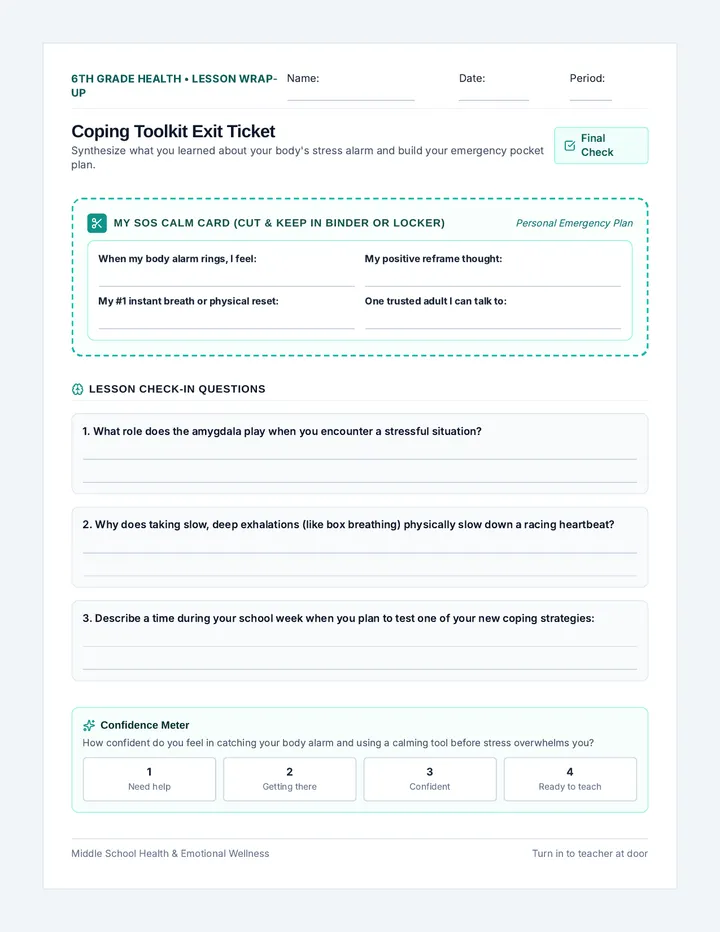
Coping Toolkit Exit Ticket 6th Grade Health • Lesson Wrap-Up
Name: Date: Period:
Coping Toolkit Exit Ticket
Synthesize what you learned about your body's stress alarm and build your emergency pocket plan.
Final Check
My SOS Calm Card (Cut & Keep in Binder or Locker)
Personal Emergency Plan
When my body alarm rings, I feel:
My #1 instant breath or physical reset:
My positive reframe thought:
One trusted adult I can talk to:
Lesson Check-In Questions
1. What role does the amygdala play when you encounter a stressful situation?
2. Why does taking slow, deep exhalations (like box breathing) physically slow down a racing heartbeat?
3. Describe a time during your school week when you plan to test one of your new coping strategies:
Confidence Meter
How confident do you feel in catching your body alarm and using a calming tool before stress overwhelms you?
1 Need help
2 Getting there
3 Confident
4 Ready to teach
Middle School Health & Emotional Wellness Turn in to teacher at door