Mind and Mood Worksheet Mind & Mood Tracker
Mental, Social, and Emotional Well-being
Name:
Date:
Part 1: The Stress Signal
Stress affects our mental, physical, and social health. Identify three stress management techniques and describe how they help regulate your emotions.
1
Technique Name
How it affects emotional health
2
Technique Name
How it affects emotional health
Part 2: Relationship Radar
Healthy Markers
Unhealthy Markers
Part 3: The Influence Map
Analyze how the following social systems influence your mental health. Consider both positive (support) and negative (pressure) factors.
Family & Heritage
Peers & Friend Groups
Community & Social Media
Part 4: Boundaries & Resilience
"Bullying, harassment, and intentional injury directly damage physical and emotional health."
Scenario:
You notice a classmate being excluded and mocked on social media by a group you hang out with.
How might this impact the individual's mental health?
Identify two healthy alternatives to joining the behavior.
Reflection: The Interconnected Self
Explain how your attitude toward yourself affects the health of others in your community.
Mind and Mood Slides VITALITY
VAULT
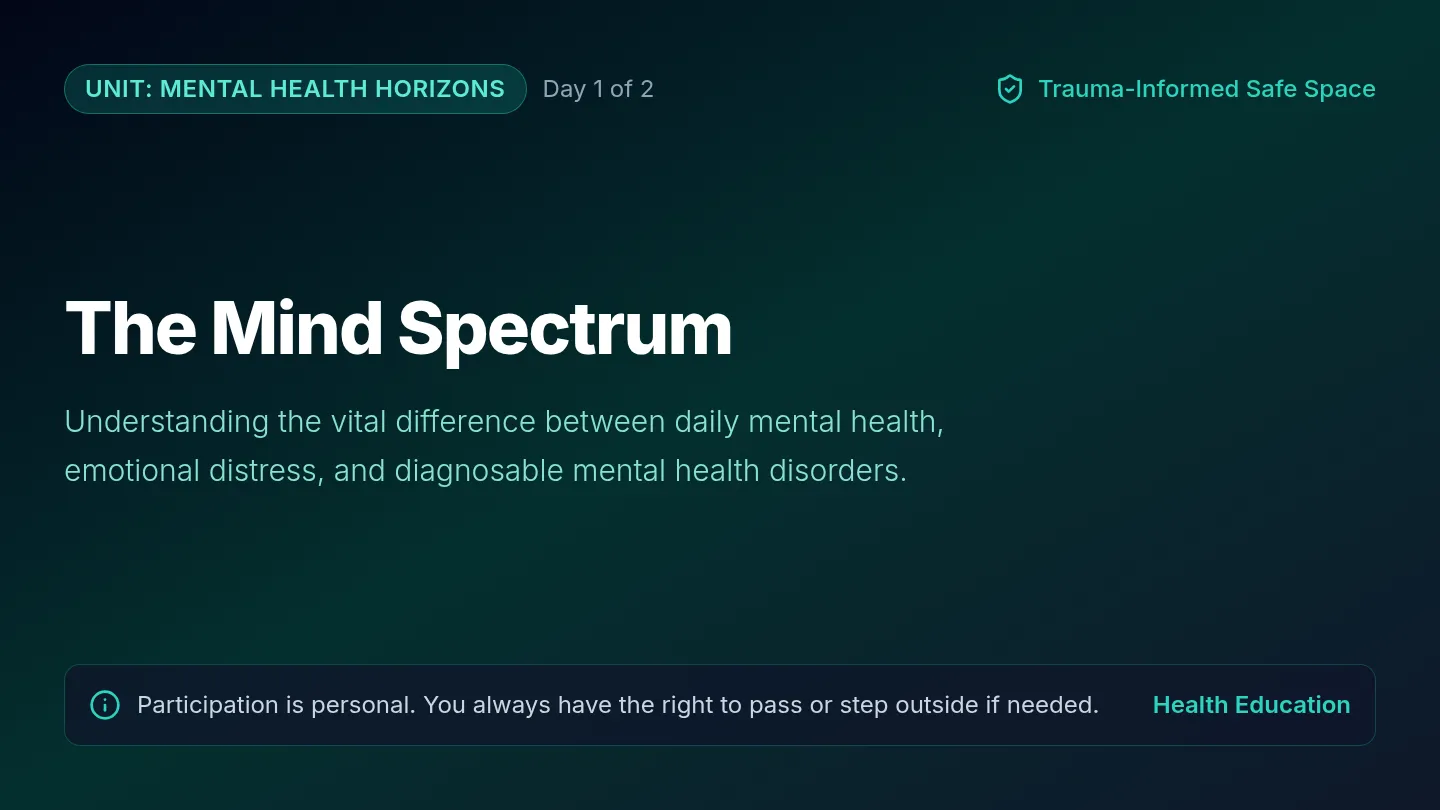
Mental, Social, and Emotional Well-being
Mental
Emotional
Social
The Health Web
Your health is not just one thing. It's a complex web where every strand affects the others.
Physical health impacts your mood.
Social connections reduce stress.
Emotions drive physical behavior.
"How does your mood affect the way you treat others?"
Negative
Irritability, withdrawal, or defensive attitudes.
Positive
Patience, empathy, and active listening.
Stress Management
Strategies
Relaxation
Breathing exercises and meditation to lower cortisol levels.
Physical Activity
Exercise releases endorphins, the body's natural "feel-good" chemicals.
Social Support
Talking to trusted friends or mentors to process emotions.
Healthy vs.
Unhealthy
Healthy
• Mutual Respect
• Honest Communication
• Clear Boundaries
• Encouraging Independence
• Conflict Resolution
Unhealthy
• Control & Dominance
• Dishonesty/Secrecy
• Boundary Crossing
• Isolation from Peers/Family
• Bullying & Harassment
Social Influence & Peer Pressure
How do family, peers, and the community impact your choices?
Natural Highs
Finding fulfillment through hobbies, sports, and genuine connections rather than risk behaviors.
Refusal Skills
Communicating boundaries effectively when facing pressure to engage in unhealthy behaviors.
The Goal:
"Identify alternatives to health risk behaviors and manage social systems for lifelong mental wellness."
Mind and Mood Teacher Guide Facilitator's Guide
Lesson 1: Mental & Emotional Mastery
Teacher Resource
Duration
90 Minutes
Grade Level
9-12 (High School)
Standards
CS1, 9-12 BM 2 & 4
Learning Objectives
Analyze the interrelationship of mental, emotional, social, and physical health.
Differentiate between healthy and unhealthy relationship behaviors.
Identify stress management techniques and their impact on emotional regulation.
Analyze how family, peers, and community influence personal health choices.
Instructional Flow
1. Introduction (10 mins)
Hook: Use the "Health Web" slide to discuss how a bad mood might affect someone's physical desire to exercise or social interactions.
2. Direct Instruction (30 mins)
Present Slide Deck. Focus on the nuances of "Healthy vs. Unhealthy" relationships. Encourage students to think of "Red Flags" vs. "Green Flags".
3. Guided Practice (20 mins)
Influence Mapping: Students work on Part 3 of the worksheet. Facilitate a discussion on how "Community Norms" (Benchmark 4) affect mental health.
4. Independent Work (20 mins)
Scenario Analysis: Students complete Part 4 of the worksheet, focusing on refusal skills and alternatives to risk behaviors like bullying.
5. Debrief (10 mins)
Exit Ticket: Have students share one "Natural High" (e.g., music, art, sports) that helps them manage stress.
Discussion Framework
Benchmark 2 Connection
"How can family history (genetics or habits) influence your mental health later in life?"
Benchmark 4 Connection
"In what ways can a community be a 'hindrance' to healthy emotional expression?"
Answer Key & Assessment Guide
Part 1: Stress Techniques (Expected Responses)
Techniques: Deep breathing, physical activity, journaling, talking to a counselor, mindfulness.
Emotional Impact: Lowers heart rate (physical), clears mind (mental), provides perspective (social), prevents impulsive reactions (emotional).
Part 2: Relationship Radar
Healthy
Open, honest communication
Setting/respecting boundaries
Supporting individual growth
Safe expression of disagreement
Equality in decision-making
Unhealthy
Controlling who the partner sees
Vitality Vault Unit Plan Vitality Vault Unit Plan
High School Health Curriculum Overview
Unit Scope & Sequence
Unit Outcomes
Differentiate risks/benefits in ATOD, nutrition, and sexuality.
Analyze interrelationships of mental, emotional, social, and physical health.
Identify ways to avoid risk behaviors through refusal skills.
Explain how behaviors affect health over the lifespan (adult health).
Analyze how family, peers, and policy influence health choices.
Evaluate research and medical advances in disease prevention.
Week 1: Mind & Mood
Focus on mental health, stress management, and relationship dynamics. Analyze how attitude affects community health.
BM 2: Interrelationships BM 4: Influence
Week 2: Fuel & Flow
Nutrition and physical activity's impact on body systems. Long-term chronic disease prevention and public policy.
BM 3: Body Systems BM 7: Policy
Week 3: Substance Shields
ATOD risks, addiction pathways, and refusal skills. Identification of "natural highs" as healthy alternatives.
BM 6: Early Behaviors BM 8: Medical Research
Week 4: Connection Blueprint
Sexuality, reproduction, STI/pregnancy prevention. Analysis of boundaries and values in healthy relationships.
CS 1: Sexuality BM 6: Contraception
Summative Assessment Concept
"Create a 30-year Vitality Plan. Predict how choices made in the next 12 months in ATOD, Nutrition, and Sexuality will affect your functioning body systems and mental well-being when you are 45 years old."
• Must include 3 refusal strategies.
• Must cite 1 public policy influence.
• Must list 2 natural high alternatives.
• Must explain 2 STI prevention methods.
Fuel and Flow Worksheet Fuel & Flow Matrix
Nutrition, Physical Activity, and Body Systems
Name:
Date:
Part 1: The System Impact
Identify how specific health behaviors affect the functioning of body systems. (Benchmark 3)
Behavior: High Sugar Intake
Impact on Body Systems
Behavior: Aerobic Exercise
Impact on Body Systems
Part 2: Long-Term Consequences
"Behaviors practiced early in life can potentially affect health problems during adulthood." (Benchmark 6)
Current Health Choice Potential Adult Health Condition System Affected Lack of physical activity Poor nutritional choices
Part 3: Policy & Choice
How does a local or national policy (e.g., school meal regulations, soda taxes) influence health promotion and disease prevention? (Benchmark 7)
Fuel and Flow Slides UNIT 2
Fuel & Flow
The Power of Nutrition & Physical Activity
Circulatory
Respiratory
Digestive
The System Impact
The Digestive Engine
Healthy food choices provide the nutrients needed for cellular repair and energy production. High fiber protects the colon; lean proteins build muscle.
The Cardiorespiratory Pump
Aerobic activity strengthens the heart muscle and increases lung capacity, improving oxygen delivery to the whole body.
Benchmark 3 Analysis:
"How does untreated high blood pressure (from poor nutrition/lack of activity) affect the brain and kidneys over time?"
Policies that Shape Health
Public health policies influence our environment and our choices. (Benchmark 7)
Governance
School Nutrition
Regulating what is sold in cafeterias to ensure nutrient density and limit "empty calories."
Food Labeling
FDA requirements for nutrition facts allow consumers to make informed choices about what they put in their bodies.
Infrastructure
Community planning (parks, bike lanes) influences how easily citizens can participate in physical activity.
DATA
Research &
Advances
Scientific journals and research agencies (like the CDC or WHO) drive medical breakthroughs. (Benchmark 8)
New Treatments
Advances in diabetes control and heart disease management change how we prevent health problems.
The Big Question:
"How does research on the 'Gut-Brain Connection' influence your meal choices today?"
Substance Shield Worksheet Substance Shield
Alcohol, Tobacco, and Other Drugs (ATOD)
Name:
Date:
Part 1: Chemical Impact
Explain how substance use affects the functioning of body systems and can lead to long-term health conditions. (Benchmark 3 & 6)
Tobacco/Vaping & The Respiratory System
Alcohol & The Nervous System
Part 2: Refusal Skills Mastery
Scenario: You are at a party and your friends are pressuring you to try a "new substance." Identify 3 refusal techniques you could use. (Benchmark 4)
Technique 1
Technique 2
Technique 3
Alternatives: Natural Highs
Identify two "natural highs" that provide mental and emotional benefits without the risk of substance use. (Benchmark 1)
Connection Blueprint Worksheet Connection Blueprint
Sexuality and Healthy Relationships
Name:
Date:
Part 1: Prevention Strategies
Understand human reproduction and how pregnancy and STIs can be prevented through various methods. (Benchmark 6)
Barrier Methods
(e.g., Condoms)
How it works:
Effectiveness on STIs vs Pregnancy:
Hormonal Methods
(e.g., Pill, Patch, IUD)
How it works:
Effectiveness on STIs vs Pregnancy:
Part 2: Health Consequences
Describe how an untreated STI (like Chlamydia or Syphilis) can affect the reproductive and other body systems over time. (Benchmark 3)
Part 3: Boundaries & Values
How do family values and personal budget influence contraception choices? (Benchmark 4)
Explain why abstinence is the only 100% effective way to prevent both STIs and unintended pregnancy.