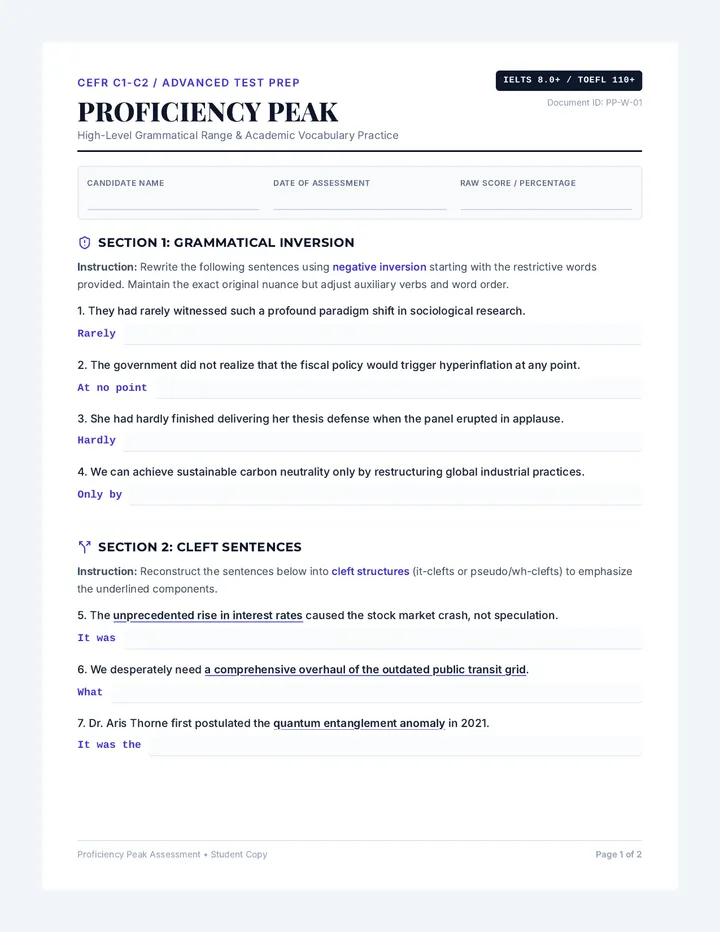
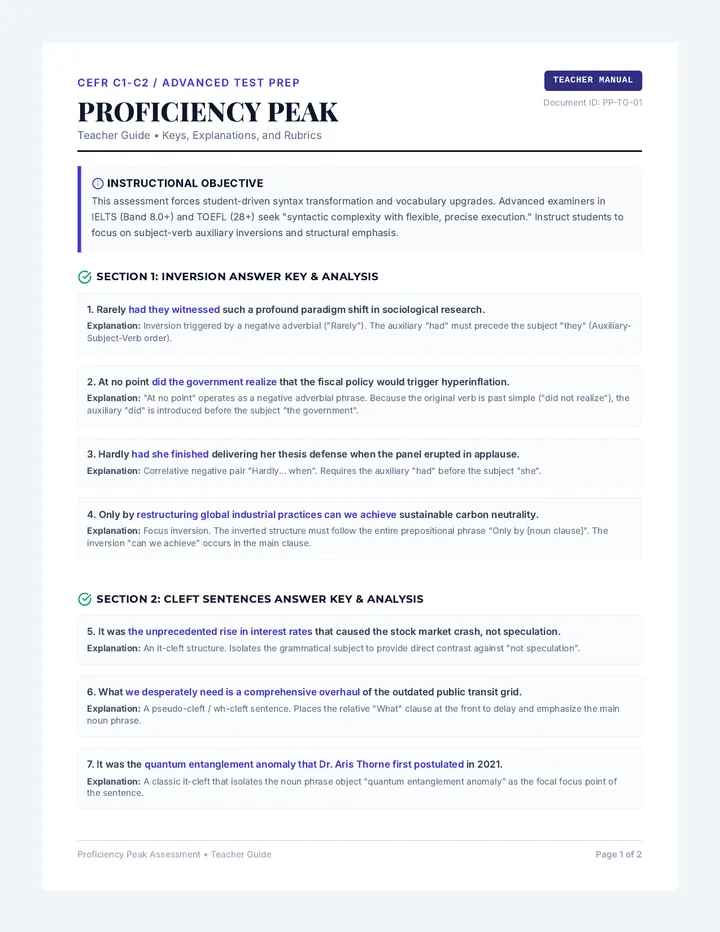
Tone Terrain Slides Tone Terrain
Navigating the Four Tones of Mandarin
The "Ma" Mystery
Listen to the same phoneme "ma" pronounced four different ways.
Which is which?
Essential Question
How does pitch contour fundamentally alter semantic meaning in tonal languages?
The Four Profiles
Tone 1: High Flat
ā — Long and steady
Tone 2: Rising
á — Like asking a question?
Tone 3: Dipping
ǎ — Low, down, then up
Tone 4: Falling
à — Short and sharp!
Don't Forget: The Neutral Tone
Short, light, and unstressed. It takes its pitch from the syllable before it.
ma (no mark)
Listen & Drill
Opening the "Ear Training" Worksheet
1
Listen to the isolated syllable.
2
Visualize the "shape" of the sound.
3
Identify the tone (1, 2, 3, or 4).
Tone Terrain Worksheet Tone Terrain
Listening & Discrimination Drill
Student Name:
Date:
Part 1: Pitch Mapping
Below are common pinyin syllables. Above each, draw the tone mark (\(\bar{x}\), \(\acute{x}\), \(\check{x}\), \(\grave{x}\)) and a small arrows indicating the pitch movement.
Tone 1
ba
Tone 2
li
Tone 3
wo
Tone 4
qu
Part 2: Auditory Identification
Your teacher will read a series of syllables. For each, circle the correct tone number. Listen closely to the pitch contour.
Tone 1 Tone 2 Tone 3 Tone 4
Part 3: Meaning Contrast
Write down the meaning of the syllable "ma" for each tone heard. Then, write one sentence explaining why tones are crucial for communication.
mā (1st Tone)
má (2nd Tone)
mǎ (3rd Tone)
mà (4th Tone)
Reflection: Why do tones matter?
Tone Terrain Teacher Guide Teacher Guide: Tone Terrain
Lesson 1: Discriminating the Four Tones
Objectives
• Identify pitch contours of all four Mandarin tones plus the neutral tone.
• Discriminate between similar syllables based solely on pitch.
• Associate specific tones with changes in semantic meaning.
Audio Key for Worksheet Part 2
Read these syllables clearly for students to mark on their sheets. Pause 3 seconds between each.
1 tā (Tone 1)
2 lái (Tone 2)
3 hǎo (Tone 3)
4 qù (Tone 4)
5 nǐ (Tone 3)
6 shì (Tone 4)
Quick Tips
The "Ma" Meanings
1: Mother (mā)
2: Hemp (má)
3: Horse (mǎ)
4: Scold (mà)
Common Pitfalls
Students often confuse Tone 2 (rising) with Tone 3 (dipping) when Tone 3 is spoken quickly.
Facilitation Prompts
On Physicality:
"How does your throat feel different when pronouncing Tone 4 (falling) versus Tone 1 (flat)?"
On Language Comparison:
"In English, we use pitch for emotion or questions. How is that different from Mandarin using pitch for vocabulary?"
Sound Scanners Slides Sound Scanners
Decoding Initials and Finals
The Sound-Alike Challenge
Are these the same? Or are they different?
Clip A
ju
Clip B
zhu
One is a "j", one is a "zh". Can your ear hear the difference?
Initial Battlegrounds
Palatal: j, q, x
Sounds produced with the tongue flat against the roof of the mouth. Very "bright" sounds.
ji qi xi
Retroflex: zh, ch, sh
Tongue tipped up and curled back. Sounds more "hollow" or "muffled" compared to j/q/x.
zhi chi shi
Final Frontier
-an vs -ang
Front vs Back Nasal
-en vs -eng
Closed vs Open Throat
u vs ü
The "Lip-Rounder"
Sharpen Your Ears
We are about to perform a "Sound Scan" drill. Your goal is to distinguish between minimal pairs—words that differ by only one sound.
Start Drills
Review Key
Pinyin Pairings Worksheet Pinyin Pairings
Minimal Pair Phonetic Workshop
Unit: Mandarin Phonetics 101
Student:
1
Initial Sound Scans
Listen as your teacher reads one word from each pair. Circle the pinyin syllable you hear.
Pair A
ju
zhu
Pair B
qi
chi
Pair C
xi
shi
Pair D
zi
zhi
2
Final Nasal Focus
Distinguish between front-nasal (-n) and back-nasal (-ng) sounds. Write the full pinyin syllable with Tone 1 (\(\bar{x}\)).
3
The Lip-Rounding Test
Mastery Challenge
Your teacher will read three words. Some contain the standard "u" sound, while others contain the "ü" (the umlaut sound). Circle the correct pinyin below.
Word 1:
lu lü
Word 2:
nu nü
Word 3:
qu chu
Phoneme Key Teacher Guide Instructional Guide
Phoneme Key
Scripted Audio Drills for Lesson 2: Initials & Finals
Auditory Key: Part 1 (Initials)
Read the Bolded Word from each pair. Exaggerate the tongue position for the first few repetitions.
Pair A:
ju / zhu
Pair B:
qi / chi
Pair C:
xi / shi
Pair D:
zi / zhi
Auditory Key: Part 2 (Nasal Finals)
Item 1
mān
Front nasal
Item 2
shāng
Back nasal
Item 3
fèn
Front nasal
Item 4
lěng
Back nasal
Item 5
xīn
Front nasal
Item 6
hóng
Back nasal
Instructional Tip: Tongue Positioning
For j, q, x:
Tell students to place the tip of their tongue against their lower teeth. The middle of the tongue rises to touch the hard palate. Smile while saying these sounds to widen the mouth.
For zh, ch, sh:
Instruct students to curl the tip of their tongue back towards the roof of the mouth (but not touching the very back). The mouth should be more rounded, like saying "sh" in "shoe."
Sandhi Secrets Slides Sandhi Secrets
When Written Tones Don't Match the Sound
The Auditory Mystery
Listen to this common greeting:
Nǐ hǎo
Written: Tone 3 + Tone 3
But wait... it sounds like Ní hǎo (Tone 2 + Tone 3). Why the change?
Listen for the shift
Rule #1: The Double Dip
3 + 3
WRITTEN
2 + 3
SPOKEN
When two 3rd tones are together, the first one shifts to a 2nd tone. It's too tiring to "dip" twice in a row!
Rule #2: The "Bu" Variation
Usually...
bù
(Tone 4)
bù hǎo (4 + 3)
BUT Before Tone 4...
bú
(Tone 2)
bú shì (2 + 4)
Case Study Time
Open your "Sandhi Secrets" packet. We will listen to natural speech samples. Your job: identify the tone heard versus the tone written.
Pattern Hunter Worksheet Linguistic Field Investigation
Pattern Hunter
Uncovering Tone Sandhi in Natural Speech
Case File #003
Activity 1: Tone Mismatch Identification
Listen to the spoken phrases. Compare the audio to the written pinyin. Mark the tone you hear on the first word.
Phrase 1:
nǐ hǎo
Tone Heard:
Tone 1 Tone 2 Tone 3
Phrase 2:
bù shì
Tone Heard:
Tone 2 Tone 3 Tone 4
Phrase 3:
yī kuài
Tone Heard:
Tone 2 Tone 3 Tone 4
Phrase 4:
yǐng zhǎn
Tone Heard:
Tone 1 Tone 2 Tone 3
Activity 2: Hypothesis Workshop
Observations:
The Rule Hypothesis:
Mastery Verification
If a word has two 3rd tones in a row, like "Wǒ yě" (I also), how will it actually sound in conversation? Use tone marks over the syllables below.
Wo
Predicted Spoken Tone
ye
Predicted Spoken Tone
Rules of Tone Teacher Guide Rules of Tone
Lesson 3 Facilitation & Audio Script
Audio Script: Part 1
Read these phrases at a natural, conversational speed. Do not over-enunciate the written tones; use the natural sandhi.
Phrase 1: nǐ hǎo
Read as: ní hǎo (2nd + 3rd)
Phrase 2: bù shì
Read as: bú shì (2nd + 4th)
Phrase 3: yī kuài
(Advanced Rule: "yi" before Tone 4 becomes Tone 2)
Read as: yí kuài (2nd + 4th)
Phrase 4: yǐng zhǎn
Read as: yíng zhǎn (2nd + 3rd)
Concept Check
Students may ask: "Do I write it with the change?"
Answer: No. Pinyin tone marks are almost always written as the "base" tone (the tone of the dictionary entry), regardless of how they are spoken in sandhi. This is a crucial distinction for transcription.
The Why
Sandhi rules exist because languages naturally gravitate toward "ease of articulation" (the principle of least effort).
Doing two full low-dipping tones in a row is physically taxing for the speaker and slows down speech too much.
Extension
For advanced students, introduce the Half-3rd Tone rule: when a 3rd tone is followed by anything other than another 3rd tone, it stays low and doesn't rise back up.
Dictation Dash Slides Dictation Dash
The Synthesis of Sound and Script
Our Mission Today
Transcription Mastery
Translate spoken Mandarin directly into accurate Pinyin with correct tone marks.
1
Listen
2
Process
3
Transcribe
h-ǎ-o
PHONETIC CODE
The Code Breaker
At the end of your worksheet, your transcriptions will reveal a hidden message. One wrong tone mark, and the code remains locked!
_ _ _ _ _ _
Strategy: The Echo Method
Mouth It
Silently mouth the sound. Physical movement reinforces the sound shape.
Hand Marks
Trace the tone in the air with your finger as you hear it.
Isolate
Focus on the Initial first, then the Final, then the Tone.
Get Ready!
Pencils up. Ears open.
Opening Worksheet 4
Pinyin Pro Worksheet Audio-to-Orthography Workshop
Pinyin Pro
Advanced Syllable Transcription Drill
Dictation Session 04
Name:
Transcription Zone
Listen to the spoken syllables. Transcribe the pinyin initial, final, and tone mark accurately.
01
Initial Final Tone
02
Initial Final Tone
03
Initial Final Tone
04
Initial Final Tone
05
Initial Final Tone
06
Initial Final Tone
Word-Level Transcription
Listen to these two-syllable words. Mark BOTH tones.
A.
B.
The Code Breaker
Use the TONE NUMBERS from items 01 to 06 to find the hidden phrase below.
_ _ _ _ _ _
Example: If Item 1 was Tone 3, the first letter is the 3rd letter of the alphabet (C).
Script Master Teacher Guide Dictation Facilitator Script
Script Master
Official Audio Cues for Lesson 4 Workshop
Syllable Script (Items 01-06)
Pace: Repeat each syllable three times. 1. Normal Speed, 2. Enunciated, 3. Normal Speed.
01
fēi
Tone 1
02
ái
Tone 2
03
dǎ
Tone 3
04
bà
Tone 4
05
ér
Tone 2
06
dào
Tone 4
Two-Syllable Script
Word A
lǎoshī
Meaning: Teacher
Tones: 3rd + 1st
Word B
xuésheng
Meaning: Student
Tones: 2nd + Neutral
The Code Breaker Key
Logic: Tone # = Alphabet Position
A B C D B D
(Tones: 1, 2, 3, 4, 2, 4)
Explain to students that the letters represent the tones in order. A correct transcription unlocks the secret sequence.
Final Feedback Slides Mastery Showdown
The Final Auditory Challenge
Today's Final Stages
Warm-Up
Rapid-Fire Tone Bingo. Fast ears win.
The Check
Cumulative Auditory Assessment.
Analysis
Peer-Review & Error Analysis Lab.
Tone Bingo Rules
1
Listen to the syllable and tone read by the teacher.
2
Find the matching tone number on your grid.
3
Five in a row wins. Speed is essential!
1
4
2
FREE
3
1
The Analysis Lab
Debriefing the Assessment
Trade papers. If your partner missed a tone, don't just mark it wrong. Diagnose why.
Common Diagnosis A
Confused Tone 2 (Rise) with Tone 3 (Dip).
Common Diagnosis B
Missed Tone Sandhi (3+3 spoken as 2+3).
Pitch Perfect!
You have developed the ears of a linguist.
Mastery Achieved
Tone Bingo Board Tone Bingo
Auditory Response Training
Your teacher will call out pinyin syllables. Mark the Tone Number of the sound you hear. Five in a row (vertical, horizontal, or diagonal) wins!
1
4
3
2
1
2
3
1
4
2
4
1
FREE
SPACE
3
4
3
2
4
1
3
1
4
2
3
4
Teacher Quick-Ref
To maintain challenge, call out syllables that use the same phonemes with different tones (e.g., mā, má, mǎ, mà). Randomize the order. Ensure students have a physical token or marker to place on their grid if using for multiple rounds.
Mastery Check Assessment Mastery Check
Cumulative Auditory Assessment
Student Name:
Mastery Score:
/ 20
Section 1: The Tone Gallery
Listen to the isolated syllables. Circle the tone number. (10 Points)
1 2 3 4
1 2 3 4
1 2 3 4
1 2 3 4
1 2 3 4
1 2 3 4
Section 2: Orthography Test
Listen to the full words. Transcribe accurately with Pinyin and Tone Marks. (10 Points)
A. Word One (2 Syllables)
B. Word Two (2 Syllables)
C. Word Three (3 Syllables)
D. The Sandhi Challenge (Write as Written)
Error Analysis Diagnosis
After trading papers, identify ONE common mistake your partner made. Why do you think this mistake happened (e.g., confusing similar contours, sandhi rule)?
Mastery Assessment Key Assessment Key & Script
Mastery Guide
Final Evaluation Standards for Unit 1
Section 1: The Tone Gallery (Audio Key)
01
mā (T1)
02
mǎ (T3)
03
má (T2)
04
mà (T4)
05
hǎo (T3)
06
tā (T1)
Section 2: Orthography (Audio Key)
A. Word One
bàba
Father (Tone 4 + Neutral)
B. Word Two
míngtiān
Tomorrow (Tone 2 + Tone 1)
C. Word Three
duìbuqǐ
Sorry (Tone 4 + Neutral + Tone 3)
D. Sandhi Challenge
nǐ hǎo
Written: 3+3 (Spoken as 2+3)
Assessment Rubric
Transcription Accuracy:
- Correct Initial/Final: 1pt
- Correct Tone Mark Placement: 1pt
- Correct Tone Choice: 1pt
Error Analysis Lab:
- Full Credit: Identifies mistake AND linguistically accurate reason.
- Partial Credit: Identifies mistake only.