A comprehensive sequence for 7th-grade students on the Mandarin Chinese particle 'le', focusing on aspect, change of state, syntax with objects, and negation through a detective-themed narrative.
A training sequence designed to equip pre-service elementary school teachers with the foundational skills and practical tools needed to teach English as a Foreign Language (EFL).
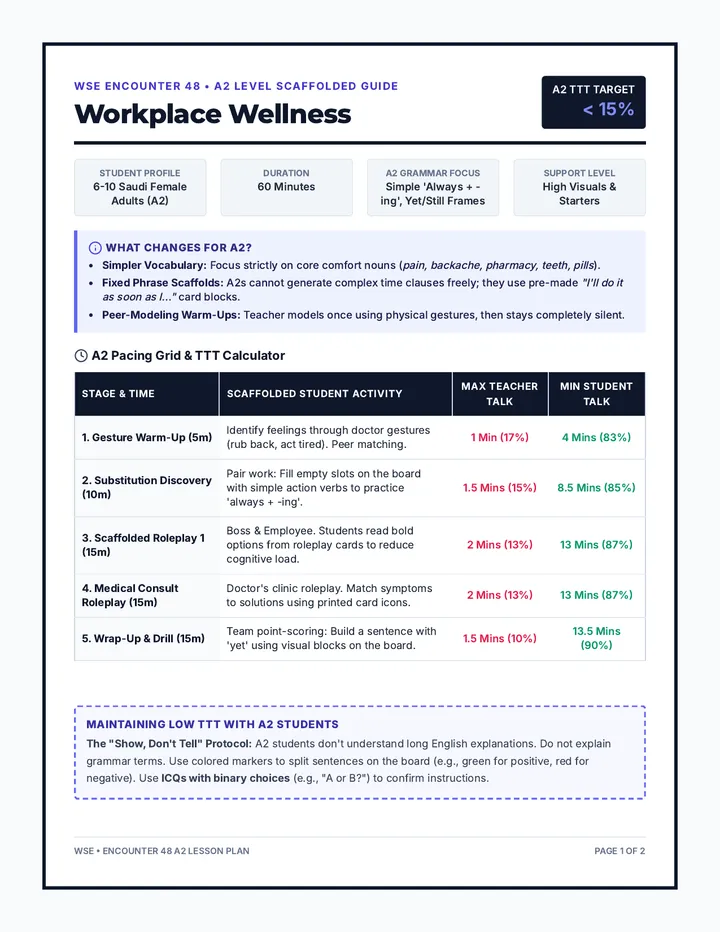
A language learning sequence focused on practical conversation in Portuguese for A2 level students, specifically targeting healthcare interactions.
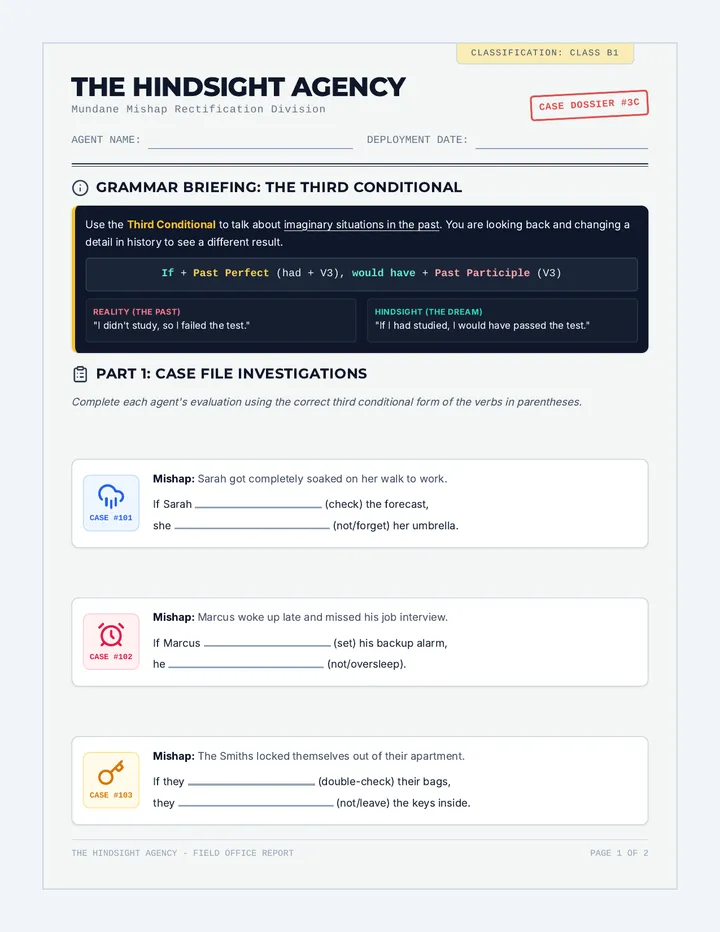
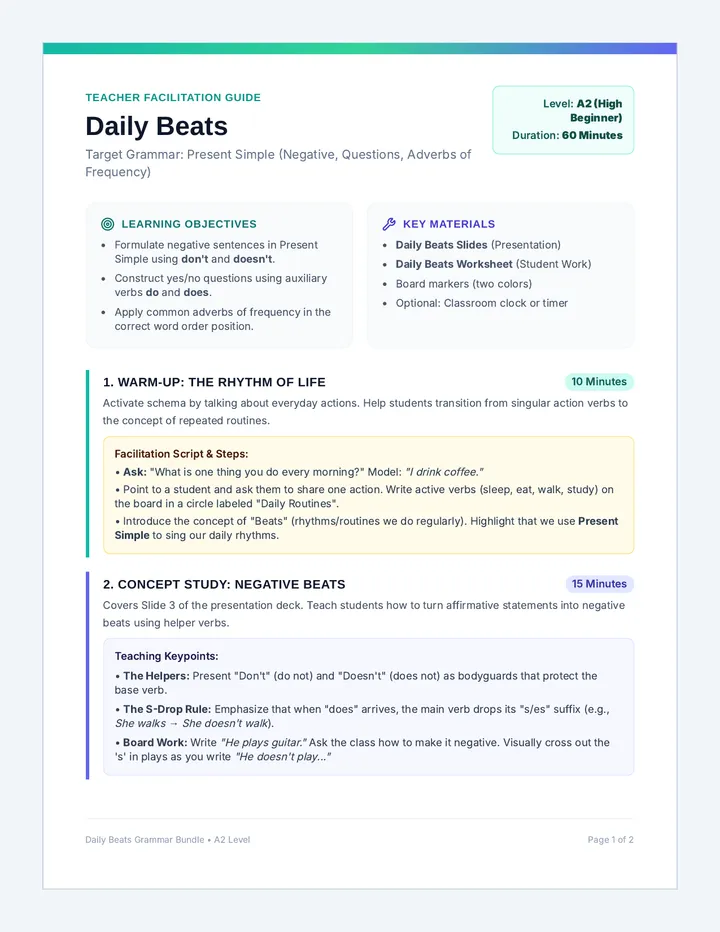
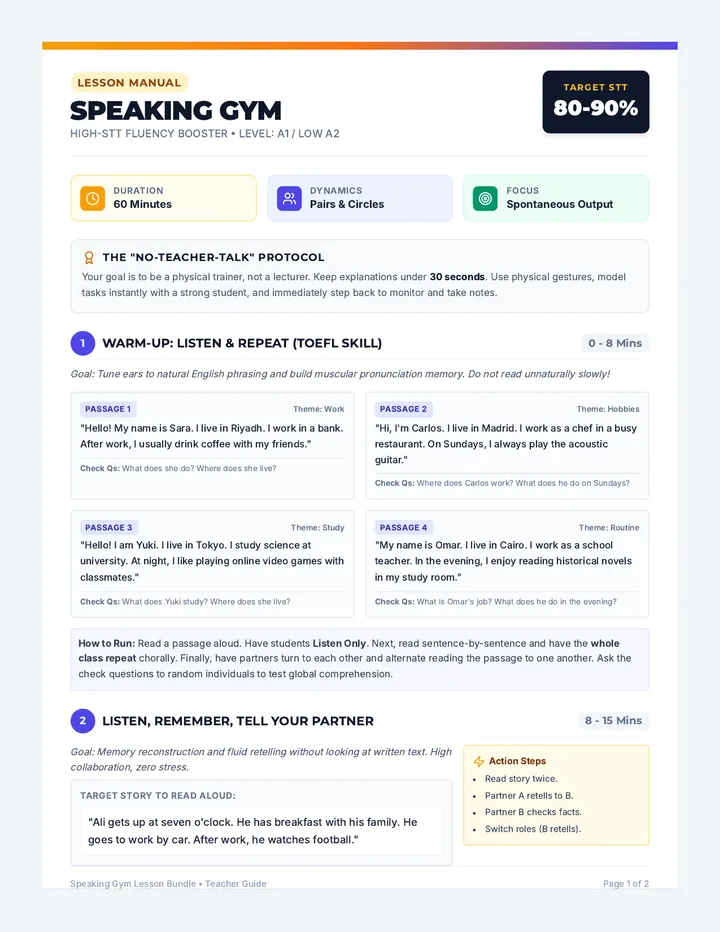
A beginner English sequence for adults focusing on essential auxiliary verbs in daily contexts like work, health, and shopping.
A comprehensive 30-day literacy program designed for Spanish-speaking English Learners, focusing on vowels, CVC blending, rhyming, and multisyllabic word decoding. The curriculum uses a 'construction' theme to build reading skills from the ground up, with specific support for ESL phonetic challenges.
A three-day Spanish 1 unit focused on community vocabulary, regular present tense verbs, 'estar' for location, and social invitations at a Novice-Low level. Students will learn to describe their neighborhood and navigate social interactions like accepting or rejecting plans.
A series of resources designed to help English Language Learners navigate and identify common classroom objects and areas through visual labeling and bilingual support.
A 5-day introductory Spanish sequence focusing on verb conjugation in major tenses (Present, Preterite, Gerund, and Future) using common everyday verbs. Students practice sentence construction and time-marker classification through daily worksheets and visual slides.
A series of prefix-focused labs designed to help students master common prefixes and suffixes through contextual application and logic puzzles.
Une séquence d'alphabétisation complète en Bamanankan pour débutants, intégrant l'apprentissage des voyelles, des consonnes et des salutations de base à travers un livret imprimable et des supports visuels.
A Novice-Low Japanese lesson sequence focusing on cultural comparisons between Japan and the United States, specifically regarding school life and transportation. The materials use Comprehensible Input (CI) strategies to make the content accessible to beginners.
A two-part introductory Spanish sequence focusing on clothing, weather, and activities through Comprehensible Input (CI) strategies like TPRS and Picture Talk. Students explore cultural contexts and seasonal variations in the Spanish-speaking world while building basic communicative proficiency.
A foundational Spanish sequence focusing on numbers and colors through practical application and classroom-based activities.
A two-lesson German introductory unit focusing on weather, seasons, and outdoor activities in Germany using Comprehensible Input (CI) methods. Students will learn to describe weather using 'Es ist' and activities using 'Man kann' through visual-heavy instruction and repetition.
An introductory Japanese language and culture unit for 8th grade that follows the 'TABI' (Journey) framework. Students explore geography, etiquette, writing systems, daily life, and traditional arts through immersive daily 45-minute lessons.
A comprehensive 3-day review sequence for Spanish 1 students focusing on city vocabulary, directions, and describing urban environments to prepare for Unit 5 summative assessments.
A 3-day cultural immersion unit for Spanish 1 students exploring the unique Semana Santa traditions in Quito, Ecuador, focusing on the Jesús del Gran Poder procession and community culinary traditions.
A series of lessons focused on mastering high-frequency irregular Spanish verbs to build foundational communication skills.
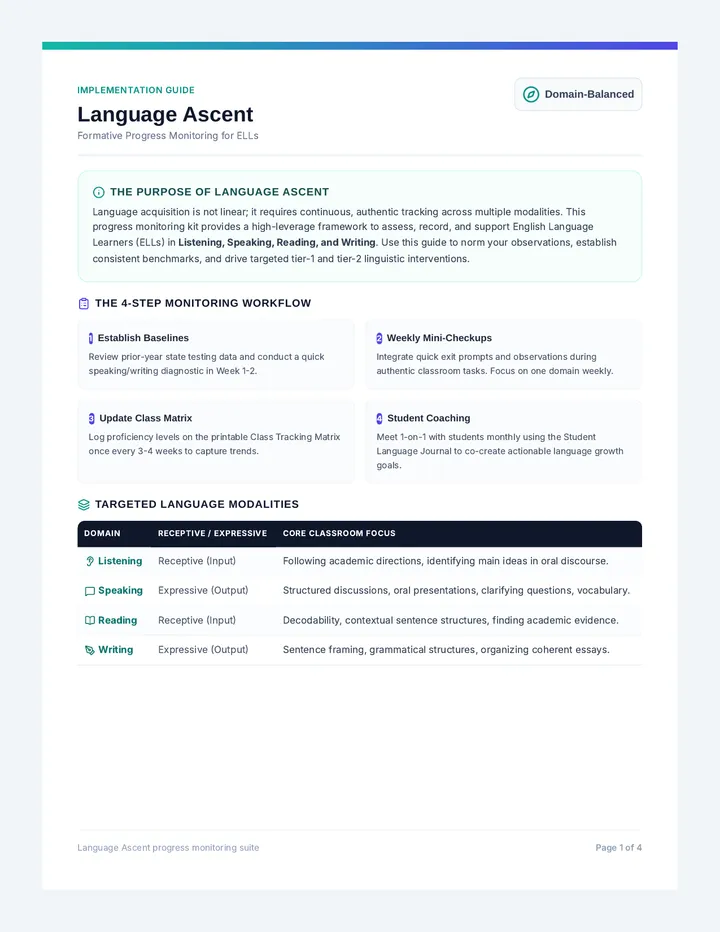
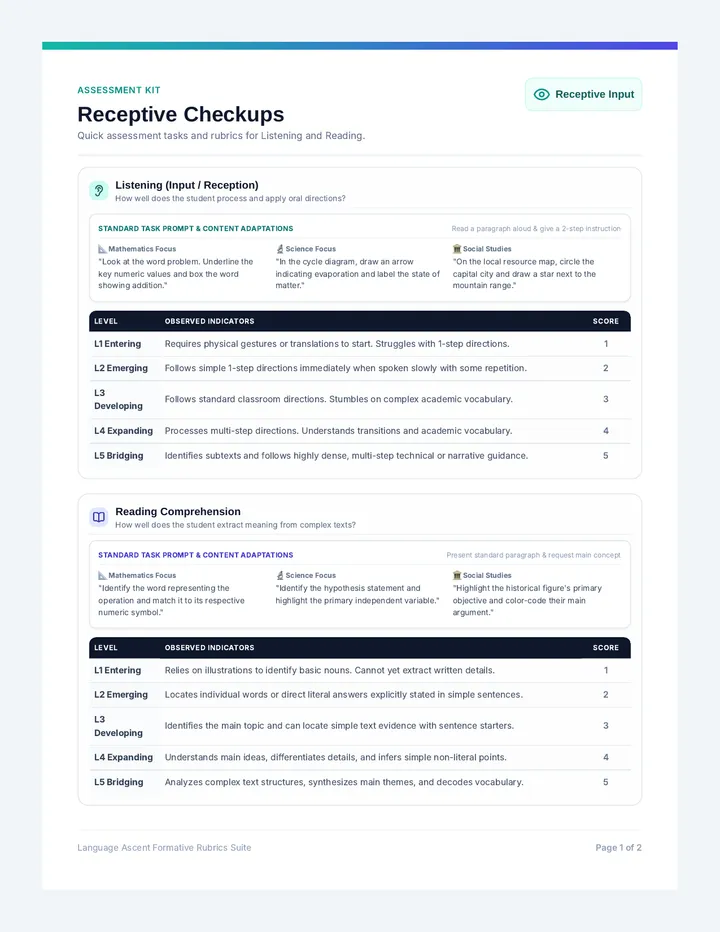
A comprehensive curriculum framework for primary English Language Learners, aligning theme-based social studies and science units with WIDA's four Key Language Uses: Narrate, Inform, Explain, and Argue. This sequence provides instructional scaffolding for students at proficiency levels 1-3.
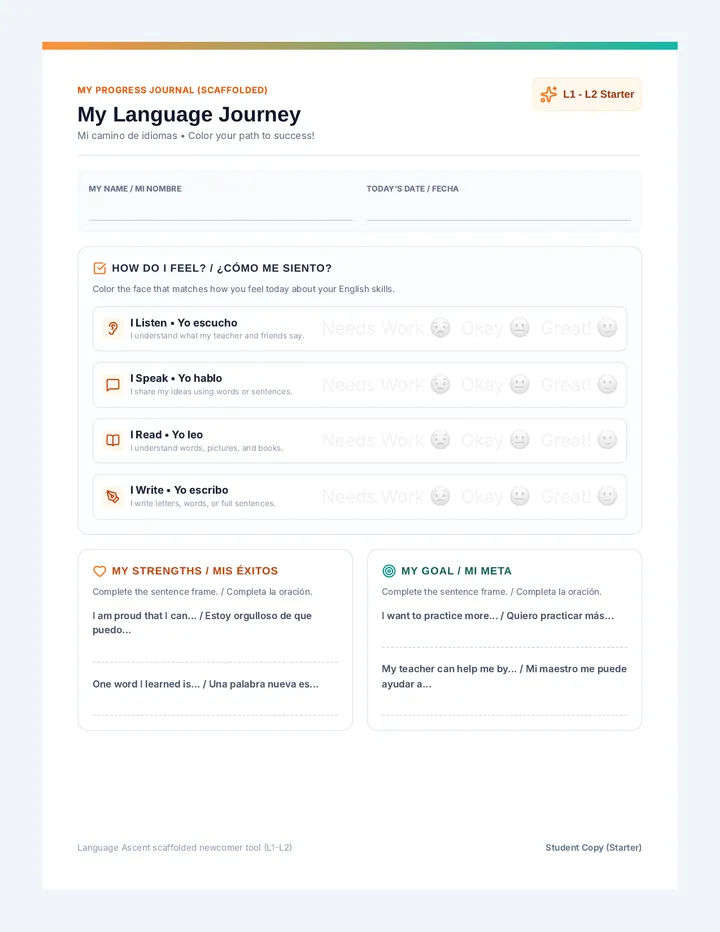
A foundational English as a Second Language (ESL) sequence for Spanish-speaking middle schoolers, focusing on essential survival phrases, school navigation, and personal relationships.
A two-lesson sequence for Spanish class exploring themes of diversity, social tolerance, and empathy through language and cultural connection. Students develop vocabulary to describe identity and practice perspective-taking to build inclusive communities.
Une séquence pédagogique complète sur les différents types de médias, leurs fonctions et le vocabulaire journalistique. Elle comprend des supports visuels, des outils d'organisation et des évaluations.
A cultural exploration of the Dominican Republic, focusing on geography, history, and traditions while developing CER writing skills in Spanish.
A unit covering animal vocabulary, descriptions, and likes/dislikes in Spanish, designed for Level 1 learners to build foundational communication skills about the natural world.
A sequence focused on leveraging digital translation tools for language self-assessment and speech improvement. Students learn to use Google Translate not just for translation, but as a 'mirror' for their own pronunciation, grammar, and fluency.
A Spanish I/II unit focused on Valentine's Day, covering vocabulary related to love, relationships, and emotions through interactive activities and communicative practice.
A high-energy Mandarin Chinese sequence for Pre-K students using the Total Physical Response (TPR) method. Students learn to respond to physical commands and action verbs through games and movement, building direct meaning without translation.
A foundational Mandarin Chinese sequence for Pre-K students focused on identifying family members. Students learn vocabulary for parents, siblings, and grandparents through interactive games, songs, and visual inquiry.
A Pre-K sequence focused on teaching basic Mandarin greetings and social etiquette through play, puppets, and a final tea party synthesis. Students learn phrases for hello, goodbye, thank you, and sorry in a culturally immersive environment.
A 5-lesson sequence for Pre-K students to learn basic self-introduction in Mandarin Chinese, covering name, gender, age, and personal preferences using simple sentence patterns.
A foundational sequence for Pre-K learners to explore the four tones of Mandarin Chinese through auditory play, physical movement, and vocal exploration. Students learn to associate pitch changes with meaning using relatable sounds like questioning 'Huh?' or firm 'No!' gestures.
A vibrant, Pre-K focused sequence exploring Spanish and Latin American holidays and traditions. Through hands-on crafts like piñatas, masks, and crowns, students learn about cultural celebrations while developing fine motor skills and emotional expression.
A sensory-rich sequence for Kindergarten students exploring staple foods from Latin America and Spain, focusing on origins, Spanish vocabulary, and the cultural significance of family dining. Students identify ingredients like corn, cacao, and tropical fruits through workshop-style activities and simulations.
A fun, interactive Spanish vocabulary sequence for Pre-K students focusing on family members and pets. Through songs, games, and creative projects, children learn to name the most important people and animals in their lives.
A physical and interactive Spanish vocabulary sequence for Pre-K students focusing on body parts and movement through Total Physical Response (TPR). Students learn through songs, games, and creative activities, culminating in a 'Simón Dice' challenge.
A Kindergarten sequence focused on foundational Spanish greetings (Hola, Adiós, Buenos días, Buenas noches), expressing basic emotions (bien, mal, más o menos), and counting 1-5. Students learn through songs, movement, and role-play culminating in a 'Mercado' market simulation.
This advanced Mandarin Chinese sequence for graduate students focuses on analyzing contemporary social issues through the lens of sophisticated rhetoric and four-character idioms (chengyu). Students explore urbanization, demographic shifts, and environmental policy to build a high-level academic vocabulary and persuasive argumentation skills.
This advanced Spanish sequence transitions 9th-grade students from intermediate proficiency to professional linguistic precision. It focuses on academic register, workplace vocabulary, logical connectors, and sociolinguistic etiquette through authentic simulations and analysis.
An immersive intermediate French sequence where students navigate travel scenarios in Paris, Dakar, and Montreal, mastering future, past, and conditional tenses through simulated real-world interactions.