Mindset Matters Slides MINDS MATTER: LESSON 1
Mindset Matters
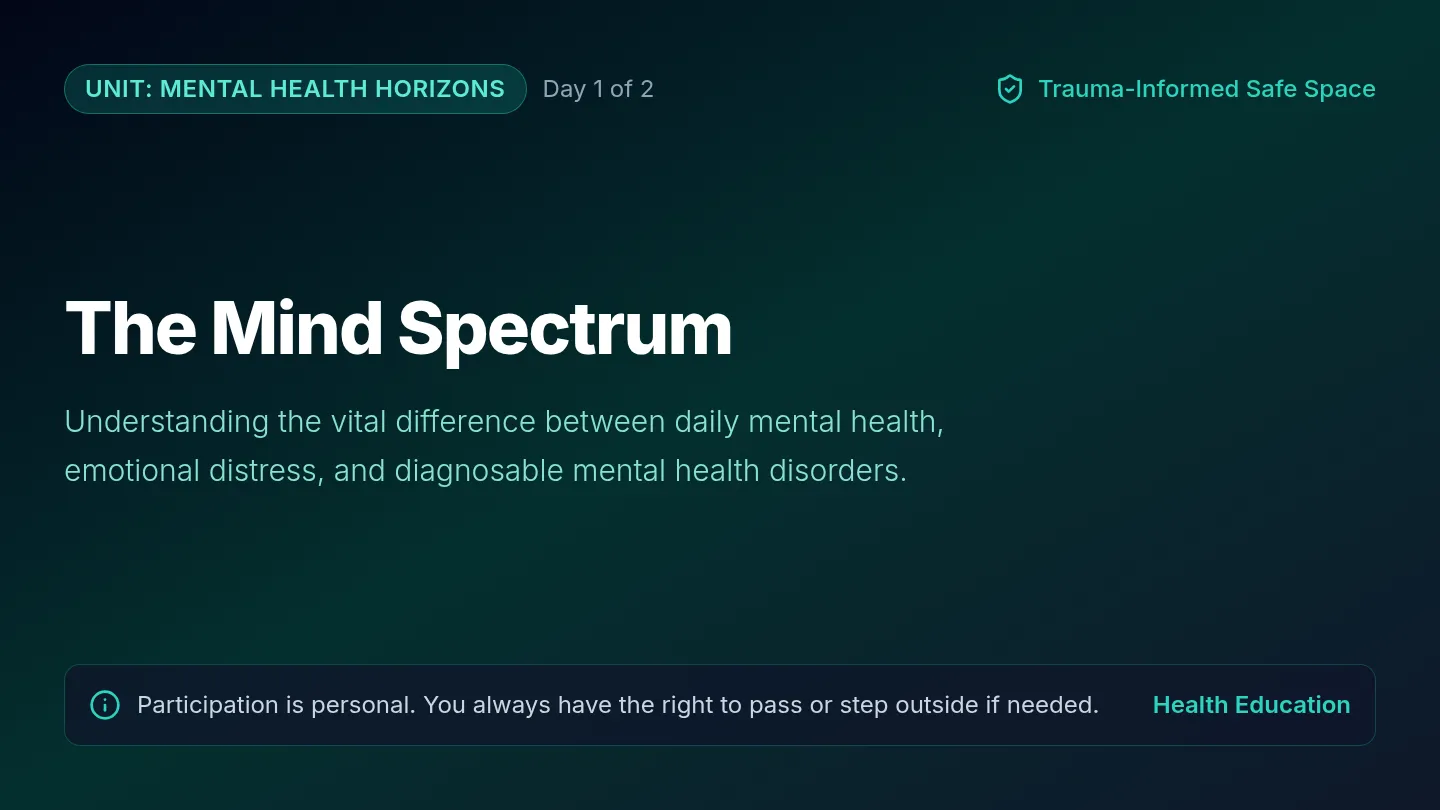
Defining Mental Health & Breaking the Stigma
Understanding Our Minds
Starting the Conversation
How Are You Feeling?
Pulse Check
On a scale of 1-10, how is your internal "weather" today?
☀️
🌤️
☁️
🌧️
⛈️
"Mental health is not a destination, but a process. It's about how you drive, not where you're going."
Today, we're going to talk about that process—how we take care of our minds just like we take care of our bodies.
What is Mental Health?
Emotional
How you feel and how you manage your emotions.
Social
How you relate to others and navigate your relationships.
Psychological
How you think, handle stress, and make choices.
Everyone has mental health, just like everyone has physical health.
The Mental Health Continuum
Healthy
Normal fluctuations, calm, active, sleeping well.
Reacting
Nervous, irritable, sad, trouble sleeping.
Injured
Anxious, angry, pervasive sadness, withdrawal.
Ill
Excessive anxiety, depressed mood, unable to cope.
We can move back and forth along this line depending on what's happening in our lives.
Myth vs. Fact
Myth
Mental health issues are a sign of weakness or character flaws.
Myth
You can just "snap out of it" if you try hard enough.
Fact
Mental health issues are health conditions with biological, social, and environmental causes.
Fact
Recovery is possible with the right support, tools, and professional care.
What is Stigma?
Definition
A mark of disgrace associated with a particular circumstance, quality, or person.
In Mental Health
Negative stereotypes that lead to discrimination, shame, and fear.
The Impact of Stigma:
Prevents people from seeking help early.
Causes isolation and loneliness.
Reduces self-esteem and hope.
Makes it harder to talk openly about feelings.
How We Break the Stigma
Talk Openly
Share your experiences and listen without judgment.
Educate
Learn the facts and challenge misconceptions when you hear them.
Show Empathy
Treat mental health issues with the same care as physical ones.
Mind Your Language
Avoid using diagnostic terms as casual adjectives (e.g., "I'm so OCD").
Your Mind Matters
In our next lesson, we'll dive into how to manage stress and identify the signals our bodies send us when we need a break.
Today's Reflection Activity
Complete the Mental Health Mythbusters Worksheet
Mythbusters Worksheet Mythbusters Worksheet
Minds Matter: Lesson 1 Activity
Name:
Date:
Stigma often thrives on misinformation. Today, we're going to examine common beliefs about mental health and separate fact from fiction. For each statement below, decide if it is a Myth or a Fact , and then write a brief explanation for your choice.
1. Mental health issues are extremely rare among teenagers.
MYTH
FACT
Why did you choose this?
2. Having a mental health condition means you are "unstable" or "dangerous."
MYTH
FACT
Why did you choose this?
3. Mental health and physical health are deeply connected.
MYTH
FACT
Why did you choose this?
Personal Reflection
Think about the concept of Stigma . Why do you think people find it harder to talk about a panic attack than a broken arm?
Q1: How does stigma affect a person's willingness to seek support?
Q2: What is one way YOU can help reduce the stigma surrounding mental health in our school community?
"Your mental health is a priority. Your happiness is an essential. Your self-care is a necessity."
Breaking the Silence Guide Breaking the Silence
Lesson 1: Teacher Guide
Duration 45-60 Min
Learning Objectives
Define mental health as a continuum that affects everyone.
Distinguish between myths and facts regarding mental illness.
Identify the impact of stigma and brainstorm ways to reduce it.
Prep Checklist
Projector for Slides
Mythbusters Worksheets
Chart Paper / Markers
Facilitation Guide
1
Hook: The Weather Check (5-10 min)
Use Slide 2 to check in with students. Emphasize that there are no "wrong" answers.
"Just like we can't control the weather outside, sometimes we can't control our internal weather. But we can learn how to dress for it and when to seek shelter."
2
Defining the Continuum (15 min)
Slides 3-4. Clarify that mental health is not just the absence of illness.
Key Discussion Question:
"Can someone have a mental illness diagnosis but still be in the 'Healthy' or 'Reacting' part of the continuum?" (Yes, with management and support).
3
Mythbusting Activity (20 min)
Distribute the Mythbusters Worksheet . Allow students 10 minutes to work individually, then use Slides 5-6 to discuss.
Teacher Tip: Watch for students who may be sensitive to these topics. Remind the class of confidentiality and respectful language.
Handling Sensitive Disclosures
When discussing mental health, students may feel comfortable sharing personal experiences or struggles. Here is how to handle disclosures:
1. Listen & Validate
Acknowledge their courage for sharing. Avoid giving medical advice or "fixing" the problem on the spot.
2. Clarify Boundaries
Remind them of your mandatory reporting obligations if they are at risk of harm to themselves or others.
3. Connect to Support
Know your school's referral process (counselor, nurse, or social worker) and offer to walk them there.
4. Self-Care
Supporting others can be taxing. Ensure you have your own support system and follow school protocols.
Discussion Starters
"Why do we use the word 'crazy' so casually, and how does that contribute to stigma?"
"How does social media play into the stigma of mental health?"
"If you had a broken leg, what support would you expect? How is that different for a mental health challenge?"
Stress Signals Slides Lesson 2
Stress Signals
Listening to Your Body & Building Your Toolkit
What is Stress?
Stress is your body's natural reaction to a challenge or demand.
It's a survival mechanism designed to help you act quickly in dangerous situations.
Eustress
"Good stress" that motivates and focuses energy.
Distress
"Bad stress" that causes anxiety and discomfort.
Fight, Flight, or Freeze
Fight
Getting irritable, argumentative, or aggressive to "confront" the threat.
Flight
Wanting to escape, avoid, or run away from the situation.
Freeze
Feeling stuck, unable to move or think, or "numb" to the situation.
Your Body's Early Warning System
Common Physical Signals:
Racing Heart
Sweaty Palms
Headache / Tense Jaw
"Butterflies" or Upset Stomach
Trouble Sleeping
Where do YOU feel stress first?
What Pushes Your Buttons?
School
Grades, exams, college pressure, deadlines.
Social
Friend drama, fitting in, popularity, conflicts.
Home
Family dynamics, chores, expectations.
Schedule
Sports, clubs, jobs, no time to relax.
"Knowing your triggers is the first step in managing them before they overwhelm you."
Building Your Coping Toolkit
Instant Relief
Box Breathing (4-4-4-4)
5-4-3-2-1 Grounding Method
Tense & Release Muscle Relaxation
Daily Maintenance
Physical Movement
Journaling / Creative Outlet
Digital Breaks
Try It: The 5-4-3-2-1 Method
When your mind is racing, bring it back to the present moment using your senses.
5
See
4
Feel
3
Hear
2
Smell
1
Taste
Focusing on your senses signals to your brain that you are safe right now.
Listen to Your Signals
Stress isn't the enemy—it's information. The goal isn't to live a life with zero stress, but to learn how to navigate it when it arrives.
Stress Mapping Worksheet Stress Mapping Worksheet
Minds Matter: Lesson 2 Activity
Name:
Date:
Part 1: The Body Map
Use icons or labels to mark where you feel stress (head, chest, stomach, etc.)
When I am stressed, my body feels:
Tense muscles
Fast heart rate
Sweaty palms
Stomach ache
Headache
Shaky hands
Other signals:
Part 2: Identifying Triggers
Identify 3 common stressors in your life and categorize them.
Stressful Situation 1
Category: (School / Social / Home)
Stressful Situation 2
Category: (School / Social / Home)
Stressful Situation 3
Category: (School / Social / Home)
Part 3: My Stress Toolkit
Which strategies work best for you? Choose or create 4 strategies you can use this week.
1
2
3
4
Take a breath. You've got this.
Stress Management Toolkit Guide Stress Management Toolkit
Lesson 2: Teacher Guide
Duration 45-60 Min
Lesson Roadmap
01
The Anatomy of Stress (10m)
Define stress as a physical response. Move away from the idea that stress is purely "mental."
02
Body Scan Practice (15m)
Lead a guided 2-minute body scan to help students identify their "Warning Lights."
03
Mapping & Toolkit (25m)
Independent worksheet completion followed by small-group sharing of strategies.
Key Vocabulary
Sympathetic Nervous System
The "gas pedal"—activates the fight-or-flight response.
Parasympathetic Nervous System
The "brakes"—helps the body calm down and recover.
Cortisol
The primary stress hormone that helps the body manage threats.
Classroom Demo: Box Breathing
Box breathing is used by Navy SEALs to stay calm under intense pressure. Guide the class through 4 rounds:
Inhale
4 Seconds
Hold
4 Seconds
Exhale
4 Seconds
Hold
4 Seconds
Deepening the Dialogue
Social Comparison
"How does comparing ourselves to others on social media trigger a stress response?"
The 'Goldilocks' Zone
"Can we have too little stress? What happens to our motivation without any challenge?"
Coping vs. Avoiding
"What's the difference between a coping skill (calming the mind) and avoidant behavior (running from the task)?"
Modeling Stress
"How do adults in your life handle stress? What have you learned from them (both good and bad)?"
Next Lesson Prep
Brain Balance: Common Conditions & Helping Friends
Brain Balance Slides Lesson 3
Brain Balance
Common Conditions & Supporting Our Community
Support Network
The A.C.T. Method
Is it more than a "bad day"?
Look for the "P"s:
1
Pervasive
Does the feeling impact almost everything you do?
2
Persistent
Has it lasted for more than two weeks?
3
Powerful
Is it so intense that you can't carry out normal tasks?
"When feelings become pervasive, persistent, and powerful, it may be time to reach out for professional support."
Understanding Common Challenges
Anxiety
Excessive, uncontrollable worry or fear that interferes with daily life.
May look like:
Restlessness, difficulty concentrating, muscle tension, sleep disturbance, irritability.
Depression
A persistent feeling of sadness or loss of interest that lasts for weeks.
May look like:
Loss of energy, feelings of worthlessness, changes in appetite, withdrawal from friends.
How to Help: The A.C.T. Method
A
Acknowledge
Notice the signs. Let them know you've noticed they haven't been themselves.
"I've noticed you've been really quiet lately..."
C
Care
Listen without judgment. Show them that they are not alone.
"I'm here for you and I want to support you."
T
Tell
Tell a trusted adult. You don't have to carry this secret alone.
"Let's go talk to the school counselor together."
Who is in your Circle?
ME
Trusted Adults at School:
School Counselor
School Nurse
A Coach or Teacher
Identifying these people *before* you need them is a superpower.
Help is Always Available
988
Suicide & Crisis Lifeline
Call or text 24/7. It's free, confidential, and available to anyone.
741741
Crisis Text Line
Text HOME to 741741 to connect with a crisis counselor.
You don't have to be in a life-threatening crisis to use these resources.
Connections Save Lives
In our final lesson, we'll talk about how the digital world affects our mental balance and how to set healthy boundaries.
Support Systems Organizer Support Systems Organizer
Minds Matter: Lesson 3 Activity
Name:
Date:
My Circle of Support
No one can handle everything alone. Identifying your "go-to" people now ensures you know where to turn when things get tough. Fill in the circles with names of people you trust.
ME
IMMEDIATE (Friends/Siblings)
TRUSTED ADULTS
Support Script
Imagine a friend says to you: "I've been feeling really overwhelmed lately, and I just don't see the point in anything anymore." Using the ACT method , write what you would say or do.
Acknowledge
Care
Tell
Emergency Contacts
Save these numbers in your phone right now. They are available 24/7 for you or anyone you're worried about.
988 Lifeline
Call or Text for immediate crisis support.
Text HOME to 741741
To connect with a Crisis Counselor.
One school resource I will use if I am worried:
Write the name of a counselor, teacher, or office...
Crisis Connection Guide Crisis Connection
Lesson 3: Teacher Guide
Duration 45-60 Min
Teaching with Sensitivity
This lesson deals with more serious mental health conditions. It is essential to maintain a tone that is clinical yet compassionate. Avoid using "scare tactics" or sensationalizing mental health struggles. Focus on the message that recovery is possible and help is available .
Pacing & Flow
Introduction (10m)
Review the continuum from Lesson 1. Introduce the "3 Ps" for identifying when a concern requires professional intervention.
Conditions & ACT (20m)
Explain Anxiety and Depression. Role-play the ACT method as a class. Be the "Care" voice yourself to model empathy.
Resource Mapping (20m)
Students complete the Support Systems Organizer. Ensure every student identifies at least one school-based adult.
Referral Protocol
If a student discloses significant distress during or after this lesson:
Don't leave them alone: If the student is in immediate distress, stay with them until a professional arrives.Notify Counseling: Send a discreet email or message to the school counselor immediately.Document: Follow your school's official protocol for reporting mental health concerns or potential self-harm.
ACT Practice Scenarios
Scenario A: The Withdrawn Teammate
"Your teammate used to be the loudest person at practice, but for the last three weeks, they barely speak and often miss drills. You see them sitting alone on the bus looking lost."
Scenario B: The Stressed Student
"Your best friend is constantly talking about how their heart is racing and they can't breathe before every test. They've started skipping school on quiz days because they're so scared of failing."
Important: Provide local crisis center numbers if they differ from national ones.
Digital Detox Slides Lesson 4
Digital Detox
Balancing Connection & Comparison in a Digital World
The Infinite Scroll
The Dopamine Loop
Apps are designed to keep you scrolling by giving your brain small "hits" of dopamine through likes, comments, and notifications.
The Comparison Trap
We often compare our "behind-the-scenes" (our real, messy lives) to everyone else's "highlight reel" (their perfect, filtered posts).
99+
How Social Media Affects Our Minds
Sleep Quality
Blue light and late-night scrolling interfere with the hormones that help us sleep.
Body Image
Constant exposure to "perfect" bodies can lead to dissatisfaction with our own appearance.
F.O.M.O.
The "Fear Of Missing Out" can lead to feelings of exclusion and anxiety about our social lives.
Social media isn't inherently bad, but how we use it matters.
Creating a Healthier Digital Life
Curate Your Feed
Unfollow or mute accounts that make you feel bad about yourself.
No Phones in Bed
Try keeping your phone out of your bedroom to improve sleep.
App Limits
Use built-in screen time tools to set hard limits for specific apps.
The 20-20-20 Rule
Every 20 minutes, look at something 20 feet away for 20 seconds.
Signs You Need a Break
Emotional Signs
• Feeling more irritable than usual
• Feeling anxious when you can't check your phone
• Comparing your life to others constantly
• Feeling lonely after scrolling
Physical Signs
• Eye strain or headaches
• "Phantom vibrations" (thinking your phone buzzed)
• Neck or back pain
• Difficulty falling asleep
"If your phone is making you feel worse, it's time to put it down for a while."
The 24-Hour Detox Challenge
Can you go 24 hours without social media? Notice how you feel, what you do with your time, and who you connect with in the real world.
Unplug
Unfollow
Unwind
Your Mind is Yours
Mental health is a journey, not a destination. Thank you for being open and honest during this curriculum. Keep taking care of yourself and each other.
Final Activity
Complete the Social Media Audit Worksheet
Social Media Audit Worksheet Social Media Audit
Minds Matter: Lesson 4 Activity
Name:
Date:
Social media isn't just something we use; it's an environment we live in. This audit is designed to help you notice how that environment affects your mental well-being.
Part 1: The Screen Time Pulse
Estimated Daily Screen Time:
Hours
The app I spend the MOST time on is:
How do you usually feel AFTER spending 30+ minutes on that app?
Inspired
Anxious
Bored
Inadequate
Connected
Lonely
Part 2: Curation Reflection
Q1: Identify one account you follow that consistently makes you feel positive, inspired, or educated. Why does it have this effect?
Q2: Identify one account (or type of content) that makes you feel comparison or self-doubt. What would happen if you muted or unfollowed it?
Part 3: My Digital Boundaries
Set three achievable goals for your digital life this week.
Goal 1: Bedtime Routine
Goal 2: Social Interactions
Goal 3: App Clean-up
You are more than your online profile.
Healthy Habits Reflection Guide Healthy Habits Reflection
Lesson 4: Teacher Guide
Duration 45-60 Min
Facilitating Digital Wellness
Students often feel judged when adults talk about screen time. Avoid a "lecture" approach. Instead, frame the discussion around autonomy —how can students take back control of their time and attention from apps designed to keep them addicted?
Discussion Flow
10m
Hook: "What's the last thing you saw on social media that made you laugh? What's the last thing that made you feel bad?"
20m
Instruction: Use slides to discuss the Dopamine Loop and Comparison Trap. Keep it relatable.
20m
Activity: Social Media Audit. Encourage honesty and emphasize that this is for their own awareness, not for a grade.
Terms to Know
Dopamine Loop
The cycle of seeking rewards that triggers the brain's pleasure centers.
Shadow Banning
When an app hides a user's content without notifying them (often leads to social anxiety).
Curation
The process of selecting and organizing content to present a specific image.
Deepening the Reflection
The "Like" Factor
"Why do we delete a photo if it doesn't get enough likes? What does that say about where we find our value?"
Digital Citizenship
"How does being behind a screen make it easier to be unkind? How can we practice 'digital empathy'?"
Curriculum Conclusion
Wrap up the entire "Minds Matter" sequence. Remind students of the resources available to them and that their mental health is a lifelong priority.
Minds Matter: Final Lesson Completed