Cognate Codebreakers Slides Cognate Codebreakers
Lesson 1: Cracking the French Code with Cognates
Secret Dossier #001
The Secret Document
"Attention! L'agent secret est intelligent et courageux. La mission est importante pour la sécurité nationale. Le transport est un hélicoptère rapide. Le capitaine est extraordinaire."
Your Mission:
You have 60 seconds. How many words look like English? What do they mean?
01:00
Scanning in progress...
The Linguist's Secret Weapon
Vrai Cognats (True Cognates)
Words that look similar and mean the same thing in two languages. English and French share over 45% of their vocabulary!
Transparent → Transparent
Difference → Différence
Music → Musique
Strategy: Skimming
Don't read every word! Scan your eyes quickly over the text to find the "anchor words" (cognates) that give you the gist.
Pro Tip
"Look for familiar shapes and patterns first."
Suffix Cheat Sheet
-tion
Usually the same in English!
Nation
Information
Action
-té
Often becomes -ty in English.
Université
Liberté
Sécurité
-ique
Often becomes -ic or -ical.
Fantastique
Historique
Magique
Warning: Faux Amis!
Some words are "False Friends." They look like English, but have a completely different meaning!
Actuellement Currently
(It does NOT mean "Actually")
How to beat them?
If a word makes the sentence sound weird or nonsensical, it might be a false friend.
Context is everything!
Decoding the Dossier
"Le journaliste explore le musée d'art moderne. L'atmosphère est calme et artistique."
1. Find the Cognates
Which words look familiar?
2. Decode the Gist
What is the person doing and where?
Cognate Hunt Worksheet Cognate Hunt: Operation Decode
Linguistic Intelligence Agency • File #001
Agent:
Date:
Your Mission
Read the following "Secret Dossier" about a mystery traveler. Use your skimming and scanning skills to identify 10 cognates (words that look like English). Then, answer the comprehension questions based on what you understood.
Intercepted Message
"Bonjour! Ma destination est la ville de Lyon. C'est une ville historique et magnifique. Mon appartement est confortable et moderne. J'adore la gastronomie locale, particulièrement la salade lyonnaise. La culture ici est extraordinaire et le climat est agréable. C'est une expérience mémorable."
Step 1: The Cognate List
Identify 10 French words from the text and write their English meanings.
Step 2: Analysis & Context
1. Where is the traveler going?
2. List three words used to describe the apartment:
3. What does the traveler like about the city? (Give two details)
4. Based on the ending, how would you summarize the traveler's overall experience?
Detective Challenge
Can you guess what these words mean based on context clues, even if they aren't exact cognates?
A. Ville:
B. J'adore:
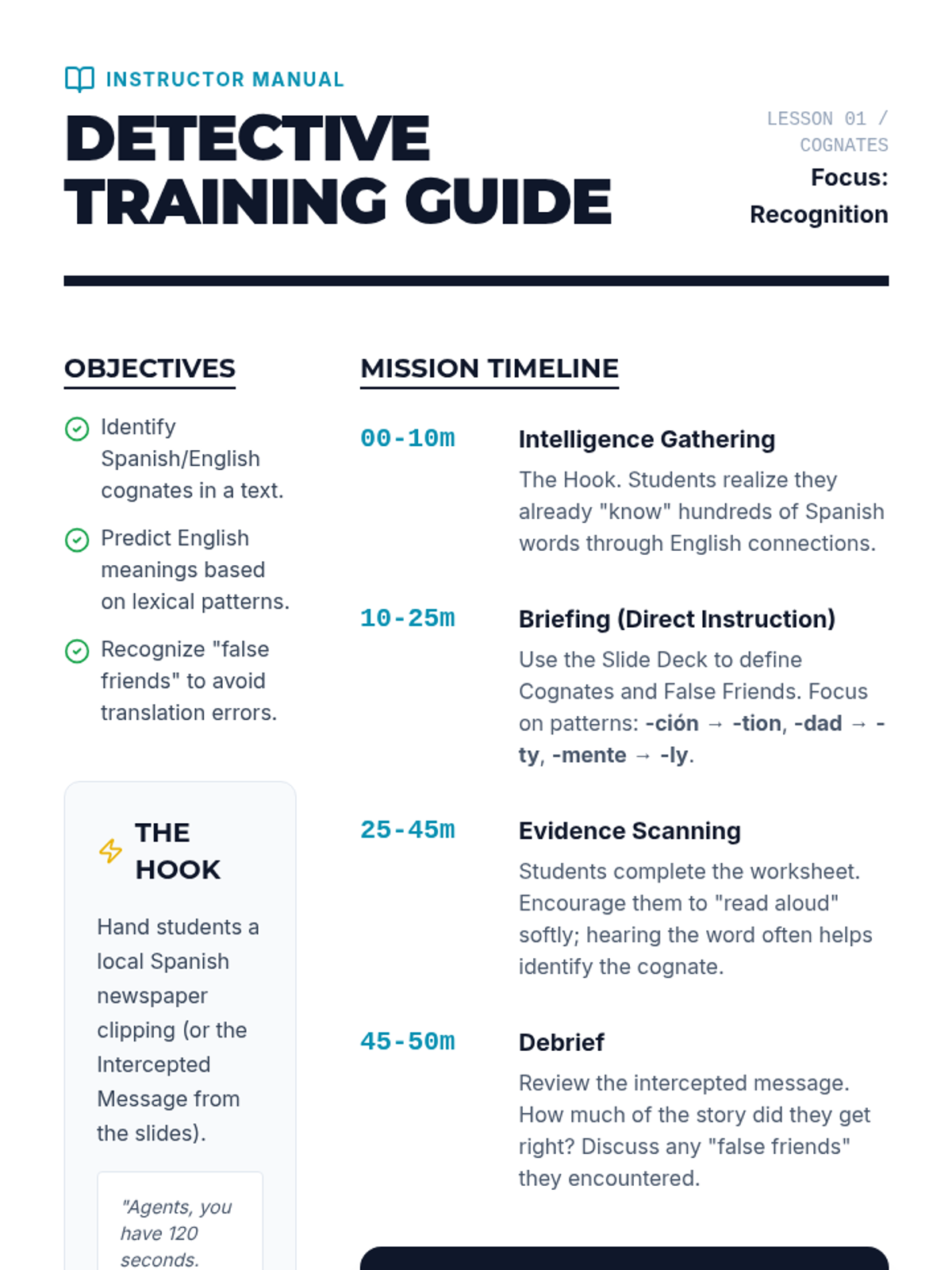
Cognate Codebreakers Teacher Guide Teacher Guide: Cognate Codebreakers
Level: Beginner French (8th Grade) | Duration: 50 Minutes
Objective
Students will develop reading confidence by identifying linguistic patterns and cognates in French. They will learn to skim for the "gist" of a text without needing a dictionary for every word.
Key Vocabulary
Cognat Faux ami Contexte Information Culture
Materials Needed
Cognate Codebreakers Slides
Cognate Hunt Worksheet
Highlighters (Yellow/Orange)
Instructional Flow
00-10m
The Hook: Mystery Message
Display Slide 2. Give students 60 seconds to scan the text. Ask: "What did you understand?" Point out that they haven't learned French yet, but they already understood 80% of that sentence. This builds immediate self-efficacy.
10-20m
Direct Instruction: Suffixes & Strategies
Walk through Slides 3-5. Emphasize the -tion, -té, -ique suffixes. Show "Faux Amis" as a warning—context is their safety net.
20-40m
The Cognate Hunt
Distribute the "Cognate Hunt Worksheet." Students work individually or in pairs to highlight the cognates and decode the paragraph. Circulate and ask students to point to specific context clues that helped them with the "Detective Challenge" section.
40-50m
Debrief & Synthesis
Ask: "What was the most surprising word you understood?" "Why do you think English and French share so many words?" (Briefly mention the Norman Conquest of 1066 for history buffs).
Differentiation Strategies
For Scaffolding
Provide a "Word Bank" for the cognates in English and ask students to find the French equivalent. Focus on just three suffixes (-tion, -té, -ique).
For Extension
Challenge students to write their own "Secret Message" using at least 5 cognates. Can they write a sentence that looks like French but is actually understandable in English?
Introduction Blueprint Slides Introduction Blueprint
Lesson 2: Decoding Identity Patterns & Subject Pronouns
Secret Dossier #002
Celebrity Mystery
"Je suis un acteur célèbre. Je suis américain. Je m'appelle Iron Man."
Who am I?
Look at the structure. What words are repeated? What are they doing in the sentence?
Mystery Agent #01
The Building Blocks: Pronouns
Je → I
Tu → You (singular/informal)
Il / Elle → He / She
Nous → We
Vous → You (plural/formal)
Ils / Elles → They
The Power of "Être"
The most important verb for introductions (to be)
être
Je suis I am
Nous sommes We are
Tu es You are
Vous êtes You are
Il / Elle est He / She is
Ils / Elles sont They are
The Introduction Blueprint
Je m'appelle [Name] . Je suis [Nationality] . Je suis [Personality Trait] .
1
Identifier
Subject Pronoun
2
Action
Conjugated Verb
3
Detail
Adjective / Noun
Introduction Blueprint Worksheet Blueprint Rebuild: Introduction Workshop
Grammar & Structure • File #002
Agent:
Date:
Task 1: Subject Pronoun Decoder
Draw a line to match the French subject pronoun to its English meaning.
Je
Tu
Il / Elle
Nous
Ils / Elles
He / She
They
I
We
You (singular)
Task 2: Introduction Fragments
Complete the sentences with the correct form of the verb être (suis, es, est, sommes, êtes, sont).
Je
étudiant.
Tu
intelligent!
Il
de Paris.
Nous
américains.
Elles
courageuses.
Task 3: Sentence Rebuild
Unscramble these fragments to create a coherent self-introduction.
m'appelle / Bonjour / Je / Marc / .
suis / français / Je / .
optimiste / est / Ma / mère / .
Your Profile
Write a 3-sentence introduction about yourself using "Je m'appelle" and "Je suis".
Introduction Blueprint Answer Key Answer Key: Introduction Blueprint
Teacher Reference • File #002-KEY
LEVEL: BEGINNER
Task 1: Subject Pronoun Decoder
Je → I
Tu → You (singular)
Il / Elle → He / She
Nous → We
Ils / Elles → They
Task 2: Introduction Fragments
Je suis étudiant.
Tu es intelligent!
Il est de Paris.
Nous sommes américains.
Elles sont courageuses.
Task 3: Sentence Rebuild
m'appelle / Bonjour / Je / Marc / .
Bonjour, je m'appelle Marc.
suis / français / Je / .
Je suis français.
optimiste / est / Ma / mère / .
Ma mère est optimiste.
Teaching Tip
Watch for students confusing "suis" (I am) with "es" (you are). Remind them that "Je suis" is a very frequent pairing in French. In Task 3, capitalization and punctuation are good indicators of sentence start/end.
Agreement Detective Slides Agreement Detective
Lesson 3: Tracking Gender and Number in Text
Secret Dossier #003
The Visual Clue
Group A:
Un ami intelligent Un prof optimiste
Group B:
Une amie intelligente Une prof optimiste
What's the difference?
Why does Group B have an extra letter in "intelligente"? Why does "optimiste" stay the same?
You have 2 minutes to investigate the pattern.
The Balance Principle
Gender Agreement
Adjectives must match the gender of the noun they describe.
Masculin Intelligent
Féminin Intelligente
Number Agreement
Adjectives must match the quantity (singular or plural).
Singulier Intelligent(e)
Pluriel Intelligent(e)s
The Transformer Chart
Standard (+e)
Adds an 'e' for feminine.
Masculin: Patient
Féminin: Patiente
The Neutral (-e)
If it already ends in 'e', stay same!
Masculin: Optimiste
Féminin: Optimiste
The Irregular
The spelling changes more.
Masculin: Sportif
Féminin: Sportive
Evidence Collection
"Ma sœur est petite et amusante. Mes cousins sont grands et forts."
Exhibit A: Ma Sœur
Why are there "e" endings here? What does it tell us about "sœur"?
Exhibit B: Mes Cousins
Why are there "s" endings here? What does it tell us about "cousins"?
Gender Detective Worksheet Gender Detective: The Case of the Missing 'E'
Linguistic Forensics • File #003
Agent:
Date:
Forensic Analysis
Examine the following suspect descriptions. Circle the adjective endings (-e, -s, -es) and use them to determine if the subject being described is Masculine, Feminine, Singular, or Plural.
01
"Le suspect est intelligent et sportif. Il est grand."
Gender:
M
F
Number:
Sing.
Plur.
02
"La personne est intelligente et sportive. Elle est grande."
Gender:
M
F
Number:
Sing.
Plur.
03
"Les agents sont intelligents et forts. Ils sont célèbres."
Gender:
M
F
Number:
Sing.
Plur.
Task 2: Transformation Lab
Change the masculine adjective to match the feminine subject.
Masculin Il est petit.
Masculin Il est timide.
Masculin Il est créatif.
Féminin Elle est __________.
Gender Detective Answer Key Answer Key: Gender Detective
Teacher Reference • File #003-KEY
LEVEL: BEGINNER
Task 1: Forensic Analysis
01. "...intelligent... sportif... grand."
RESULT: Masculine / Singular
(No extra 'e', no 's')
02. "...intelligente... sportive... grande."
RESULT: Feminine / Singular
(Presence of 'e' endings, 'if' becomes 'ive')
03. "...intelligents... forts... célèbres."
RESULT: Masculine / Plural
(Presence of 's' endings, no 'e' before the 's' in first two words)
Task 2: Transformation Lab
Il est petit.
Il est timide.
Il est créatif.
Elle est petite.
Elle est timide.
Elle est créative.
Key Observation
Point out to students that "timide" stays the same because it already ends in an "e". "Créatif" follows the irregular pattern where -f changes to -ve for feminine. This is a common pattern in French (e.g., sportif/sportive, actif/active).
Profile Investigator Slides Profile Investigator
Lesson 4: Analyzing Identity on Social Media
Secret Dossier #004
Who should you follow?
@Léo_Aventurier
Léo, 15 ans
"Je suis sportif et énergique."
Bonjour! Je suis de Montréal. J'adore le skate et l'aventure. Je suis très actif.
@Clara_Artiste
Clara, 14 ans
"Je suis créative et calme."
Salut! Je suis de Paris. J'adore le dessin et la musique classique. Je suis une personne tranquille.
The Scanning Technique
What is Scanning?
Looking for specific pieces of information without reading the whole text.
Numbers (Age)
Capital Letters (Cities)
Adjectives (Traits)
Practice Run
"Salut, je suis Marie. J'ai 16 ans. Je suis de Bruxelles. Je suis optimiste."
Scan for Age:
16 ans
Decoding Origins
Structure: "Je suis de..."
Followed by a City or Place.
Structure: "Je suis..."
Followed by Nationality or Personality.
Spot the difference:
"Je suis française."
(Nationality)
"Je suis de Marseille."
(Origin/City)
Key Identity Vocabulary
Timide
Shy
Sociable
Social
Sérieux
Serious
Amusant
Funny
Curieux
Curious
Patient
Patient
Généreux
Generous
Calme
Calm
Bio Scan Activity Worksheet Bio Scan: The Influencer Search
Information Extraction • File #004
Agent:
Date:
Scanning Mission
Read the three social media bios below. Use the Scanning Technique to find the specific details needed to complete the Investigator's Table.
@Hugo_Foot
"Salut! Je suis Hugo. J'ai 16 ans. Je suis de Lyon. Je suis très sportif et dynamique. J'adore le football et la pizza!"
@Zoe_Musique
"Bonjour! Je m'appelle Zoé. J'ai 15 ans. Je suis de Bruxelles. Je suis timide mais créative. J'adore le piano et le chocolat."
@Théo_Global
"Coucou! Moi, c'est Théo. J'ai 17 ans. Je suis de Genève. Je suis très intelligent et sérieux. J'adore la science et les jeux vidéo."
Investigator's Table
Agent Name Age City of Origin Personality Traits Hugo Zoé Théo
The Influencer Match
Based on their bios, which influencer should these brands hire? Explain why.
Brand 1: "Sport-Max Equipment"
They need someone energetic and active.
Brand 2: "Future-Think Science Lab"
They need someone serious and intelligent.
Mystery Bio Decoder
Read this short sentence and identify the TWO personality traits mentioned:
"Je suis généreuse et patiente."
1:
2:
Profile Investigator Exit Ticket Exit Ticket
Daily Dispatch
Subject: Personal Identity Vocabulary Check
Name:
Date:
1. What is the difference between "Je suis de Lyon" and "Je suis français"?
2. Translate these three traits into English:
Amusant
Sérieux
Sociable
3. Circle the "Scanning Clue" you would look for if you needed to find someone's origin in a text:
Numbers
Capital Letters
Punctuation
Identity Synthesis Slides Identity Synthesis
Lesson 5: Putting the Pieces Together
Mastery Level #005
What have we decoded?
Cognates
Using "anchor words" to find the gist.
Structure
Subject + Être + Adjective agreement.
Scanning
Extracting age, origin, and traits.
Ready for the Final Challenge?
Logic Puzzle Preview
"Marc est à côté de la personne timide. Sophie est très intelligente. La personne de Paris est à côté de Marc."
The Mission:
You will receive four detailed descriptions. Your goal is to map out where everyone is sitting based ONLY on the French text.
TABLE
The Synthesis Method
1. Separate the Data
Find the Name, Age, and Origin first.
2. Link the Traits
Connect the personality adjectives to the person.
3. Infer the Meaning
Read the "extra" details to solve the puzzle.
"Mastery is not knowing every word—it's knowing how to use the words you do know to find the truth."
Identity Synthesis Assessment Mission: The Dinner Table Puzzle
Summative Mastery Assessment • File #005
Agent:
Score:
The Challenge
Four French students are sitting at a table. Read the descriptions below and use the clues to place each person in their correct seat. Then, provide a short English summary for each student.
A. "Bonjour! Je m'appelle Alice. Je suis française, de Paris. Je suis intelligente et sérieuse. Je suis à la PLACE 1."
B. "Salut! Moi, c'est Bastien. Je suis de Bruxelles. Je suis très sportif et actif. Je suis à côté d'Alice, à la PLACE 2."
C. "Coucou! Je suis Camille. Je suis de Lyon. Je suis timide et calme. Je suis en face de Bastien, à la PLACE 4."
D. "Bonjour! Je m'appelle David. Je suis de Montréal. Je suis amusant et généreux. Je suis à la PLACE 3."
The Dinner Table Map
TABLE
P1
Name
Name
P2
P3
Name
Name
P4
Student Profiles (English)
Summarize each person's identity in English based on the texts.
Alice:
Camille:
Bastien:
David:
Reflective Conclusion
What was the most helpful strategy (cognates, structure, or scanning) for you to solve this mission? Why?
Identity Synthesis Answer Key Answer Key: Identity Synthesis
Teacher Reference • File #005-KEY
SUMMATIVE
The Table Map Key
P1
Alice
P2
Bastien
P3
David
P4
Camille
Profile Summaries (Expected English)
Alice
Alice is French, from Paris. She is intelligent and serious.
Bastien
Bastien is from Brussels. He is very athletic and active.
David
David is from Montreal. He is funny and generous.
Camille
Camille is from Lyon. She is shy and calm.
Grading Rubric
4/4 Map Correct: Mastery of spatial vocabulary and context clues.
4/4 Summaries: High proficiency in translating identity vocabulary.
Inference Check: Camille is "en face de" (across from) Bastien. Bastien is "à côté de" (next to) Alice. This verifies students aren't just matching names but reading relational clues.