Headline Decoder Worksheet Headline Decoder
Lesson 1: Cognates and Context
Student Name: _______________________
Date: _______________________
Goal: Use your existing knowledge of English and academic vocabulary to "unlock" French news headlines without using a dictionary.
Phase 1: The Cognate Hunt
Analyze the following headlines from Le Monde . Underline words that look like English (cognates). Circle the words you are 100% sure about.
1. "Le président annonce une nouvelle stratégie économique pour l'innovation."
2. "Crise climatique : les conséquences pour la biodiversité marine sont alarmantes."
3. "Festival International de Musique : une célébration de la culture globale."
Phase 2: Decoding Meaning
Based on the cognates you found, summarize the main topic of each article in English. What specific words helped you decide?
Article 1 Topic:
Article 2 Topic:
Article 3 Topic:
Strategy Tip: Word Endings
Many French words follow patterns that map directly to English:
-tion (FR) = -tion (EN)-té (FR) = -ty (EN)-ique (FR) = -ic/ical (EN)-isme (FR) = -ism (EN)
Can you find examples of these in the headlines above? Write them below:
Phase 3: Real-Time Decoding
Follow your instructor's guidance to visit a French news site (e.g., Le Monde , Radio France Internationale , Le Figaro ). Find one headline that you can decode using these strategies.
The Original French Headline:
Cognates Found:
Key Gist (English):
Reflective Inquiry
As a graduate student, why is it useful to start with authentic media rather than a simplified textbook?
Headline Decoder Slides Headline Decoder
Cognates, Context, and Confidence
First Impression
"Le gouvernement français propose une nouvelle réforme de l'éducation nationale."
How much of this do you actually understand right now?
Scan
Look for words that look like English.
Ignore
Filter out small "filler" words for now.
Your Secret Weapon: Cognates
True Cognates
Words that share the same origin, look similar, and mean the same thing.
45% of English vocabulary has French origins!
"Faux Amis"
"False Friends." Words that look the same but mean something different.
Example: Actuellement means "Currently," not "Actually."
Linguistic DNA
-tion
Nation, Action, Réduction
-té
Liberté, Université, Identité
-ique
Politique, Musique, Critique
-isme
Optimisme, Journalisme, Réalisme
Identify these patterns to quickly expand your vocabulary by thousands of words.
The "Gist" Strategy
01
Identify Nouns and Verbs (The "Who" and "What").
02
Use Context Clues (Images, section titles, dates).
03
Make an Educated Guess . Refinement comes later.
Graduate students: You already have the domain knowledge. Use it!
Live Decoding
lemonde.fr
We are going to navigate to the live site. Find one headline in the "International" or "Économie" section that you can translate using only cognates.
1. Find
2. Decode
3. Share
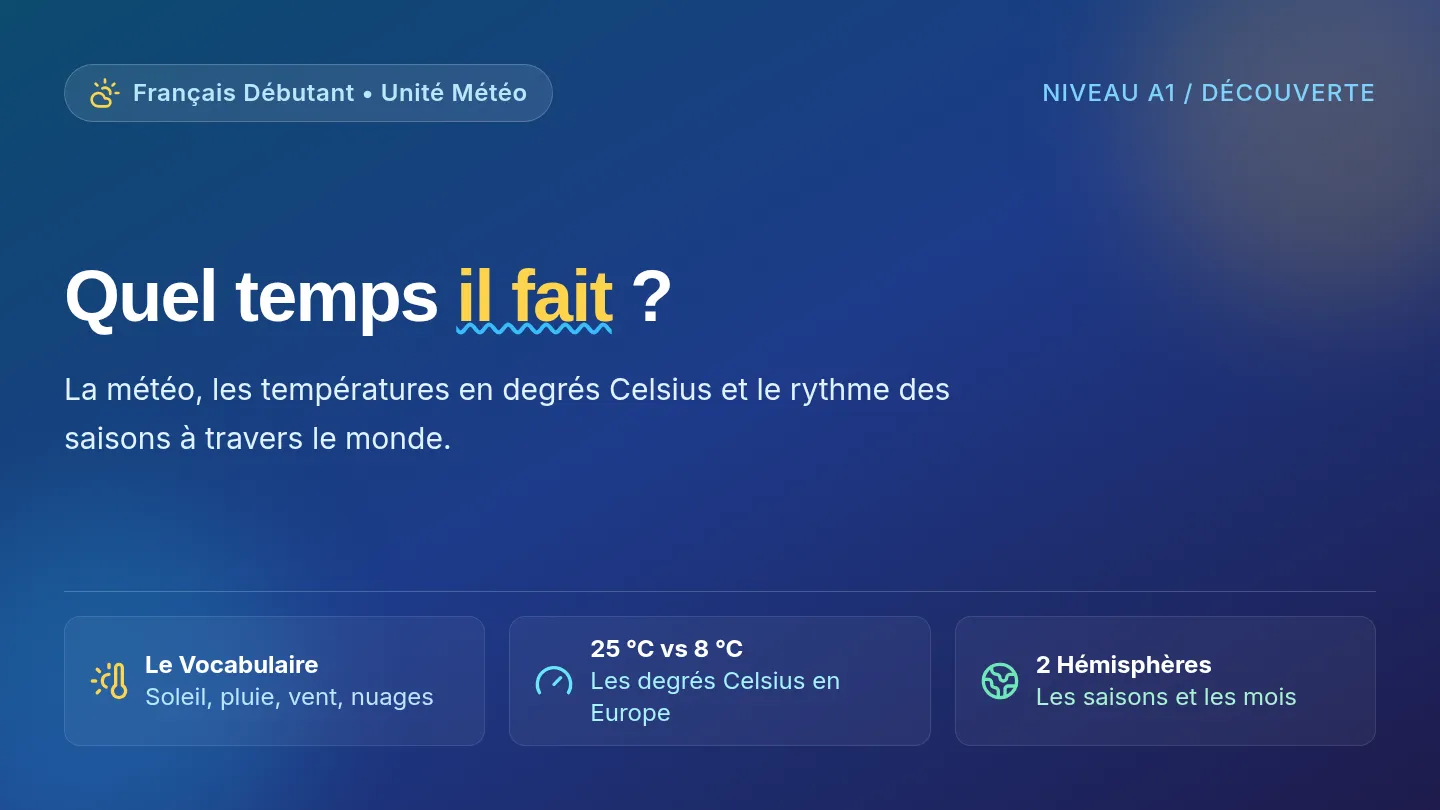
Global Weather Slides Global Weather Map
Climate, Geography, and the Francophone World
A Tale of Two Cities
Montréal
-12°C
"Il fait froid. Il neige."
Dakar
31°C
"Il fait chaud. Il y a du soleil."
What connects these two places?
Météo Essentielle
Le soleil
Sun
La pluie
Rain
Le vent
Wind
Les nuages
Clouds
Le froid
Cold
Le chaud
Heat
Où est-ce ? (Where is it?)
Nord
North
Sud
South
Est
East
Ouest
West
"C'est dans le nord de l'Afrique."
La Francophonie
L'Europe
France, Belgique, Suisse
L'Afrique
Sénégal, Côte d'Ivoire, RDC
L'Amérique
Québec, Haïti
L'Océanie
Vanuatu, Nouvelle-Calédonie
Votre Mission
Choose one city in the Francophone world. Use the weather patterns and location vocabulary to give a 30-second "Weather Briefing" to the class.
Mention the city and country.
Describe the temperature.
State the weather condition.
Global Weather Worksheet Global Weather Map
Lesson 2: Weather and Geography
Nom: _______________________
Date: _______________________
La Météo (Weather)
Conditions
Il fait beau - It is nice outIl fait mauvais - The weather is badIl y a du soleil - It is sunnyIl pleut - It is rainingIl y a des nuages - It is cloudyIl y a du vent - It is windy
Températures
Il fait chaud - It is hotIl fait froid - It is coldIl fait frais - It is coolLa température est de... degrés
Comparative Analysis
Compare the current weather reports for these two Francophone cities.
Bruxelles, Belgique
Europe
8°C
"Aujourd'hui à Bruxelles, il pleut. Il fait frais."
Abidjan, Côte d'Ivoire
Afrique
32°C
"À Abidjan, il fait très chaud. Il y a du soleil."
Synthesis: What are the main differences between these two climates?
Localisation
Use the compass points (Nord, Sud, Est, Ouest) to describe where these regions are relative to France.
1. Le Québec est au...
de la France. (West)
2. Le Sénégal est au...
de la France. (South)
3. La Suisse est à l'...
de la France. (East)
Projet: Bulletin Météo
Choose a city from the list below and write a short weather forecast (3-4 sentences).
Nouméa
Genève
Antananarivo
Fort-de-France
Luxembourg
Djibouti
Ma Ville Choisie:
Mon Bulletin Météo (French):
Academic Extension: How does regional geography influence the language used in these areas? Consider if "froid" in Paris means the same as "froid" in Quebec.
Opinion Engine Slides Opinion Engine
Expressing Preferences, Ideas, and Debate
Hot Take Generator
"Les chats sont meilleurs que les chiens."
(Cats are better than dogs.)
D'accord
I agree
Pas d'accord
I don't agree
Fueling the Engine
Preferences
"J'aime..."
(I like...)
"Je préfère..."
(I prefer...)
Thoughts
"Je pense que..."
(I think that...)
"À mon avis..."
(In my opinion...)
The Comparison Valve
Plus ... que
More ... than
Aussi ... que
As ... as
Moins ... que
Less ... than
"Paris est plus grand que Lyon."
Debate Engine: Cultural Artifacts
Let's look at two trends. Use your "Opinion Engine" to express your stance.
1. Le télétravail (Work from home)
2. Le café en capsules (Coffee pods)
3. Les livres numériques (E-books)
Useful Adjectives:
Bon / Mauvais
Pratique
Cher
Écologique
Intéressant
Important
Le Grand Débat
"Turn to a colleague. Discuss your preferences for travel. Do you prefer the train or the plane? Why?"
J'aime... parce que...
À mon avis, c'est...
Opinion Engine Activity Sheet Opinion Engine Debate Cards
Lesson 3: Preferences & Debate
Name: _______________________
Date: _______________________
Instructions: Use the structures below to discuss the topics on the cards. Try to use at least one comparison in every answer.
Opinions
À mon avis...
Je pense que...
Je crois que...
Comparisons
...plus [adj] que...
...moins [adj] que...
...aussi [adj] que...
Agreement
Je suis d'accord.
Je ne suis pas d'accord.
C'est vrai.
Le Café vs. Le Thé
Which is better for graduate students? Why?
Papier vs. Digital
Reading a physical book vs. an e-reader.
Ville vs. Campagne
Living in a big city vs. the countryside.
Cuisiner vs. Commander
Cooking at home vs. ordering takeout.
My "Hot Take"
Choose a controversial topic (e.g., Pineapple on pizza, Netflix vs. Cinema, working at night). Write 3 sentences in French expressing your opinion using comparisons.
Vocabulary focus: plus...que, moins...que, aussi...que, car/parce que, intéressant, pratique, cher, efficace.
Cultural Clue Quest Slides Cultural Clue Quest
Decoding Artifacts and Inferring Values
The Evidence
L'Affiche
(The Poster)
Le Dépliant
(The Brochure)
Le Billet
(The Ticket)
These are "primary sources" for contemporary culture.
The Investigator's Lens
Qui?
Who?
The target audience.
Quoi?
What?
The event or purpose.
Où?
Where?
The specific location.
Quand?
When?
The date and time.
Beyond the Facts
As graduate students, you analyze implicit meaning .
What does the design say about style?
What values are being promoted?
How does it differ from your home country?
"Culture is what remains when you've forgotten everything you were taught."
Case Study: Fête de la Musique
21 JUIN
"Faites de la musique !"
Observation:
Free concerts in every street of France.
Inference:
Public space is valued. Community participation is central to French cultural life.
Mission: Artifact Decoder
Your group will receive a mystery artifact from a French-speaking city. Use your worksheet to decode it and prepare a 2-minute "Cultural Profile."
Groups of 3
15 Minutes
Report Out
Artifact Analysis Worksheet Artifact Case File
Cultural Investigation Unit
Investigator(s): _______________________
Date: _______________________
Phase 1: Gist & Format
Type of Artifact:
Affiche (Poster)
Ticket (Ticket)
Brochure (Brochure)
Autre (Other)
Key Cognates Spotted:
Phase 2: Decoding the Details
Qui? (Who is it for?)
Quoi? (What is it about?)
Où? (Where is it?)
Quand? (When is it?)
Phase 3: Cultural Inference
As a graduate student, what deep observations can you make? Consider values, aesthetics, and social priorities.
1. Values: What does this artifact suggest is important to this culture? (e.g. leisure, art, punctuality, history)
2. Comparison: How would a similar artifact look or feel in your home country?
End of Report // Artifact #__________
Habit Seminar Slides Habit Seminar
Comparative Discourse: Routines and Values
The Catalyst
"La semaine de 35 heures en France est nécessaire pour une vie équilibrée."
(The 35-hour work week in France is necessary for a balanced life.)
D'accord?
Pas d'accord?
Protocoles du Séminaire
01
Listen to understand, not to respond.
02
Use the phrase bank provided.
03
Invite others into the conversation.
Grading Focus
• Strategic use of cognates
• Clarity of simple opinion structures
• Engagement with peers' ideas
L'Art de la Conversation
Adding On
"De plus..." (Furthermore)
Contrasting
"En revanche..." (On the other hand)
Agreement
"Je suis d'accord avec [Nom]..."
Inquiry
"Et toi, qu'est-ce que tu penses?"
The Round Table
Le Déjeuner
"The French lunch break is often 2 hours. Is this efficient or a waste of time?"
Le Travail
"In France, it is illegal to email employees after work hours. Should this be global?"
Final Thoughts
"How did your perception of 'work' change today by looking through the lens of another language?"
Habit Seminar Teacher Guide Habit Seminar Guide
Teacher Resource: Facilitation & Assessment
Level: Graduate / Basic Communication
Lesson Flow
10m
Preparation:
Students complete the Habit Comparison Organizer. They must have at least 3 statements ready to share.
5m
Hook & Norms:
Display the "35-hour week" statement. Review the phrase bank for discourse (agreement, addition, contrast).
25m
The Seminar:
Facilitate the open discussion. The teacher acts as a "silent referee," only intervening to balance participation or provide critical vocabulary.
10m
Debrief:
Reflection on the Essential Question: How did we discuss complex ideas with a 100-word vocabulary?
Questioning Framework
Opening Questions
• Qu'est-ce que vous pensez du déjeuner en France?
• Est-ce que les vacances sont importantes pour vous?
• Travail vs. Vie : Quel est l'équilibre idéal?
Deepening Questions
• Pourquoi est-ce différent aux États-Unis / [Pays]?
• Quel est l'impact sur la société?
• Est-ce "pratique" ou "culturel"?
Socratic Assessment Rubric
Criteria Developing (1) Proficient (2) Exceptional (3) Linguistic Strategy Relies heavily on English; few cognates used. Uses cognates effectively to bridge gaps. Seamlessly blends cognates and learned structures. Engagement Only speaks when prompted. Responds to others and offers own opinion. Facilitates others; uses discourse markers. Cultural Insight Literal understanding of habits. Identifies differences between cultures. Infers values behind cultural habits.
Habit Comparison Organizer Habit Comparison
Seminar Prep Sheet
Nom: _______________________
Date: _______________________
Contrastes Culturels
Prepare for the seminar by comparing habits in France with your home country. Use simple adjectives (pratique, traditionnel, important, long, court).
Habit / Catégorie
En France...
Dans mon pays...
La semaine de travail (Work week)
35 heures. C'est court.
Le déjeuner (Lunch break)
2 heures. Très important.
Les vacances (Vacation)
5 semaines minimum.
Les magasins le dimanche
Souvent fermés. Calme.
My Arguments
Draft 2-3 points you want to make during the seminar. Use the structures: "À mon avis..." , "Je pense que..." , and "Parce que..." .
Point 1 (Topic: _______________):
Point 2 (Topic: _______________):
Vocabulary Check
L'équilibre (Balance)
La routine (Routine)
Efficace (Efficient)
Différent (Different)
Le repos (Rest)
La société (Society)
Nécessaire (Necessary)
Ensemble (Together)