HACCP Food Safety Protocol Worksheet
Culinary Arts & Food Science Laboratory
HACCP Food Safety Protocol Analysis
45-Minute Practical
Student Name
Class / Kitchen Station
Date
Score / Evaluation
/ 50 pts
1 System Foundations & The 7 HACCP Principles
12 Points
1. Full Definition & Philosophy
What does the HACCP acronym stand for, and how does its preventative model differ fundamentally from traditional end-product food inspection?
2. Regulatory & Public Health Rationale
Explain two distinct operational liabilities or health consequences a commercial foodservice operation faces if it operates without an active HACCP plan:
3. Sequential Architecture: List the 7 Standard HACCP Principles in Order
Principle 1
Principle 2
Principle 3
Principle 4
Principle 5
Principle 6
Principle 7
2 Culinary Process Flow & Tri-Hazard Analysis
14 Points
Operational Case Study: The Bella Vista Bistro — Classic Chicken Alfredo
The brigade receives raw chicken breast fillets from a purveyor, trims them on wooden prep blocks, sautés individual portions to order in heavy stainless pans, prepares heavy cream sauce batches with parmesan in steam kettles, holds the sauce hot at the line steam table, tosses with pasta, and chills excess cooked chicken nightly in 6-inch deep pans in the walk-in cooler.
Process Flow Chart:
Step 1 Receiving & Cold Storage
Step 2 Trimming & Raw Prep
Step 3 Thermal Cooking (Sauté)
Step 4 Sauce Hot-Holding
Step 5 Rapid Chill & Storage
| Hazard Category | Specific Contaminant or Source in Alfredo Recipe | Affected Stage | Preventative Kitchen Control Measure |
|---|
| Biological | Identify target pathogen (e.g., Salmonella, Campylobacter): | | |
| | | |
|
|
| Chemical | Identify chemical/cleaner or allergen vector:
|
|
|
| Physical | Identify foreign material/equipment hazard:
|
|
|
HACCP Practical Protocol — Culinary & Hospitality Science Page 1 of 3
Critical Control Points (CCPs) & Science-Based Limits
Student: _______________________
3 CCP Decision Logic & Process Differentiation
10 Points
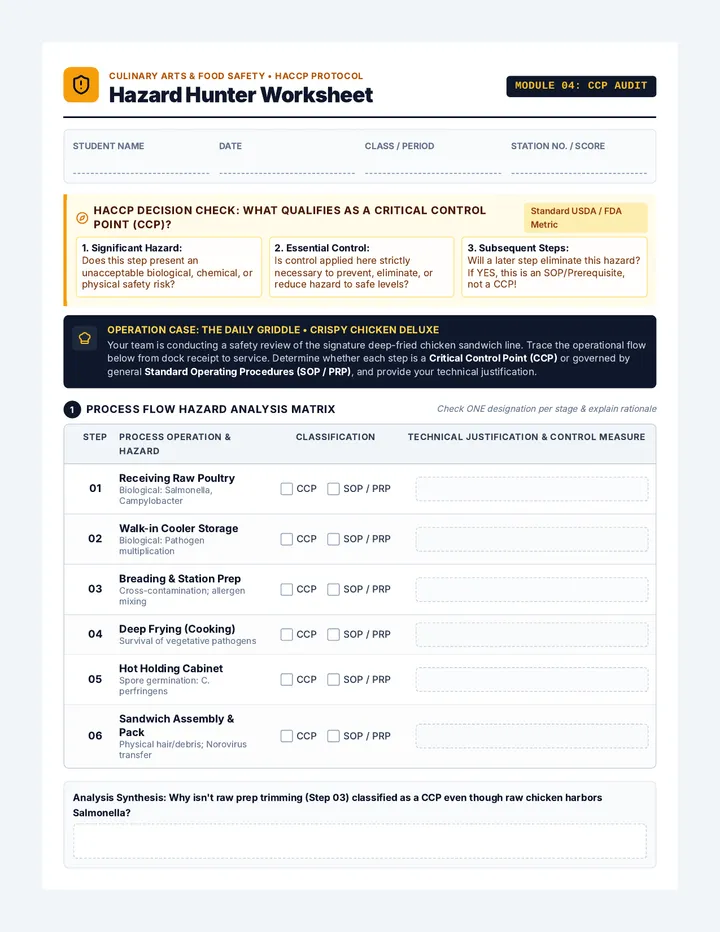
4. The Definitive Distinction: Control Point (CP) vs. Critical Control Point (CCP)
Define a Critical Control Point (CCP). How does a CCP differ from a standard sanitation Standard Operating Procedure (SSOP) or general Control Point (CP)?
5. Applying the USDA / FDA CCP Decision Tree to Chicken Alfredo
Evaluate the following two operational steps using standard CCP criteria (Yes / No logic):
Evaluation A: Step 2 Raw Chicken Trimming
Does this step eliminate or reduce pathogens to an acceptable level?
Is Step 2 a designated CCP or an SSOP prerequisite? Justify:
Evaluation B: Step 3 Thermal Cooking (Sautéing)
Will a subsequent step eliminate biological hazards if cooking fails?
Is Step 3 a designated CCP? State why:
4 Critical Limits & Real-Time Kitchen Deviation Simulation
12 Points
6. Setting Science-Based Critical Limits
For Step 3 (Thermal Sauté of Poultry), specify the exact parameters mandated by the FDA Food Code:
Minimum Internal Temp: ____ °F / ____ °C
Minimum Dwell / Hold Time: ____ seconds
Measurement Tool & Location:
7. Protocol Monitoring Design (4 Elements)
Establish the standard 4-element monitoring plan for the chicken cooking station:
WHAT:
HOW:
FREQUENCY:
WHO:
8. Critical Deviation Incident Simulation & Two-Tier Corrective Action
Incident Report: At 7:35 PM on Friday night service, line cook Marco removes a skillet of seared chicken breast meant for Table 14. Marco probes the thickest fillet with an instant-read probe thermometer. The core temperature reads 151°F (66°C). The expeditor is shouting for the dish.
A. Immediate Food Disposition Action
What exact physical action must Marco take with this pan of chicken right now?
B. Root-Cause Operational Correction
What systemic check (equipment, timing, prep thickness) must be executed before service continues?
HACCP Practical Protocol — Culinary & Hospitality Science Page 2 of 3
Verification, Recordkeeping & Master HACCP Architecture
Student: _______________________
5 Verification vs. Monitoring Analytical Breakdown
6 Points
9. The Core Difference
Culinary students often confuse Monitoring with Verification. Explain the functional difference between these two distinct HACCP principles:
10. Kitchen Verification Practices
List two specific verification activities a Head Chef or Health Inspector conducts that prove the HACCP system is actively functioning:
6 Independent Master HACCP Chart Construction
8 Points
Choose a complex culinary recipe or process (e.g., House-Made Hollandaise, Smoked Salmon, Beef Chili Chill & Reheat, or Sushi Rice Acidification). Construct a complete HACCP control row for one verified Critical Control Point:
Selected Recipe / Food Item:
Target Process Step (Must be a CCP):
| 1. Significant Hazard | 2. Critical Limit | 3. Monitoring Protocol | 4. Corrective Action | 5. Verification & Log |
|---|
| | | | |
| | | | |
|
|
|
|
7 Synthesis & Public Health Defense
8 Points
11. Critical Evaluation: Why Testing Alone Cannot Guarantee Food Safety
A restaurant owner asserts: "Instead of recording temperatures every day and keeping binders of HACCP logs, I will simply send 2 prepared meals each week to a private microbiology lab for testing." Relying on your understanding of HACCP, explain why this approach fails to protect the public from foodborne outbreaks:
Executive Chef / Instructor Final Verification:
Station Sanitized: [ ] HACCP Log Filed: [ ]
HACCP Practical Protocol — Culinary & Hospitality Science Page 3 of 3