Volleyball Sideline Student Packet
Physical Education Alternative Packet
Volleyball Sideline Analyst
Day 1 of 2 • 40 Pts
PE Injury Exemption Curriculum
Student Name
Date
Class Period
PE Instructor
Tournament Sideline Briefing: While you are physically recovering and exempt from on-court play, you will take on the role of Tactical & Cultural Sideline Analyst. Having participated in the skills training, you will evaluate how volleyball evolved, analyze its unique team dynamics, and scout competitive systems for our tournament.
1. Origins & Evolutionary Milestones
In 1895, at the YMCA in Holyoke, Massachusetts, Physical Director William G. Morgan invented a new indoor sport called "Mintonette." Designed as a less strenuous, non-contact alternative to basketball for older businessmen, it blended elements of tennis (the net), basketball (the ball), baseball (innings/rotations), and handball. A spectator soon observed that players were "volleying" the ball back and forth, prompting the permanent name change to Volleyball.
1916 • The Spike
In the Philippines, players pioneered the offensive passing "set" and jumping downward strike ("bomba").
1964 • Olympic Debut
Volleyball officially joined the Olympic Games in Tokyo, introducing specialized team defenses worldwide.
1998 • The Libero
FIVB introduced the libero—a back-row defensive specialist in a contrasting jersey to sustain longer rallies.
1999 • Rally Scoring
Shifted from side-out scoring (only serving team could score) to rally scoring (every rally awards a point).
2. Global Culture & Team Psychology
The Ultimate Synergy Sport
Unlike basketball or soccer, where an elite athlete can dominate by dribbling the full court alone, volleyball legally enforces collaboration: no player may hit the ball twice consecutively. The sacred "Pass-Set-Spike" rhythm demands complete mutual trust, active communication ("Mine!", "Help!"), and rapid collective emotional resilience between points.
Global Phenomenon & Beach Culture
Volleyball ranks among the top 3 participation sports globally with over 800 million players. In nations like Brazil, Italy, Poland, and Japan, professional leagues rival soccer in TV ratings. Simultaneously, the 1996 Olympic debut of Beach Volleyball in Atlanta cemented a distinct culture of two-player grit, sand conditioning, and celebratory camaraderie.
Next Step: Review the core reading above, then proceed to Page 2 to complete your Day 1 Written Portfolio.
Page 1 of 4
Student Turn-In Assignment
Day 1 Portfolio: History & Cultural Analysis
Total: 40 Points
Submit to Teacher at End of Day 1
Directions: Synthesize today's reading and your observations from our volleyball unit. Answer each prompt thoroughly in complete sentences. Your responses should reflect sophomore-level physical education critical thinking.
1 Rule Evolution & Game Dynamics (15 Points) Suggested: 4-6 sentences
In 1999, volleyball abandoned side-out scoring in favor of modern rally scoring. Explain how rally scoring fundamentally changed the pace, psychological pressure, and television broadcasting appeal of a high school or Olympic match.
2 Cultural & Tactical Comparison: Indoor vs. Beach (15 Points) Suggested: 4-6 sentences
Indoor volleyball features 6 specialized players per side, while Beach volleyball features only 2 all-around players. Contrast the communication demands, mental resilience, and physical adaptability required when competing in sand versus on a gym floor.
3 Unit Connection & The Psychology of Trust (10 Points) Suggested: 3-5 sentences
Reflect on the skills drills you completed prior to your injury (forearm passing, setting, attacking, serving). Which single contact requires the greatest amount of mutual trust between teammates, and why does one player's mistake immediately impact the entire team?
Student Signature: _______________________ Score: _____ / 40
Page 2 of 4
Technical Handbook & Officiating
Rules, Rotations & Tactical Systems
Day 2 of 2 • 60 Pts
Tournament Analyst Prep
Official Court Specs
- • Dimensions: 18m × 9m (59' × 29'6")
- • Attack Line: 3m (10') from net
- • Men's Net: 2.43m (7' 11⅝")
- • Women's Net: 2.24m (7' 4⅛")
- • Antennas: Boundary markers
Rotational Zones (Clockwise Flow)
Zone 4 (Front L)
Zone 3 (Front M)
Zone 2 (Front R)
Zone 5 (Back L)
Zone 6 (Back M)
Zone 1 (Server)
Teams rotate clockwise one spot when winning back serve from opponents (a "side-out").
Critical Rule Infractions to Officiate
1. Contact Faults (Lift & Double)
A lift/carry occurs when the ball visibly rests on a player's hands or arms. A double hit occurs when a player contacts the ball twice consecutively (legal only on initial team receive of a hard-driven ball).
2. Net & Centerline Infractions
Touching any part of the net mesh or antennas during live play is a fault. Crossing the centerline into opponent space is permitted only if part of the foot/hand remains on or directly above the line without interfering with an opponent.
3. Back-Row Attack Violation
A back-row player (Zones 1, 6, 5) cannot jump and complete an attack over the net if they take off on or in front of the 3-meter (10-ft) attack line while the ball is entirely above the height of the net.
4. Rotational Overlap Fault
At the exact moment the server strikes the ball, all players must be in their proper relative rotational positions (front-row players in front of their corresponding back-row partners; side-by-side players in proper lateral order).
Positional Specialization & Offensive Systems
Setter (S)
The court "quarterback" who delivers precise second balls to attackers.
Outside Hitter (OH)
Primary pin attacker in Zone 4; anchors serve receive and hits out-of-system balls.
Middle Blocker (MB)
First line of defense against opponent spikes; runs quick 1-tempo sets in Zone 3.
Libero (L)
Defensive ace in distinct jersey; unlimited back-row subs; cannot attack or serve-block.
Tactical Offensive Systems: In a 5-1 System, one dedicated setter plays all 6 rotations (running offense from both back and front row). In a 6-2 System, two setters alternate so the setter is always in the back row, allowing 3 active front-row attackers at all times.
Sideline Assignment: Apply these technical rules to solve the Referee Scenarios and Tournament Scout Report on Page 4.
Page 3 of 4
Student Turn-In Assignment
Day 2 Portfolio: Tournament Analyst Report
Total: 60 Points
Final Packet Turn-In
A Tournament Officiating Decisions (30 Points • 10 Pts Each) Analyze the ruling, infraction name & call
You are the head referee officiating our class tournament. Review each match incident below. Identify whether a fault occurred, name the exact rule infraction, and specify which team receives the point.
Incident 1: During a heated rally, Team A's Middle Blocker jumps to block. Their stomach accidentally brushes against the middle net mesh while the ball is still in active play on Team B's side. Team A yells that their touch "didn't affect the ball."
Official Ruling & Infraction Name:
Penalty / Point Awarded To:
Incident 2: Team B's Setter rotates to back-row Zone 1. During transition, they run up to the 2-meter mark (inside attack line), jump, and attack an overpassed ball over the net while the ball is completely above the top of the net.
Official Ruling & Infraction Name:
Penalty / Point Awarded To:
Incident 3: While receiving a float serve, Team A's passer mishandles the ball off their platform; the ball spins awkwardly, hits their chest, and bounces up for the setter. Team B claims an illegal "double contact."
Official Ruling (Legal or Fault?):
Rule Explanation & Next Action:
B Tournament Scout & Tactical Game Plan (30 Points) Strategic Match Coaching
Match Scouting Scenario: You are scouting our PE class tournament finals between Team Gold (your squad) and Team Blue. Team Blue features an aggressive, tall Middle Blocker who scores easily on quick sets, but their passer in Zone 5 consistently struggles to pass deep float serves.
Formulate a 2-part tactical game plan for Team Gold: (1) Serving Strategy: Where and how should Team Gold serve to neutralize Team Blue's middle attacker? (2) Defensive / Blocking Adjustment: How should Team Gold's front-row blockers position themselves at the net to counter Team Blue?
Day 1 Score: ___ / 40 Day 2 Score: ___ / 60 Total Unit Score: ___ / 100
Page 4 of 4 • Final Turn-In
Volleyball Sideline Teacher Key
Physical Education Teacher Resource
Volleyball Sideline Teacher Key
Evaluation Guide & Key
High School PE Alternative
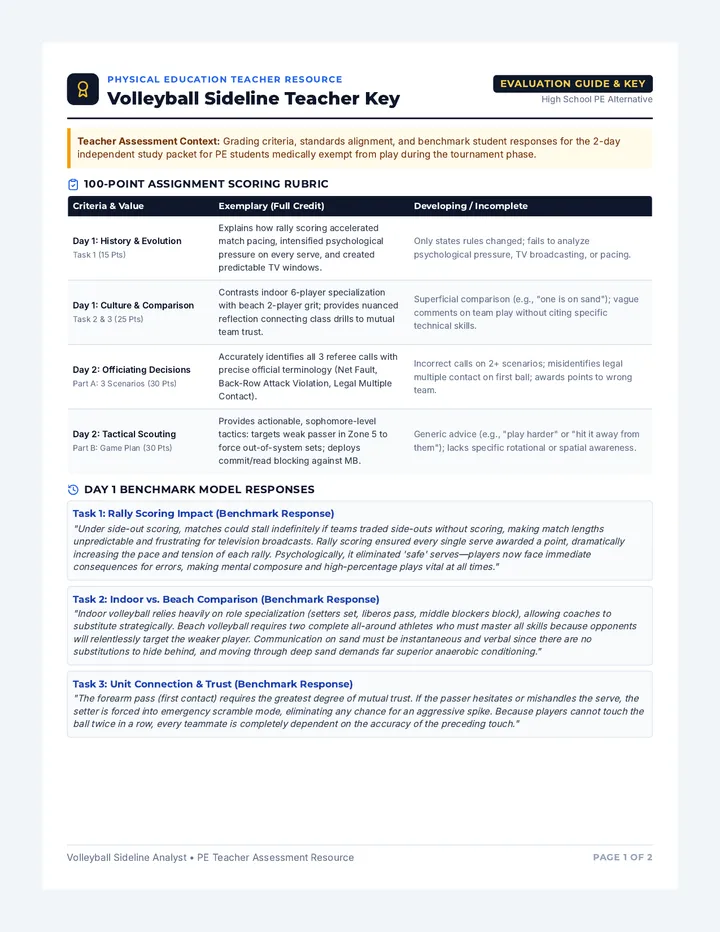
Teacher Assessment Context: Grading criteria, standards alignment, and benchmark student responses for the 2-day independent study packet for PE students medically exempt from play during the tournament phase.
100-Point Assignment Scoring Rubric
| Criteria & Value |
Exemplary (Full Credit) |
Developing / Incomplete |
| Day 1: History & Evolution |
|
|
| Task 1 (15 Pts) |
Explains how rally scoring accelerated match pacing, intensified psychological pressure on every serve, and created predictable TV windows. |
Only states rules changed; fails to analyze psychological pressure, TV broadcasting, or pacing. |
| Day 1: Culture & Comparison |
|
|
| Task 2 & 3 (25 Pts) |
Contrasts indoor 6-player specialization with beach 2-player grit; provides nuanced reflection connecting class drills to mutual team trust. |
Superficial comparison (e.g., "one is on sand"); vague comments on team play without citing specific technical skills. |
| Day 2: Officiating Decisions |
|
|
| Part A: 3 Scenarios (30 Pts) |
Accurately identifies all 3 referee calls with precise official terminology (Net Fault, Back-Row Attack Violation, Legal Multiple Contact). |
Incorrect calls on 2+ scenarios; misidentifies legal multiple contact on first ball; awards points to wrong team. |
| Day 2: Tactical Scouting |
|
|
| Part B: Game Plan (30 Pts) |
Provides actionable, sophomore-level tactics: targets weak passer in Zone 5 to force out-of-system sets; deploys commit/read blocking against MB. |
Generic advice (e.g., "play harder" or "hit it away from them"); lacks specific rotational or spatial awareness. |
Day 1 Benchmark Model Responses
Task 1: Rally Scoring Impact (Benchmark Response)
"Under side-out scoring, matches could stall indefinitely if teams traded side-outs without scoring, making match lengths unpredictable and frustrating for television broadcasts. Rally scoring ensured every single serve awarded a point, dramatically increasing the pace and tension of each rally. Psychologically, it eliminated 'safe' serves—players now face immediate consequences for errors, making mental composure and high-percentage plays vital at all times."
Task 2: Indoor vs. Beach Comparison (Benchmark Response)
"Indoor volleyball relies heavily on role specialization (setters set, liberos pass, middle blockers block), allowing coaches to substitute strategically. Beach volleyball requires two complete all-around athletes who must master all skills because opponents will relentlessly target the weaker player. Communication on sand must be instantaneous and verbal since there are no substitutions to hide behind, and moving through deep sand demands far superior anaerobic conditioning."
Task 3: Unit Connection & Trust (Benchmark Response)
"The forearm pass (first contact) requires the greatest degree of mutual trust. If the passer hesitates or mishandles the serve, the setter is forced into emergency scramble mode, eliminating any chance for an aggressive spike. Because players cannot touch the ball twice in a row, every teammate is completely dependent on the accuracy of the preceding touch."
Volleyball Sideline Analyst • PE Teacher Assessment Resource Page 1 of 2
Officiating Key & Match Strategy
Day 2 Solutions & Tactical Standards
60 Pts Value
FIVB & NFHS High School Rules
Part A: Officiating Decisions Key (10 Pts Each)
Incident 1: Blocker Contacting Net Mesh Net Fault (Violation)
Official Call: Fault on Team A (Net Violation). Under NFHS and FIVB rules, contacting any part of the net between antennas during live play is an illegal net violation, regardless of whether it altered the ball's trajectory.
Penalty & Signal: Whistle, indicate the net with an open hand, and point to Team B's court to award the point and serve.
Incident 2: Back-Row Setter Jump-Attack Illegal Back-Row Attack
Official Call: Fault on Team B (Back-Row Attack Violation). A player whose rotational position is back-row (Zone 1) cannot take off on or in front of the 3-meter attack line and contact the ball when it is completely above net height to complete an attack over the net.
Penalty & Signal: Whistle, raise one arm vertically and move the forearm downward in an overhand sweep, point to Team A for the point and serve.
Incident 3: Serve Receive Platform-to-Chest Contact Legal Play (No Fault)
Official Call: Legal play; play continues! On a team's first contact (receiving a serve or hard-driven spike), consecutive contacts by the same player are legal provided they occur during a single continuous effort and the ball is not caught or thrown.
Penalty & Signal: No whistle. Play continues; Team A still has two contacts remaining (set and spike).
Part B: Tactical Game Plan Benchmark (30 Pts)
Exemplary Tactical Plan Elements:
- 1. Serving Strategy (Targeting Zone 5): Team Gold servers should target aggressive, deep float serves directly into Zone 5 at Team Blue's struggling passer. By forcing poor or erratic passes off the net, Team Blue's setter will be forced into "out-of-system" high-arching sets, completely neutralizing their Middle Blocker's quick-tempo attack.
- 2. Defensive & Blocking Positioning: Team Gold's blockers should employ a "Commit Block" or "Read Block" focused on the Middle Blocker when Team Blue achieves a clean pass, but quickly release to double-team Team Blue's outside pins whenever the pass is pushed off the 10-foot line. Back-row defenders should shift deeper into Zone 6 and Zone 1 to dig tips and rolls.
National PE Standards Alignment (SHAPE America)
• Standard 2: Applies knowledge of concepts, principles, strategies and tactics related to movement and performance (tactical scouting, offensive systems, and officiating rules).
• Standard 4: Exhibits responsible personal and social behavior that respects self and others (evaluating sportsmanship, non-contact synergy, and peer support).
Volleyball Sideline Analyst • Answer Key & Assessment Benchmark Page 2 of 2