Steady Hands Workbook
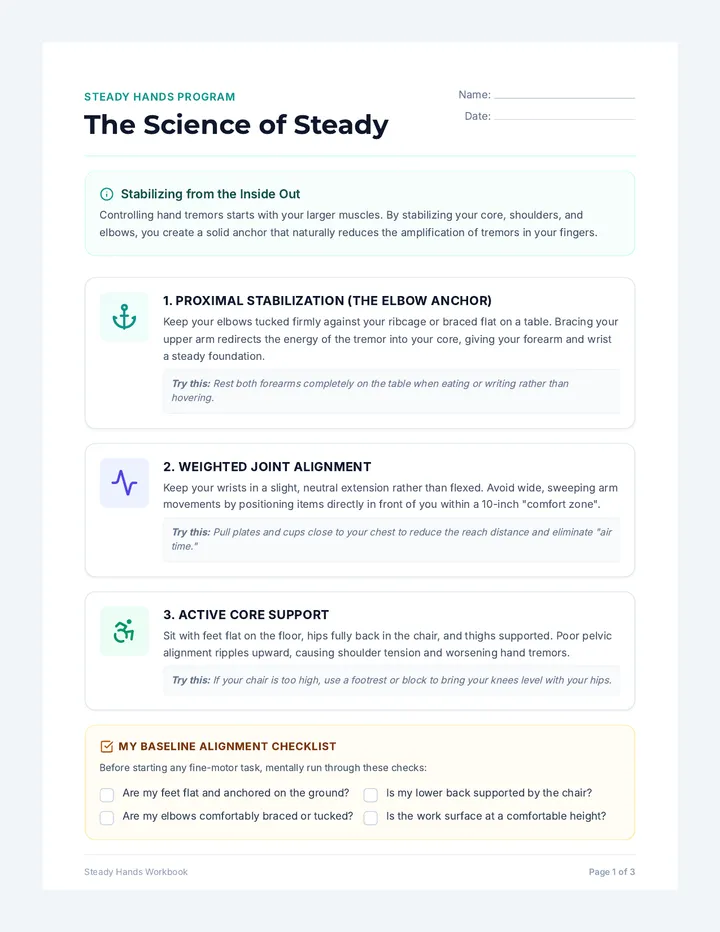
Steady Hands Program
The Science of Steady
Name:
Date:
Stabilizing from the Inside Out
Controlling hand tremors starts with your larger muscles. By stabilizing your core, shoulders, and elbows, you create a solid anchor that naturally reduces the amplification of tremors in your fingers.
1. Proximal Stabilization (The Elbow Anchor)
Keep your elbows tucked firmly against your ribcage or braced flat on a table. Bracing your upper arm redirects the energy of the tremor into your core, giving your forearm and wrist a steady foundation.
Try this: Rest both forearms completely on the table when eating or writing rather than hovering.
2. Weighted Joint Alignment
Keep your wrists in a slight, neutral extension rather than flexed. Avoid wide, sweeping arm movements by positioning items directly in front of you within a 10-inch "comfort zone".
Try this: Pull plates and cups close to your chest to reduce the reach distance and eliminate "air time."
3. Active Core Support
Sit with feet flat on the floor, hips fully back in the chair, and thighs supported. Poor pelvic alignment ripples upward, causing shoulder tension and worsening hand tremors.
Try this: If your chair is too high, use a footrest or block to bring your knees level with your hips.
My Baseline Alignment Checklist
Before starting any fine-motor task, mentally run through these checks:
Are my feet flat and anchored on the ground? Is my lower back supported by the chair? Are my elbows comfortably braced or tucked? Is the work surface at a comfortable height?
Steady Hands Workbook Page 1 of 3
Steady Hands Program
Steady Hands Daily Tracker
Name:
Date:
Pick one challenging task each day (e.g., eating soup, writing a signature, buttoning a shirt). Apply one of our biomechanical strategies (Elbow Anchor, Joint Alignment, or Active Core) and track how it impacts your control and comfort.
| Day | Daily Task & Goal | Stabilization Strategy Tried | Stability (1-5) | Quick Observations |
|---|
| Mon | | | | |
| Tue | | | | |
| Wed | | | | |
| Thu | | | | |
| Fri | | | | |
Rating Key (1-5):
1 = Severe Tremor / High Difficulty 3 = Moderate Tremor / Manageable 5 = Minimal Tremor / High Control
Weekly Observation Reflection
Which activities felt noticeably easier once your elbows or forearms were stabilized?
Steady Hands Workbook Page 2 of 3
Steady Hands Program
My Action Plan
Name:
Date:
My Stable Space Design
Draw or describe how you will set up your workspace (e.g., dining table, writing desk) to promote stabilization.
[ Draw or map forearm contact points, ] [ chair height, & object positions here ]
Height checklist: Is table height around elbow level?
My Independence Goal
What daily task matters most to me right now?
Which specific bracing strategy will I use?
Adaptive Prompts
Notes on how you can change things if you run into barriers (e.g. fatigue or heavier tremors on some days).
If I get fatigued while eating:
If my table surface is too low:
Ready for Stability
I will prioritize postural setup before doing tasks.
Client Signature
Therapist Signature
Steady Hands Workbook Page 3 of 3
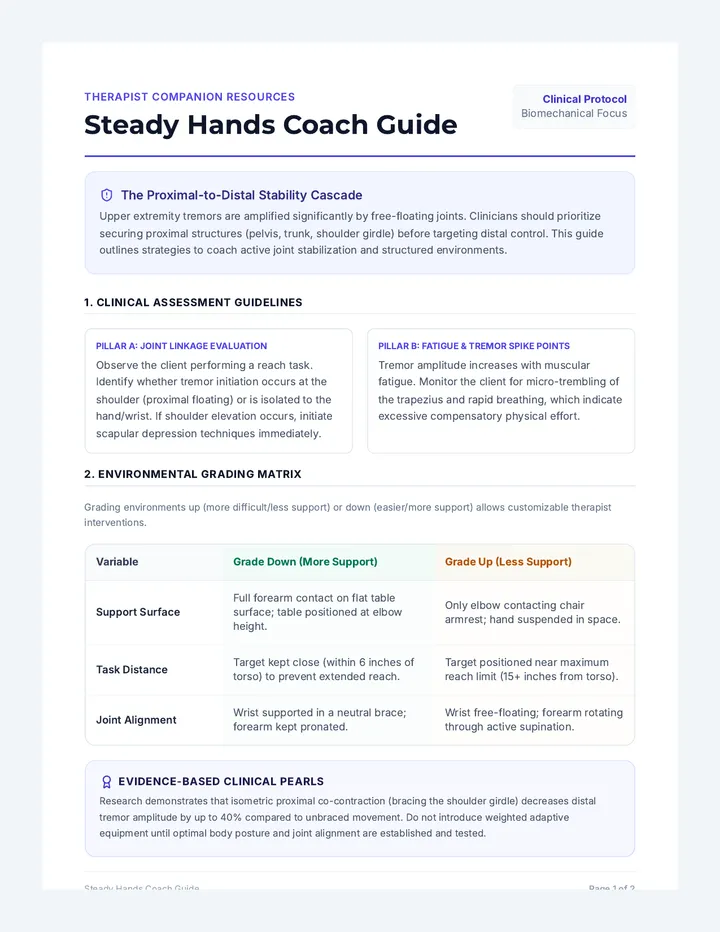
Steady Hands Coach Guide
Therapist Companion Resources
Steady Hands Coach Guide
Clinical Protocol
Biomechanical Focus
The Proximal-to-Distal Stability Cascade
Upper extremity tremors are amplified significantly by free-floating joints. Clinicians should prioritize securing proximal structures (pelvis, trunk, shoulder girdle) before targeting distal control. This guide outlines strategies to coach active joint stabilization and structured environments.
1. Clinical Assessment Guidelines
Pillar A: Joint Linkage Evaluation
Observe the client performing a reach task. Identify whether tremor initiation occurs at the shoulder (proximal floating) or is isolated to the hand/wrist. If shoulder elevation occurs, initiate scapular depression techniques immediately.
Pillar B: Fatigue & Tremor Spike Points
Tremor amplitude increases with muscular fatigue. Monitor the client for micro-trembling of the trapezius and rapid breathing, which indicate excessive compensatory physical effort.
2. Environmental Grading Matrix
Grading environments up (more difficult/less support) or down (easier/more support) allows customizable therapist interventions.
| Variable | Grade Down (More Support) | Grade Up (Less Support) |
|---|
| Support Surface | Full forearm contact on flat table surface; table positioned at elbow height. | Only elbow contacting chair armrest; hand suspended in space. |
| Task Distance | Target kept close (within 6 inches of torso) to prevent extended reach. | Target positioned near maximum reach limit (15+ inches from torso). |
| Joint Alignment | Wrist supported in a neutral brace; forearm kept pronated. | Wrist free-floating; forearm rotating through active supination. |
Evidence-Based Clinical Pearls
Research demonstrates that isometric proximal co-contraction (bracing the shoulder girdle) decreases distal tremor amplitude by up to 40% compared to unbraced movement. Do not introduce weighted adaptive equipment until optimal body posture and joint alignment are established and tested.
Steady Hands Coach Guide Page 1 of 2
Therapist Companion Resources
Observation & Coaching
Clinical Protocol
Facilitation & Cues
Use this checklist during active task simulations (e.g. handwriting, self-feeding) to evaluate biomechanical alignment. Focus on correcting the root postural patterns that elevate hand tremors.
Observation & Correction Protocol Check boxes as criteria are met