High Cost of Highs Lesson Plan High Cost of Highs
Lesson Plan: Grade 11 Substance Use & Prevention
45 Minutes
Why This Matters
By understanding how substances affect brain function, performance, and real-world consequences, students will be empowered to make informed decisions, confidently refuse offers, and develop proactive coping strategies to protect their future goals.
Approach
Interactive teach, calculate, role-play, plan, and reflect.
Objective
Students will explain brain impairment, estimate 3+ consequences, practice refusal strategies, and draft a 3-2-1 coping plan.
Prep & Materials
Teacher Preparation (10 mins)
Preview Your Brain At Work Evidence Slides
Review Texas Laws One-Pager (local context)
Print/Prep Cost Calculator & 3-2-1 Template
Prepare Pre/Post Survey and Rubric
Materials Checklist
Slide Deck & One-Pager
Consequences Cost Calculator
Scenario Role-Play Cards
3-2-1 Coping Plan Template
Pre/Post Survey & Exit Ticket
Instructional Sequence
5 min
Engage and Pre-Survey
Distribute 5-Item Likert Pre-Survey (anonymous). Pose prompt: "How do today's choices connect to your future goals?" Invite 2-3 quick shares to spark relevance.
10 min
Explore Brain & Policies
Present Your Brain At Work Evidence Slides . Focus on judgment and motor skill impairment. Debunk myths. Review key points from Texas Laws One-Pager .
15 min
Consequences & Refusal Role-Play
Calculation:
In pairs, use Cost Calculator to list 3 potential consequences (legal, financial, academic).
Refusal:
Small groups role-play Scenario Party/Workplace . Practice refusal strategies & provide peer feedback.
10 min
Plan Coping Strategies
Distribute 3-2-1 Coping Plan Template . Students draft 3 healthy alternatives, 2 triggers, and 1 support person. Pair-share plans for accountability.
5 min
Post-Survey and Exit Ticket
Administer Post-Survey. Students submit Exit Ticket identifying their most protective strategy takeaway.
Success Criteria
Students are successful when they achieve "Proficient" or "Exemplary" growth on the Likert survey, moving from uncertainty to confidence in their refusal skills and personal coping plans.
Your Brain At Work Evidence Slides Health & Wellness
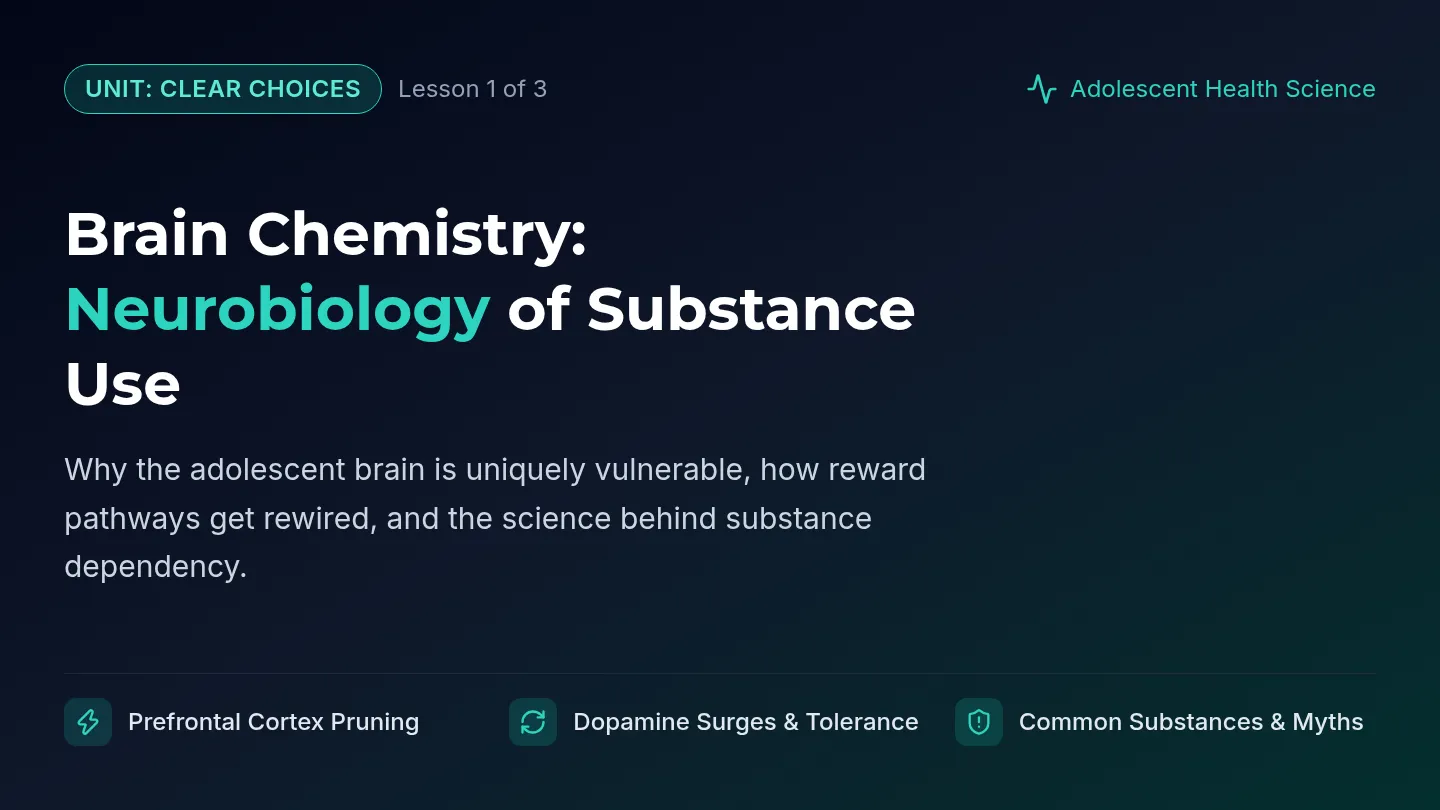
Your Brain at Work
Understanding Substance Impact on Performance
Lesson Objectives
Explore adolescent brain vulnerabilities
Examine impairment data (driving & sports)
Debunk common substance myths
Review key local laws and school policies
Teacher: Welcome students. Emphasize that today is about facts and performance.
Adolescent Brain Development
Synaptic Pruning
The brain streamlines connections, creating temporary "construction zone" vulnerabilities.
The Control Center
The Prefrontal Cortex (decision-making) matures last—not until your mid-20s.
Speed of Signals
Myelination (signal insulation) is still ongoing, affecting reaction time and impulse control.
Under
Teacher Note: Connect to impulse control.
How Substances Impair Performance
Cognitive Impairment
Reduced attention span
Slowed problem solving
Impaired memory recall
Motor Skill Disruption
Delayed reaction time
Poor physical coordination
Increased risk of accidents
20% SLOWER
Reaction times at .08% BAC
30% DROP
Free-throw accuracy (cannabis)
Myths vs. Facts
"I can sober up in 10 minutes with a strong coffee."
Only TIME eliminates alcohol. Caffeine doesn't speed metabolism.
"Smoking weed occasionally won't affect my grades."
Regular use is linked to lower GPA and reduced motivation.
Policy Highlights
Legal & Academic
Texas Laws
Possession under 21 leads to fines up to $500 , community service, and license suspension.
School Code
Disciplinary steps: suspension, mandatory counseling, or possible expulsion.
Extracurricular
UIL programs: Random testing. Positive tests result in removal from team/activity.
Refer to your One-Pager for specific details on Zero Tolerance.
Protect Your Performance
Teen brains are highly sensitive to substance use due to rapid development.
Texas Laws And School Policy One-Pager Texas Laws & School Policy
Essential Reference Guide for Grade 11 Students
Legal Age & Definitions
Minor in Possession (MIP):
Any person under 21 who has alcohol in their system (BAC > 0.00%) or in their possession.
Controlled Substances:
Includes marijuana, prescription medications without a valid prescription, and other illicit drugs.
Criminal Penalties
Alcohol (MIP/MIC)
Class C Misdemeanor
Fines up to $500
8–40 hours community service
Possible juvenile probation
Driver's license suspension (90 days to 2 years)
Marijuana & Drugs
Varies by Weight/Type
<2 oz Marijuana: Class B Misdemeanor (up to 180 days jail, $2,000 fine)≥2 oz: Felony charges escalate significantly
Zero Tolerance
Any detectable alcohol or controlled substance in a minor's system triggers automatic license suspension.
Duration: 90 days to 2 years, based on prior offenses.
School Disciplinary
Suspension (1–5 days)
DAEP Referral (Alternative Education)
Possible Expulsion
Loss of extracurricular privileges
UIL Athletics & Extracurriculars
Random and reasonable-suspicion testing programs apply to all participants.
Positive Test Consequence: Removal from team/activity (2 weeks to one full season) and mandatory education course.
Support & Resources
National Helpline
SAMHSA: 1-800-662-HELP (4357)
State Resources
Texas HHS: hhs.texas.gov
Campus Support
School Counselors, Social Workers, Prevention Specialists
Community
Youth centers & peer support groups
High Cost of Highs • Texas Law & School Policy Fact Sheet
Consequences Cost Calculator Activity Consequences Cost Calculator
Measuring the Real-World Impact of Substance Use
Name:
Date:
Instructions
Choose one substance scenario: (e.g., alcohol at a party, cannabis at school event).Brainstorm: List at least three potential consequences (tickets, court fees, lost scholarship, suspension, counseling program costs, etc.).Estimate: Research or estimate an approximate dollar amount or non-monetary impact for each.Discuss: Which consequence surprised you most? How might these add up over time?
Selected Scenario:
# Consequence Type Description Estimated Cost / Impact Notes / Source 1 $ 2 $
| |
| 3 | | | $
| |
| 4 | Optional | | $
| |
Pair Share Discussion
Compare your estimates with another pair:
Where did your costs differ significantly?
Which consequence surprised you most?
Reflect on Personal Goals:
Identify which consequence could have the biggest short-term vs. long-term impact on your personal goals.
Teacher Tip: Circulate and prompt students to consider both direct costs (fines, fees, legal counsel) and indirect costs (lost wages, college scholarship eligibility, extracurricular eligibility, and damaged reputation).
Scenario Role Play Party And Workplace Activity Scenario Role-Play
Purpose: Practice context-specific refusal strategies and build confidence in saying no.
Group Instructions
Form Triads: Assign roles: Offerer, Refuser, Observer.
Read Scenarios: Choose Scenario A or B. Decide on a refusal strategy (direct, excuse, humor, alternative).
Role-Play (3 mins): Refuser practices strategy; Offerer is realistic; Observer takes notes.
Swap Roles: Ensure everyone practices being the Refuser.
Scenario A: House Party
Peer Pressure
Context
You arrive at a friend's house party. Music is loud, lights are low. One friend approaches you with a cup and says they snagged beer from their older sibling's fridge.
Offerer Script
"Hey, I grabbed some beer. You going to try one? It’s no big deal—everyone’s doing it."
Refusal Goal
Stay calm and firm without escalating. Use a style that suits you.
Scenario B: Workplace Offer
Professional Boundaries
Context
You're working a weekend shift at a local café with an older coworker. After a slow hour, they pull out a small flask and offer you a sip to "chill out."
Offerer Script
"Man, it’s been a long shift. Take a little sip—won’t hurt you. Your shift’s almost over anyway."
Refusal Goal
Maintain professionalism. Protect your job and reputation.
Debrief Questions
What worked well about the refusal? What could be stronger?
How did it feel to say no? Was it uncomfortable? Why?
Which alternative strategy might you try next time? Why?
How do local policies support your decision to refuse?
Observer Checklist
Strategy used? Firm & Clear? Eye Contact? Tone of Voice? Body Language?
Teacher Tip: Circulate and encourage observers to offer specific, actionable feedback: “You made great eye contact,” or “Next time, try stating your reason quickly and changing the subject.”
3-2-1 Coping Plan Template Activity 3-2-1 Coping Plan
Strategy for Handling Pressure and Protecting Your Future
Name:
Date:
1 Three Healthy Alternatives
List three activities or behaviors you can turn to instead of using substances. Be specific and realistic for your daily life.
2 Two Personal Triggers
Identify two situations, feelings, or people that make you more likely to consider using substances. Knowing your triggers helps you plan ahead.
Trigger #1
Trigger #2
3 One Go-To Support Person
Choose one person you trust and can contact when you feel tempted or overwhelmed.
Name
Relationship
Contact Method (text, call, in person, etc.)
Reflection: Using Your Plan
How will you remind yourself to use this plan when you're under pressure? (Examples: phone reminder, note on locker, share with a friend.)
Keep this plan somewhere visible. Protect your future goals.
5-Item Likert Pre/Post Survey Pre/Post Learning Survey
High Cost of Highs • Knowledge & Confidence Check
Anonymous Response
Instructions: Please indicate your level of agreement with each statement by circling the corresponding number. Complete the PRE-LESSON column before we begin and the POST-LESSON column at the end of class.
1 = Strongly Disagree 2 = Disagree 3 = Neutral 4 = Agree 5 = Strongly Agree
# Statement Pre Post 1 I feel confident explaining two ways substances impair the adolescent brain and my performance (e.g., driving, sports). 1 2 3 4 5
|
1 2 3 4 5
|
| 2 | I can identify at least three potential legal, financial, or academic consequences of underage substance use or possession. |
1 2 3 4 5
|
1 2 3 4 5
|
| 3 | I am comfortable using a refusal strategy to say no to substances in both party and workplace scenarios. |
1 2 3 4 5
|
1 2 3 4 5
|
| 4 | I have a clear personal plan (3 healthy alternatives, 2 triggers, 1 support person) to cope with pressure to use substances. |
1 2 3 4 5
|
1 2 3 4 5
|
| 5 | I intend to use the coping plan and refusal strategies I learned to protect my future goals. |
1 2 3 4 5
|
1 2 3 4 5
|
Educational Resource • High Cost of Highs • Knowledge Evaluation
Likert Growth Rubric And Success Criteria Guide Growth Rubric & Success Criteria
Teacher Resource: Interpreting Pre/Post Survey Shifts
Use this rubric to interpret individual and class‐wide shifts on the 5-Item Likert Pre/Post Survey . It defines performance levels based on the number of items with positive change and the total point increase across all five questions.
Performance Level Improvement Summary Typical Survey Profile Beginning
1 Point
|
0–1 items show any increase
Total point gain: 0–2
| Most responses remain “Neutral” or below. Few, if any, “Agree” selections. |
|
Developing
2 Points
|
2–3 items increased by at least one scale point
Total point gain: 3–5
| Several responses move to “Agree”. Some items still “Neutral” or lower. |
|
Proficient
3 Points
|
4 items increased by at least one scale point
Total point gain: 6–7
| Majority of responses at “Agree” or above. At least two “Strongly Agree” selections. |
|
Exemplary
4 Points
|
All 5 items increased by at least one scale point
Total point gain: ≥8
| All responses at “Agree” or “Strongly Agree”. At least three “Strongly Agree” selections. |
Lesson Success Criteria
Target Growth
Students achieve Proficient or Exemplary growth on average.
Class Goal
At least 80% of students improve on 4 or more survey items.
Reflection Point
Review data to identify specific areas (e.g., refusal strategies) needing reinforcement.
Next Steps
Plan targeted intervention for students at Beginning or Developing levels.
High Cost of Highs Teacher Resource
Exit Ticket My Protective Strategy Ticket Exit Ticket
My Protective Strategy
Name:
Date:
As you wrap up today, reflect on the lesson and identify the single most protective strategy you will use to safeguard your future goals.
1 My Most Protective Strategy:
2 Why I chose this strategy & how I'll use it:
Remember
"Your future self is counting on the choices you make today."