A high-energy culinary challenge where students use mystery Easter-themed ingredients to create unique dishes, focusing on creativity, flavor, and presentation.
A critical drug education and safety lesson designed for middle or high school students, focusing on the dangers of illicit fentanyl, how fake prescription pills are manufactured to look identical to real medicine, refusal strategies, and emergency safety protocols. This lesson uses an interactive read-aloud scenario to engage students in critical thinking and real-world decision-making.
An immersive gardening lesson introducing pruning principles. Students master key tools, safety protocols, and the mechanics of plant growth to make clean, professional, and healthy cuts.
A hands-on, engaging lesson on the science and art of pruning. Students learn the botanical reasons for pruning (apical dominance), the "3 Ds" of identifying what to cut, and proper pruning cuts to keep plants healthy.
A premium, cohesive collection of beautifully designed spiritual and religious reminders for daily, weekly, and seasonal practices, featuring high-contrast connected Arabic typography, elegant arches, and glowing celestial themes.
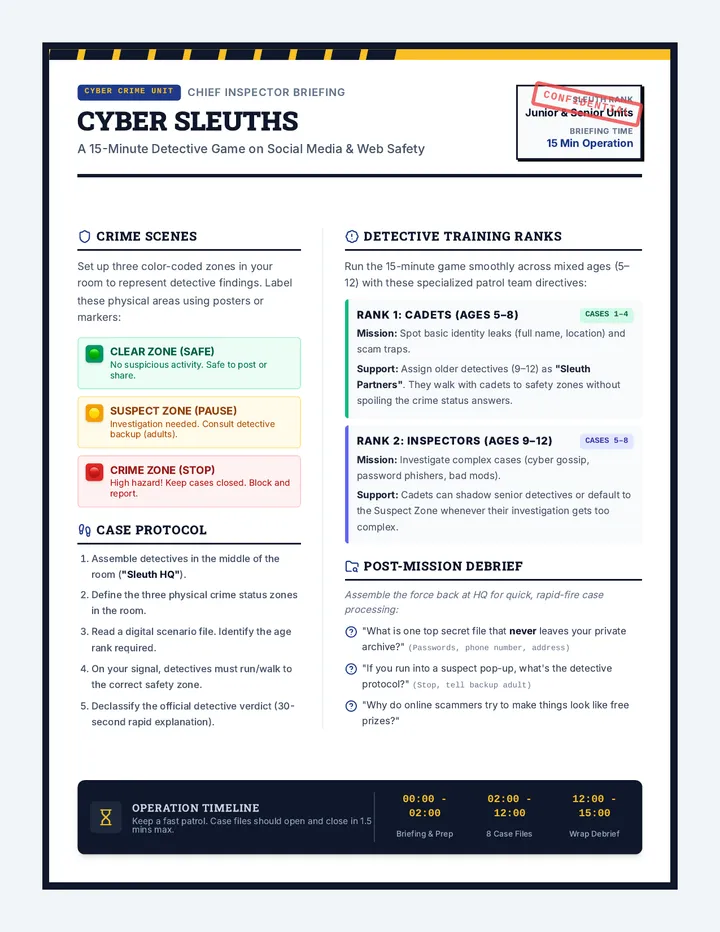
A digital design lesson focusing on social media brand personas, digital footprint, and visual design aesthetics using Adobe and Canva. Students compare contrasting brand voices, from Wendy's playful roasts to polished professional corporate presences.
A professional-grade graphic design lesson for Grades 11-12. Students explore the core mechanics of visual hierarchy, typography pairings, color psychology, and platform post formatting for social media feeds.
An advanced social media copywriting lesson for Grades 11-12. Students learn the science of scroll-stopping hooks, high-impact body copy, strategic calls-to-action (CTAs), and hashtag mechanics, concluding with a real-world caption-writing workbook activity.
Students synthesize their understanding of radioactive decay, fission, fusion, and nuclear energy. They analyze historical case studies and participate in a structured debate on global nuclear energy and policy futures.
A tense, role-play nuclear control room simulation. Students act as engineers, reactor operators, and safety officers trying to manage a surging core under crisis while learning about nuclear energy systems and safety protocols.
An active, station-based inquiry into fission, fusion, and mass-energy equivalence. Students rotate through tactile and analytical stations to untangle the powerful physics that bind and break atomic nuclei.
Students investigate alpha, beta, and gamma radioactive decay by building interactive paper models. They track nuclear equations and explore how unstable elements shed mass and energy to reach stability.
An introductory lesson on biotechnology, focusing on key tools like CRISPR, recombinant DNA, and gel electrophoresis. Students complete interactive guided notes and a formative assessment to demonstrate understanding of genetic engineering.
A self-paced study lesson designed for students catching up on Evolution and Classification. It chunk-packs Darwinian theory, speciation, lines of evolutionary evidence, Linnaean taxonomy, and cladograms into accessible, digestible visual summaries and active workbook exercises.
This lesson focuses on Academy Simulation Mission Logistics, including simulation roles (Caregiver, Observer, and Reader) and the simulation log for documenting observations across different stations.
An art and history integration lesson focusing on 18th-century Chinese nodding-head figures. Students explore clay science, learn pinch pot and coil techniques, and sculpt their own clay bobble heads using balanced counterweights.
A comprehensive review lesson where students synthesize paleoclimate concepts, isotope calculations, and feedback loops. Students participate in interactive review challenges and complete a structured synthesis worksheet to demonstrate mastery.
An engaging exploration of renewable and non-renewable natural resources, fossil fuels, and local conservation efforts through field-guide inspired readings, assessments, interactive sorting, and local mapping exercises.
An art and science lesson exploring how to transform ordinary, irregular river rocks into convincing 3D animal illusions. Students learn the principles of light, shadow, value, and form placement to turn flat or rounded stone surfaces into realistic sleeping animals.
An introductory lesson on kinetic art and mechanics where students build their own flapping butterfly automaton. Using simple classroom materials like paperclips, bottle caps, and paper, students learn about cranks, linkages, and the history of art in motion without needing hot glue.
An engaging, collaborative high school anatomy project where students research and design educational communication posters tracking the monthly physical and physiological milestones of human fetal development across gestation.
An introductory science lesson exploring ecological levels of organization, biotic versus abiotic factors, and population growth limits.
Master the illusion of deep space using one-point perspective, horizontal grid contraction, and overlapping spheres. Students create a striking optical illusion of a checkerboard tunnel with falling 3D apples using black markers and colored pencils.
A deep dive into the photorealistic and abstract grid style of Chuck Close. Students explore his life story, master his concentric organic shape grid technique, and discover how to build optical illusion portraits.