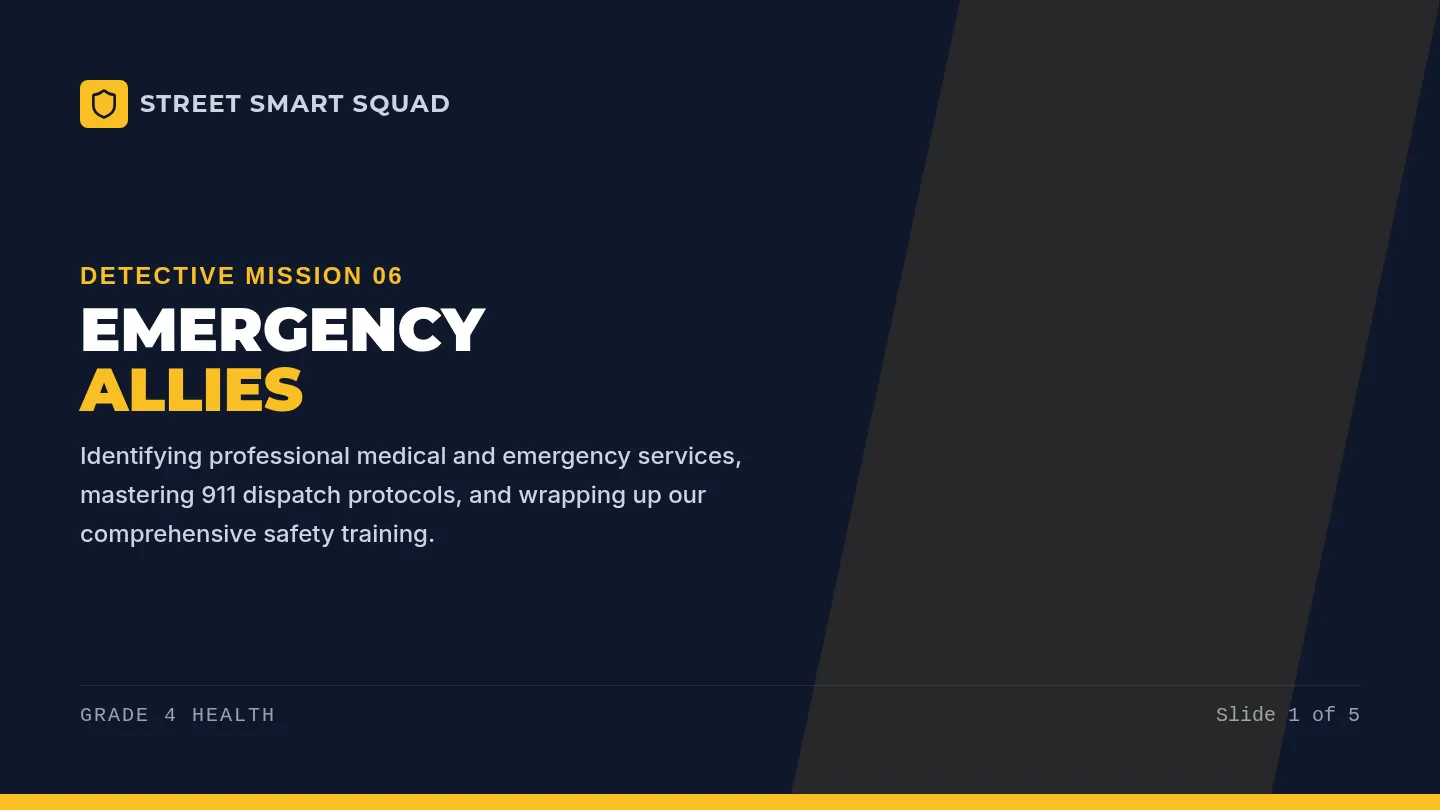
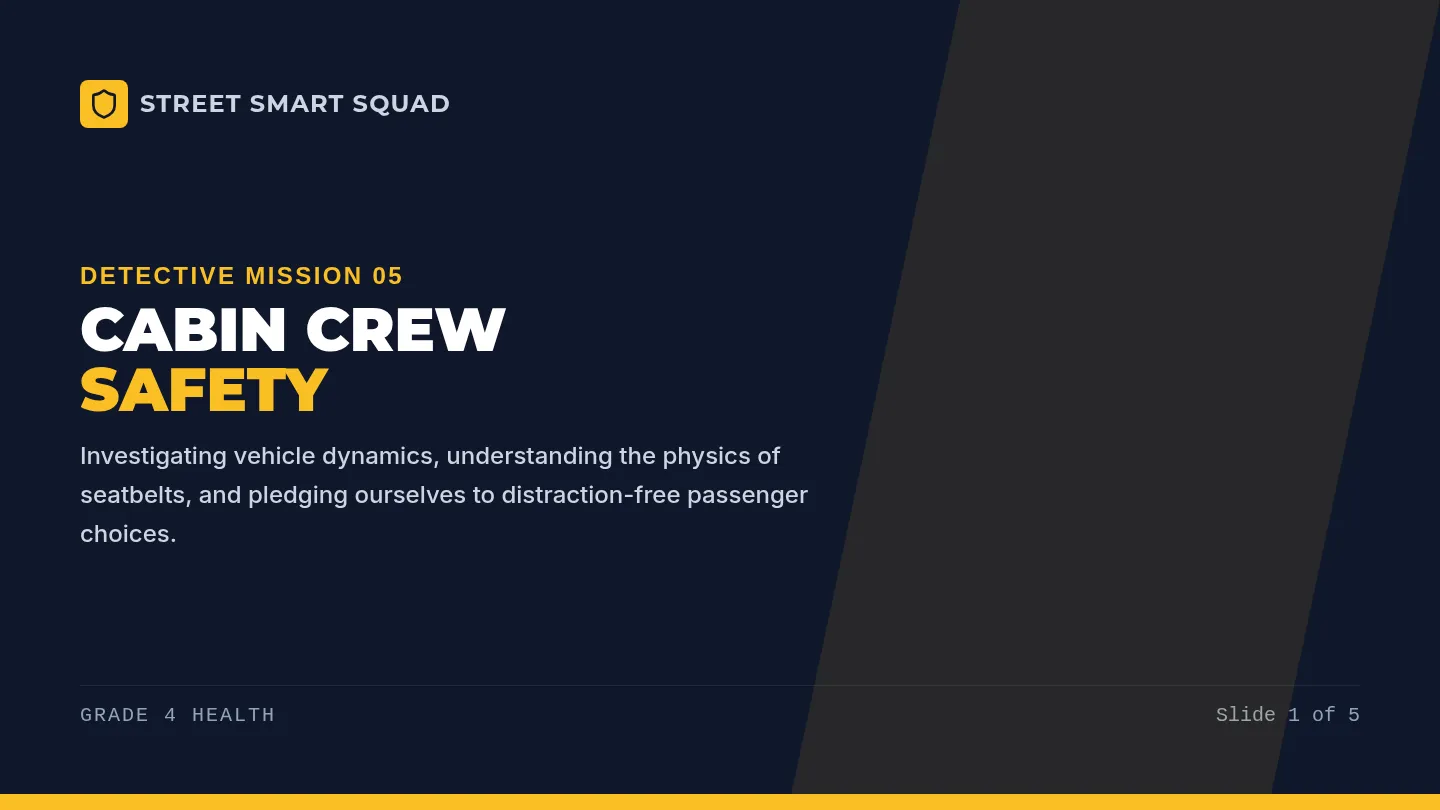
A comprehensive 6-lesson unit for 4th graders exploring personal, home, school, and community safety. Students learn to spot hazards, practice safe travel, and identify school and community helper resources through hands-on activities, interactive slides, and a cumulative booklet.
3. Why is running out into the road between parked cars extremely dangerous?
Explain from the perspective of an oncoming driver.
STREET SMART SQUAD / FORMATIVE ASSESSMENTS TICKET 3
Formative Check
Safety Check-In
Lesson 4: Wheel Warriors
STUDENT NAME:
DATE:
1. For a safe helmet fit, how high above your eyebrows should the helmet sit?
Think of the "EYES Check" rule.
A. Exactly 2 fingers width above your eyebrows. B. Tilted far back, resting on the top crown of the head. C. Drooping down over your eyes so it covers your forehead fully.
2. When riding a bicycle on a public street, which direction should you ride?
Defensive riding safety rules.
A. Against traffic flow (facing cars head-on so they see you). B. On whichever side has the smoothest pavement or sidewalks. C. With the traffic flow (traveling in the same direction as vehicles).
3. Write two concrete safety practices for riding wheeled toys (like scooters or skateboards) on sidewalks.
Consider pedestrians, driveways, or safety gear.
STREET SMART SQUAD / FORMATIVE ASSESSMENTS TICKET 4
Formative Check
Safety Check-In
Lesson 5: Cabin Crew Safety
STUDENT NAME:
DATE:
1. What physical force keeps your body moving forward when a car brakes suddenly?
Choose the science concept we studied.
A. Gravity (the force pulling you down) B. Inertia (the resistance of any physical object to any change in its velocity) C. Friction (the rub of wheels on tarmac)
2. Why is riding in the backseat of a car much safer for 4th graders?
Select the primary safety reason.
A. The back of the car has better air vents and speaker volume. B. Children are protected from powerful front-seat airbags, which are made for fully grown adult bodies. C. It keeps you far away from the driver's phone so you don't play games.
3. Write down two responsibilities of a safe passenger ("Cabin Crew" member).
How do your choices keep the driver safe and focused?
STREET SMART SQUAD / FORMATIVE ASSESSMENTS TICKET 5
Formative Check
Safety Check-In
Lesson 6: Emergency Allies
STUDENT NAME:
DATE:
1. In which of the following situations is it correct and safe to call 911?
Choose the active, high-priority emergency.
A. Your bicycle chain came off, and you cannot get it back on. B. A fire has broken out in a house kitchen, and smoke is filling the building. C. Your sibling refuses to eat their dinner or share the television remote.
2. What is the single most critical detail you must give to a 911 operator first?
Select the priority answer.
A. Your complete physical location/address so responders can navigate to you. B. Your full first and last name and spelling of your email. C. What school you go to and what grade you are currently in.
3. Write one sentence explaining why we do NOT make prank/fake calls to 911.
Think about resources and response times for real emergencies.
STREET SMART SQUAD / FORMATIVE ASSESSMENTS TICKET 6
[Show Slide 4: The Forrestdale SEL Team] "We are very lucky at Forrestdale School to have a dedicated Social/Emotional Learning Team—including our School Counselor and Social Worker. They specialize in helping you with big, heavy feelings or conflicts with friends. Remember, physical bumps go to the nurse, but emotional 'bumps' go to the counselor!"
[Transition to Handbook Page 2] "Open your handbook to Page 2. Write down your family helpers, and then let's map out our Forrestdale School allies together."
STREET SMART SQUAD / TEACHER GUIDE PAGE 2
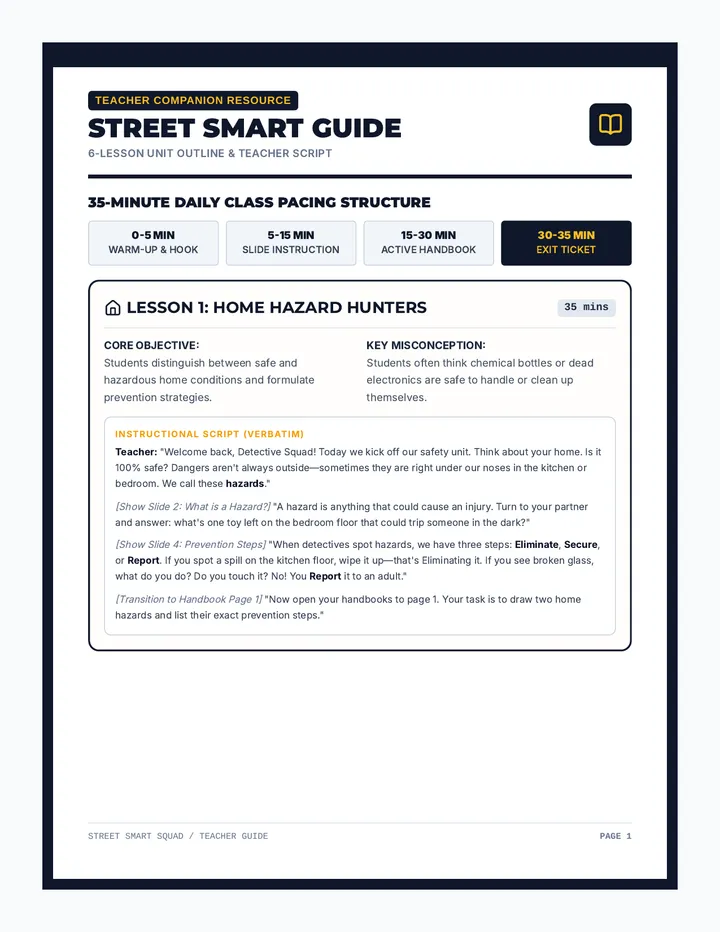
Teacher Companion Resource
Street Smart Guide
6-Lesson Unit Outline & Teacher Script
Lesson 3: Pedestrian Patrol
35 mins
Core Objective:
Students apply the '3 Crossing Keys' and read critical street signs to navigate traffic safely as walkers.
Key Misconception:
Students assume drivers can always see them simply because they can see the driver's vehicle lights or windshield.
Instructional Script (Verbatim)
Teacher: "Hey, walkers! Today we hit the streets. Being a pedestrian means walking near traffic, which requires high focus. We use our 3 Crossing Keys to stay safe: Stop, Look, and Listen."
[Show Slide 2: The 3 Crossing Keys] "Step 1: Stop at the curb, two big steps back on the sidewalk. Step 2: Look left, right, and left again. Why left twice? Because that's the lane closest to you! Step 3: Listen for quiet hybrid engines or backup sirens."
[Show Slide 4: Invisible Pedestrian] "Never assume a driver sees you. Make direct eye contact and wait for their wave. If it's dark, bright colors and reflective gear make you a superstar walker!"
[Transition to Scenario Cards & Handbook Page 3] "We're going to break into small groups and use our Safety Scenario Cards to debate real situations. After discussing, open your handbook to Page 3 and label the crosswalk blueprint zones!"
STREET SMART SQUAD / TEACHER GUIDE PAGE 3
Teacher Companion Resource
Street Smart Guide
6-Lesson Unit Outline & Teacher Script
Lesson 4: Wheel Warriors
35 mins
Core Objective:
Students explain the mechanics of helmet protective foam and check fit using the Eyes, Ears, Mouth test.
Key Misconception:
Students believe any helmet thrown over their head is safe, ignoring issues with straps, tilt, or extreme wobbling.
Instructional Script (Verbatim)
Teacher: "Get ready, wheel riders! Whether you ride a bike, scooter, or board, you are moving fast. If you hit an obstacle or slip, gravity works in milliseconds. That's why we wear our Brain Buckets—helmets!"
[Show Slide 2: The Brain Bucket] "Your brain is incredibly precious but soft. A safety-certified helmet has specialized protective foam that squishes and breaks to absorb the hit, instead of your skull. But a tilted helmet won't protect you at all."
[Show Slide 3: Eyes, Ears, Mouth Check] "We must perform our three inspection steps: Eyes Check—it should sit 2 fingers above your eyebrows. Ears Check—the side straps must form a flat 'V' under each lobe. Mouth Check—when you open wide, the helmet must hug your head snug."
[Transition to Handbook Page 4] "Let's open our handbooks to Page 4. Check off the helmet fit checklist and declare your official defensive riding sidewalk rules."
STREET SMART SQUAD / TEACHER GUIDE PAGE 4
Teacher Companion Resource
Street Smart Guide
6-Lesson Unit Outline & Teacher Script
Lesson 5: Cabin Crew Safety
35 mins
Core Objective:
Students explain seatbelt physics (inertia) and identify passenger behaviors that distract drivers and cause accidents.
Key Misconception:
Students think backseat passengers don't need seatbelts, or that sitting in the front passenger seat is safe before age 13.
Instructional Script (Verbatim)
Teacher: "Cabin Crew, buckle up! When we ride in a car, we are not just passengers—we are part of the team keeping everyone safe. Unsafe passenger habits are a massive cause of accidents."
[Show Slide 2: Physics of the Click] "Let's study the physics of safety. There is a scientific law called inertia. It means an object in motion wants to keep moving in that same direction. When the car stops suddenly, your body wants to fly forward at the exact same speed. The seatbelt is the safety shield that catches you instantly!"
[Show Slide 3: Backseat Shield] "Remember: students our age must sit in the backseat until age 13. Front seats contain airbags designed for large adults. For smaller bodies, airbags are too powerful. Also, our job is to avoid distracting the driver with screaming or throwing items."
[Transition to Handbook Page 5] "Open your handbook to Page 5. Complete the science alignment lab and draft your official Cabin Crew Pledge contract to sign with your parent."
STREET SMART SQUAD / TEACHER GUIDE PAGE 5
Teacher Companion Resource
Street Smart Guide
6-Lesson Unit Outline & Teacher Script
Lesson 6: Emergency Allies
35 mins
Teacher: "Our final detective task: identifying emergency helpers. When an emergency happens, community allies are ready. But we must know how to contact them safely."
[Show Slide 2: Emergency or Not?] "Active emergencies threaten life or property and require 911 immediately. Minor scrapes or disputes are non-emergencies—tell a trusted parent or teacher instead. If you call 911, the most critical piece of info is your complete street address so paramedics can find you."
[Transition to Handbook Page 6] "Open your handbook to Page 6. Connect your allies and write down your official dispatch script response!"
Grading Rubric: Handbook & Exit Tickets
Criteria
Target (3 pts)
Developing (1-2 pts)
Dilemma Spotting
Accurately draws & identifies home, street, and wheeled hazards.
Identifies vague issues; drawing lacks details.
Safety Physics
Accurately describes inertia, seatbelt mechanics, and airbag risks.
Confuses physical concepts or seatbelt position rules.
Dispatch Call
Details a complete home address and clear, calm scenario description.
Omits address or location; description is incoherent.
STREET SMART SQUAD / TEACHER GUIDE PAGE 6
Section 3: Mental & Emotional Health Slide 4 of 5
Case Work Mission
Handbook Duty
Your Mission
Open your Street Smart Handbook to Page 2.
Fill out your family trusted adults, and then write down the names of your Forrestdale School Safety Allies (Teacher, Principal, SEL Counselor, and Nurse!).
Allies Map
Get your pencil and write down your network of safety helpers!
Active Learning Workshop Slide 5 of 5
Backseat Pandemonium
Your cousin is driving you and your younger sibling to the park. Your sibling unbuckles their seatbelt, stands up in the backseat, and starts throwing crayons at the cousin to get attention.
Investigator Questions:
How could these actions lead to an accident?
What is your duty as a member of the "Cabin Crew"?
What should the driver do immediately?
Card 6 • Home Safety
The Sparkling Cord
You plug in your computer charger, and you hear a loud "SNAP" sound. A blue spark flies out of the wall outlet, and you smell something slightly burnt, like singed plastic.
Investigator Questions:
What danger does a sparking socket present?
Should you pull the plug out yourself? Why or why not?
What is the first step you should take?
Card 7 • Community
The Park Incident
You are playing tag at the community park after school. Your friend trips on a rock, falls, and cries out in pain. Their ankle is swelling quickly, and they cannot stand or walk. No parents are at the playground.
Investigator Questions:
Is this an emergency or a non-emergency? Why?
How can you find a trusted adult in this setting?
What details must you provide if you call for help?
Card 8 • School Rules
The Hallway Stampede
Your class is walking to the library. A small group of students starts running, shoving, and sliding down the hallway banisters. You see a kindergarten student carrying books get knocked down.
Investigator Questions:
What safety rule is being violated here?
How does hallway running put others in danger?
What should you do to help the knocked-down student?
STREET SMART SQUAD / RESOURCE CARD DECK PAGE 2
Complete your "Crosswalk Blueprint" challenge! Review the intersection diagram, find the safest zones, and label your signs.
Crosswalk Challenge
Analyze the intersection and draft your blueprint!
Active Learning Workshop Slide 5 of 5
Active Learning Workshop Slide 5 of 5
Reminding others to sit safely in the back.
Section 3: Distraction Management Slide 4 of 5
Case Work Mission
Handbook Duty
Your Mission
Open your Street Smart Handbook to Page 5.
Complete the seatbelt alignment fill-ins and craft your own "Cabin Crew Pledge." Get your driver or parent to co-sign when you get home!
Passenger Pledge
Fill out your contract and agree to ride safe!
Active Learning Workshop Slide 5 of 5
Complete your "Emergency Allies Matchmaking" activity and practice writing out your exact home address and safety details for the dispatch script!
Graduate Detective
Complete the final case file and receive your graduation badge!