Kickball Tactical Study Guide
PE Tactical Playbook Series
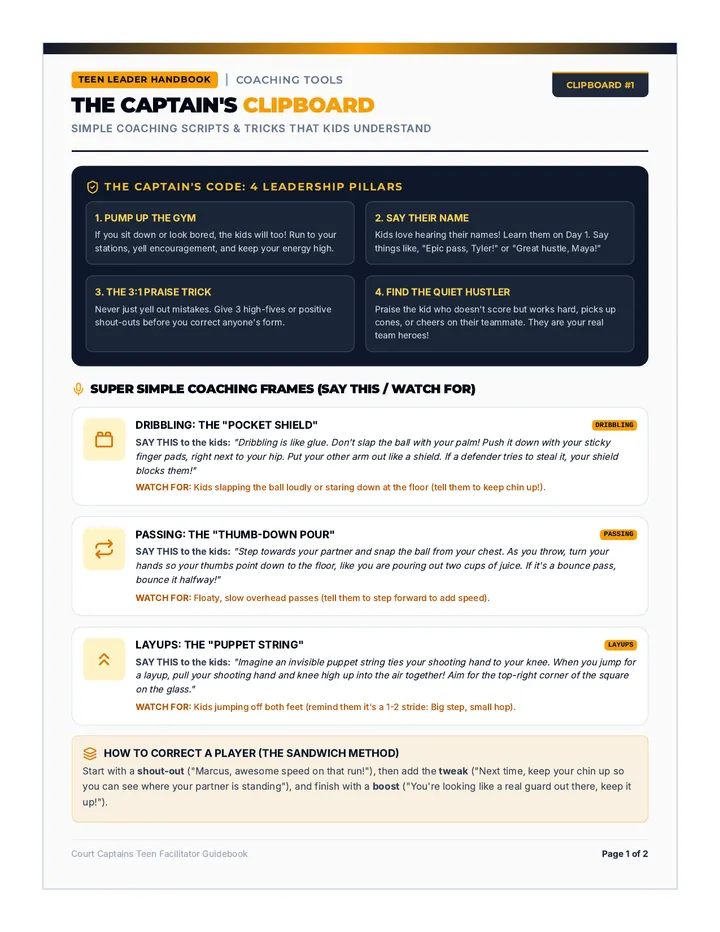
KICKBALL STUDY GUIDE
Grades 9-12 High-Contrast Informational Study Packet
UNIT: KICKBALL Review Guide
This comprehensive study guide is designed to accompany your Kickball Knowledge Review Worksheet. It provides the historical context, exact technical rules, field layouts, tactical plays, and defensive strategies required to master the sport and complete your review materials.
1. Historical Context & Original Purpose
Creation by Nicholas C. Seuss (1917): Originally called "Kick Baseball," kickball was designed in Cincinnati, Ohio, as a structured physical education tool to teach school children the fundamental rules, structures, and tactical layout of baseball and softball without requiring expensive, specialized, or potentially hazardous gear like heavy bats and hard leather baseballs.
Rapid Integration into School Systems: Kickball became an overnight staple of American school systems due to its extreme adaptability. It accommodates large physical education classes of all skill levels, can be played on grass, dirt, or asphalt surfaces, requires minimal funding (just a red utility rubber ball and basic floor markers), and guarantees maximum cardiovascular engagement.
2. Field Layout, Standard Distances & Objectives
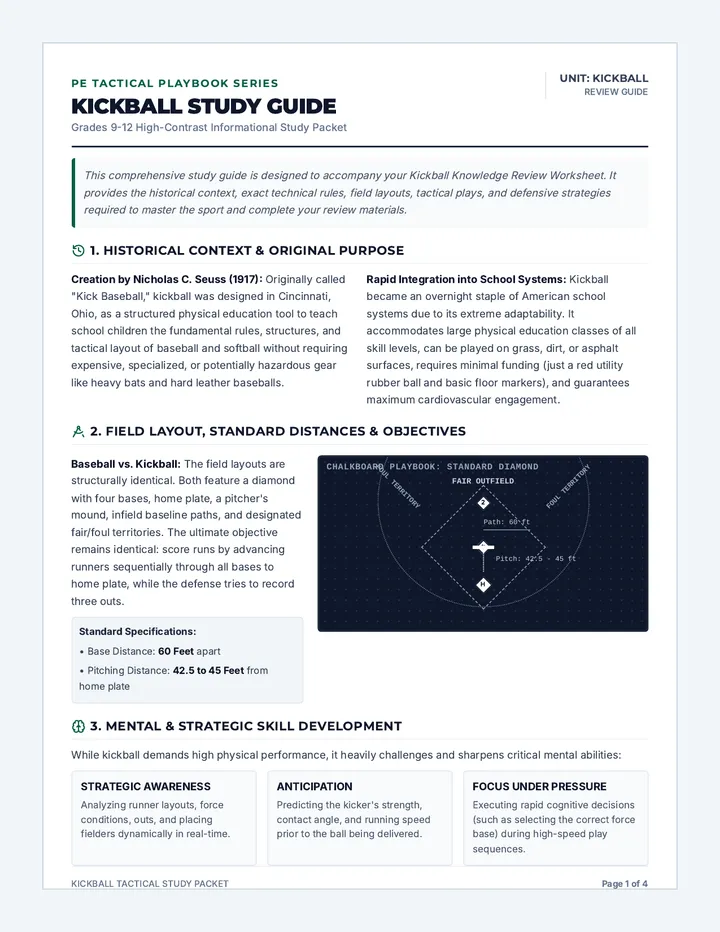
Baseball vs. Kickball: The field layouts are structurally identical. Both feature a diamond with four bases, home plate, a pitcher's mound, infield baseline paths, and designated fair/foul territories. The ultimate objective remains identical: score runs by advancing runners sequentially through all bases to home plate, while the defense tries to record three outs.
Standard Specifications: • Base Distance: 60 Feet apart • Pitching Distance: 42.5 to 45 Feet from home plate
Chalkboard Playbook: Standard Diamond
H
1
2
3
Path: 60 ft
Pitch: 42.5 - 45 ft
FOUL TERRITORY FOUL TERRITORY FAIR OUTFIELD
3. Mental & Strategic Skill Development
While kickball demands high physical performance, it heavily challenges and sharpens critical mental abilities:
Strategic Awareness Analyzing runner layouts, force conditions, outs, and placing fielders dynamically in real-time.
Anticipation Predicting the kicker's strength, contact angle, and running speed prior to the ball being delivered.
Focus Under Pressure Executing rapid cognitive decisions (such as selecting the correct force base) during high-speed play sequences.
KICKBALL TACTICAL STUDY PACKET Page 1 of 4
PE Tactical Playbook Series
GAME FLOW & DEFENSIVE MECHANICS
Player Positions, Scoring Rules, and Force Out Physics
UNIT: KICKBALL Review Guide
4. The Pitcher's Operational Playbook
The pitcher holds the most dynamic position on the defense, divided into distinct operational phases:
Phase A: Pre-Kick Execution
- Deliver an underhand roll toward home plate.
- Ensure the pitch remains smooth with minimal or no high vertical bouncing.
- Present a fair, completely kickable opportunity to the kicker.
Phase B: Post-Kick Defense
- Serve as an active infielder to field short bunts.
- Back up throws to first base and home plate to prevent errors.
- Secure the ball at the pitcher's rubber to call time and halt runner progress.
5. Scoring Requirements & Half-Inning Transitions
Scoring a Run Step-by-Step:
To score a legal run, the offensive player must kick the ball into fair territory, and complete a continuous counter-clockwise loop by touching First Base, Second Base, Third Base, and Home Plate in precise sequential order without being declared "out" during the sequence.
Immediate Transition Event:
The moment the defensive team records exactly three outs, play halts. Teams execute an immediate, rapid switch: the defense takes the plate to kick (offense), and the offense grabs their gloves to field (defense), concluding that half-inning.
6. Force Outs vs. Tag Outs
| Category | Force Out | Tag Out |
|---|
| Definition | Runner must advance because behind them is occupied. | Runner advances at their own risk (no force). |
| Execution | Fielder touches base with ball in possession. | Fielder physically tags runner with ball in hand. |
| Applicable | Kicker running to 1st base; forced base runners. | Stealing or running during non-force scenarios. |
Tactical Diagram: Base Force Event
2B
1B
O (Runner)
◀
X (Fielder)
BALL IN GLOVE
* FORCE: Fielder X touches 2B bag. Tag unnecessary!
KICKBALL TACTICAL STUDY PACKET Page 2 of 4
PE Tactical Playbook Series
TACTICAL SHIFTS & OFFENSIVE PLACEMENT
Directional Kicking, Defensive Positioning, and Specialized Game Rules
UNIT: KICKBALL Review Guide
7. Advanced Offensive Strategies & Kicking Accuracy
Elite kickers don't just kick with power; they place the ball based on defensive weaknesses:
1. Strategic Placement Options: • Tactical Bunting: Gentle contact down the 1st or 3rd base lines. Forces deep defense to race forward, creating easy safe paths for fast runners. • Deep Corner Placements: Directing kicks to vacant gaps in the deep outfield, completely bypassing the infield.
2. Mechanics of Directional Accuracy: Kickers control the direction of the ball by adjusting their plant foot position and contact timing. To pull the ball (to the left), plant slightly behind and execute an early contact. To push the ball (to the right), allow the ball to travel deeper into the strike zone before swinging.
Directional Contact Angles (Right-Kicker)
BALL
PULL LEFT
PUSH RIGHT
↖
↗
FOOT DIRECTION DECIDES THE OUTCOME
8. Defensive Shifting & Strategic Positioning
Defensive Positioning Adjustment:
• Against Power Kickers: All fielders execute a deep backward retreat; outfielders back up to the field borders.
• Against Bunters: Third baseman and first baseman creep inward (shallow) to jump on short rolling balls.
Why Defense Teamwork Beats Individual Skill:
A single star athlete cannot cover a 60-foot diamond alone. A defense wins through systematic verbal communication (calling out base plays and pop-flies), providing defensive backing behind throws, and relaying long throws cleanly from the deep outfield.
9. Critical Rule Variations & Safety
The Infield Fly Rule (The Drop Rule): With less than two outs and runners on first and second (or bases loaded), a high infield pop-fly causes the kicker to be automatically called out. This prevents fielders from intentionally letting the ball drop to trigger an easy force double play.
Runner Decision Considerations (To Advance): Before deciding to advance to the next base, base runners must rapidly assess key parameters: ball location, outfielder throwing arm strength, current number of outs, and their own running speed.
KICKBALL TACTICAL STUDY PACKET Page 3 of 4
PE Tactical Playbook Series
VOCABULARY MASTERY REFERENCE MATRIX
Complete Definitions and Letter Counts matching the Vocabulary Matrix Worksheet
UNIT: KICKBALL Glossary Key
Use these exact terms, definitions, and spelling structures to solve your Vocabulary Mastery Matrix Worksheet (Page 4). All terms are structured to match the block lengths on the worksheet.
Roles & Actions (Items 1 - 4)
1. PITCHER (7 Letters): The critical defensive player situated in the center of the field responsible for executing underhand deliveries of the ball.
2. KICKER (6 Letters): The active offensive player positioned at home plate preparing to boot the rolled ball into play.
3. RUNNING (7 Letters): The rapid physical movement executed by players to travel safely from base to base.
4. KICK (4 Letters): The direct strike or impact action executed by the foot upon contact with the utility ball.
Field & Gear (Items 5 - 8)
5. DIAMOND (7 Letters): The structural geometric pattern created by the paths connecting 1B, 2B, 3B, and Home Plate.
6. FIRST (5 Letters): The initial landing base point that must be reached safely by a kicker after putting a ball in play.
7. BALL (4 Letters): The standardized 10-inch red, high-bounce utility rubber object utilized to play the game.
8. INNING (6 Letters): The primary unit of gameplay during which both teams receive one turn at defense and offense.
Score & Territory (Items 9 - 12)
9. RUN (3 Letters): A single score achieved when an offensive player touches all four bases in consecutive order.
10. SCORE (5 Letters): The primary goal or metric used to compile running points earned by a playing team.
11. THREE (5 Letters): The exact standard amount of defensive outs that must be executed to conclude a half-inning.
12. FOUL (4 Letters): The status of a kicked ball coming to rest outside the line markers of the playing field.
Defense & Comm (Items 13 - 16)
13. TAG (3 Letters): To touch an active base runner off-base with the ball held in hand to record a direct out.
14. CATCH (5 Letters): To secure a kicked ball directly in the air before it makes physical contact with the ground.
15. FORCE (5 Letters): An out recorded at a base when a runner is physically forced to advance.
16. TACTICS (7 Letters) / TALKING (7 Letters): The strategic planning and intense team communication required on defense. Use either to complete matrix #16.
PLAYBOOK MENTAL CODE: "COMMUNICATE EARLY • BACK UP BASE THROWS • CONTROL THE MOUND"
KICKBALL TACTICAL STUDY PACKET Page 4 of 4