Primary Colors Slides ¡Hola Colores!
Primary Colors Discovery
¿Agua Mágica?
Let's look at our magic jars! What happens when we shake them?
Rojo
Azul
Amarillo
ROJO
🍎
Manzana
🍓
Fresa
❤️
Corazón
Repeat after me: "¡Rojo!"
AZUL
🌊
Mar
🫐
Arándano
🦋
Mariposa
Repeat after me: "¡Azul!"
AMARILLO
☀️
Sol
🍌
Plátano
🐥
Pollito
Repeat after me: "¡Amarillo!"
Veo, Veo...
I see something ROJO in our room!
Can you point to it?
Rojo
Azul
Amarillo
Primary Colors Teacher Guide Guía del Maestro
Primary Colors Discovery
Lesson 1 of 5
Colores Primarios
Learning Objectives
Identify and name primary colors in Spanish: rojo, azul, and amarillo.
Associate Spanish color words with common objects.
Participate in color-based sorting and creative activities.
Materials
• 3 Clear jars with lids
• Red, blue, yellow paint
• Finger paint / Brushes
• Color Sorting Worksheet
• Classroom items for sorting
The Hook: Magic Water Jars
Prep 3 jars with a drop of paint hidden under the lid. Fill with clear water.
1
Show the jars: Ask "What color is this water?" (Expect: Clear/Transparent).
2
The Magic Shake: Say "¡Es magia!" and shake the first jar. As it turns red, announce: "¡Es ROJO!"
3
Repeat: Continue for AZUL and AMARILLO. Have students chant the names.
Instructional Flow
I. Direct Instruction (Slide Presentation)
Use the slides to introduce vocabulary. Emphasize the vowel sounds in Spanish (rojo, azul, amarillo). Use the "Veo, Veo" (I Spy) slide to practice spotting colors in the room.
II. Guided Practice: Color Sorting
Set up three "color stations" around the room labeled with large color cards. Give students random toys (blocks, cars, plastic fruit). Ask them to take their item to the correct station while saying the color name aloud.
III. Creative Exploration: Finger Painting
Provide students with the "Primary Color Sorting" worksheet. Instead of just coloring, have them use finger paints to fill the boxes, reinforcing the physical connection between the paint and the Spanish word.
Support (Scaffolding)
Use hand gestures for each color. For "Azul," pretend to swim. For "Amarillo," point to the sun. For "Rojo," point to the heart.
Challenge (Extension)
Introduce "claro" (light) and "oscuro" (dark) if students are quickly identifying the primary colors.
Primary Colors Sorting Mat Nombre:
Mis Colores
Primary Colors Sorting Mat
Paint, color, or glue items in the correct boxes!
¡Pinta, colorea o pega objetos en los cuadros correctos!
ROJO
🍎
AZUL
🦋
AMARILLO
☀️
Secondary Colors Slides ¡Más Colores!
Secondary Colors Exploration
🦎
El Camaleón Mágico
Look at our chameleon friend! He loves to change colors.
When he changes, shout the Spanish word!
🦎
Verde
🦎
Naranja
🦎
Morado
=
VERDE
🌳
Árbol
🐸
Rana
🍃
Hoja
=
NARANJA
🍊
Naranja
🥕
Zanahoria
🐯
Tigre
=
MORADO
🍇
Uvas
🍆
Berenjena
🎆
Fuegos
¡Mezclamos los colores!
VERDE
NARANJA
MORADO
Secondary Colors Teacher Guide Guía del Maestro
Secondary Colors Exploration
Lesson 2 of 5
Colores Secundarios
Learning Objectives
Identify and name secondary colors in Spanish: verde, naranja, and morado.
Understand the concept of color mixing (Primary + Primary = Secondary).
Review primary colors while building new vocabulary.
Materials
• Playdough (Primary colors)
• "Chameleon" cutout/toy
• Secondary Colors Slides
• Mixing Activity Sheet
• Baggies for storage
The Hook: El Camaleón Mágico
Tell a short story about a chameleon who is bored of being just one color.
"Our friend the chameleon wanted to be special. He saw a leaf and turned... VERDE! He saw a carrot and turned... NARANJA! He saw some grapes and turned... MORADO!"
Invite students to act out the chameleon, changing their "pose" every time the color changes.
Instructional Flow
I. The Mystery of Mixing
Show the slides detailing how primary colors mix to make secondary colors. Use clear containers of water with food coloring to demonstrate live if possible.
Pro-tip: Let students predict the outcome before mixing.
II. Hands-On: Playdough Mixing
Give each student two small balls of primary color playdough. Have them squish and knead them together while chanting the new color name. "Rojo y azul... ¡Morado!" "Azul y amarillo... ¡Verde!"
III. Application: Classroom Labeling
Hand out sticky notes or small cards with the words Verde, Naranja, and Morado. Challenge students to find one item in the room for each label.
Support
Provide color-coded labels (e.g., the word "Verde" written in green ink) to help students associate the written word with the color visual.
Extension
Ask students to name objects at home that are secondary colors. "My blanket is morado!"
Color Mixing Activity Sheet Nombre:
¡Mezcla Mágica!
Color Mixing Lab
Mix your colors and see what happens!
¡Mezcla tus colores y mira qué pasa!
Azul
Amarillo
=
VERDE
Rojo
Amarillo
=
NARANJA
Rojo
Azul
=
MORADO
🦎
Color like a chameleon! / ¡Colorea como un camaleón!
Basic Shapes Slides ¡Formas Divertidas!
Basic Shapes Identification
🕵️♂️
Detective de Formas
Grab your magnifying glass! There are shapes hidden all over the room.
Can you help me find them?
¡Misión: Formas!
CÍRCULO
🟡 🍕 ⚽ 🎡
"Gira y gira como un círculo..."
CUADRADO
🟦 🎁 🖼️ 🥪
"Cuatro lados iguales tiene mi cuadrado..."
TRIÁNGULO
🔼 🍕 ⛺ ⛵
"Tres puntas tiene mi triángulo..."
¡Vamos a dibujar en el aire!
Círculo
Cuadrado
Triángulo
Basic Shapes Teacher Guide Guía del Maestro
Basic Shapes Identification
Lesson 3 of 5
Formas Básicas
Learning Objectives
Identify and name basic shapes in Spanish: círculo, cuadrado, and triángulo.
Describe simple properties (e.g., a circle is round, a square has 4 sides).
Locate shapes in the classroom environment.
Materials
• Magnifying glasses (toy)
• Shape blocks
• Masking tape for floor shapes
• Shape Hunt Checklist
• "Detective" badges/hats
The Hook: Shape Detective Mission
Gather students on the rug. Whisper: "I have a top-secret mission for my Shape Detectives today. Some shapes are hiding, and they only speak Spanish!"
"We need to find the círculo, the cuadrado, and the triángulo. Are you ready?"
Instructional Flow
I. Visual Introduction
Use the slides to introduce each shape. Have students repeat the name 3 times: whisper, normal, and shout! Show real-world items (a clock for círculo, a book for cuadrado, a slice of pizza for triángulo).
II. Air Tracing & Body Shapes
Practice tracing shapes in the air with big arm movements. Then, try to make shapes with your body! Can two friends hold hands to make a big círculo? Can they use their fingers to make a triángulo?
III. Guided Mission: The Hunt
Students use their magnifying glasses and the "Shape Hunt Checklist" to find items in the room. When they find one, they must say "¡Encontré un [forma]!" (I found a [shape]!).
Support
Tape large shapes on the floor for students to walk along the perimeter while saying the name. Physical movement helps memory!
Extension
Introduce "Rectángulo" or ask students to count the sides in Spanish (uno, dos, tres, cuatro).
Shape Hunt Checklist Misión: Detective de Formas
Shape Detective Mission
Agente:
🕵️♀️
Find 3 of each shape in our room!
¡Encuentra 3 de cada forma en nuestro salón!
Círculo
Cuadrado
Triángulo
Buen Trabajo
Shape Attribute Slides ¡Dos Palabras!
Describing Objects by Attribute
Color + Form
🍕
¡Pizza de Formas!
Who wants a Shape Pizza? I have special toppings today!
To order, you must name the shape and the color.
Círculo Rojo
Cuadrado Verde
Triángulo Morado
The Spanish Secret: Shape FIRST!
Círculo Azul
(Circle Blue)
➡️
Cuadrado Amarillo
(Square Yellow)
¿Qué es?
¡Cuadrado Verde!
¡Triángulo Naranja!
Shout it out in Spanish!
¡Súper Desafío!
Can you describe something on your desk?
Say: "Es un [forma] [color]."
Shape
Color
Shape Attribute Teacher Guide Guía del Maestro
Describing Objects by Attribute
Lesson 4 of 5
Combinando Palabras
Learning Objectives
Combine shape and color vocabulary into 2-word phrases.
Identify the correct Spanish word order (Noun + Adjective).
Create a creative project (Shape Pizza) and describe its components in Spanish.
Materials
• Pre-cut colored shapes (paper)
• Glue sticks
• Large paper plates (for pizza)
• Shape Pizza Activity Sheet
• Attribute Slides
The Hook: La Pizzería de Formas
Tell students you are opening a new restaurant where the pizzas are made of shapes!
"I need a chef to help me. Can someone bring me a Círculo Rojo for my pepperoni? How about a Cuadrado Amarillo for the cheese?"
Have students "fetch" the requested pre-cut shapes from a central pile.
Instructional Flow
I. The Noun-First Rule
Explain that in Spanish, the shape comes first, then the color. Use the slides to show the "Secret Order." Practice with physical blocks: pick up a blue block and say "Cuadrado azul."
II. Guided Creation: Shape Pizza
Give each student a paper plate or the Pizza Activity Sheet. Have them choose 5 shapes to "top" their pizza. As they glue each one, they must tell a teacher or a peer what it is in Spanish.
III. The Menu Presentation
In small groups, have students "present" their pizza menu. "Mi pizza tiene un círculo verde y un triángulo rojo." (My pizza has a green circle and a red triangle).
Support
Provide a "Cheat Sheet" or anchor chart with pictures of the shapes and colors labeled to help with recall during the project.
Extension
Challenge students to find objects that have multiple shapes or colors. "El libro es un cuadrado azul y rojo."
Shape Pizza Activity Sheet ¡Pizzería de Formas!
Chef: ___________________________
👨🍳
Glue your shapes here!
¡Pega tus formas aquí!
El Menú del Chef (The Chef's Menu)
Describe your pizza! Mark the color and shape for each topping.
Topping #1
Forma: _______________
Color: _______________
Topping #2
Forma: _______________
Color: _______________
Topping #3
Forma: _______________
Color: _______________
"Mi pizza tiene un [forma] [color]."
Rainbow Walk Slides ¡El Paseo del Arcoiris!
The Rainbow Walk
Reviewing Our Colors
🕶️🌈
Lentes Mágicos
Put on your special Rainbow Glasses!
They help us see the Spanish world more clearly.
¡Vámonos! (Let's Go!)
Todos los Colores
ROJO
NARANJA
AMARILLO
VERDE
AZUL
MORADO
Nuestra Misión
As we walk, find something for every color.
When you see it, whisper:
"Veo algo [color]..."
🌳🎒👟🌼🚗
¡Hacemos un Mural!
We will paint our Rainbow together!
¡Excelente trabajo!
Rainbow Walk Teacher Guide Guía del Maestro
The Rainbow Walk
Lesson 5 of 5
Paseo de Colores
Learning Objectives
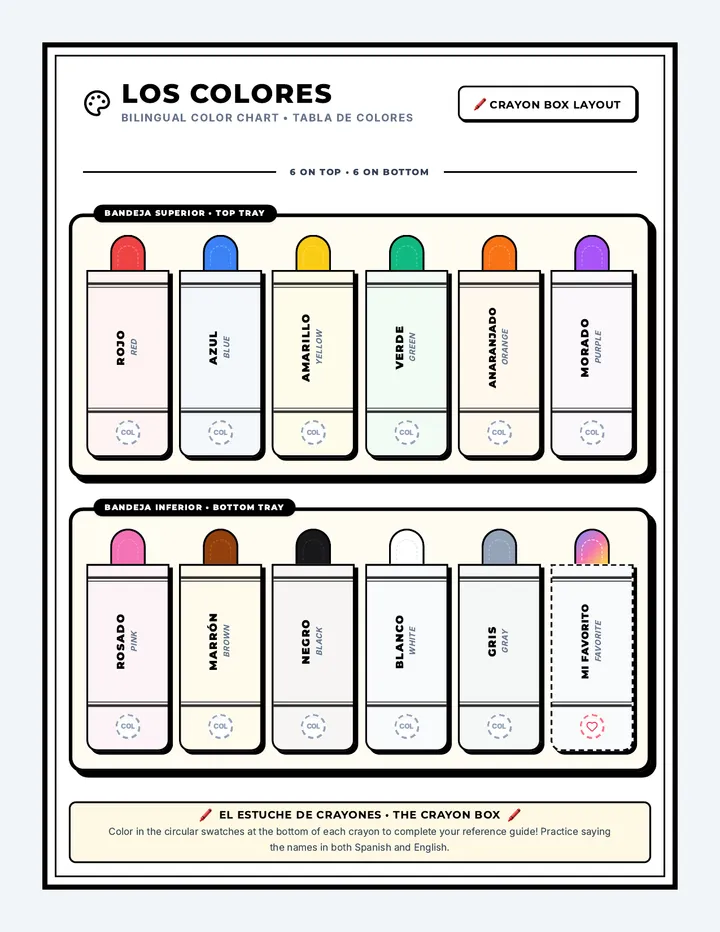
Review and consolidate all color vocabulary (rojo, azul, amarillo, verde, naranja, morado).
Apply vocabulary to real-world objects in the school/nature environment.
Work collaboratively on a visual project (Rainbow Mural).
Materials
• "Rainbow Glasses" (paper craft)
• Rainbow Scavenger Hunt
• Butcher paper (for mural)
• Paints/markers for all colors
• Clipboards
The Hook: Rainbow Glasses
Give students paper glasses frames decorated with rainbow colors.
"These aren't normal glasses. They are Spanish Rainbow Glasses! When you wear them, you can't see 'red', you only see ROJO. Are you ready to go find all the colors in our school?"
Instructional Flow
I. The Great Rainbow Walk
Lead students on a walk through the playground, garden, or hallways. Use the "Rainbow Scavenger Hunt" sheet. Every time a student finds a color, they stop and everyone chants: "¡Veo algo [color]!"
II. Collection & Observation
If outdoors, allow students to collect small natural items (fallen leaves, pebbles, flowers) that match the colors. Store them in color-coded bags or buckets.
III. Collaborative Mural
Back in the classroom, roll out a long sheet of butcher paper with large rainbow arcs drawn on it. Have students paint, glue their found items, or draw objects they saw during the walk in the correct color band.
Sequence Wrap-Up
Finish the sequence by having students walk by the finished mural. Point to each color/shape and have the class name them one last time. Hand out small "Certificado de Colores" to celebrate their hard work!
Rainbow Scavenger Hunt ¡Mi Paseo del Arcoiris!
My Rainbow Walk Scavenger Hunt
Nombre:
Can you find all 6 colors? Draw what you see!
¿Puedes encontrar los 6 colores? ¡Dibuja lo que ves!
ROJO
🍎
NARANJA
🍊
AMARILLO
☀️
VERDE
🍃
AZUL
🦋
MORADO
🍇
I can see the rainbow in Spanish! / ¡Veo el arcoiris en español!