Byrne Identity Presentation The Byrne Identity
A Day in the Life of John Byrne
The Multi-Hyphenate
John Byrne is a celebrated Scottish artist who doesn't stick to just one medium.
Master Painter
Playwright & Scriptwriter
Graphic Artist & Illustrator
"I don't think of myself as a painter or a writer. I think of myself as a maker of things."
Observation Mode
Watch the film and look for his specific habits and tools.
Embedded media
Watch the studio setup
Notice his materials
Observe his routine
Discussion Points
The Work Environment
How does John's studio reflect his personality? Is it messy, organized, or a "controlled chaos"?
The Daily Grind
He mentions starting work early. Why do you think a routine is important for creative people?
Word vs. Image
How do his drawings influence his writing, and vice versa?
The "Perfect" Tool
John is very particular about his pencils and brushes. Why does the material matter?
Ready to live the life?
It's time to choose your artistic path and step into the studio yourself.
Option 1
The Observational Eye
Focus on the world around you. Sketch the mundane and make it extraordinary.
Option 2
Script & Sketch
Build a character from the inside out. Write their voice, then draw their face.
Artist Dispatch Worksheet Artist Dispatch
Video Follow-Along: John Byrne
Student:
1. The Morning Ritual
What time does John typically start his work day, and why does he prefer this early hour?
2. Words & Images
Notice how John uses his drawings to help him write. How does he describe the connection between these two crafts?
3. The Artist's Toolkit
Notice the materials in his studio. List three specific tools he mentions or uses:
A.
B.
C.
Page 1 of 2
Creative Pulses Module 01
Dispatch Continued
Part II: Visuals & Philosophy
4. Studio Snapshot (Sketch)
Quickly sketch one interesting detail you saw in John's studio space. Focus on texture or a specific cluster of tools.
Sketch Area
5. The Philosophy of Work
Byrne says "it takes as long as it takes." How does this relate to his view of artistic discipline and the final quality of his work?
Page 2 of 2
Creative Pulses Module 01
Observational Eye Activity The Observational Eye
Activity 01: The Studio Challenge
Student:
John Byrne finds inspiration in the overlooked. Select three mundane objects and document them with intense visual focus.
1
The First Subject
What is it?
Texture & weight:
Study 01
2
The Second Subject
What is it?
Texture & weight:
Study 02
3
The Final Subject
What is it?
Texture & weight:
Study 03
Artist Reflection
"Drawing is simply a way of seeing." — After looking intensely at these three items, how has your perception of your surroundings shifted? Is there more magic in the room than you first thought?
Live Like an Artist: Observational Mastery Sequence • Creative Pulses
Script and Sketch Story Project Script & Sketch Project
Phase 1: Character Identity & Voice
Student:
"I don't distinguish between the two... for me, it's all making stuff." — John Byrne. Before you draw your character, you must understand their soul. Use this page to "script" their existence.
The Vital Signs
Full Name
Age & Occupation
Secret Motivation (What drives them?)
The Voice
How do they sound?
Are they formal? Do they use slang? Do they stutter or talk fast?
A Signature Quote
The Setting
Where does this character live or work? Describe their immediate surroundings (like John's studio) with at least three specific textures or sensory details.
Part 01: The Script
Script & Sketch Project
Phase 2: Visual Anatomy
The Portrait Study
Based on your script from Phase 1, draw your character. Focus on expression , posture , and materials (the weave of a jacket, the shine of a button).
Drawn with Intention
Clothing Texture
Pocket Contents
Specific Accessory
Part 02: The Sketch
Script & Sketch Project
Phase 3: The Short Story
?
The Moment of Truth
Put your character into a scene. What happens when they encounter an obstacle?
"Every line must mean something. Every word must have a place." — Write a short story or script scene (approx. 250-400 words) where your character's voice and appearance are clearly shown through their actions.
Creative Pulses Module 01 • Character Culmination
Byrne Teacher Notes Teacher Resource:
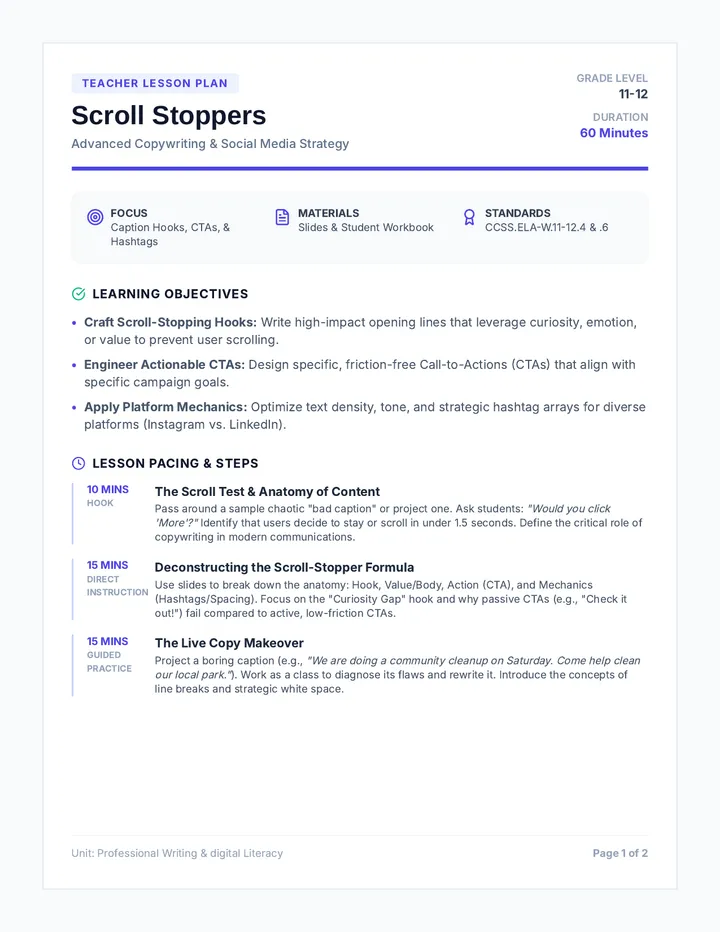
The Byrne Identity
Instructional Guide & Master Key
Teaching Context
This lesson explores the routine of John Byrne, demystifying the creative process by focusing on "the work." Use the slides to guide the viewing, then distribute the video worksheet. Following the video, choose between the short Observational Eye activity or the more intensive 3-phase Script & Sketch Project .
Key Timestamps
0:45 - The Studio Setup
1:30 - Early Morning Routine
4:15 - Tool Specificity
8:00 - Words vs. Images
Video Worksheet Answer Key
1. The Morning Ritual
John starts early (around 6:00 AM) to utilize the silence. He views routine as the foundation of creative freedom.
2. Words & Images
He sees them as interchangeable; "painting with words" is how he views writing scripts. One informs the other.
3. The Artist's Toolkit
Acceptable: Conté crayons, specific lead pencils, mapping pens, oil paints, palette knives, easels.
4. Studio Snapshot
Key objects for visual verification: The drafting table, the paint-splattered floor, stacked books, or specific pens.
5. The Philosophy of Work
He emphasizes that creative work cannot be rushed. It requires "as long as it takes"—dedication to the process rather than just the result.
Script & Sketch Project Guide
Phase 1 & 2: The Character
Push students to be highly specific . If a character is "nervous," how does that show in their pocket contents? (e.g., a shredded tissue). If they have a "voice," how does that show in their signature quote?
In the sketch, look for cross-medium consistency . The textures described in Phase 1 (setting) should ideally influence the lighting or environment of the Phase 2 sketch.
Phase 3: The Narrative
Assessment Tip: Evaluate based on the fusion of the two modes. Does the character in the story sound like the quote on page 1? Do their actions reflect the items drawn on page 2? The "moment of truth" should test their secret motivation.
Teacher Support • Creative Pulses Sequence • John Byrne Module