Mother Sauces Quiz
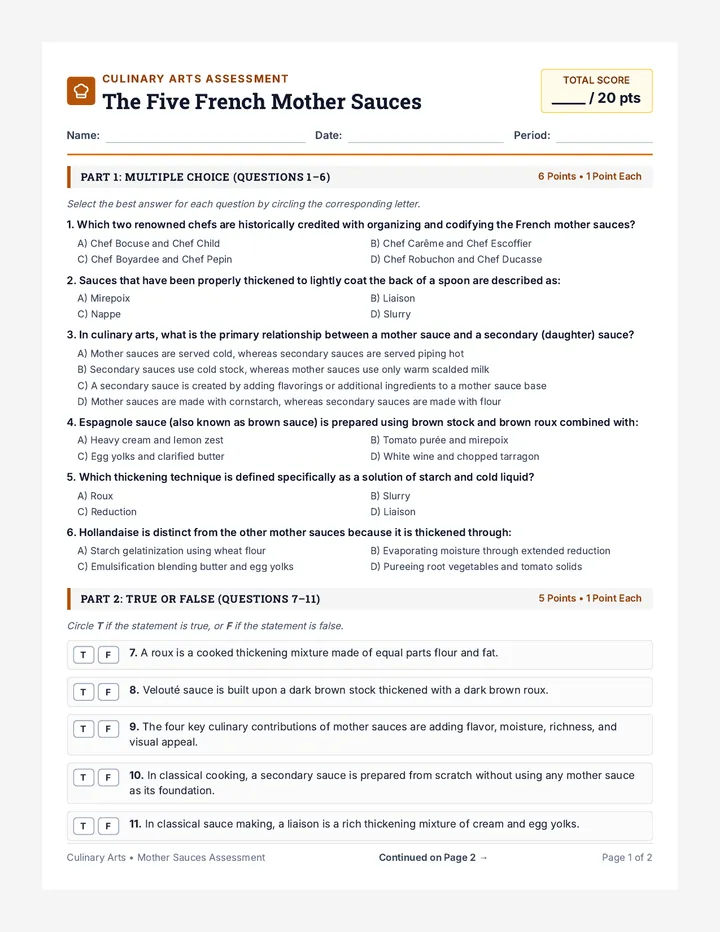
Culinary Arts Assessment
The Five French Mother Sauces
Total Score _____ / 20 pts
Name:
Date:
Period:
Part 1: Multiple Choice (Questions 1–6)
6 Points • 1 Point Each
Select the best answer for each question by circling the corresponding letter.
1. Which two renowned chefs are historically credited with organizing and codifying the French mother sauces?
A) Chef Bocuse and Chef Child
B) Chef Carême and Chef Escoffier
C) Chef Boyardee and Chef Pepin
D) Chef Robuchon and Chef Ducasse
2. Sauces that have been properly thickened to lightly coat the back of a spoon are described as:
A) Mirepoix
B) Liaison
C) Nappe
D) Slurry
3. What liquid base and thickening agent form the foundation of a classic Béchamel sauce?
A) Milk thickened with white roux
B) White stock thickened with blonde roux
C) Brown stock thickened with brown roux
D) Butter emulsified with egg yolks
4. Espagnole sauce (also known as brown sauce) is prepared using brown stock and brown roux combined with:
A) Heavy cream and lemon zest
B) Tomato purée and mirepoix
C) Egg yolks and clarified butter
D) White wine and chopped tarragon
5. Which thickening technique is defined specifically as a solution of starch and cold liquid?
A) Roux
B) Slurry
C) Reduction
D) Liaison
6. Hollandaise is distinct from the other mother sauces because it is thickened through:
A) Starch gelatinization using wheat flour
B) Evaporating moisture through extended reduction
C) Emulsification blending butter and egg yolks
D) Pureeing root vegetables and tomato solids
Part 2: True or False (Questions 7–11)
5 Points • 1 Point Each
Circle T if the statement is true, or F if the statement is false.
T F
7. A roux is a cooked thickening mixture made of equal parts flour and fat.
T F
8. Velouté sauce is built upon a dark brown stock thickened with a dark brown roux.
T F
9. The four key culinary contributions of mother sauces are adding flavor, moisture, richness, and visual appeal.
T F
10. Mornay, Soubise, and Aurora sauces are all secondary sauces derived from Hollandaise.
T F
11. In classical sauce making, a liaison is a rich thickening mixture of cream and egg yolks.
Culinary Arts • Mother Sauces Assessment Continued on Page 2 → Page 1 of 2
Mother Sauces Quiz • Page 2
Questions 12–20
Part 3: Matching Secondary Sauces (Questions 12–16)
5 Points • 1 Point Each
Match each secondary (daughter) sauce to its parent mother sauce. Write the correct letter (A–E) on the blank line provided.
A Béchamel
B Velouté
C Espagnole
D Tomato
E Hollandaise
_____ 12. Béarnaise, Mousseline, and Maltaise
_____ 13. Bordelaise, Chasseur, and Demi-glace
_____ 14. Mornay, Soubise, Crème, and Aurora
_____ 15. Allemande, Suprême, and Normande
_____ 16. Provençale, Spanish, and Bolognese-style variations
Part 4: Short Answer (Questions 17–20)
4 Points • 1 Point Each
Write clear, concise answers in complete sentences where appropriate.
17. What type of liquid stock serves as the base for a classic Velouté, and what specific type of roux is used to thicken it?
18. How does the culinary thickening technique of reduction work, and what two results does it achieve in a sauce?
19. Name two classic dishes or menu items that traditionally use Béchamel sauce.
20. What classic brunch dish is prepared using Hollandaise sauce, and what two core ingredients are emulsified together to create this sauce?
Culinary Arts • Mother Sauces Assessment End of Assessment • 20 Total Points Page 2 of 2
Mother Sauces Answer Key
Teacher Resource • Scoring Guide
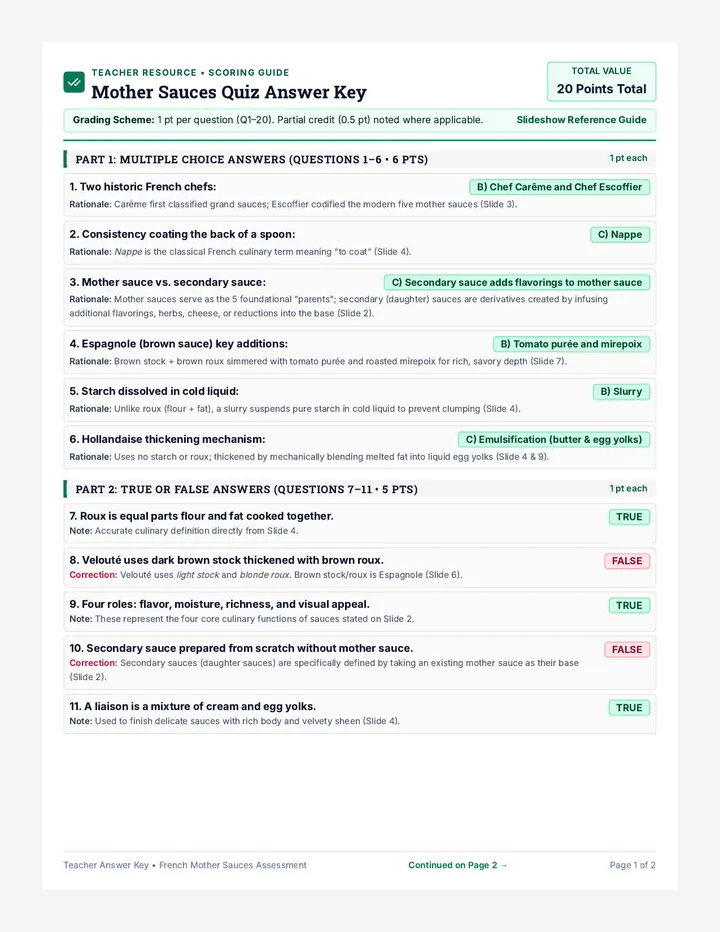
Mother Sauces Quiz Answer Key
Total Value 20 Points Total
Grading Scheme: 1 pt per question (Q1–20). Partial credit (0.5 pt) noted where applicable. Slideshow Reference Guide
Part 1: Multiple Choice Answers (Questions 1–6 • 6 pts)
1 pt each
1. Two historic French chefs: B) Chef Carême and Chef Escoffier
Rationale: Carême first classified grand sauces; Escoffier codified the modern five mother sauces (Slide 3).
2. Consistency coating the back of a spoon: C) Nappe
Rationale: Nappe is the French term meaning "coating" or "covering" (Slide 4).
3. Béchamel base and thickener: A) Milk thickened with white roux
Rationale: Milk base thickened with equal parts flour and butter cooked briefly without browning (Slide 5).
4. Espagnole (brown sauce) key additions: B) Tomato purée and mirepoix
Rationale: Brown stock + brown roux simmered with tomato purée and mirepoix for roasted depth (Slide 7).
5. Starch dissolved in cold liquid: B) Slurry
Rationale: Unlike roux (flour + fat), a slurry suspends pure starch in cold liquid to prevent clumping (Slide 4).
6. Hollandaise thickening mechanism: C) Emulsification (butter & egg yolks)
Rationale: Uses no starch; thickened by mechanically blending melted fat and liquid egg yolks (Slide 4 & 9).
Part 2: True or False Answers (Questions 7–11 • 5 pts)
1 pt each
7. Roux is equal parts flour and fat cooked together.
Note: Accurate culinary definition directly from Slide 4.
TRUE
8. Velouté uses dark brown stock thickened with brown roux.
Correction: Velouté uses light stock and blonde roux. Brown stock/roux is Espagnole (Slide 6).
FALSE
9. Four roles: flavor, moisture, richness, and visual appeal.
Note: These represent the four core culinary functions stated on Slide 2.
TRUE
10. Mornay, Soubise, and Aurora are derived from Hollandaise.
Correction: These are secondary sauces of Béchamel (Slide 5). Hollandaise derivatives include Béarnaise (Slide 9).
FALSE
11. A liaison is a mixture of cream and egg yolks.
Note: Used to finish delicate sauces with rich body and velvety sheen (Slide 4).
TRUE
Teacher Answer Key • French Mother Sauces Assessment Continued on Page 2 → Page 1 of 2
Mother Sauces Scoring Guide • Page 2
Questions 12–20