Sonic Building Blocks Slides
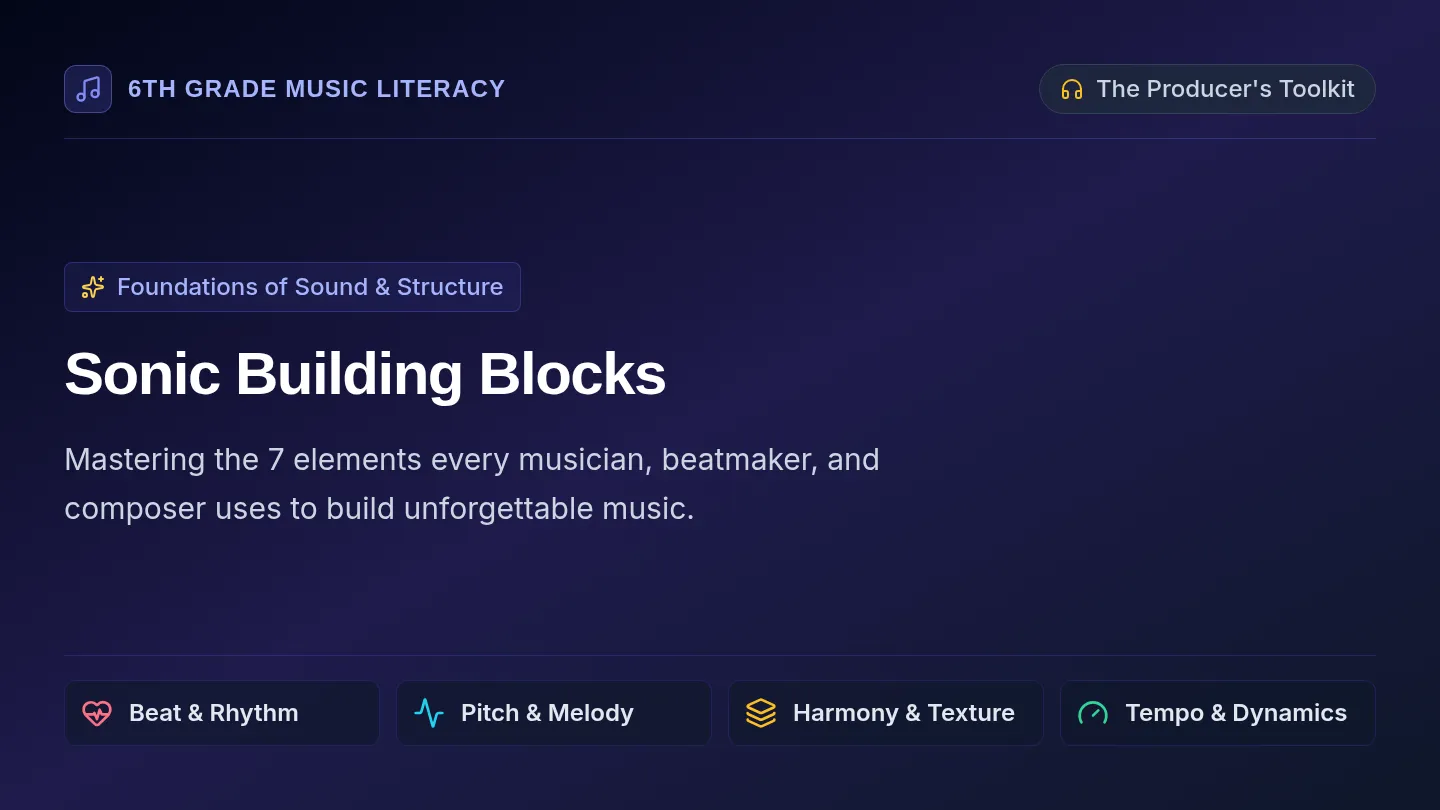
6th Grade Music Literacy
The Producer's Toolkit
Foundations of Sound & Structure
Sonic Building Blocks
Mastering the 7 elements every musician, beatmaker, and composer uses to build unforgettable music.
Beat & Rhythm
Pitch & Melody
Harmony & Texture
Tempo & Dynamics
01 & 02
Beat vs. Rhythm
The Timekeepers
The Beat
The steady, unwavering pulse
Like your heartbeat or the ticking of a clock. It stays constant and never stops moving forward.
Think of it as:
1 2 3 4
Tap your foot steady: tap • tap • tap • tap
The Rhythm
Patterns of short and long notes
The actual groove! Notes and rests arranged over the beat. Rhythm matches the syllables of lyrics.
Think of it as:
Ti - Ti Ta Ti - Ti - Ti Shh
Clap the words: "We Will, We Will Rock You!"
Rule of Thumb: You tap your foot to the beat, but you clap your hands to the rhythm!
03 & 04
Pitch & Melody
Highs, Lows, & The Big Tune
Pitch
How high or low a sound is
Determined by vibration frequency! Fast vibration creates high pitches; slow vibration creates low rumbles.
🐦 Flute / Bird Song HIGH PITCH
🦁 Tuba / Lion Roar LOW PITCH
Melody
Pitch + Rhythm in sequence
The memorable "main tune" that gets stuck in your head. Moving note by note across musical time.
Melodic Contour (The Shape):
📈
Ascending (Rising)
📉
Descending (Falling)
〰️
Wave / Arch
Example: The vocal hook in your favorite pop track
Producer Key: Individual pitches are like letters; the melody is the full sentence!
05
Harmony: Layering Sound
Multiple Pitches Together
The Definition
When two or more different pitches sound at the very same time.
Chords on a piano, guitar strumming behind a singer, or backup vocals.
Consonance
Sounds that blend smoothly, creating feelings of peace, resolution, and sweetness.
Standard major chords, warm acoustic strums, happy endings.
Dissonance
Notes that clash and create tension, suspense, or friction wanting to resolve.
Horror movie soundtracks, tense build-ups in EDM drops, jazzy friction.
Visual Analogy: Melody is the solo portrait; Harmony is the rich background scenery and colors! Root + 3rd + 5th = Triad
06
Tempo: The Speed of Sound
Italian Terms & BPM
What is Tempo?
Tempo is the speed of the underlying beat—musicians use Italian terms and BPM to mark tempo.
Beats Per Minute
🐢
Largo
Very Slow & Broad
40–60 BPM
🚶
Andante
Walking Pace
76–108 BPM
🏃
Allegro
Fast, Quick & Lively
120–156 BPM
🏎️
Presto
Extremely Fast
168–200 BPM
Accelerando: Gradually speeding up the beat ⏩
Ritardando: Gradually slowing down the beat ⏪
07
Dynamics: Volume & Energy
Loud vs. Soft
In music, dynamics describe how loud or soft sound is played. Musicians use Italian terms and symbols.
pp
Pianissimo
Very Soft
p
Piano
Soft
mp
Mezzo Piano
Medium Soft
mf
Mezzo Forte
Medium Loud
f
Forte
Loud
ff
Fortissimo
Very Loud
Crescendo
Gradually get louder
<
Decrescendo
Gradually get softer
>
Pro Tip: Pitch is frequency (high/low note), but Dynamics is volume (soft/loud air pressure)!
08
Texture: The Sonic Fabric
How Musical Layers Intertwine
Mono = One
Monophonic
A single melody line with no accompaniment or harmony whatsoever.
Real-Life Example:
A solo singer humming alone in a room, or a lone trumpet fanfare.
Homo = Same
Homophonic
One main melody supported by chords or harmonic backup.
Real-Life Example:
95% of pop music! A lead singer accompanied by guitar, bass, and synth chords.
Poly = Many
Polyphonic
Multiple independent melodies weaving together at the same time.
Real-Life Example:
Singing "Row, Row, Row Your Boat" as a round; a complex Bach organ fugue.
Fabric Analogy: Monophony is a single thread; Homophony is cloth with backing; Polyphony is a braided tapestry!
PRACTICE
The Listening Lab: Dissecting a Track
Active Ear Training
When you hear any piece of music, ask these diagnostic questions to analyze its sonic elements:
01
Beat & Tempo
Can you tap the pulse? Is it slow (Largo), walking (Andante), or fast (Allegro)?
02
Rhythm & Groove
Are the patterns syncopated, repetitive, smooth, or punchy?
03
Pitch & Melody
What instrument carries the main tune? Does the contour rise, fall, or leap?
04
Harmony & Dynamics
Are the chords sweet (consonant) or tense (dissonant)? Is it piano, forte, or changing?
Grab Your Worksheet: Turn to Part 5 (Listening Lab)
Element Matrix
CHECK
Producer Flash Check
Wrap-Up
Q1
Beat vs. Rhythm Challenge
If someone claps along to the syllables of a song's words, are they performing the beat or the rhythm?
Answer: Rhythm!
Q2
Dynamic Decode
A passage begins with p and has a < symbol ending with ff. What happens?
Answer: Starts soft (piano) and crescendos to very loud (fortissimo)!
Q3
Texture Mystery
Four choir singers enter one by one singing the exact same melody at different start times. What texture is this?
Answer: Polyphonic (a round / canon)!
Q4
Speed Shift
A song moves from 80 BPM to 140 BPM. Which Italian term describes this gradual speeding up?
Answer: Accelerando!
Complete your Sonic Building Blocks Worksheet to finalize today's lesson!
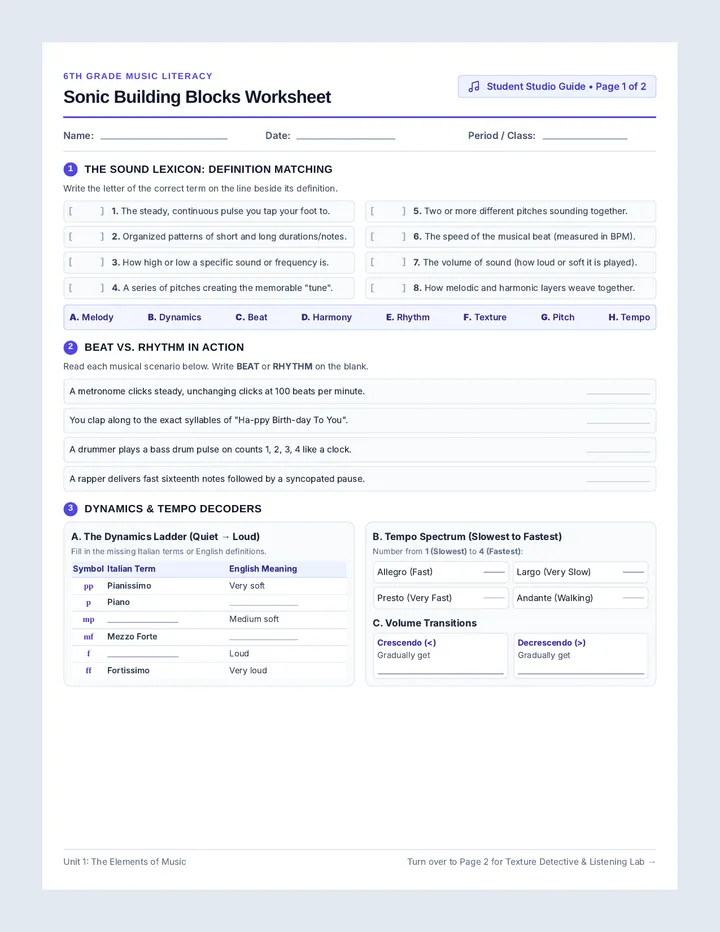
Sonic Building Blocks Worksheet
6th Grade Music Literacy
Sonic Building Blocks Worksheet
Student Studio Guide • Page 1 of 2
Name:
Date:
Period / Class:
1
The Sound Lexicon: Definition Matching
Write the letter of the correct term on the line beside its definition.
[ ] 1. The steady, continuous pulse you tap your foot to.
[ ] 2. Organized patterns of short and long durations/notes.
[ ] 3. How high or low a specific sound or frequency is.
[ ] 4. A series of pitches creating the memorable "tune".
[ ] 5. Two or more different pitches sounding together.
[ ] 6. The speed of the musical beat (measured in BPM).
[ ] 7. The volume of sound (how loud or soft it is played).
[ ] 8. How melodic and harmonic layers weave together.
A. Melody B. Dynamics C. Beat D. Harmony E. Rhythm F. Texture G. Pitch H. Tempo
2
Beat vs. Rhythm In Action
Read each musical scenario below. Write BEAT or RHYTHM on the blank.
A metronome clicks steady, unchanging clicks at 100 beats per minute.
____________
You clap along to the exact syllables of "Ha-ppy Birth-day To You".
____________
A drummer plays a bass drum pulse on counts 1, 2, 3, 4 like a clock.
____________
A rapper delivers fast sixteenth notes followed by a syncopated pause.
____________
3
Dynamics & Tempo Decoders
A. The Dynamics Ladder (Quiet → Loud)
Fill in the missing Italian terms or English definitions.
| Symbol | Italian Term | English Meaning |
|---|
| pp | Pianissimo | Very soft |
| p | Piano | __________________ |
| mp | __________________ | Medium soft |
| mf |
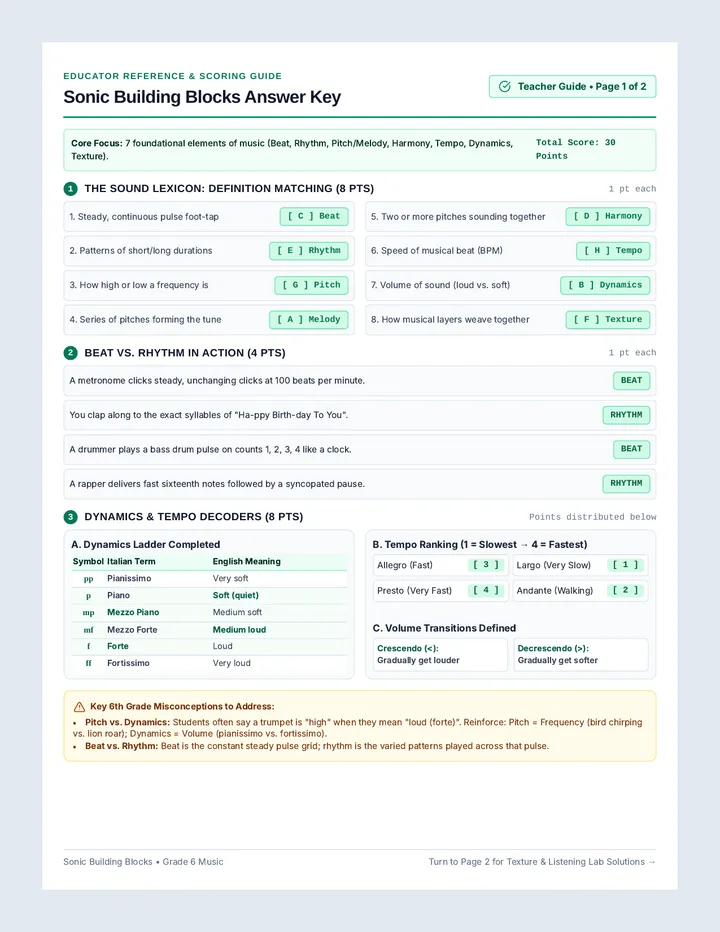
Sonic Building Blocks Answer Key
Educator Reference & Scoring Guide
Sonic Building Blocks Answer Key
Teacher Guide • Page 1 of 2
Core Focus: 7 foundational elements of music (Beat, Rhythm, Pitch/Melody, Harmony, Tempo, Dynamics, Texture). Total Score: 30 Points
1
The Sound Lexicon: Definition Matching (8 pts)
1 pt each
1. Steady, continuous pulse foot-tap [ C ] Beat
5. Two or more pitches sounding together [ D ] Harmony
2. Patterns of short/long durations [ E ] Rhythm
6. Speed of musical beat (BPM) [ H ] Tempo
3. How high or low a frequency is [ G ] Pitch
7. Volume of sound (loud vs. soft) [ B ] Dynamics
4. Series of pitches forming the tune [ A ] Melody
8. How musical layers weave together [ F ] Texture
2
Beat vs. Rhythm In Action (4 pts)
1 pt each
A metronome clicks steady, unchanging clicks at 100 beats per minute. BEAT
You clap along to the exact syllables of "Ha-ppy Birth-day To You". RHYTHM
A drummer plays a bass drum pulse on counts 1, 2, 3, 4 like a clock. BEAT
A rapper delivers fast sixteenth notes followed by a syncopated pause. RHYTHM
3
Dynamics & Tempo Decoders (8 pts)
Points distributed below
A. Dynamics Ladder Completed
| Symbol | Italian Term | English Meaning |
|---|
| pp | Pianissimo | Very soft |
| p | Piano | Soft (quiet) |
| mp | Mezzo Piano | Medium soft |
| mf | Mezzo Forte | Medium loud |
| f | Forte | Loud |
| ff | Fortissimo | Very loud |
B. Tempo Ranking (1 = Slowest → 4 = Fastest)
Allegro (Fast) [ 3 ]
Largo (Very Slow) [ 1 ]
Presto (Very Fast) [ 4 ]
Andante (Walking) [ 2 ]
C. Volume Transitions Defined
Crescendo (<): Gradually get louder
Decrescendo (>): Gradually get softer
Key 6th Grade Misconceptions to Address:
- Pitch vs. Dynamics: Students often say a trumpet is "high" when they mean "loud (forte)". Reinforce: Pitch = Frequency (bird chirping vs. lion roar); Dynamics = Volume (pianissimo vs. fortissimo).