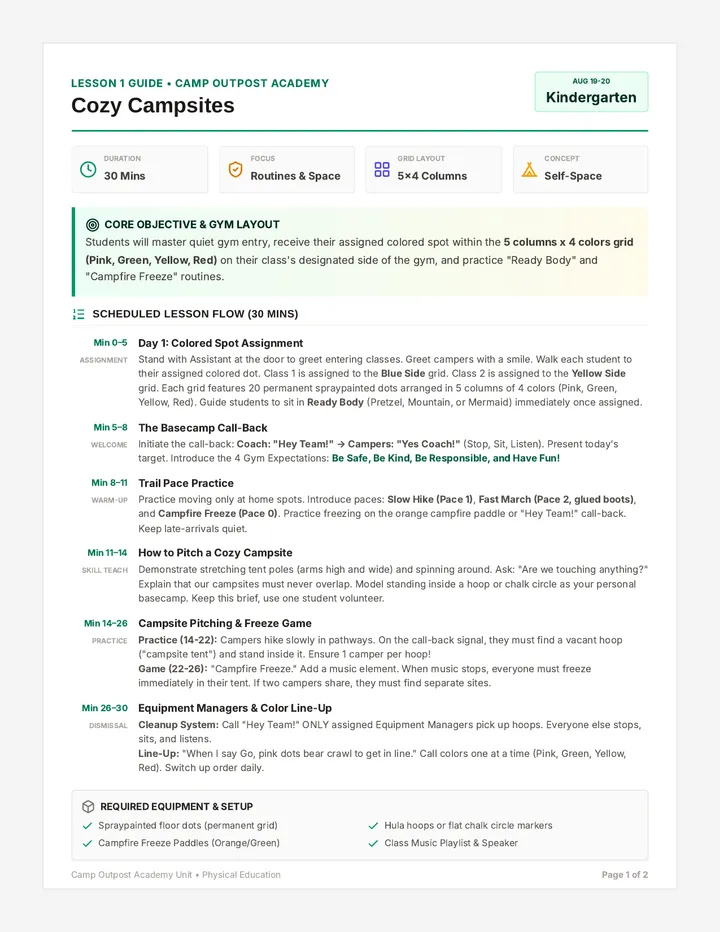
A comprehensive physical education sequence for Kindergarten focused on spatial awareness, gym routines, and safety. Through imaginative camping-themed play, students learn to define personal space, navigate shared forest environments safely, and respond to non-verbal signals.
Path Visuals: Place arrow placards indicating the direction of forest movement on gymnasium walls.
Sensory Strategies
Gentle Environmental Audio: Play soft crickets or forest wind sounds instead of standard gym echoes.
Cozy Meadow Stop: Designate a soft, visually quiet, carpeted corner as the "Rest Meadow."
Tactile Markers: Encourage sensory seekers to touch soft foam logs during scheduled huddles.
Motor Adaptations
Cleared Fire Lanes: Keep wide, straight lanes completely clear of obstacles for students with walking aids.
Ranger Escort: Allow a peer buddy or paraeducator to hold a "hiking stick" alongside the student.
Lower Obstacles: Replace tall cones with flat poly spots to prevent tripping hazards.
Emotional Regulation
Ranger Badge Progress: Reward calm, slow movements with a visual sticker badge on a wrist band.
Pre-Hike Walkthrough: Allow anxious students to walk the trail with the teacher before game begins.
Visual Timer Board: Display a visual countdown showing how long the hiking expedition will last.
Ranger Verbal Scripts & Phrases
Say this to encourage steering: "Campers, look ahead on the trail! There is a prickly bush coming up. Turn your hiking boots to the left, clear the bush safely! High five!"
Say this during crowd build-ups: "I see a traffic jam on the forest bridge! Let's choose a new, empty trail. Turn around and explore the quiet woods over there!"
Say this for sensory comfort: "If the forest feels too loud or busy, you can always take a short rest in the quiet Rest Meadow. Hike back when you are ready!"
Camp Outpost Academy Unit • Inclusive Practice Page 2 of 2
Role Necklaces: Provide colored ribbons (green/orange) indicating whose turn it is to walk.
Sensory Strategies
Tactile Firewood: Use soft textured knobby balls or visual fleece blocks instead of heavy canvas beanbags.
Lower Acoustics: Encourage students to speak in "tent whispers" during cooperative discussions.
Resting Outpost: Establish a calm resting zone marked with visual pine tree decals on the gym boundary.
Motor Adaptations
Scoop Grabbers: Provide plastic scoops or easy-grip handles for picking up beanbags from the floor.
Closer Wood Piles: Shorten the distance between basecamp and firewood for students with limited stamina.
Rolling Tents: Allow students to lock hands or touch wheels/crutches with a buddy to build an active tent.
Emotional Regulation
Visual Turn Tracker: Put a colorful, double-sided marker on the floor that students flip when switching turns.
Co-Rangers: Form teams of three instead of pairs to minimize pressure on high-anxiety learners.
Gentle Cueing: Say "Your turn, Ranger!" in a highly encouraging, low-pressure tone.
Ranger Verbal Scripts & Phrases
Say this to model cooperation: "Pioneers, a forest camp is built by working together. Cheer on your buddy! When they place their firewood, give them a double thumbs up!"
Say this during role switches: "Tag! You're back! Flip your turn tracker. Now, Ranger B, hike slowly out to gather some dry birch bark!"
Say this to reassure and redirect: "It's okay if the firewood slips. Pick it up gently, reset with your partner, and keep walking together down the open path!"
Camp Outpost Academy Unit • Inclusive Practice Page 2 of 2