Safe Shift Slides
Workplace Safety Basics
Plain Language Guide for Young Workers
Safe Shift: Your Safety Shield at Work
Learn how to spot danger, use protective gear, handle emergencies, and vote on real workplace incident photos in the "Safe or Not Safe?" game!
Spot Danger Fast
Find risks before anyone gets hurt
Wear Your Gear
Your boss must provide free PPE
Vote on Incidents
Discuss photos before the reveal
Video Lesson
What is OSHA? Meet the Safety Referee
Watch & Learn
Embedded media
What does OSHA stand for?
Occupational Safety and Health Administration. It is a government team that keeps workplaces safe.
The Main Rule
Every employer must give workers a job environment that does not cause serious harm or sickness.
The Big Goal
You go to work healthy, do your shift, and return home safe and sound every single day.
Think of OSHA as workplace rules of the road: they keep everyone from getting hurt!
Worker Rights
3 Things You Never Have to Guess About
Guaranteed by Law
1
A Safe Workspace
Your workplace must be clean, well lit, and free from dangerous machines or broken equipment.
You have the right to a clean, safe job
2
Free Gear & Lessons
Your boss must provide safety goggles, gloves, masks, and training without taking money from your paycheck.
Free gear and easy-to-read training
3
No Getting in Trouble
You cannot be fired, punished, or yelled at for pointing out a danger or asking for help.
Protected against retaliation
Got questions or safety worries? Anyone can call OSHA at 1-800-321-OSHA for free advice.
Always Free
Hazard Spotter
What is a Hazard? The 4 Sneaky Types
Danger Traps
1. Slips, Trips & Falls
Wet floors, loose wires across walkways, open boxes on the floor, and wobbly ladders.
2. Chemical Nasties
Harsh bleach, oven cleaners, mystery spray bottles without names, and strong chemical fumes.
3. Body Strain
Lifting heavy crates with your back, twisting while carrying boxes, or repeating the same motion all day.
4. Bad Environments
Super hot kitchens with no fresh air, freezing outdoor loading docks, and noisy machine rooms.
Easy definition: A hazard is anything around you that has the chance to hurt your body.
Spot it • Speak up
Video Lesson
Hazard Detective: Spotting Real Dangers
Watch & Discuss
Embedded media
1. Notice the Clutter
Look for walkway blockers like empty pallets, tangled extension cords, and trash near doors.
2. Check the Signs & Tags
Warning stickers and bright yellow wet floor cones are there to stop bad accidents before they happen.
3. Pause if it Looks Wrong
Never rush into a task if something feels broken or dangerous. Stopping to ask is always the smart move!
Quick Chat Question: What is one hazard you spotted in the clip that you could easily fix or report?
Everyday Work
What Safety Looks Like in Real Jobs
Common Roles
Fast Food & Kitchens
Sneaky Risk: Hot fryer oil & slippery tile floors
Smart Fix: Non-slip rubber soles and burn-proof gloves
Never run in a kitchen area
Grocery & Retail
Sneaky Risk: Reaching for heavy boxes on high shelves
Smart Fix: Use a sturdy step ladder—never climb shelves
Ask for a buddy lift over 40 lbs
Cleaning & Custodial
Sneaky Risk: Mixing cleaning chemicals together
Smart Fix: Read every bottle and wear splash goggles
Never mix bleach with anything
Every job has safety habits. Doing them every time turns you into a trusted pro!
How to Solve Danger
The 4 Shields of Workplace Safety
Best to Backup
1
Shield 1: Delete the Danger (Elimination)
Get rid of the hazard completely. Clean up the puddle or turn off the broken wire.
Super Best!
2
Shield 2: Put Up a Guard (Engineering)
Lock the danger behind a shield: blade guards on meat slicers and exhaust fans for smoke.
Physical Wall
3
Shield 3: Change the Routine (Rules)
Set safe habits: put up wet floor cones, rotate heavy tasks, and take shade breaks in heat.
Smart Rules
4
Shield 4: Suit Up (Personal Gear / PPE)
Wear gear on your body: safety goggles, gloves, earplugs, and steel-toed boots.
Last Line
Remember: Safety gear is great, but fixing the actual hazard is always 10 times better!
Fast Action
What to Do in an Emergency
Stay Calm • Move Fast
Fire Extinguisher P.A.S.S.
For tiny fires you can easily put out
P
Pull the metal pin ring
A
Aim low at the bottom of the flame
S
Squeeze the handle lever
S
Sweep side to side across the floor
Getting Out Alive
Rules that save lives
Know 2 Ways Out
Always memorize 2 emergency exit doors wherever you are working.
Eye Wash: 15 Whole Minutes
If chemicals get in your eyes, flush them with water for a full 15 minutes!
Meet Outside
Walk directly to the outdoor meeting spot so the manager knows you are safe.
If a fire is bigger than a wastebasket, do not fight it. Get out, pull the alarm, and call 911!
Your Voice
Speaking Up: You Have Stop-Work Power!
Be a Safety Hero
Step 1: Tell Your Lead
If you see a spill, a broken machine guard, or exposed wires, politely tell your team leader right away.
Speaking up is teamwork, not tattling!
Step 2: Press Pause
If you are asked to do something dangerous without training or without gear, you have the right to pause and say: "I need training first."
Pause, ask, and stay safe
Step 3: Call OSHA
If dangerous problems get ignored, anyone can contact OSHA confidentially. Your boss will never be told your name.
100% confidential reporting
Good bosses love workers who spot hazards—because keeping people safe saves lives and businesses!
We Look Out for Each Other
Work Incident Challenge
Safe or Not Safe? Real Photo Edition!
Classroom Voting Game
Two-Step Challenge Rules
1
Discuss First: Inspect the photo, talk in groups, and look for danger traps.
2
Cast Your Vote: Thumbs Up (SAFE 👍) or Thumbs Down (NOT SAFE 👎)!
3
The Big Reveal: Next slide shows the verdict, the danger, and the safe OSHA fix!
👍
SAFE
Proper PPE, certified tools, anchored guardrails, and safe habits.
👎
NOT SAFE
Dangerous shortcuts, missing fall gear, improper footwear, or reckless setups.
Get ready to judge! The answers stay hidden until your team has cast its vote!
Case 1 • Class Inspection
What Is Your Call on This Scene?
Discuss & Vote!
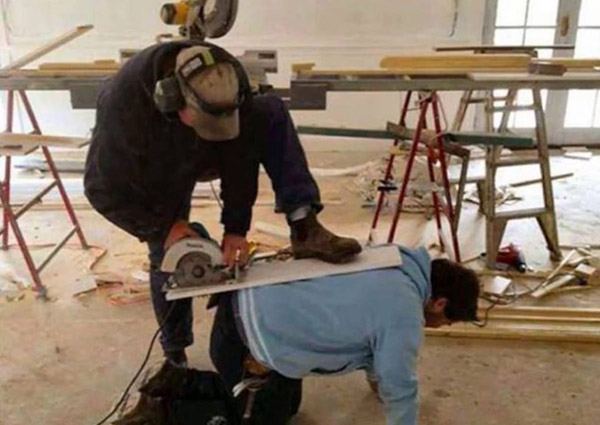
Detective Clues:
• What tool is being used, and where is the cutting board resting?
• What could happen if the power saw kicks back or slips?
• Is this an approved piece of work equipment?
Cast Your Vote Now!
👍 SAFE 👎 NOT SAFE
Lock in your final vote! Turn to the next slide to reveal the official OSHA verdict →
Case 1 • Official Verdict
The Human Sawhorse: Revealed
👎 NOT SAFE
👎 NOT SAFE! Catastrophic Hazard
Circular saws spin at over 5,000 RPM. When a blade binds, it violently kicks back. Using another human being as a cutting table risks fatal spinal and nerve injuries in milliseconds.
OSHA Rule Broken:
OSHA 1926.300: Power tools must only be used on secure, stable, approved work surfaces with guards in place.
The Safe Way:
Place materials on sturdy wooden sawhorses or clamp them to a rigid workbench. Never use human bodies!
Did your team get this right? Let's move to Incident #2!
Case 2 • Class Inspection
What Is Your Call on This Scene?
Discuss & Vote!
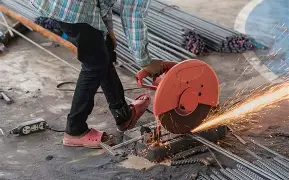
Detective Clues:
• Look closely at the worker's feet. What are they wearing?
• Where are the hot metal sparks flying as the blade cuts rebar?
• What protective gear is missing from this picture?
Cast Your Vote Now!
👍 SAFE 👎 NOT SAFE
Lock in your final vote! Turn to the next slide to reveal the official OSHA verdict →
Case 2 • Official Verdict
Metal Cutting in Sandals: Revealed
👎 NOT SAFE
👎 NOT SAFE! Extreme Foot & Burn Risk
Cutting metal in rubber flip-flops! Sparks reach 1,000°F+ and melt into skin. If a high-speed cutoff blade shatters or rebar rolls off, it will amputate toes instantly.
OSHA Rule Broken:
OSHA 1910.136: Workers must wear steel-toed safety boots whenever heavy objects, rollers, or metal-cutting hazards exist.
The Safe Way:
Suit up with steel-toed leather work boots, spark-resistant pants, safety face shield, and heavy leather welding gloves!
Did your team call it? Next up is Incident #3!
Case 3 • Class Inspection
What Is Your Call on This Scene?
Discuss & Vote!
Detective Clues:
• How high off the ground is this worker standing?
• What is supporting the wooden plank they are standing on?
• Do you see any guardrails, safety nets, or tied-off harnesses?
Cast Your Vote Now!
👍 SAFE 👎 NOT SAFE
Lock in your final vote! Turn to the next slide to reveal the official OSHA verdict →
Case 3 • Official Verdict
High-Rise Beam Balance: Revealed
👎 NOT SAFE
👎 NOT SAFE! Fatal Fall Hazard
Falls are the #1 killer in the construction industry. Standing on a rickety wooden stick stuck out into the open air with no guardrails or harness tie-off is an accident waiting to happen.
OSHA Rule Broken:
OSHA 1926.501: Fall protection (guardrails or personal fall arrest harness) is mandatory anywhere workers are 6 feet or higher above the ground.
The Safe Way:
Use an OSHA-certified aerial boom lift, or a secure scaffold platform with a full-body harness tied off to a 5,000-lb rated anchor point!
Did your class spot the fall risk? On to Incident #4!
Case 4 • Class Inspection
What Is Your Call on This Scene?
Discuss & Vote!
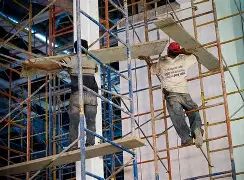
Detective Clues:
• What are the two workers standing on while lifting heavy planks?
• Is there a solid floorboard underneath their feet?
• Are there guardrails behind them to keep them from falling backwards?
Cast Your Vote Now!
👍 SAFE 👎 NOT SAFE
Lock in your final vote! Turn to the next slide to reveal the official OSHA verdict →
Case 4 • Official Verdict
Scaffold Gymnastics: Revealed
👎 NOT SAFE
👎 NOT SAFE! Severe Scaffold Violation
Workers are balancing on thin metal pipes and crossing braces while hoisting heavy boards! One missed step or slippery shoe means falling straight down to the concrete.
OSHA Rule Broken:
OSHA 1926.451: All scaffold working platforms must be fully planked and equipped with top rails, mid-rails, and toe-boards.
The Safe Way:
Install fully decked walking planks, secure perimeter safety railings, and wear personal fall arrest harnesses hooked into safety lines!
Almost through the gauntlet! Time for the final incident: #5!
Case 5 • Class Inspection
What Is Your Call on This Scene?
Discuss & Vote!
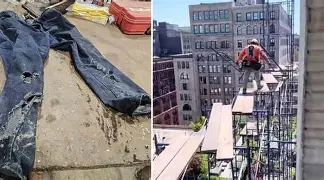
Detective Clues:
• What happened to the work jeans shown on the left?
• How do sharp metal corners and ripped clothing cause severe falls?
• If your safety gear or clothing gets shredded, what should you do?
Cast Your Vote Now!
👍 SAFE 👎 NOT SAFE
Lock in your final vote! Turn to the next slide to reveal the official OSHA verdict →
Case 5 • Official Verdict
The Catwalk & Snagged Gear: Revealed
👎 NOT SAFE
👎 NOT SAFE! Equipment Damage & Snag Hazard
Shredded clothing on high-rise scaffolding reveals a major near-miss! Loose or damaged apparel easily snags on jagged metal ties and scaffold brackets, pulling workers off balance.
OSHA Rule Broken:
OSHA 1926.95: Defective or damaged protective equipment and torn work apparel that poses entanglement risks must be removed from service immediately.
The Safe Way:
Inspect all harnesses, lanyards, and work clothes before every shift. Replace damaged gear on the spot and ensure clear, unblocked walkways!
Great job, safety detectives! You've analyzed every incident like an OSHA inspector!
Safety Champion Certified
Incident Detective Graduate
You Are Ready for a Safe Shift!
Now that you can spot real-life workplace hazard fails, remember the golden rules: pause first, wear your gear, and look out for your teammates!
1. Pause First
If you don't know how to do it safely, ask your supervisor.
2. Free Gear
Never pay for your own required protective equipment.
3. Head Home Safe
Your health and life are always more important than rushing!