Vape Lesson Plan Vape Lesson Plan
Topic: Vaping Awareness & Refusal Skills
9TH GRADE • 60 MINS
Why this lesson?
Teen vaping rates are rising, yet many students don’t know the hidden risks or how to resist peer pressure. This lesson empowers 9th graders with facts and skills to make informed decisions.
Learning Objective
Students will explore the chemical makeup, health impacts, and social pressures of vaping, then practice refusal strategies and reflect on healthier choices.
Prep (15 mins)
Print Infographic Handouts & Reflection Journals
Cue up Vaping Awareness Slide Deck
Familiarize with Role-Play Script & Chemical Chart
Review key facts for discussion points
Required Materials
Vaping Awareness Slide Deck
Vaping Infographic Handout
Chemical Components Chart
Peer Pressure Role-Play Script
Reflection Journal Worksheet
Vaping Risks Exit Ticket Quiz
Lesson Delivery
10
MINS
Introduction & Hook
Display opening statistics slide from the deck.
Facilitate discussion: "What do you know about vaping?"
Ask students why they think peers might start vaping.
Introduce lesson goals and distribute Vaping Infographic Handout .
15
MINS
Infographic Analysis
Students work in pairs with the Infographic Handout .
Focus on: Which chemicals are most concerning? How have trends shifted?
Each pair identifies three surprising facts to share with the class.
10
MINS
Chemical Components Discussion
Project the Chemical Components Chart .
Review major chemicals in aerosol and associated risks (Nicotine, PG/VG, metals).
Discuss short-term vs. long-term impacts clearly.
Invite student questions to clarify common misconceptions.
15
MINS
Peer Pressure Role-Play
Divide students into small groups.
Distribute Peer Pressure Role-Play Script .
Groups rehearse and perform skits demonstrating specific refusal strategies.
Debrief: "What worked? What could improve?"
10
MINS
Reflection & Assessment
Complete Reflection Journal Worksheet (personal application).
Administer Vaping Risks Exit Ticket Quiz as a formative check.
Collect materials to review for understanding.
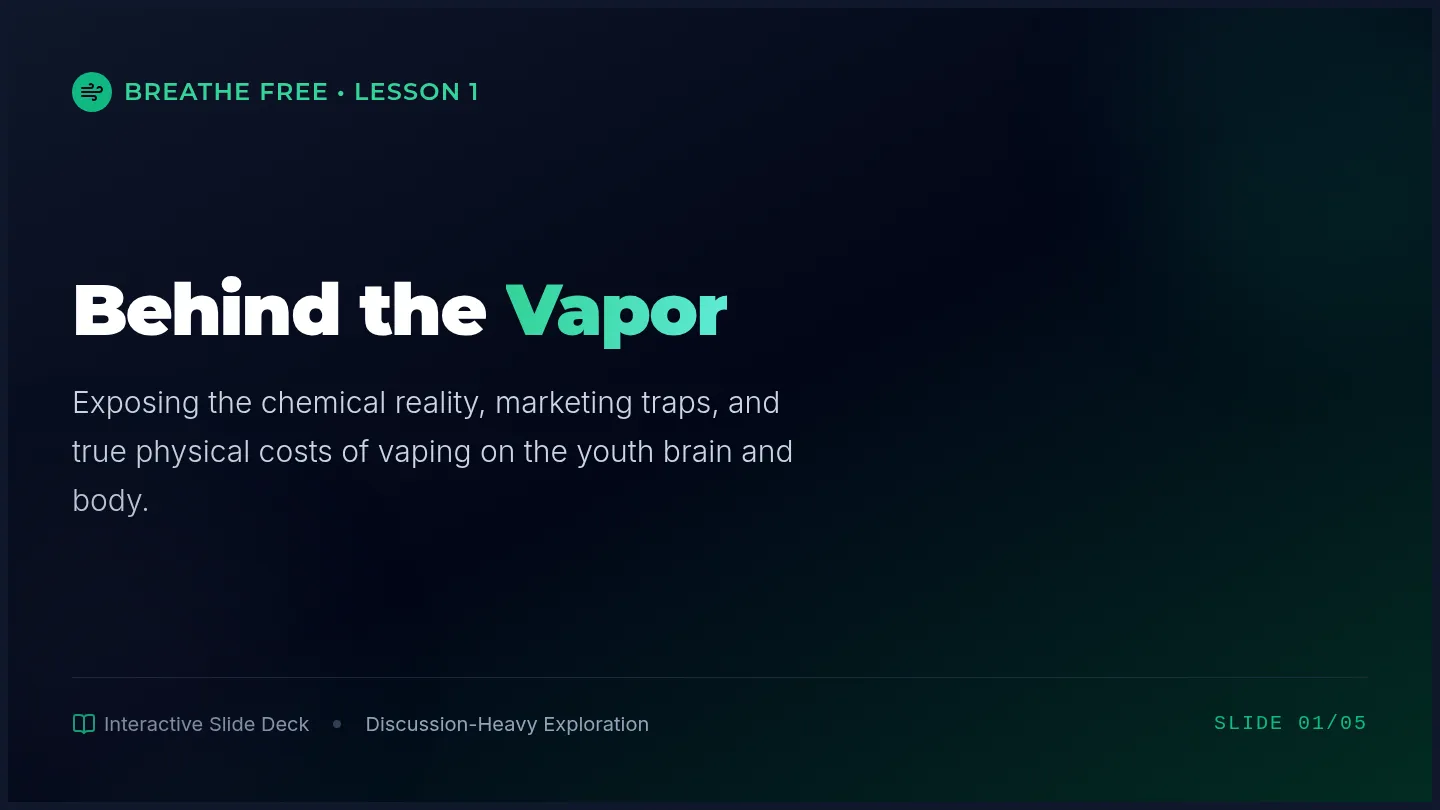
Vaping Awareness Slides Health & Wellness
What’s Really in
That Vape?
A 60-minute exploration of hidden health risks, social pressures, and chemical contents.
Teacher Note: Introduce the purpose of today’s lesson.
Understanding Vaping
Vaping: Inhaling aerosol produced by an electronic device.
Common Devices: E-cigarettes, vape pens, mods, disposables.
Often marketed as a “safer” alternative to smoking, but is it?
[Visual of various vaping devices: sleek pens, USB-style pods, and boxy mods]
Teen Vaping Statistics
1 in 4
High schoolers tried vaping in the past month
+75%
Increase in youth usage over the last three years
90%
Don’t know all the chemicals inside the aerosol
Chemical Components
Nicotine
Highly addictive; hijacks brain development in teens. Affects focus and mood.
Heavy Metals
Lead, nickel, and cadmium leach from heating coils. Toxic with exposure.
Carriers (PG/VG)
Propylene glycol & vegetable glycerin. Lung irritants that break down when heated.
Flavorings
Chemicals like diacetyl linked to severe respiratory disease (popcorn lung).
Health Impacts
Short-Term
Cough & throat irritation
Headaches & dizziness
Increased heart rate
Long-Term
Chronic lung disease
Severe addiction
Cognitive impairment
Resisting Peer Pressure
01
Say "No" firmly & confidently
02
Offer an alternative activity
03
Use humor or change subject
Pro-Tip:
"Actually, I'm trying to keep my lungs clear for the game this weekend. You guys want to grab a snack instead?"
Your Turn
Analyze Facts
Review the infographic handout with a partner.
Role-Play
Practice your refusal skills using the script template.
Reflect
Complete your journal and the exit ticket quiz.
Let's get started!
Vape Facts Worksheet Vape Facts Worksheet
WHAT'S REALLY IN THAT VAPE?
Student Info
DATE
QUICK FACTS & FIGURES
1. THE NUMBERS
1 in 4 high schoolers tried vaping in the past month.
Usage rates rose 75% in just 3 years.
90% of teen users don't know every chemical inside.
2. FLAVORS & MARKETING
Fruity/Candy flavors are the #1 reason teens try it.
SLEEK DESIGNS make devices look like tech or school supplies.
Influencers and social ads target youth.
3. KEY HAZARDS
NICOTINE
Highly addictive; impairs teen brain growth.
PG & VG
Aerosol carriers; can irritate lung tissue.
HEAVY METALS
Lead and nickel can leach into the aerosol.
LONG-TERM RISKS
Lung disease, cognitive impairment, gateway to tobacco addiction.
1. Which statistic from this infographic surprised you the most, and why?
2. Of the chemicals listed, which one concerns you the most? Describe how it could affect your health.
3. How do flavorings and marketing strategies specifically target teens? Provide two examples.
4. After reviewing this information, how has your perception of vaping changed? Explain your thoughts.
5. What additional questions do you have about vaping and its risks?
Vape Chemical Guide Vape Chemical Guide
Reference Chart: Components & Risks
This guide outlines common chemicals found in vape aerosol, their sources, and associated health risks. Use this to understand the true impact of inhaling these substances.
Chemical Source Health Risks Nicotine Synthetic or plant-derived salts Highly addictive; impairs teen brain development; raises BP and heart rate. Propylene Glycol (PG) Primary solvent/carrier liquid Irritates throat/airways; breaks down into potential carcinogens when heated. Vegetable Glycerin (VG) Secondary solvent for vapor density Potential respiratory irritation; linked to lipid accumulation in lungs. Flavoring Agents Chemical additives (e.g., diacetyl) Linked to "popcorn lung" (bronchiolitis obliterans) and chronic inflammation. Heavy Metals Leached from heating coils (Lead, Nickel) Neurotoxicity; kidney/lung damage; potential carcinogens with long exposure. Carbonyl Compounds Thermal breakdown of carriers Includes Formaldehyde; causes airway irritation; linked to chronic bronchitis. Volatile Organic Compounds Thermal emissions (Benzene, Toluene) Increased cancer risk; potential neurological and reproductive effects. Ultrafine Particles Aerosolized droplets/particulates Deep lung penetration; cardiovascular stress; chronic inflammation.
Short-Term Impact
Coughing, wheezing, dizziness, and throat irritation often occur within minutes of use.
Long-Term Impact
Permanent lung damage, severe addiction, and impaired cognitive function over months/years.
Refusal Skill Script Refusal Skill Script
Practice Resisting Peer Pressure
Use this template to practice saying “no” to vaping. In your group, assign roles and fill in the blanks to make the scene realistic. Use strategies like a firm “no,” humor, or offering an alternative activity.
Scene Title
Location
(e.g., parking lot, school bathroom, friend's house)
Characters
Pressuring Peer: ________________________Refusing Student: ________________________Supportive Bystander: ________________________
Pressuring Peer:
"Hey, check this out. It's [flavor]. You want a hit?"
Refusing Student:
"No thanks, [Refusal strategy: firm no / reason / humor]..."
Pressuring Peer:
"Come on, it's just flavor. It's not even a cigarette. Everyone is doing it..."
Refusing Student:
"Actually, [Refusal strategy: alternative activity / fact]..."
Supportive Friend:
"Yeah, leave them alone. We're actually heading to..."
Final Response:
Scene Reflection
1. Which refusal strategy did you use first? Was it effective? Why or why not?
2. How did adding a supportive friend or bystander change the interaction?
3. What would you do differently if the pressure continued outside this scene?
Healthy Choices Journal Healthy Choices Journal
NAME: ________________________ DATE: ____________
1 Which fact or statistic from today’s lesson resonated most with you, and why?
2 Recall a situation where you felt pressured. How did you respond, and what would you change?
3 Plan your refusal strategies. List three strategies and a realistic scenario for each.
Strategy 1:
How I'd use it:
Strategy 2:
How I'd use it:
4 Write a short letter to a friend considering vaping. Include 3 concerns and 2 alternatives.
Dear Friend, ...
5 Set two personal goals related to avoiding vaping.
Goal 1
Step A
Step B
Goal 2
Step A
Step B
6. Create a symbol or slogan representing your commitment to health.
Draw or write your commitment here
Vape Risk Quiz Vape Risk Quiz
Exit Ticket • Formative Assessment
NAME:
SCORE: / 5
1
Which chemical in vape aerosol is highly addictive and can impair adolescent brain development?
Nicotine
Propylene Glycol
Flavoring Agents
Ultrafine Particles
2
Which of the following is a common short-term health effect of vaping?
Chronic lung disease
Throat irritation
Neurotoxicity
Kidney damage
3
Which refusal strategy was NOT recommended in today’s lesson?
Say “No” firmly and confidently
Offer an alternative activity
Use humor to change the subject
Encourage your friend to vape with you
4
On a scale of 1-5, how confident are you that you can use refusal strategies?
Not Confident
1
2
3
4
5
Very Confident
5
Describe one action you can take this week to support a friend in making healthy choices.
Vape Quiz Answer Key Answer Key
Vape Risk Quiz • Teacher Reference
1
Which chemical in vape aerosol is highly addictive and can impair adolescent brain development?
Nicotine
Explanation: Nicotine is the primary addictive substance in both cigarettes and vapes; it interferes with the prefrontal cortex during adolescent development.
2
Which of the following is a common short-term health effect of vaping?
Throat irritation
Explanation: While chronic disease is a long-term risk, immediate effects include coughing, irritation, and increased heart rate.
3
Which refusal strategy was NOT recommended in today’s lesson?
Encourage your friend to vape with you
Explanation: Encouraging use is the opposite of refusal; effective strategies include saying no, humor, and alternatives.
Question 4 (Likert)
This is a self-assessment of student self-efficacy. Use it to gauge if more role-play practice is needed for the class.
Question 5 (Open Response)
Look for specific, actionable answers such as: "Invite them to play basketball after school" or "Tell them about the heavy metals we learned about today."