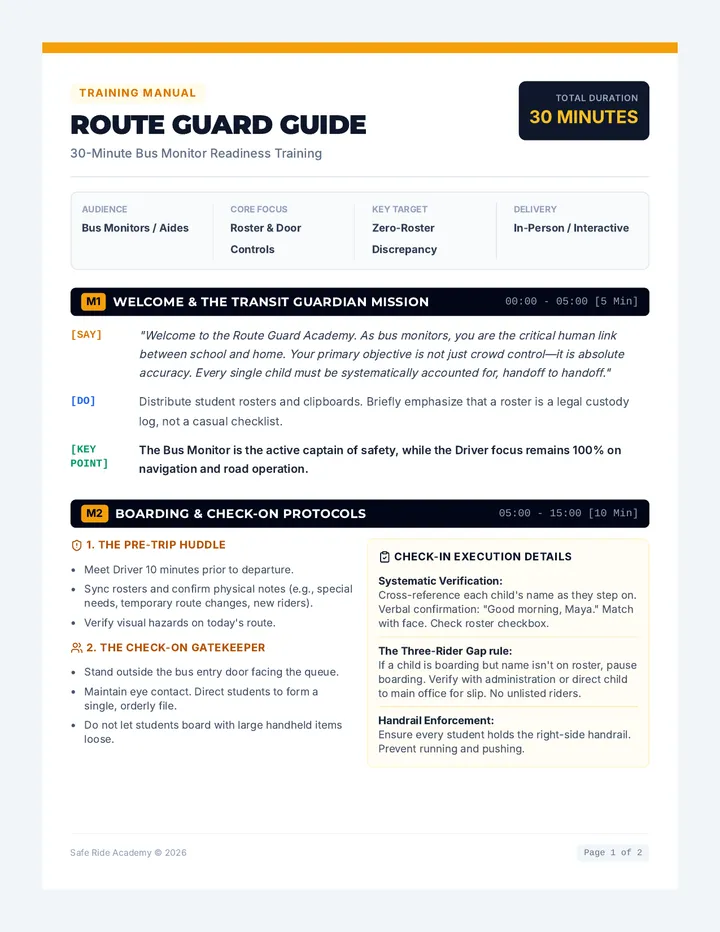
Route Guard GuideTraining Manual ROUTE GUARD GUIDE 30-Minute Bus Monitor Readiness Training Total Duration 30 MINUTES Audience Bus Monitors / Aides Core Focus Roster & Door Controls Key Target Zero-Roster Discrepancy Delivery In-Person / Interactive M1 Welcome & The Transit Guardian Mission 00:00 - 05:00 [5 Min] [Say] "Welcome to the Route Guard Academy. As bus monitors, you are the critical human link between school and home. Your primary objective is not just crowd control—it is absolute accuracy. Every single child must be systematically accounted for, handoff to handoff." [Do] Distribute student rosters and clipboards. Briefly emphasize that a roster is a legal custody log, not a casual checklist. [Key Point] The Bus Monitor is the active captain of safety, while the Driver focus remains 100% on navigation and road operation. M2 Boarding & Check-On Protocols 05:00 - 15:00 [10 Min] 1. The Pre-Trip Huddle Meet Driver 10 minutes prior to departure. Sync rosters and confirm physical notes (e.g., special needs, temporary route changes, new riders). Verify visual hazards on today's route. 2. The Check-On Gatekeeper Stand outside the bus entry door facing the queue. Maintain eye contact. Direct students to form a single, orderly file. Do not let students board with large handheld items loose. Check-In Execution Details Systematic Verification: Cross-reference each child's name as they step on. Verbal confirmation: "Good morning, Maya." Match with face. Check roster checkbox. The Three-Rider Gap rule: If a child is boarding but name isn't on roster, pause boarding. Verify with administration or direct child to main office for slip. No unlisted riders. Handrail Enforcement: Ensure every student holds the right-side handrail. Prevent running and pushing. Safe Ride Academy © 2026 Page 1 of 2 Safety Operations ROUTE GUARD GUIDE Operational Safety & Deboarding Routines Total Duration 30 MINUTES M3 Transit Monitoring & Deboarding Routines 15:00 - 25:00 [10 Min] Transit Control Best Practices During the journey, your main job is visual scanning. Do not get distracted by your phone or paperwork. Seat Belt & Posture Check: Confirm all kids remain seated, bottoms-on-cushion. Keep Aisles Clear: Backpacks, musical instruments, and limbs must not obstruct pathways. Sound Levels: Keep noise below "distraction thresholds" so driver can hear sirens/horns. Precise Handoff Protocols The deboarding moment is when custody is most vulnerable. Follow this exact ritual: Secure the Bus: Wait until the vehicle stops completely before standing up. Exit First: The monitor steps out first to secure the perimeter and assist stairs. Roster Cross-Off: Look at each child's face, match name, and check off departure. Verified Handover: Kindergarten/primary students require visual and physical handover to designated adult or teacher. The Non-Negotiable Final Sweep Routine At the final terminal stop, you must walk to the absolute rear of the bus, physically looking under every seat. Do not perform this task from the front. Scan for sleeping students, lost items, and garbage. Mark "SWEEP COMPLETE" and sign the time sheet. M4 Emergencies, Scenarios & Wrap-Up 25:00 - 30:00 [5 Min] Key Crisis Behaviors: Vehicle Breakdowns: Keep students calm and inside the bus unless instructed otherwise by the driver or dispatcher. Evacuation (Rear Exit): Lead evacuation. The monitor opens the rear exit door, drops down first to assist students down the drop. Medical Emergency: Secure the area around the affected child. Driver contacts dispatch instantly. Interactive Check-In: Ask participants: "A child is trying to step off at a stop not listed on their sheet because their friend is getting off there. What is your exact move?" Correct Answer: "Hold the student on the bus, and coordinate immediately with dispatch for parent verification." I have completed the Safe Ride Academy Transit Training: Monitor Sign: ___________________________ Date: _________ Trainer Verified: Signature File Copy Safe Ride Academy © 2026 Page 2 of 2
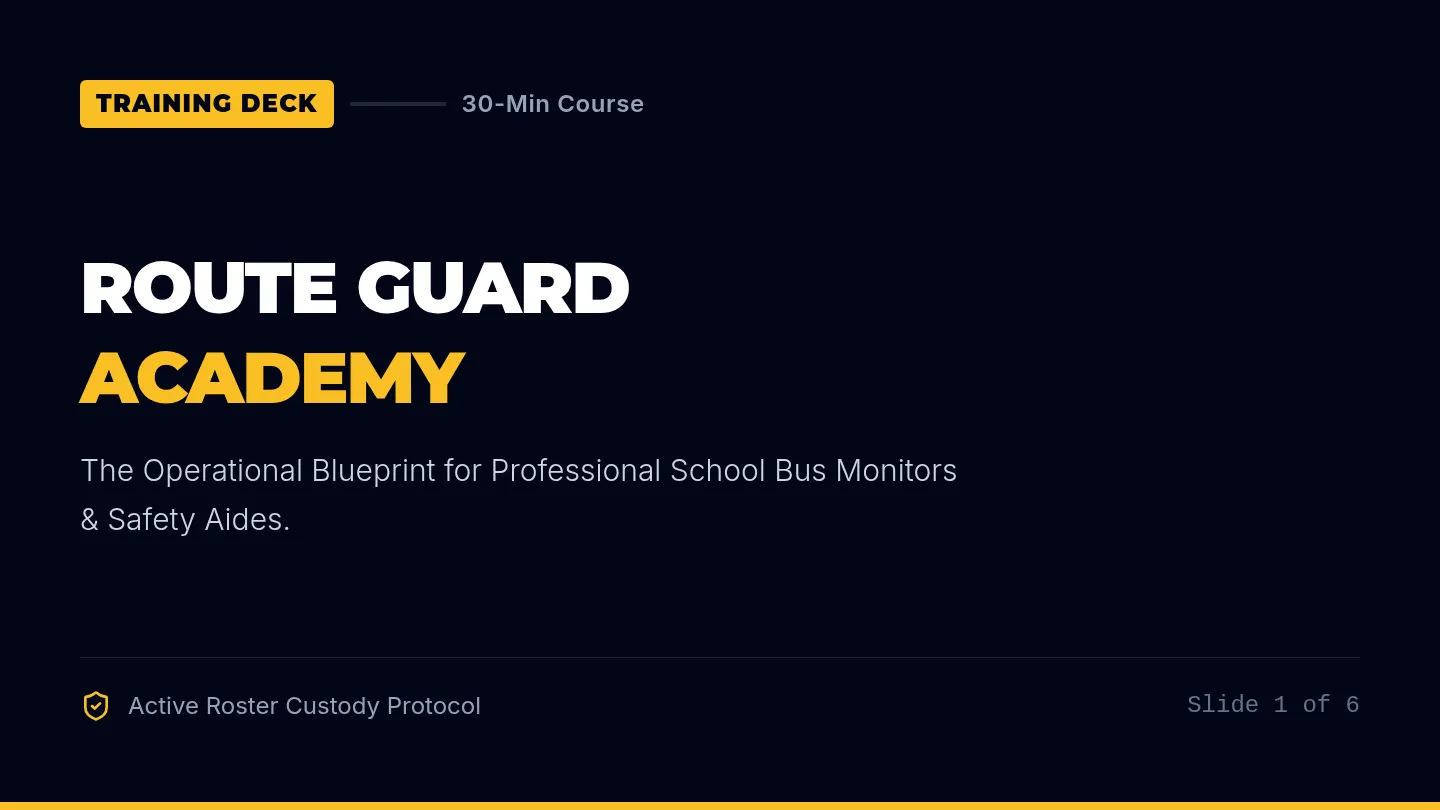
Safe Ride SlidesTraining Deck 30-Min Course ROUTE GUARD ACADEMY The Operational Blueprint for Professional School Bus Monitors & Safety Aides. Active Roster Custody Protocol Slide 1 of 6 THE ROUTE GUARD MISSION 01: Welcome Active Custody Every student must be visually and physically checked off. No student is unaccounted for. Driver Partner The driver focuses 100% on the road. The monitor is entirely in charge of student safety and behavior. Crisis Leader You are the anchor in emergency situations, guiding orderly evacuations and securing student safety. Remember: Security begins before wheels roll. Slide 2 of 6 BOARDING & CHECK-ON SYSTEM 02: Boarding 1 The Pre-Trip Sync Check in with driver 10 mins before departure. Confirm exceptions, alerts, and medical flags. 2 The Door Guard Stand outside the bus entry. Direct students to form a single orderly line. 3 Verbal Check-On Verify names and mark them off on your physical roster. Absolutely no unregistered riders allowed. The "Unlisted" Rule If a student steps up but is not on your roster sheet: Do not let them board. Send them to the main office to verify. Zero tolerance for unverified boarding. Slide 3 of 6 TRANSIT SAFETY CONTROL 03: On the Road Bottoms-on-Seats Ensure students remain fully seated with bottoms on cushions, facing forward while the bus is in motion. Clear Aisles Backpacks, instruments, and boxes must be tucked under seats. Absolutely no clutter in the walkway. Noise Thresholds Keep collective noise to conversational levels. The driver must be able to hear horns and emergency sirens. No Phone Distractions Your phone must remain tucked away. Keep your head up and scan the cabin constantly. Constant visual monitoring is your core duty. Slide 4 of 6 DEBOARDING & CUSTODY TRANSFER 04: Deboarding Primary Handoff Rules Students in Kindergarten through Grade 2 require direct handoff. Do not release them to walk home alone. Must match to a recognized, authorized adult. 1 Verify bus is fully stopped before rising. 2
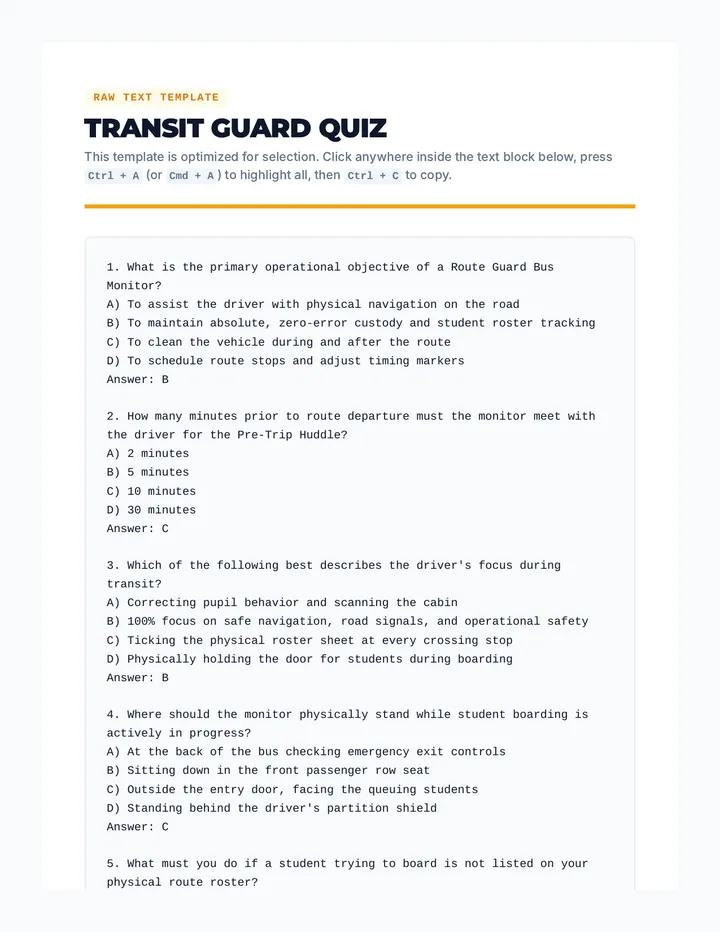
Transit Guard QuizRAW TEXT TEMPLATE TRANSIT GUARD QUIZ This template is optimized for selection. Click anywhere inside the text block below, press Ctrl + A (or Cmd + A) to highlight all, then Ctrl + C to copy. 1. What is the primary operational objective of a Route Guard Bus Monitor? A) To assist the driver with physical navigation on the road B) To maintain absolute, zero-error custody and student roster tracking C) To clean the vehicle during and after the route D) To schedule route stops and adjust timing markers Answer: B 2. How many minutes prior to route departure must the monitor meet with the driver for the Pre-Trip Huddle? A) 2 minutes B) 5 minutes C) 10 minutes D) 30 minutes Answer: C 3. Which of the following best describes the driver's focus during transit? A) Correcting pupil behavior and scanning the cabin B) 100% focus on safe navigation, road signals, and operational safety C) Ticking the physical roster sheet at every crossing stop D) Physically holding the door for students during boarding Answer: B 4. Where should the monitor physically stand while student boarding is actively in progress? A) At the back of the bus checking emergency exit controls B) Sitting down in the front passenger row seat C) Outside the entry door, facing the queuing students D) Standing behind the driver's partition shield Answer: C 5. What must you do if a student trying to board is not listed on your physical route roster? A) Allow them to ride anyway and report it at the end of the day B) Pause boarding and direct the student to the main office for a verification slip C) Tell the student to sit at the back of the bus out of sight D) Write their name in pencil and ask them to show an ID badge Answer: B 6. During the boarding process, what physical handrail enforcement rule must be followed? A) Handrails must only be used by primary school students B) Handrails should be bypassed if a student has heavy bags C) Ensure every student utilizes the handrail when stepping up the stairs D) Students should slide their bags along the handrails Answer: C 7. When checking students onto the bus, which validation method is mandatory? A) Relying solely on students nodding as they walk past you B) Verbally speaking their name, looking at their face, and checking the roster box C) Checking their name off only after the bus is in motion D) Counting only total heads without looking at the list Answer: B 8. What is the minimum spacing or distance that should be maintained between students boarding the stairs? A) No gap is needed as long as they go fast B) At least one stair tread of separation, maintaining an orderly line C) A five-foot safety barrier zone at all times D) Boarding must be done two by two on the steps Answer: B 9. What is the core rule regarding passenger positioning during the route? A) Students can change seats once the bus goes above 30 mph B) Bottoms must remain on the seat cushion, facing forward with feet out of the aisle C) Students are allowed to stand to retrieve books from their bags D) Primary students may sit on older students' laps to save space Answer: B 10. Where should bulky student items (e.g., backpacks, band instruments) be kept during travel? A) Stacked vertically in the center aisle corridor B) Placed completely flat under the seats or securely on their laps C) Held in the air by students so they do not fall D) Piled next to the emergency back exit door Answer: B 11. Why is maintaining an acceptable noise threshold on the bus considered a safety protocol? A) Loud noises distract the monitor from completing roster checks B) High volume prevents the driver from hearing ambient traffic sirens or emergency horns C) Noise levels affect the bus's internal electronic systems D) High volume is against municipal sound bylaws Answer: B 12. What is the operational rule concerning the use of personal mobile phones by the monitor during active transit? A) Monitors may stream music as long as they wear one earbud B) Phone must remain stowed; absolute visual vigilance on the cabin is required at all times C) Phone should be kept in hand to record student behavior infractions D) Monitors may answer non-urgent personal text messages only Answer: B 13. How often should the monitor execute a visual sweep or cabin scan during a route? A) Once at the start of the trip, and once at the end B) Every 2 to 3 minutes, systematically checking front, middle, and back sections C) Only when students start shouting or standing up D) Every 15 minutes as dictated by state log guidelines Answer: B 14. What are the rules for managing student seatbelt compliance? A) Monitors are not responsible for checking seatbelts B) Conduct a physical click-check prior to departure, and monitor seatbelt usage visually during transit C) Only check primary school students' belts D) Keep student seatbelts unfastened so they can exit faster Answer: B 15. When a bus is slowing down to pull into a stop, what should the passengers do? A) Line up in the aisle immediately to ensure a fast departure B) Remain fully seated until the bus comes to a complete, final stop and the air brake is heard C) Stand up and grab their bags from under the seat D) Move toward the front steps to wave at parents Answer: B 16. Who is the first person to step off the bus when arriving at a designated student drop-off stop? A) The oldest student to lead the others safely B) The student whose stop it is C) The Bus Monitor, to secure the boarding zone and assist students on the stairs D) No one steps off; students jump directly to the sidewalk curb Answer: C 17. Which student group requires a physical and visual handoff to an authorized guardian during deboarding? A) Students in Kindergarten through Grade 2 B) All students on the route, regardless of age C) High school age students only D) Only students who do not know their street address Answer: A 18. What action must you take if an authorized adult is not present at the stop for a primary-grade student? A) Leave the student at the stop with an older neighborhood student B) Keep the student on the bus and coordinate with dispatch for a return-to-school or late pickup plan C) Allow the student to walk home alone with a warning D) Drop the student at the nearest public store or safe-house Answer: B 19. If a student demands to exit at a stop other than their designated home stop, what is your action? A) Allow them to exit if they promise to walk straight home B) Hold the student on the bus and immediately notify dispatch/school administration for verification C) Allow them to get off if their friend is getting off at that stop D) Let them exit but make a written note on your ledger after the route Answer: B 20. What is the "Three-Rider Gap" guideline during deboarding? A) Allowing three empty seats between student groups B) Pausing the exit flow if there is a discrepancy to resolve, preventing mass exit until roster matches C) Checking students off in blocks of three rather than one by one D) Leaving three seconds between students crossing the street pavement Answer: B 21. What is the correct operational method for conducting the Final Sweep of the bus at the end of a route? A) Standing at the driver's dashboard area and glancing toward the back seats B) Walking to the absolute rear of the bus, physically looking under every seat cushion for students or items C) Sweeping only when a parent calls about a lost item D) Asking the last student exiting to check for anyone left behind Answer: B 22. Leaving a sleeping child on a school bus is legally categorized as which of the following? A) A minor administrative oversight B) A major safety violation and immediate grounds for termination of employment C) An acceptable incident if the child is found within one hour D) The sole responsibility of the driver, not the monitor Answer: B 23. Once the Final Sweep is completed with zero findings, what action must the monitor take? A) Immediately turn off all internal bus lights and leave B) Write "SWEEP COMPLETE", sign the roster sheet with a time stamp, and hand it to dispatch C) Lock the rear exit door and check-in for the next route on the phone app D) Leave the clipboard on the front seat without making a written mark Answer: B 24. What are you scanning for under the seats during the final sweep besides sleeping children? A) Mechanics and tools left by garage technicians B) Personal items, medical gear, lost backpacks, trash, and hazards C) Extra seatbelt extensions and clips D) Hidden emergency evacuation route markers Answer: B 25. In the event of a mechanical vehicle breakdown, what is the default protocol for student location? A) Evacuate students immediately and have them stand along the highway shoulder B) Keep students calm and inside the vehicle unless instructed otherwise by dispatch or driver C) Instruct students to walk to the nearest gas station or storefront D) Have students sit on the roof of the bus for visibility Answer: B 26. Who is responsible for opening and operating the rear emergency exit door during a structured bus evacuation? A) The driver, from their dashboard controls B) The monitor, who drops down first and helps students down the rear drop-step C) The youngest students who sit in the rear row D) The local fire department crews on scene Answer: B 27. If a medical emergency occurs in transit, how must the monitor respond? A) Stop the bus immediately and pull the student out onto the pavement B) Secure the area, keep other kids calm, and coordinate with driver to call dispatch/911 instantly C) Wait until the end of the route to report the illness to a supervisor D) Administer medicine directly from your personal first-aid stash without permission Answer: B 28. Which of the following is the standard communication tool used to coordinate with transit dispatch? A) Texting on personal cellphones during a active route B) The bus's integrated two-way radio system (coordinated by the driver) C) Signaling to passing transit vehicles on the road D) Writing notes and hanging them outside the bus window Answer: B 29. What is the baseline behavioral management response for disruptive students on the route? A) Use physical force to restrain them in their seat B) Issue clear, calm verbal commands; document infraction; report to the school administration C) Stop the bus and ask the student to step off the bus on the street side D) Ignore the behavior unless they damage the bus interior Answer: B 30. What document is legally treated as an active custody manifest during a transit emergency? A) The driver's license certificate B) The student route roster sheet checked off during boarding C) The municipal public transit timetable D) The state highway driving regulations booklet Answer: B