Rhythm Makers Slides 6th Grade Music
What Is Rhythm?
Explore how steady pulse, meter, and rhythmic subdivision organize sound and silence in time.
Today's Goal: Count, clap, and compose 4/4 rhythm patterns using standard numeric counting.
Core Concepts
Pulse, Meter & Rhythm
Pulse (Beat)
The steady, underlying clock of the music—measured in beats per minute (tempo).
1 • 2 • 3 • 4
Meter
How beats are grouped into measures—shown by a time signature like 4/4 or 3/4.
| 4 beats | 4 beats |
Rhythm
The organized pattern of sound durations and rests placed over the pulse.
1 2 & (3) 4
Analyze & Listen
What Is Rhythm?
Embedded media
Listening Focus:
1 Track the steady pulse—can you group it in 4s?
2 Listen for subdivision: beats splitting into 2 or 4 faster sounds.
3 Notice how rests create space and groove!
Notation & Subdivision
Note Values in 4/4 Time
𝅝
Whole Note
4 Beats
Count: 1–2–3–4
𝅗𝅥
Half Note
2 Beats
Count: 1–2 / 3–4
♩ / 𝄽
Quarter
1 Beat
Count: 1, 2, 3, 4
♫
Eighth Notes
½ + ½ = 1 Beat
Count: 1 &, 2 &
Guided Practice
Count & Clap in 4/4 Time
Measure A — Subdividing Beat 3:
♩
1
♩
2
♫
3 &
♩
4
Measure B — Half Note & Quarter Rest (Silent Beat 3):
𝅗𝅥
1 — 2
𝄽
(3)
♫
4 &
Partner Studio
2-Measure Groove Challenge
Compose two 4/4 measures (8 beats total) using half notes, quarter notes, eighth notes, and rests. Write the numeric counts underneath!
Measure 1 (4 Beats)
Measure 2 (4 Beats)
Count aloud ("1 & 2 3 4") while you clap your 2-measure groove for your partner!
Rhythm Makers Worksheet 6th Grade Music
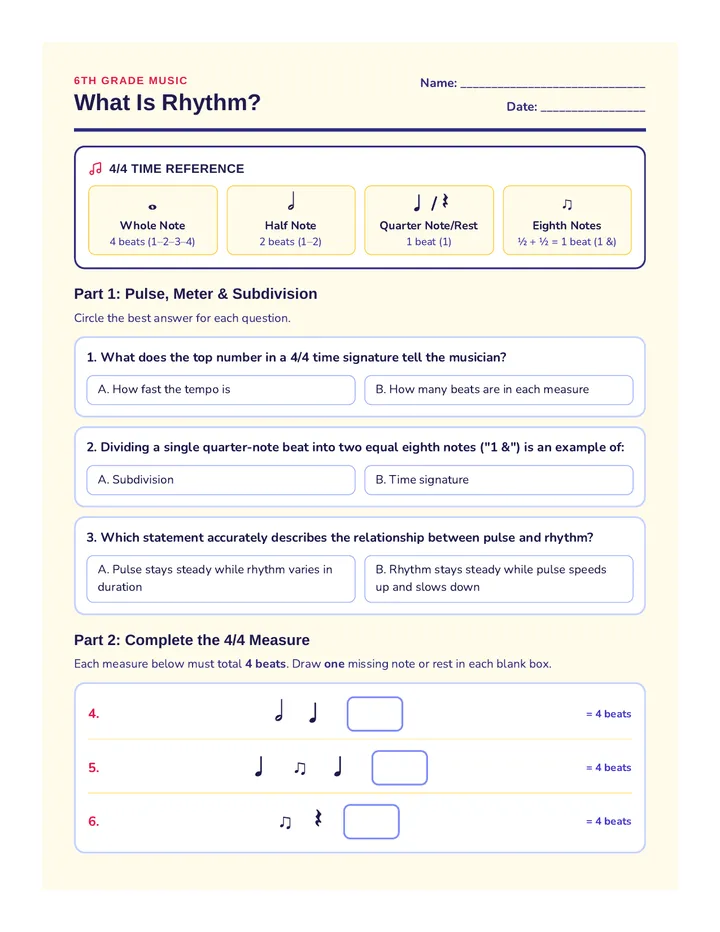
What Is Rhythm?
Name: ______________________________
Date: _________________
4/4 Time Reference
𝅝
Whole Note
4 beats (1–2–3–4)
𝅗𝅥
Half Note
2 beats (1–2)
♩ / 𝄽
Quarter Note/Rest
1 beat (1)
♫
Eighth Notes
½ + ½ = 1 beat (1 &)
Part 1: Pulse, Meter & Subdivision
Circle the best answer for each question.
1. What does the top number in a 4/4 time signature tell the musician?
A. How fast the tempo is
B. How many beats are in each measure
2. Dividing a single quarter-note beat into two equal eighth notes ("1 &") is an example of:
A. Subdivision
B. Time signature
3. Which statement accurately describes the relationship between pulse and rhythm?
A. Pulse stays steady while rhythm varies in duration
B. Rhythm stays steady while pulse speeds up and slows down
Part 2: Complete the 4/4 Measure
Each measure below must total 4 beats. Draw one missing note or rest in each blank box.
𝅗𝅥 ♩
= 4 beats
♩ ♫ ♩
= 4 beats
♫ 𝄽
= 4 beats
What Is Rhythm? — Page 2
Name: ________________________
Part 3: Numeric Counting in 4/4 Time
Write the numeric counts underneath each rhythm (use & for eighth notes, 1–2 for half notes, and parentheses like (3) for rests).
7. Measure A (4/4)
♩
♫
𝄽
♫
8. Measure B (4/4)
𝅗𝅥
♫
♩
Part 4: Compose a 2-Measure Groove (4/4 Time)
Compose two 4-beat measures using 𝅗𝅥, ♩, ♫, and 𝄽. Write the numeric counts in the bottom row.
Measure 1 (4 Beats)
Measure 2 (4 Beats)
Part 5: Analytical Check-In
How do meter (like 4/4 time) and subdivision work together to organize rhythm in a piece of music?
Rhythm Makers Answer Key 6th Grade Music • Teacher Resource
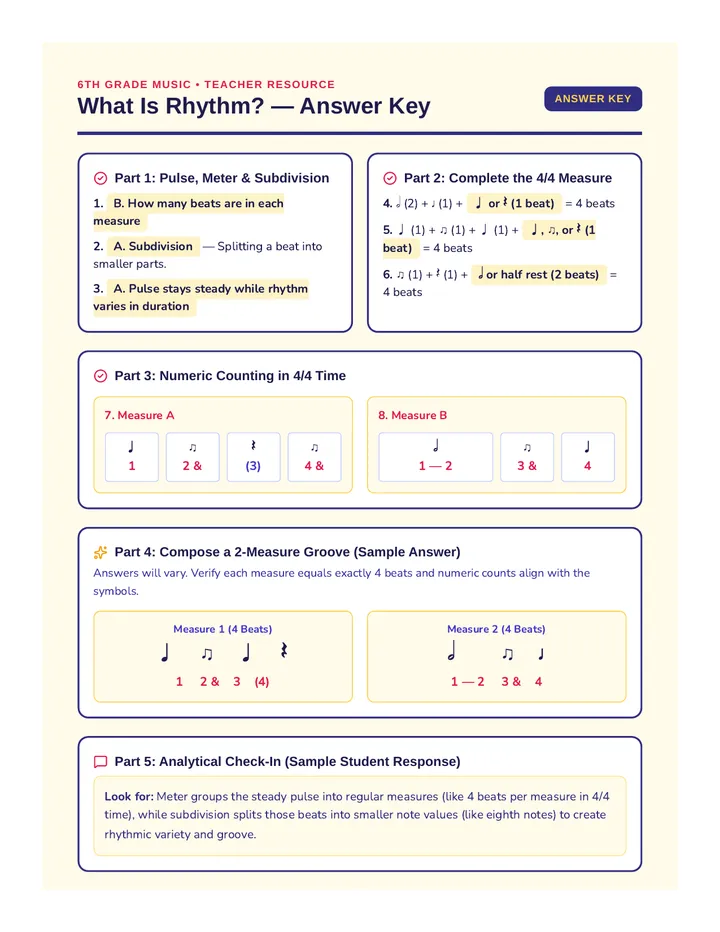
What Is Rhythm? — Answer Key
Answer Key
Part 1: Pulse, Meter & Subdivision
B. How many beats are in each measure
A. Subdivision — Splitting a beat into smaller parts.
A. Pulse stays steady while rhythm varies in duration
Part 2: Complete the 4/4 Measure
𝅗𝅥 (2) + ♩ (1) + ♩ or 𝄽 (1 beat) = 4 beats
♩ (1) + ♫ (1) + ♩ (1) + ♩, ♫, or 𝄽 (1 beat) = 4 beats
♫ (1) + 𝄽 (1) + 𝅗𝅥 or half rest (2 beats) = 4 beats
Part 3: Numeric Counting in 4/4 Time
7. Measure A
♩
♫
𝄽
♫
8. Measure B
𝅗𝅥
♫
♩
Part 4: Compose a 2-Measure Groove (Sample Answer)
Answers will vary. Verify each measure equals exactly 4 beats and numeric counts align with the symbols.
Measure 1 (4 Beats)
♩ ♫ ♩ 𝄽
1 2 & 3 (4)
Measure 2 (4 Beats)
𝅗𝅥 ♫ ♩
1 — 2 3 & 4
Part 5: Analytical Check-In (Sample Student Response)
Look for: Meter groups the steady pulse into regular measures (like 4 beats per measure in 4/4 time), while subdivision splits those beats into smaller note values (like eighth notes) to create rhythmic variety and groove.
Rhythm Makers Teacher Guide 6th Grade Music • 45 Minutes
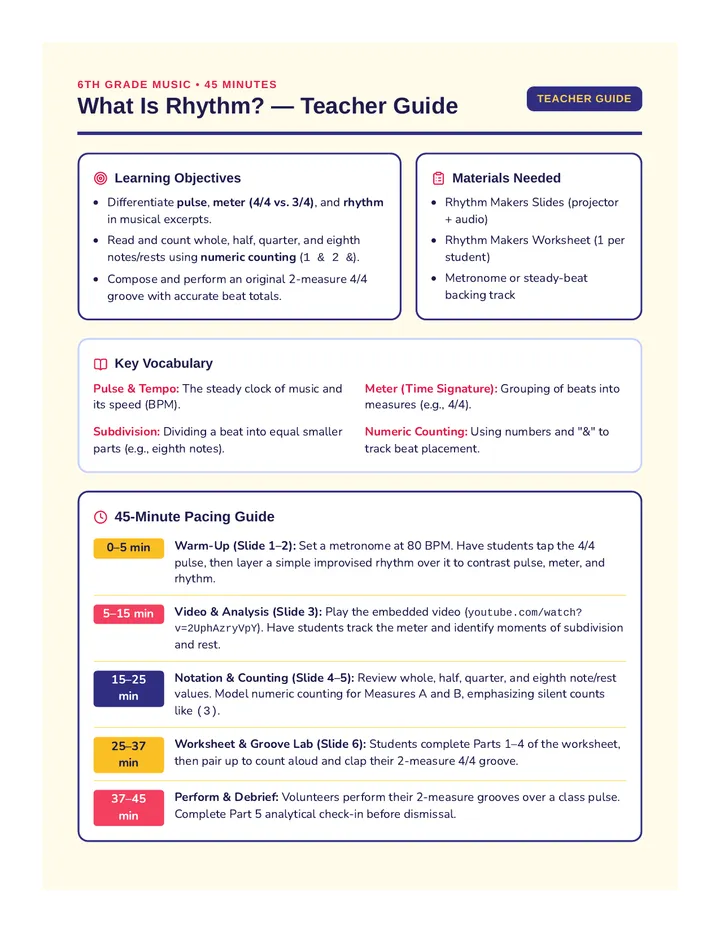
What Is Rhythm? — Teacher Guide
Teacher Guide
Learning Objectives
Differentiate pulse, meter (4/4 vs. 3/4), and rhythm in musical excerpts.
Read and count whole, half, quarter, and eighth notes/rests using numeric counting (1 & 2 &).
Compose and perform an original 2-measure 4/4 groove with accurate beat totals.
Materials Needed
Rhythm Makers Slides (projector + audio)
Rhythm Makers Worksheet (1 per student)
Metronome or steady-beat backing track
Key Vocabulary
Pulse & Tempo: The steady clock of music and its speed (BPM).
Meter (Time Signature): Grouping of beats into measures (e.g., 4/4).
Subdivision: Dividing a beat into equal smaller parts (e.g., eighth notes).
Numeric Counting: Using numbers and "&" to track beat placement.
45-Minute Pacing Guide
0–5 min
Warm-Up (Slide 1–2): Set a metronome at 80 BPM. Have students tap the 4/4 pulse, then layer a simple improvised rhythm over it to contrast pulse, meter, and rhythm.
5–15 min
Video & Analysis (Slide 3): Play the embedded video (youtube.com/watch?v=2UphAzryVpY). Have students track the meter and identify moments of subdivision and rest.
15–25 min
Notation & Counting (Slide 4–5): Review whole, half, quarter, and eighth note/rest values. Model numeric counting for Measures A and B, emphasizing silent counts like (3).
25–37 min
Worksheet & Groove Lab (Slide 6): Students complete Parts 1–4 of the worksheet, then pair up to count aloud and clap their 2-measure 4/4 groove.
37–45 min
Perform & Debrief: Volunteers perform their 2-measure grooves over a class pulse. Complete Part 5 analytical check-in before dismissal.
What Is Rhythm? — Facilitation & Support
Page 2
Video Facilitation Prompts
Source video: https://www.youtube.com/watch?v=2UphAzryVpY (embedded on Slide 3)
Before Watching: Ask students to count quietly in 4s (1-2-3-4) as soon as the musical examples begin.
Pause & Analyze: Pause after a rhythmic change and ask: "Did the tempo change, or did the musician subdivide the beat into shorter note values?"
After Watching: Discuss how rests function as active musical choices that shape phrasing and groove.
Common Misconceptions & Quick Fixes
Misconception 1: Confusing "fast rhythm" with "fast tempo."
Fix: Keep a steady 70 BPM metronome running while students clap quarter notes, then eighth notes—demonstrating that subdivision speeds up the rhythm without changing tempo.
Misconception 2: Misaligning numeric counts after a half note or rest.
Fix: Require students to write all 4 beat numbers (1 2 3 4) under every 4/4 measure first, using parentheses or dashes for held/silent beats.
Misconception 3: Overfilling or underfilling a 4/4 measure.
Fix: Have students add beat values like fractions (2 + 1 + ½ + ½ = 4) before performing their composition.
Differentiation Strategies
Extra Support
Provide a 4-box beat grid for Part 4 so each beat visually occupies one column before students combine beats into half notes.
Challenge / Extension
Invite students to incorporate sixteenth-note subdivisions (1 e & a) or rewrite their 2-measure groove in 3/4 time.
Ensemble Connection
Have band/orchestra students perform their composed rhythm on a concert B♭ or open string instead of clapping.