Mosaic Joy Slides 6th Grade Visual Arts
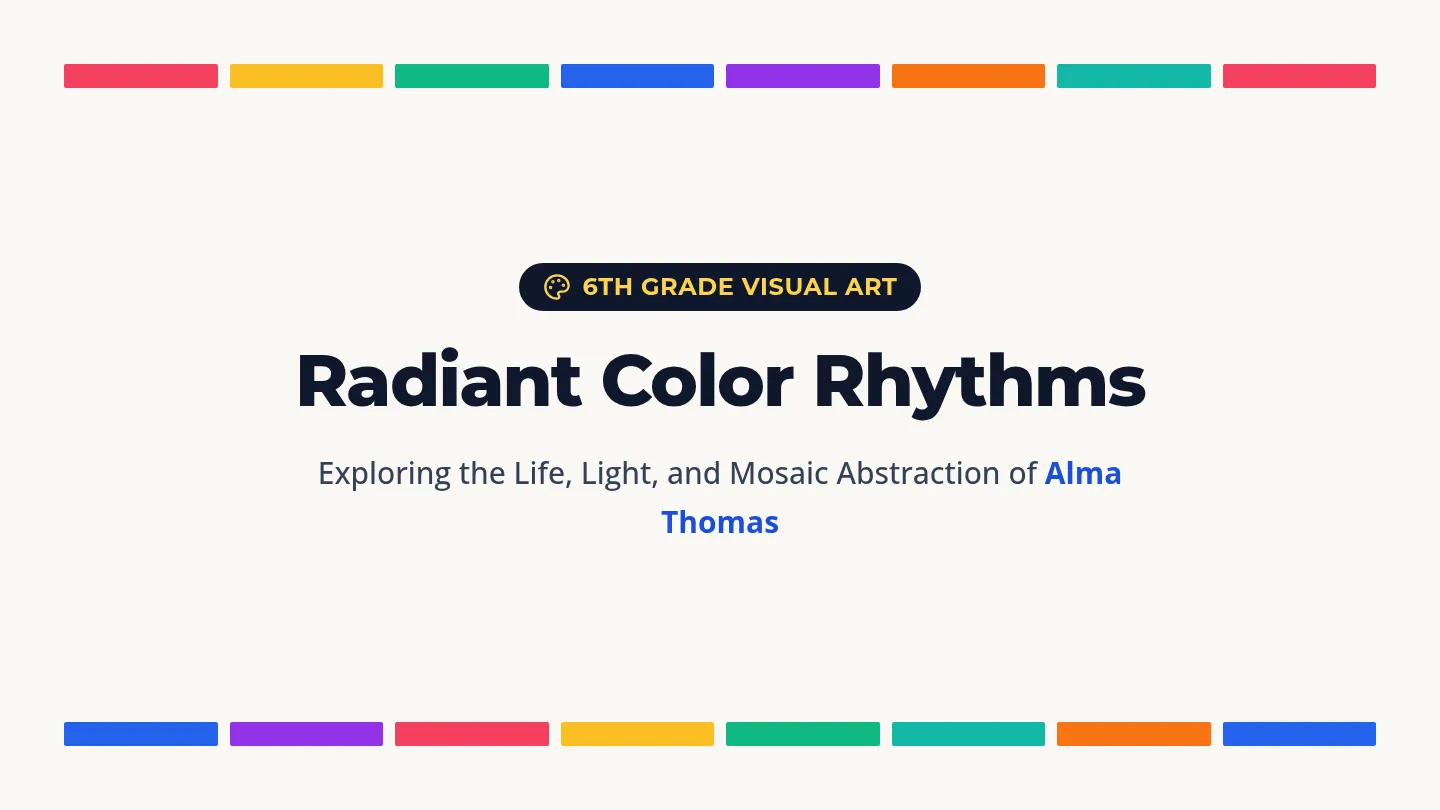
Alma Thomas:
Painting Pure Joy
Exploring Color, Rhythm, and Abstract Mosaics
1891 – 1978 • Washington, D.C.
Who Was Alma Thomas?
Teacher First, Painter Second
Born in Georgia in 1891, she moved to Washington, D.C. and became the first graduate of Howard University's Fine Arts department in 1924.
She taught middle school art for 35 years before retiring to paint full-time at age 68.
Making Art History
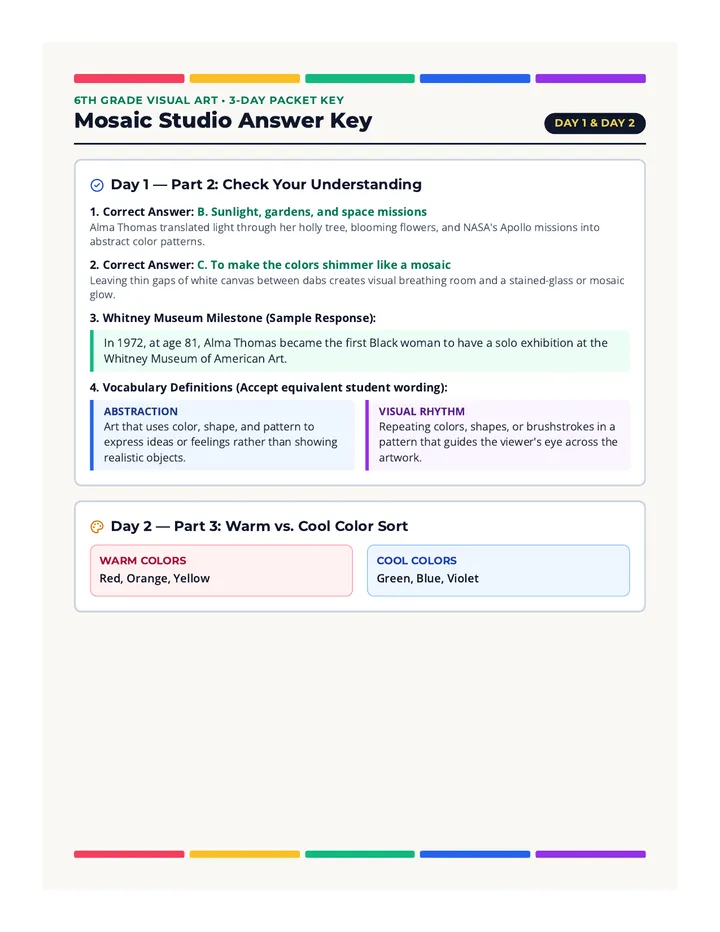
At age 81, she became the first African American woman to have a solo exhibition at the Whitney Museum in New York.
Her paintings now hang in the White House and major museums around the world.
Finding Inspiration in Everyday Wonder
Nature
Sunlight flickering through the holly tree outside her kitchen window and bright spring flowerbeds.
Music
Jazz and classical rhythms that inspired the beat, spacing, and movement of her brushstrokes.
Space
The 1969 Apollo 11 moon landing sparked her imagination about stars, eclipses, and Earth from above.
“Through color, I have sought to concentrate on beauty and happiness.”
“Alma’s Stripes” & Mosaic Rhythm
1. Short, Bold Dabs
Instead of blending paint smoothly, she placed rectangular dabs of pure color side by side.
2. White Breathing Space
Tiny slivers of white canvas peek between each dab, making the colors glow like stained glass.
3. Visual Rhythm
Repeating rows or rings of color guide your eyes across the painting like a musical beat.
Notice the white gaps between every dab!
Color Choices Create Mood
Warm Colors
Reds, oranges, and yellows feel energetic, sunny, and exciting—like a summer afternoon.
Cool Colors
Blues, greens, and violets feel calm, peaceful, and deep—like ocean water or night skies.
Complementary
Opposites on the color wheel (like blue & orange) create high contrast and visual vibration.
Art Detective: Look & Discuss
As we examine Alma Thomas’s paintings, ask yourself:
01
Color: Which color grabs your attention first, and what mood does the palette create?
02
Direction: Are the dabs arranged in straight columns, gentle waves, or glowing circles?
03
Title Clue: How does the abstract pattern connect to the title of the artwork?
Studio Challenge: Your Nature Mosaic
Step 1: Pick a Subject
Choose a moment in nature or space (a sunrise, rainstorm, flower garden, or solar eclipse).
Step 2: Choose a Palette
Select 4–5 colors (warm, cool, or complementary) that match the feeling of your subject.
Step 3: Plan Your Rhythm
Lightly sketch guide lines in pencil—vertical stripes, radiating rings, or swirling waves.
Step 4: Dab & Breathe
Place short rectangular dabs along your lines, leaving tiny white spaces between each mark.
Gallery Walk & Artist Statement
Before you share your mosaic with the class:
Give your artwork a creative title inspired by your subject.
Identify which color scheme you used (warm, cool, analogous, or complementary).
Notice one classmate’s painting and share how their rhythm makes you feel.
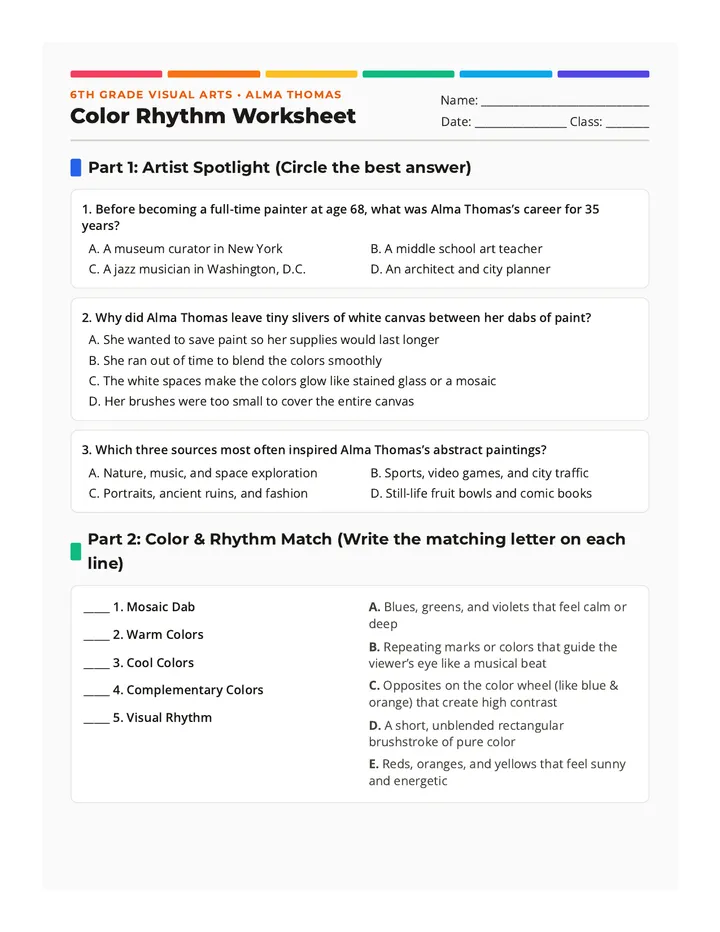
Color Rhythm Worksheet 6th Grade Visual Arts • Alma Thomas
Color Rhythm Worksheet
Name: _______________________________
Date: _________________ Class: ________
Part 1: Artist Spotlight (Circle the best answer)
1. Before becoming a full-time painter at age 68, what was Alma Thomas’s career for 35 years?
A. A museum curator in New York
B. A middle school art teacher
C. A jazz musician in Washington, D.C.
D. An architect and city planner
2. Why did Alma Thomas leave tiny slivers of white canvas between her dabs of paint?
A. She wanted to save paint so her supplies would last longer
B. She ran out of time to blend the colors smoothly
C. The white spaces make the colors glow like stained glass or a mosaic
D. Her brushes were too small to cover the entire canvas
3. Which three sources most often inspired Alma Thomas’s abstract paintings?
A. Nature, music, and space exploration
B. Sports, video games, and city traffic
C. Portraits, ancient ruins, and fashion
D. Still-life fruit bowls and comic books
Part 2: Color & Rhythm Match (Write the matching letter on each line)
_____ 1. Mosaic Dab
_____ 2. Warm Colors
_____ 3. Cool Colors
_____ 4. Complementary Colors
_____ 5. Visual Rhythm
A. Blues, greens, and violets that feel calm or deep
B. Repeating marks or colors that guide the viewer’s eye like a musical beat
C. Opposites on the color wheel (like blue & orange) that create high contrast
D. A short, unblended rectangular brushstroke of pure color
E. Reds, oranges, and yellows that feel sunny and energetic
Part 3: Studio Plan — Design Your Nature Mosaic
Page 2
1. My Nature or Space Subject:
Working Title for My Artwork:
2. My Color Palette (Color 4–5 swatches):
Circle one scheme: Warm | Cool | Complementary
3. Composition Sketch:
Sketch your guide lines (vertical columns, radiating circles, or waves) and test a few dabs with white space between them.
Part 4: Artist Statement Reflection
Explain how your color palette and dab direction express the mood of your nature or space subject.
Color Rhythm Answer Key Teacher Resource • Alma Thomas
Color Rhythm Answer Key
Answer Key
Part 1: Artist Spotlight
1. B — A middle school art teacher. Alma Thomas taught art at Shaw Junior High School in Washington, D.C. for 35 years before retiring at age 68 to paint full-time.
2. C — The white spaces make the colors glow like stained glass or a mosaic. Leaving breathing room between pure, unblended dabs creates luminous contrast.
3. A — Nature, music, and space exploration. Sunlight in her holly tree, jazz rhythms, and the 1969 Apollo 11 moon landing inspired her abstract works.
Part 2: Color & Rhythm Match
1. D — Mosaic Dab (short, unblended brushstroke)
4. C — Complementary Colors (opposites on wheel)
2. E — Warm Colors (reds, oranges, yellows)
5. B — Visual Rhythm (repeating marks/beat)
3. A — Cool Colors (blues, greens, violets)
Part 3 & 4: Studio Plan & Artist Statement Look-Fors
Studio Plan Checklist (Part 3):
Subject & Title: Clear nature or space inspiration paired with an evocative title (e.g., Midnight Rainstorm or Solar Flare Dance ).Color Swatches: 4–5 colors match the circled scheme (Warm, Cool, or Complementary).Composition Sketch: Guide lines show intentional direction (columns, rings, or waves) and test dabs leave visible white space between marks.
Sample 6th Grade Artist Statement (Part 4):
“I chose a cool color palette of blues, teals, and violets to show a calm ocean wave at twilight. My dabs curve in repeating horizontal rows with white spaces between them so the water looks like it is shimmering in the moonlight.”
Alma Thomas Teacher Guide 6th Grade Visual Arts • Teacher Facilitation
Alma Thomas Teacher Guide
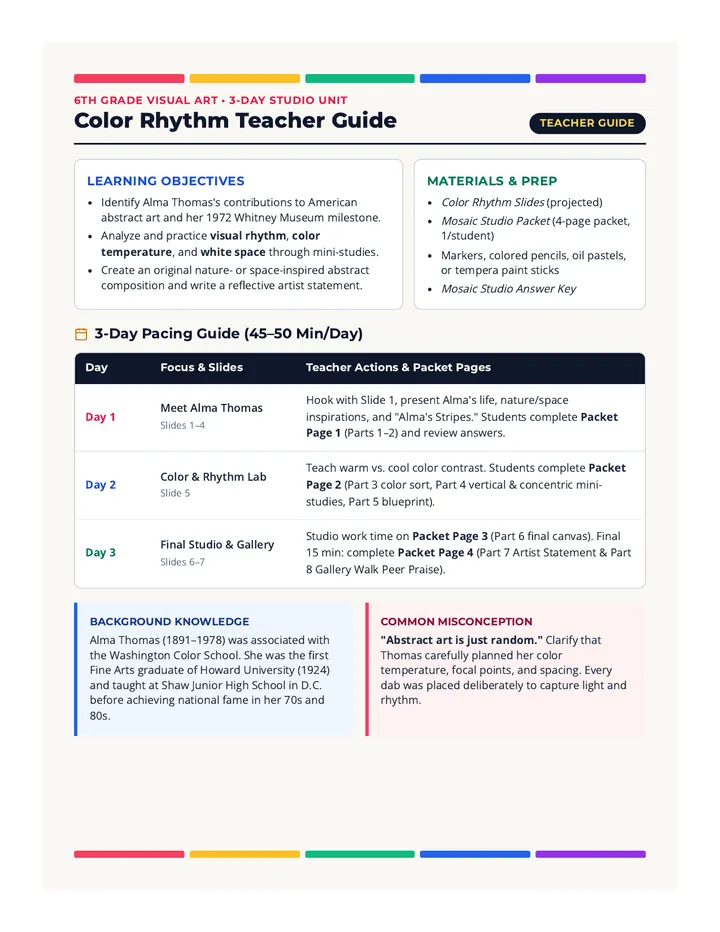
Time: Two 45-min periods
Learning Objectives
Identify how Alma Thomas used nature, music, and space to inspire abstract mosaic paintings.
Select a deliberate color scheme (warm, cool, or complementary) to communicate a specific mood.
Apply rhythmic, unblended dabs with white breathing space to create visual movement.
Studio Materials & Prep
9×12" heavyweight white drawing or watercolor paper
Tempera or acrylic paint + 1/2" flat brushes (or pre-cut colored paper strips & glue sticks)
Pencils, water cups, paper towels, palettes
Printed Color Rhythm Worksheet (1 per student)
Lesson Pacing & Facilitation Sequence
Day 1: Artist Discovery & Studio Planning (45 mins)
Hook (5 min): Show Slide 1. Ask students what feelings bright colors spark before revealing the artist.Mini-Lesson (15 min): Present Slides 2–5. Highlight that Thomas taught middle school art for 35 years before her museum breakthroughs. Model how leaving white canvas between dabs makes colors vibrate.Art Detective (10 min): Use Slide 6 while projecting an image of The Eclipse (1970) or Iris, Tulips, Jonquils, and Crocuses (1969). Have pairs discuss color, direction, and title clues.Check & Plan (15 min): Students complete Worksheet Parts 1–3 (quiz, vocabulary match, and composition sketch).
Day 2: Studio Creation & Gallery Walk (45 mins)
Studio Launch (5 min): Review Slide 7. Remind students to draw light pencil guide lines first, then paint one color family at a time.Studio Work Time (25 min): Circulate to coach spacing—remind students not to scrub or blend dabs together. Play instrumental jazz softly to reinforce the connection between musical rhythm and brushwork.Gallery Walk & Reflection (15 min): Display Slide 8. Students place their wet paintings on desks, complete Worksheet Part 4 (Artist Statement), and do a silent 5-minute gallery walk.
Coaching, Differentiation & Assessment
Page 2
Common Studio Pitfalls & Quick Fixes
Pitfall 1: Blending colors into mud. Fix: Have students rinse and blot their brush between colors, or assign one brush per color cup at shared tables.
Pitfall 2: Painting solid stripes with no white gaps. Fix: Tell students to "stamp and lift" their flat brush rather than dragging it, leaving a pencil-thin white border around every dab.
Pitfall 3: Random placement with no flow. Fix: Require 3–4 light pencil guide lines (rings, waves, or columns) before handing out paint.
Differentiation & Extensions
Language Supports
Post a visual color-wheel anchor chart with labeled mood words (energetic, calm, bold) and sentence starters for the Artist Statement.
Motor / Sensory Option
Offer pre-cut 1×1.5" construction paper rectangles or foam stamps so students can build the mosaic rhythm without brush-control frustration.
Early Finisher
Create a second mini-mosaic (4×6") using the opposite color temperature (e.g., if the first was warm, try cool) to compare moods.
Quick Studio Assessment Rubric (12 Points)
Criteria
3 — Exemplary
2 — Proficient
1 — Developing
Mosaic Dab & White Space
Consistent, unblended dabs with clear white breathing space throughout.
Mostly distinct dabs; white space visible in most areas.
Colors frequently blended together or solid with little white space.
Color Palette & Mood
Intentional palette (warm, cool, or complementary) strongly supports mood.
Palette mostly matches chosen scheme and subject.
Colors appear random without a clear scheme or mood.
Visual Rhythm
Clear directional flow (rings, stripes, or waves) guides the eye.
Some directional pattern is visible across the page.
Little evidence of directional planning or rhythm.
Artist Statement
Thoughtfully connects color, rhythm, and subject mood using art terms.
Explains color and subject choice clearly.
Incomplete or missing explanation of artistic choices.
Color Rhythm Worksheet 6th Grade Visual Arts • Alma Thomas
Color Rhythm Worksheet
Name: _______________________________
Date: _________________ Class: ________
Part 1: Artist Spotlight (Circle the best answer)
1. Before becoming a full-time painter at age 68, what was Alma Thomas’s career for 35 years?
A. A museum curator in New York
B. A middle school art teacher
C. A jazz musician in Washington, D.C.
D. An architect and city planner
2. Why did Alma Thomas leave tiny slivers of white canvas between her dabs of paint?
A. She wanted to save paint so her supplies would last longer
B. She ran out of time to blend the colors smoothly
C. The white spaces make the colors glow like stained glass or a mosaic
D. Her brushes were too small to cover the entire canvas
3. Which three sources most often inspired Alma Thomas’s abstract paintings?
A. Nature, music, and space exploration
B. Sports, video games, and city traffic
C. Portraits, ancient ruins, and fashion
D. Still-life fruit bowls and comic books
Part 2: Color & Rhythm Match (Write the matching letter on each line)
_____ 1. Mosaic Dab
_____ 2. Warm Colors
_____ 3. Cool Colors
_____ 4. Complementary Colors
_____ 5. Visual Rhythm
A. Blues, greens, and violets that feel calm or deep
B. Repeating marks or colors that guide the viewer’s eye like a musical beat
C. Opposites on the color wheel (like blue & orange) that create high contrast
D. A short, unblended rectangular brushstroke of pure color
E. Reds, oranges, and yellows that feel sunny and energetic
Part 3: Studio Plan — Design Your Nature Mosaic
Page 2
1. My Nature or Space Subject:
Working Title for My Artwork:
2. My Color Palette (Color 4–5 swatches):
Circle one scheme: Warm | Cool | Complementary
3. Composition Sketch:
Sketch your guide lines (vertical columns, radiating circles, or waves) and test a few dabs with white space between them.
Part 4: Artist Statement Reflection
Explain how your color palette and dab direction express the mood of your nature or space subject.