Color Rhythm Slides 6th Grade Visual Art
Radiant Color Rhythms
Exploring the Life, Light, and Mosaic Abstraction of Alma Thomas
Meet Alma Thomas (1891–1978)
Artist Spotlight
35 Years Teaching
Born in Georgia, Alma moved to Washington, D.C. and taught middle school art for 35 years, inspiring hundreds of young artists.
Second Act at 69
After retiring in 1960, she turned her kitchen into a sunlit studio and invented her bold, joyful abstract style.
Historic Milestone
In 1972, at age 81, she became the first Black woman to have a solo exhibition at the Whitney Museum of American Art.
"Through color, I have sought to concentrate on beauty and happiness, rather than on man's inhumanity to man." — Alma Thomas
Where Did She Find Inspiration?
Big Ideas
Backyard Nature
Alma watched sunlight flicker through the holly tree outside her living room window and studied blooming flowers in her garden.
Instead of drawing leaves or petals, she painted the feeling of light dancing through them.
The Space Age
Fascinated by NASA's Apollo moon missions and solar eclipses, she painted radiant bursts of color inspired by outer space.
Works like The Eclipse and Snoopy—Early Sun Display on Earth glow with cosmic energy.
Signature Style: "Alma's Stripes"
Technique
1. Hand-Painted Dabs
Short, uneven rectangular brushstrokes arranged in rows or rings—never mechanical or rigid.
2. Breathing White Space
Thin gaps of white canvas peek between every dab, making the colors shimmer like stained glass or mosaics.
3. Visual Rhythm
Repeating shapes and colors guide your eyes across the canvas like a musical beat.
Mosaic Rhythm Study
Notice the white space between every dab!
Color Temperature & Mood
Color Theory
Warm Colors
Red, Orange, Yellow: Feel energetic, sunny, loud, and close to the viewer. Great for sunlight, blossoms, and joy.
Cool Colors
Green, Blue, Violet: Feel calm, deep, breezy, and distant. Great for night skies, water, and shade.
Artist Tip: Placing a bright warm color next to a deep cool color creates contrast that makes both colors pop!
Today's Studio Challenge
Create
1
Pick Your Inspiration
Choose a nature or space theme: sunset, rainstorm, spring garden, ocean waves, or eclipse.
2
Choose a Color Palette
Select mostly warm or cool colors, plus one contrasting accent color to create energy.
3
Plan Your Rhythm
Decide on vertical columns, horizontal rows, or concentric circles radiating from a focal point.
4
Leave White Space
Keep thin white gaps between every dab of color so your artwork glows like a mosaic!
Gallery Walk & Reflection
Discuss
1. Mood & Color: How do your warm or cool color choices create a specific feeling?
2. Visual Rhythm: Where does your eye travel first, and how does the pattern keep it moving?
3. Peer Praise: Share one place where a classmate's white space made their colors glow!
Mosaic Studio Packet 6th Grade Visual Art • 3-Day Studio Packet
Mosaic Studio Packet — Day 1
Name: ______________________________
Date: ________________
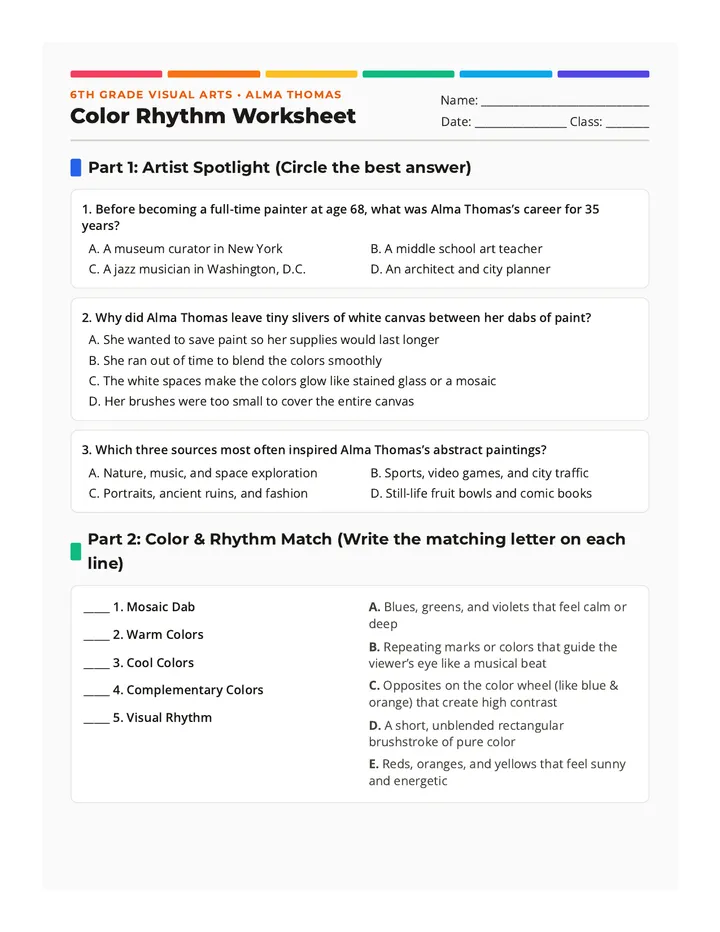
Part 1: Artist Spotlight — Alma Thomas (1891–1978)
Alma Woodsey Thomas was a trailblazing American painter and dedicated art teacher. For 35 years, she taught middle school art in Washington, D.C., encouraging students to observe the world closely. After retiring at age 69, Thomas turned her kitchen into a sunlit studio and began painting full-time. In 1972, at age 81, she made history as the first Black woman to have a solo exhibition at the Whitney Museum of American Art.
Instead of painting realistic people or objects, Thomas created vibrant abstract art. She found inspiration in sunlight flickering through the holly tree outside her window, colorful spring gardens, and NASA's Apollo space missions. Her signature style—nicknamed "Alma's Stripes"—uses short, hand-painted rectangular dabs of color arranged in rhythmic columns or concentric circles, with thin gaps of white canvas peeking through so every color glows like a mosaic.
Part 2: Check Your Understanding
1. Which of the following inspired Alma Thomas's abstract patterns?
A. Black-and-white city maps
B. Sunlight, gardens, and space missions
C. Realistic family portraits
D. Medieval stone castles
2. Why did Alma Thomas leave thin gaps of white canvas between her brushstrokes?
A. To save paint for future projects
B. To hide mistakes on the canvas
C. To make the colors shimmer like a mosaic
D. To finish her paintings in five minutes
3. Why was Alma Thomas's 1972 solo exhibition at the Whitney Museum historic?
4. In your own words, define these two art terms based on today's lesson:
Abstraction:
Visual Rhythm:
Mosaic Studio Packet — Day 2
Color & Rhythm Lab
Part 3: Warm vs. Cool Color Sort
Sort these six colors into the correct boxes below: Red, Blue, Yellow, Violet, Orange, Green .
Warm Colors (Energetic & Sunny)
Cool Colors (Calm & Breezy)
Part 4: Mosaic Rhythm Mini-Studies
Practice Alma Thomas's two signature patterns below before starting your final artwork. Leave thin white gaps between every dab!
Study A: Vertical Columns
Use mostly warm colors + 1 cool accent color.
Study B: Concentric Circles
Use mostly cool colors + 1 warm focal color.
Part 5: Final Artwork Blueprint
My Nature or Space Inspiration:
Pattern Choice (Columns, Rows, or Circles):
List your 4–5 chosen colors and the mood you want to create:
Mosaic Studio Packet — Day 3
Final Studio Canvas
Use your Day 2 blueprint to create your final Alma Thomas-inspired composition. Fill the canvas with hand-crafted rectangular dabs of color, keeping thin white spaces between every dab so your colors glow!
Artwork Title:
Artist Name:
Mosaic Studio Packet — Day 3 Reflection
Artist Statement & Critique
Part 7: My Artist Statement
1. What in nature or space inspired your artwork, and how does your title connect to it?
2. How do your warm or cool color choices and contrast create a mood or feeling?
3. Describe how you used "Alma's Stripes" (brushstroke shape, rhythm direction, and white space):
Part 8: Gallery Walk Peer Praise
Visit two classmates' artworks during the Gallery Walk. Write specific praise about their use of color, rhythm, or white space.
Classmate #1 Name: ______________________
What stands out about their color, rhythm, or white space?
Classmate #2 Name: ______________________
What stands out about their color, rhythm, or white space?
Mosaic Studio Answer Key 6th Grade Visual Art • 3-Day Packet Key
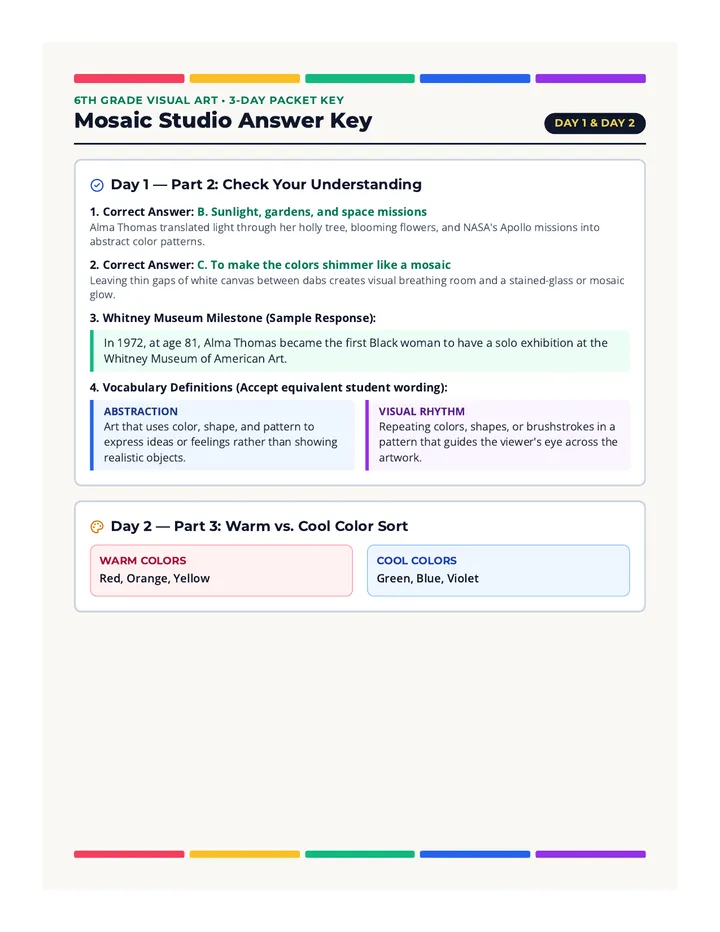
Mosaic Studio Answer Key
Day 1 & Day 2
Day 1 — Part 2: Check Your Understanding
1. Correct Answer: B. Sunlight, gardens, and space missions
Alma Thomas translated light through her holly tree, blooming flowers, and NASA's Apollo missions into abstract color patterns.
2. Correct Answer: C. To make the colors shimmer like a mosaic
Leaving thin gaps of white canvas between dabs creates visual breathing room and a stained-glass or mosaic glow.
3. Whitney Museum Milestone (Sample Response):
In 1972, at age 81, Alma Thomas became the first Black woman to have a solo exhibition at the Whitney Museum of American Art.
4. Vocabulary Definitions (Accept equivalent student wording):
Abstraction
Art that uses color, shape, and pattern to express ideas or feelings rather than showing realistic objects.
Visual Rhythm
Repeating colors, shapes, or brushstrokes in a pattern that guides the viewer's eye across the artwork.
Day 2 — Part 3: Warm vs. Cool Color Sort
Warm Colors
Red, Orange, Yellow
Cool Colors
Green, Blue, Violet
Mosaic Studio Answer Key — Page 2
Day 2 & Day 3 Look-Fors
Day 2 — Parts 4 & 5: Rhythm Mini-Studies & Blueprint
Study A (Vertical Columns): Uses mostly warm colors (red, orange, yellow) with at least one cool accent color (blue, green, or violet) arranged in vertical columns with white space between dabs.Study B (Concentric Circles): Uses mostly cool colors with a warm focal point in the center, radiating outward in rings with white space between dabs.Part 5 Blueprint: Student identifies a specific nature or space inspiration, selects a pattern direction, and lists 4–5 colors with a matching mood (e.g., "Solar Eclipse — dark violet, indigo, bright yellow, orange for a mysterious, glowing mood" ).
Day 3 — Part 6: Final Mosaic Studio Canvas
Craftsmanship & White Space: Short, hand-drawn/painted rectangular dabs fill the canvas while preserving thin, consistent white gaps between dabs.Pattern & Rhythm: Composition follows the student's chosen Day 2 pattern (columns, rows, or concentric circles).
Day 3 — Parts 7 & 8: Artist Statement & Peer Praise
1. Inspiration & Title (Sample): "My piece 'Midnight Comet' was inspired by outer space. The bright yellow center represents the comet streaking across a dark night sky."
2. Color & Mood (Sample): "I used cool blues and purples to make space feel calm and deep, and added warm yellow for exciting contrast."
3. Technique & Rhythm (Sample): "I used concentric rings of short rectangular dabs and left thin white spaces so the colors shimmer like Alma Thomas's mosaics."
Part 8 Peer Praise: Verify that students named two classmates and gave specific art-vocabulary feedback (mentioning color, rhythm, contrast, or white space) rather than generic comments like "it's nice."
Color Rhythm Teacher Guide 6th Grade Visual Art • 3-Day Studio Unit
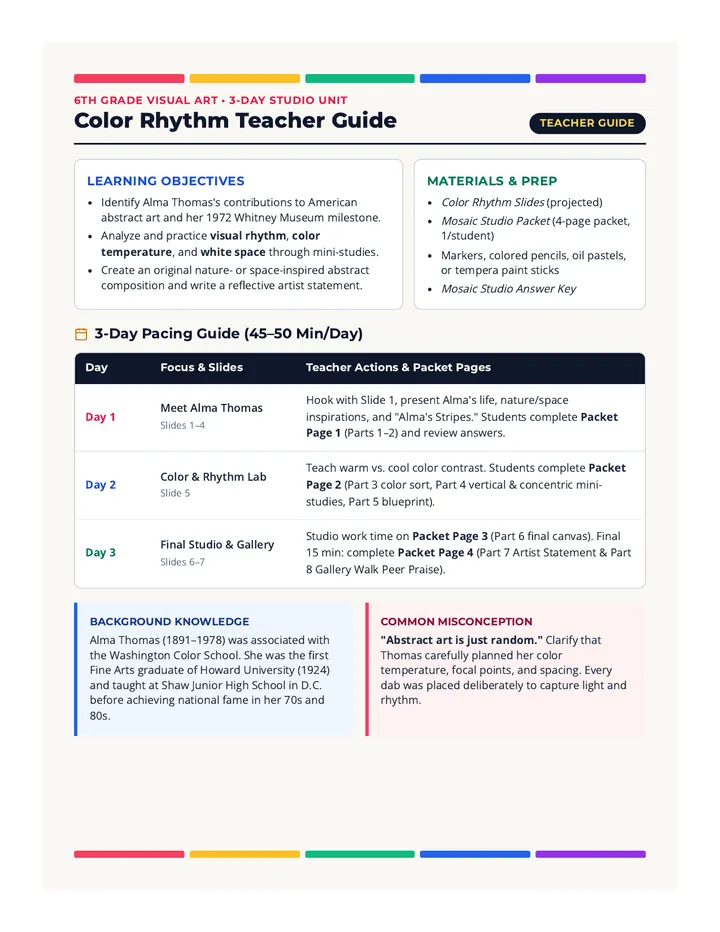
Color Rhythm Teacher Guide
Teacher Guide
Learning Objectives
Identify Alma Thomas's contributions to American abstract art and her 1972 Whitney Museum milestone.
Analyze and practice visual rhythm , color temperature , and white space through mini-studies.
Create an original nature- or space-inspired abstract composition and write a reflective artist statement.
Materials & Prep
Color Rhythm Slides (projected)Mosaic Studio Packet (4-page packet, 1/student)Markers, colored pencils, oil pastels, or tempera paint sticks
Mosaic Studio Answer Key
3-Day Pacing Guide (45–50 Min/Day)
Day
Focus & Slides
Teacher Actions & Packet Pages
Day 1
Meet Alma Thomas
Slides 1–4
Hook with Slide 1, present Alma's life, nature/space inspirations, and "Alma's Stripes." Students complete Packet Page 1 (Parts 1–2) and review answers.
Day 2
Color & Rhythm Lab
Slide 5
Teach warm vs. cool color contrast. Students complete Packet Page 2 (Part 3 color sort, Part 4 vertical & concentric mini-studies, Part 5 blueprint).
Day 3
Final Studio & Gallery
Slides 6–7
Studio work time on Packet Page 3 (Part 6 final canvas). Final 15 min: complete Packet Page 4 (Part 7 Artist Statement & Part 8 Gallery Walk Peer Praise).
Background Knowledge
Alma Thomas (1891–1978) was associated with the Washington Color School. She was the first Fine Arts graduate of Howard University (1924) and taught at Shaw Junior High School in D.C. before achieving national fame in her 70s and 80s.
Common Misconception
"Abstract art is just random." Clarify that Thomas carefully planned her color temperature, focal points, and spacing. Every dab was placed deliberately to capture light and rhythm.
Color Rhythm Teacher Guide — Page 2
Facilitation & Assessment
Differentiation Strategies
MLL / Language Support
Pre-teach abstract , mosaic , and rhythm using Slide 4's visual diagram. Provide sentence stems for Part 7's Artist Statement: "I chose ___ colors to show a ___ mood."
Scaffolded Support
Allow students to lightly sketch faint pencil guide lines (vertical columns or concentric rings) on their Day 2 mini-studies and Day 3 canvas before adding color dabs.
Early Finishers
Challenge students to create a bonus mini-study using the opposite color temperature (e.g., if they used warm colors, try cool colors) and compare the mood.
Key Discussion Prompts (Slides 3–5)
Day 1 (Slide 3 — Inspiration): "If you looked out your window right now, what colors and movement would you turn into an abstract painting?" Day 1 (Slide 4 — Technique): "How would Alma's paintings feel different if she colored every inch solid with no white space?" Day 2 (Slide 5 — Color Mood): "Why might an artist add one bright warm color inside a mostly cool-colored painting?"
3-Day Packet & Studio Rubric
Criteria
Exceeds / Meets (3–4 pts)
Developing (1–2 pts)
Day 1 & 2 Analysis & Studies
Accurate reading responses, color sort, and completed vertical/concentric mini-studies.
Incomplete responses or mini-studies missing white space/contrast.
Day 3 Mosaic Canvas
Consistent rectangular dabs with intentional white gaps and clear visual rhythm.
Dabs are blended together or rushed; pattern lacks clear direction.
Statement & Peer Praise
Artist statement connects color/rhythm to mood; specific vocabulary used in peer praise.
Reflection is brief or peer feedback lacks art vocabulary.