Pickleball Academy Study Packet
PBA
PICKLEBALL ACADEMY
Official High School Study Handbook
Part 1: Origins
01. Origins & Equipment Essential
An introduction to the history, equipment, and distinct characteristics of the world's fastest-growing sport.
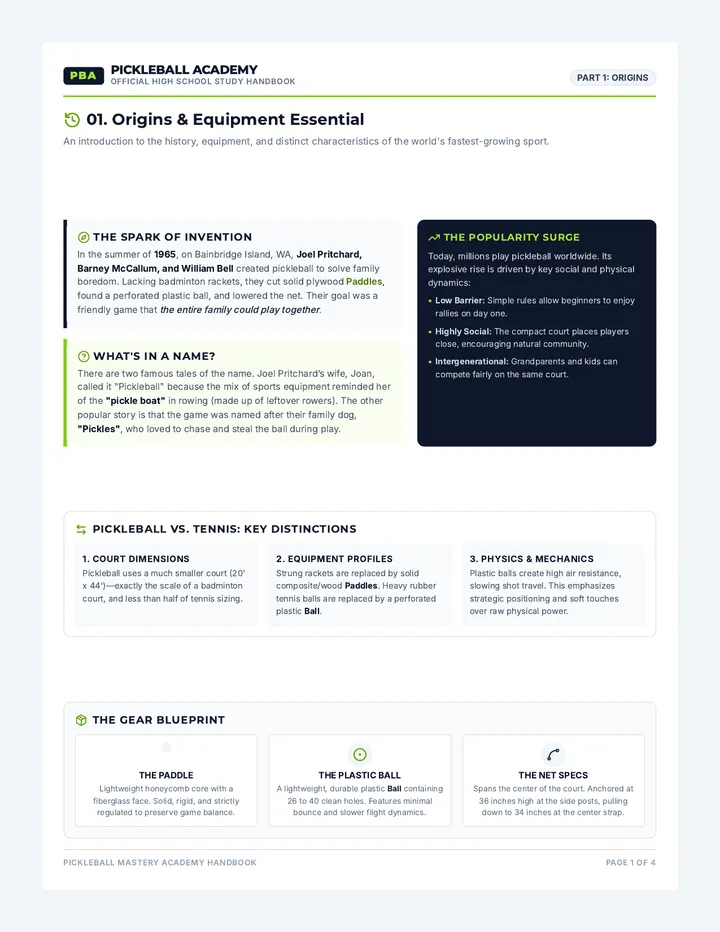
The Spark of Invention
In the summer of 1965, on Bainbridge Island, WA, Joel Pritchard, Barney McCallum, and William Bell created pickleball to solve family boredom. Lacking badminton rackets, they cut solid plywood Paddles, found a perforated plastic ball, and lowered the net. Their goal was a friendly game that the entire family could play together.
What's in a Name?
There are two famous tales of the name. Joel Pritchard’s wife, Joan, called it "Pickleball" because the mix of sports equipment reminded her of the "pickle boat" in rowing (made up of leftover rowers). The other popular story is that the game was named after their family dog, "Pickles", who loved to chase and steal the ball during play.
The Popularity Surge
Today, millions play pickleball worldwide. Its explosive rise is driven by key social and physical dynamics:
- • Low Barrier: Simple rules allow beginners to enjoy rallies on day one.
- • Highly Social: The compact court places players close, encouraging natural community.
- • Intergenerational: Grandparents and kids can compete fairly on the same court.
Pickleball vs. Tennis: Key Distinctions
1. Court Dimensions
Pickleball uses a much smaller court (20' x 44')—exactly the scale of a badminton court, and less than half of tennis sizing.
2. Equipment Profiles
Strung rackets are replaced by solid composite/wood Paddles. Heavy rubber tennis balls are replaced by a perforated plastic Ball.
3. Physics & Mechanics
Plastic balls create high air resistance, slowing shot travel. This emphasizes strategic positioning and soft touches over raw physical power.
The Gear Blueprint
The Paddle
Lightweight honeycomb core with a fiberglass face. Solid, rigid, and strictly regulated to preserve game balance.
The Plastic Ball
A lightweight, durable plastic Ball containing 26 to 40 clean holes. Features minimal bounce and slower flight dynamics.
The Net Specs
Spans the center of the court. Anchored at 36 inches high at the side posts, pulling down to 34 inches at the center strap.
PICKLEBALL MASTERY ACADEMY HANDBOOK PAGE 1 OF 4
PBA
PICKLEBALL ACADEMY
Official High School Study Handbook
Part 2: Court & Rules
02. Court Anatomy & Core Mechanics
Mastering court geometry, dimensions, and the foundational rules that govern legal match play.
TOP-DOWN COURT SPECIFICATIONS 20' x 44' Court Map
NET (34" Center / 36" Sides)
KITCHEN (7')
KITCHEN (7')
Sideline: 44 Feet Total Length
Baseline: 20' Width
Left Service Court
Right Service Court
Right Service Court
Left Service Court
20 ft x 44 ft Full Boundary Line
7 Feet Non-Volley Zone (NVZ)
34 Inches Center Net Height
10 ft x 15 ft Service Box Dimensions
The Non-Volley Zone ("Kitchen")
The Kitchen is the 7-foot restricted zone on both sides of the net. Its primary gameplay purpose is to prevent players from standing right at the net and executing powerful downward smashes. Volleying (striking the ball directly out of the air) is strictly forbidden while standing inside this zone. A player incurs a Fault if they step in the kitchen during or after striking a volley.
The Underhand Serve Mechanics
In pickleball, the Serve must be hit completely underhand, with upward paddle motion. Contact must occur below the waist line, and paddle head must remain below the wrist joint. This design exists to keep serves as a clean, simple point-initiating mechanism rather than a dominant, aggressive weapon, encouraging long rallies.
The Double Bounce Rule
This rule dictates that the ball must bounce once on each side of the court before anyone can hit a volley:
- The receiving team must let the serve bounce in their court before hitting it back.
- The serving team must let the return shot bounce once in their court before striking it.
After these two initial bounces have occurred, players are free to either volley the ball or play it off a bounce.
The "Side Out" Mechanic
A Sideout occurs when the serving team loses a rally, resulting in the transfer of service rights to the opponents. In doubles play, both teammates serve (except on the very first service turn of the game) before a sideout is declared. Remember: points can only be scored by the team currently holding the serve!
PICKLEBALL MASTERY ACADEMY HANDBOOK PAGE 2 OF 4
PBA
PICKLEBALL ACADEMY
Official High School Study Handbook
Part 3: Strategy
03. Tactical Playbook & Trajectories
Understanding the dynamic chess match of pickleball, from soft kitchen control to power drives.
TACTICAL SHOT TRAJECTORY CHART
NET
KITCHEN BOUNDARY
LOB THIRD SHOT DROP DINK DRIVE (FAST)
Your Baseline
Opponent Baseline
• The Dink Soft, low-risk placement
• Third Shot Drop Transition facilitator
• Power Drive Fast, low clearance
• Defensive Lob Deep high-arc recovery
The Strategic "Dink" Shot
A Dink is a soft, controlled shot hit from a player standing near their non-volley zone line that arcs gently over the net and lands directly within the opponent's kitchen. It neutralizes an opponent's aggressive hitting angles, forcing them to hit upward and limiting their ability to hit downward offensive smashes.
The Critical Third Shot Drop
The Third Shot Drop is widely considered the most important tactical shot in doubles. Executed by the serving team from their baseline, this high-arc, soft Drop lands in the opponent's kitchen, giving the serving team crucial time to run forward and secure their place at the kitchen line.
Offensive Playbook
-
- Net Rush & Command: Get both partners to the kitchen line immediately. This cuts off court angles and builds immense pressure.
-
- The Overhead Smash: When an opponent pops a ball high over the net, strike it with a powerful downward Smash at their feet.
Defensive Playbook
-
- Defensive Lob: High, deep Lob shots designed to fly over net-rushers and force them to retreat back to their baseline.
-
- Pace Reset: Absorb hard incoming drives by loosening paddle grip and gently "blocking" the ball into the kitchen to stop aggressive volleys.
PICKLEBALL MASTERY ACADEMY HANDBOOK PAGE 3 OF 4
PBA
PICKLEBALL ACADEMY
Official High School Study Handbook
Part 4: Applied Skills
04. Teamwork, Training & Academy Glossary
Applied techniques for doubles collaboration, reflex training, and a complete glossary of essential match vocabulary.
Doubles Dynamics & Communication
In Doubles play, communication is the ultimate catalyst. Because rallies are incredibly fast-paced, teammates must verbalize. Calling out "Mine!", "Yours!", or "Switch!" prevents collisions and ensures maximum court coverage. Partners must shift side-to-side and back-to-front like they are tied by an invisible rope.
Reflexes & Key Success Skills
Successful players develop high hand-eye coordination, lateral footwork agility, and paddle-face angle control. To improve reaction time: players utilize wall drills, dynamic split-stepping (entering a ready stance as the opponent hits), and focus drills to read the opponent's paddle early.
3-Step Beginner Training Progression
- 1 Paddle Control: Practice simple solo bouncing on the paddle face to master ball-handling and develop spatial feel.
- 2 The Groundstroke Rhythm: Practice cooperative rallies, strictly enforcing the double-bounce rule to master depth and movement.
- 3 Kitchen Positioning & Dinks: Practice positioning at the NVZ line, executing light-touch soft dinks to develop patient discipline.
Court Etiquette & Sportsmanship
Pickleball’s global community thrives on respect and high sportsmanship. Key standards include: calling lines honestly (giving the benefit of the doubt to opponents), calling out the score loudly before every serve, and tapping paddle handles at the net after every single match to show appreciation.
Academy Glossary & Match Terms (Crossword Cheat Sheet)
Pickleball The 1965 family sport.
Paddle Solid wood/composite tool.
Ball Perforated plastic object.
Serve Underhand start shot.
Kitchen Volley-forbidden zone.
Volley Striking ball out of air.
Dink Soft, strategic NVZ shot.
Fault Rule violation ending play.
Rally Continuous play back-and-forth.
Baseline The back boundary line.
Sideout Losing service rights.
Ace Unreturned scoring serve.
Doubles 2v2 team formatted match.
Smash Powerful downward overhead.
Lob High defensive arching shot.
Drop Soft strategic arc shot.
PICKLEBALL MASTERY ACADEMY HANDBOOK PAGE 4 OF 4