Mixed Media Collage Slides Mixed Media
Collage Creation
Layering Textures, Colors, and Stories
What is Mixed Media?
Mixed media art involves combining different artistic mediums to create a single piece.
Paper & Cardboard
Fabric & Textiles
Found Objects (buttons, wire, leaves)
Paint & Markers
"The goal is to blend these elements into a cohesive, tactile story."
The "Secret Sauce"
Texture
How a surface feels or looks like it feels. Think about rough vs. smooth, soft vs. hard.
• Corrugated cardboard (Rough)
• Silk scraps (Smooth)
• Sandpaper (Gritty)
Color Harmony
Choosing colors that work together to create a mood. You can use contrast or stay within a palette.
• Complementary (Opposites)
• Analogous (Neighbors)
• Monochromatic (One color)
Techniques to Try
Layering
Place thin materials over thick ones. Let the bottom layers peek through.
Tearing vs. Cutting
Torn edges look organic and soft. Cut edges look sharp and intentional.
Overdrawing
Use markers or paint on top of your glued objects to unify the piece.
Your Turn!
Create a mixed media collage that reflects a Theme or Mood.
The Process:
Choose a theme (e.g., "Memory," "Storm," "City Night").
Arrange your materials without glue first.
Check for color and texture balance.
Glue down, layer, and add finishing touches with markers.
Gallery Walk
Prepare to share your focal point and your material choices.
Focus on
Texture Blending
Focus on
Color Harmony
Layered Worlds Lesson Plan Teacher Resource
Layered Worlds
Mixed Media Collage Creation
Time
60 Minutes
Audience
Ages 13-18
Approach
Texture & Color Harmony
Why this Lesson?
Students explore the world of mixed media by combining paper, fabric, and found objects. This lesson helps develop creativity, problem-solving skills, and a deep appreciation for the tactile nature of multi-layered artwork.
Learning Objective
Students will learn how to blend different textures and colors to create a cohesive mixed media piece, focusing on compositional balance and material interplay.
Materials Checklist
Paper (various colors/weights)
Fabric scraps & ribbons
Found objects (buttons, wire, etc.)
Glue sticks & liquid glue
Scissors & X-Acto knives
Markers & paint pens
Paintbrushes & water jars
Instructional Sequence
10m
Introduction & Inspiration
Welcome students and define Mixed Media: art that combines different mediums (paper, fabric, objects).
Discuss the primary goal: blending textures and colors into a single, cohesive vision.
Show physical samples or slides to highlight how different materials interact.
10m
Technical Demonstration
Composition: Arrange materials on the base paper without gluing first to test the "flow."Adhesion: Use glue sticks for thin paper; use liquid glue for heavy found objects (buttons, fabric).Blending: Show how to layer paper over fabric or use markers to draw "bridges" between different materials.Harmony: Discuss color palettes and how choosing a limited set of colors can unify diverse materials.
30m
Hands-On Creation
Identify a Theme: Encourage a focal point (a memory, a feeling, an abstract idea).Guided Experimentation: Walk around to assist with technical glue challenges or compositional blocks.Focus: Remind students to play with overlapping and transparency .Pacing: Give a 10-minute warning for students to finalize their "sticking" process.
10m
Critique & Clean-Up
Share: Each student presents their theme and material choices.Discussion: Use the Collage Chat Discussion Guide for specific prompts.Tidy Up: properly dispose of waste and store liquid glue bottles upright. Collage Chat Discussion Guide Collage Chat
Reflection & Discussion Guide
Student:
Date:
Reflection is a vital part of the artistic process. Use these questions to think about your decisions, the materials you chose, and how your final piece came together. Be prepared to share your insights with the group.
1
Material Choices
What specific materials (paper, fabric, found objects) did you use in your collage? Why did these items feel right for your theme?
2
Texture & Color Impact
How did blending different textures and colors affect the mood of your artwork? Does the piece feel "heavy," "light," "chaotic," or "calm"?
3
The Problem-Solving Phase
What was the biggest challenge you faced during the creation process (e.g., glue issues, composition balance)? How did you solve it?
4
Creative Discoveries
What did you enjoy most about this activity? Did you discover a new material or technique that you want to use again?
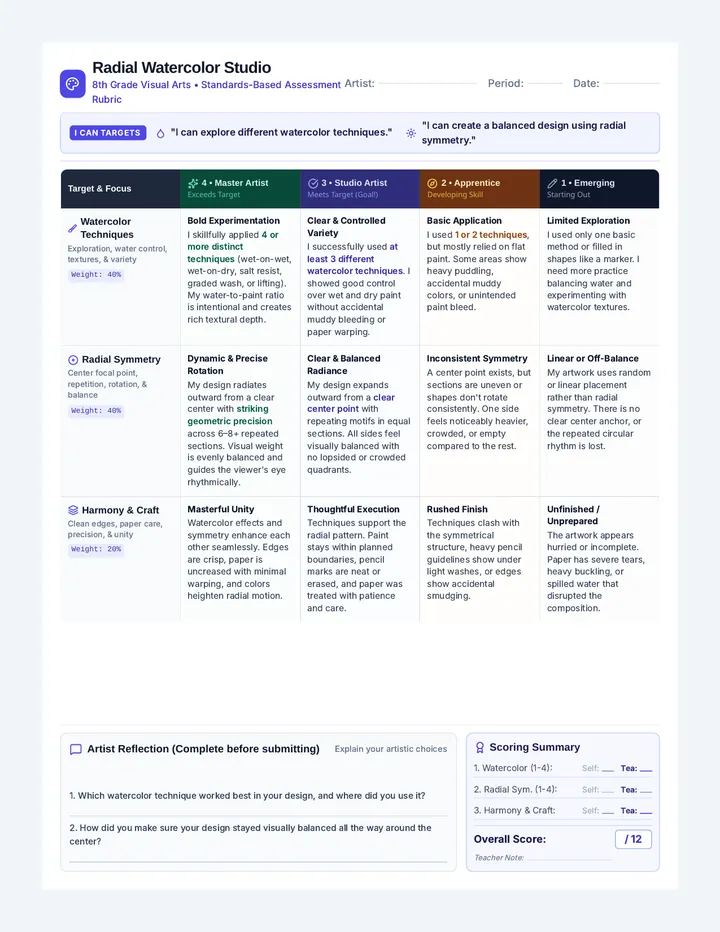
Mixed Media Mastery Rubric Mixed Media Mastery
Assessment Rubric & Feedback Tool
Student Name
Total Score
Criteria Expert (4) Proficient (3) Developing (2) Texture Blending Materials are layered seamlessly; transitions between paper, fabric, and objects feel intentional and unified. Successfully combines different materials with clear layering and thoughtful placement. Uses multiple materials, but they may feel scattered or lack physical integration. Color Harmony Palette is sophisticated and highly effective in creating a specific mood or theme. Color choices are complementary and contribute to the overall cohesion of the piece. Uses multiple colors, but the palette may feel disjointed or clash with the theme. Technical Adhesion All materials are securely adhered with no visible excess glue; delicate items are handled with care. Most materials are secure; glue is mostly hidden and appropriate for the weight of materials. Some items may be loose or falling off; significant visible glue residue. Theme & Creativity The artwork tells a powerful story or represents a clear, unique abstract concept. A focal point or theme is clearly identifiable and well-executed. The theme is present but may be difficult to discern or lacks personal creative input.
Strengths
Growth Areas
Note for Peer Critique: When providing feedback, focus on one specific area of "Texture Blending" you admired and one "Theme" question you have for the artist.