Students learn to adapt the Method of Loci for Chinese character components, creating spatial narratives to encode complex Hanzi into long-term memory.
A 45-minute ESL lesson for Grade 4 (Emerging/Developing proficiency) focused on interpreting and explaining information from infographics. Students act as 'Data Detectives' to decode visual information.
In this 45-minute Grade 5 ESL lesson, students will master precise academic language to describe cause-and-effect relationships. They will explore how natural disasters and social scenarios create chain reactions, using transitional phrases like 'consequently', 'as a result', and 'triggered by'.
A comprehensive lesson on identifying and marking broad vowel sounds for A, O, and U. Students learn the phonetic differences between short and broad sounds and master the marking conventions for single-letter vowels and multi-letter phonograms.
A B1-level Spanish lesson for adults focusing on narrative tenses. Students practice translating a multi-tense text and completing a verb-focused fill-in-the-blanks activity centered around the theme of time and personal history. Includes simplified vocabulary and clearer tense structures.
Studies the stages of growth in animals, using WIDA's Narrate (life stories) and Explain (scientific stages) functions.
Analyzes how communities access needs and wants, focusing on the WIDA functions of Argue (persuasive needs) and Explain (the journey of goods).
Investigates the characteristics of living things, utilizing WIDA's Inform function to define life and Explain function to describe biological processes.
Explores family structures, roles, and traditions while focusing on the WIDA functions of Narrate (family stories) and Inform (identifying family members).
A comprehensive diagnostic assessment suite designed for adult learners to determine their current Spanish proficiency level across reading, writing, listening, and speaking. The materials move from foundational basics to advanced structures to provide a clear placement for the learner.
A beginner-friendly lesson introducing common farm animals, their sounds, and basic characteristics for ESL newcomers. Includes a visual slide deck, a reading comprehension worksheet, and an answer key.
A French grammar lesson focused on distinguishing between the Passé Composé and Imparfait through a mystery narrative. Students learn to set the scene with descriptions (Imparfait) and identify completed actions (Passé Composé).
This lesson provides essential visual tools for 8th-grade ESL beginners, focusing on classroom navigation, common objects, and foundational phonics to build immediate confidence and communication skills.
A foundational lesson for absolute beginner ESL students focusing on high-frequency vocabulary for daily life and basic conversational structures. Students will learn greetings, common objects, and simple "I am/I have" sentences.
Une leçon complète pour comprendre et identifier les mots d'une même famille, avec une fiche mémo, des exercices et un support de présentation.
A vibrant introduction to Spanish for early learners (0-5) centered around a rainbow theme. This lesson plan provides 15 interactive play station ideas, a circle time presentation with songs and science, and bilingual support materials.
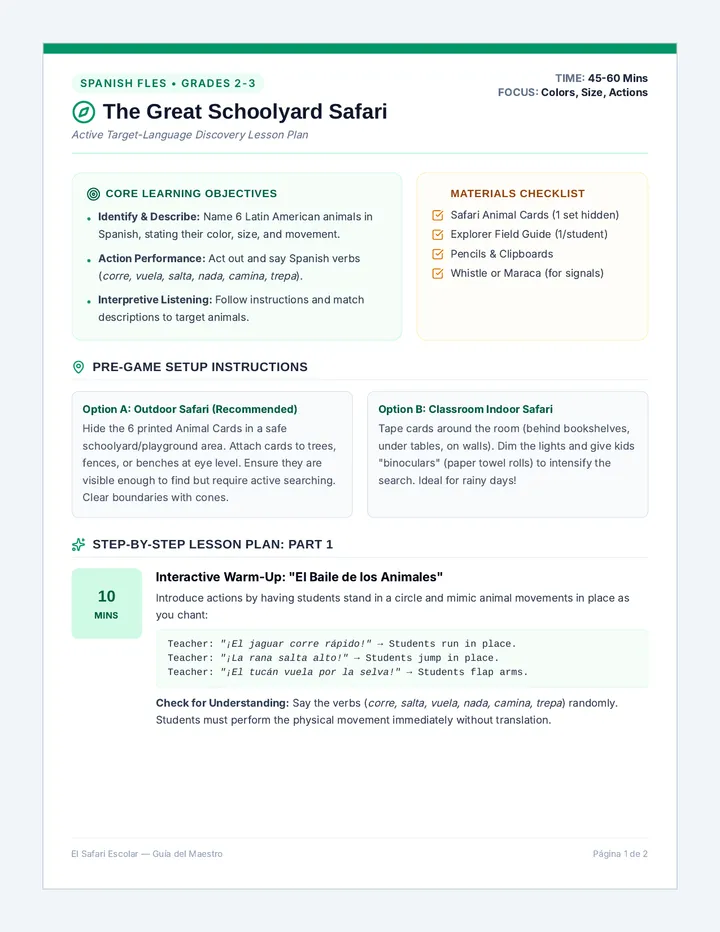
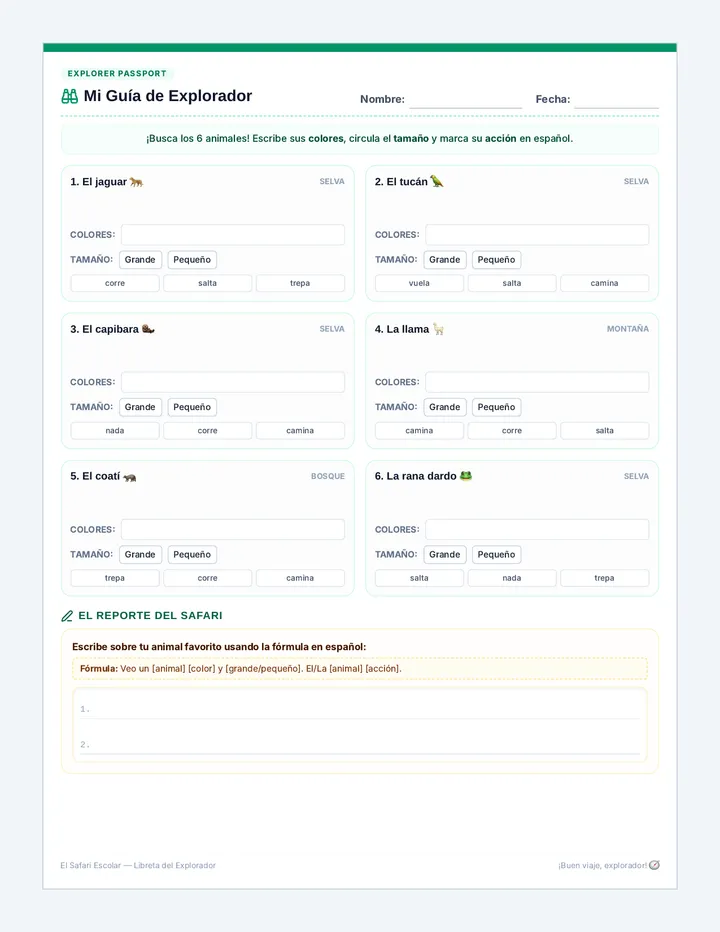
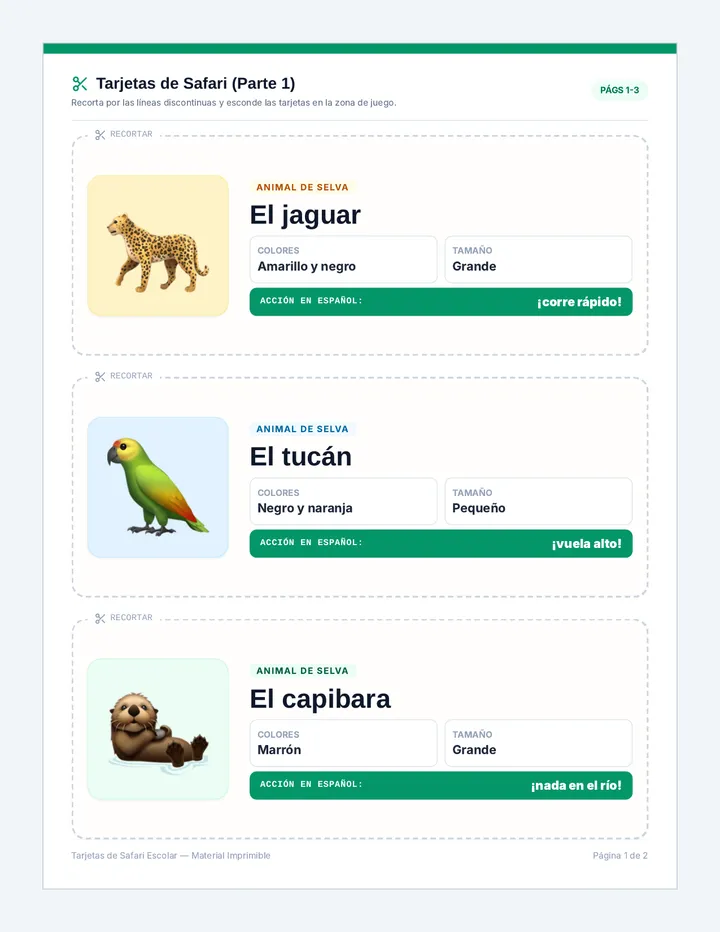
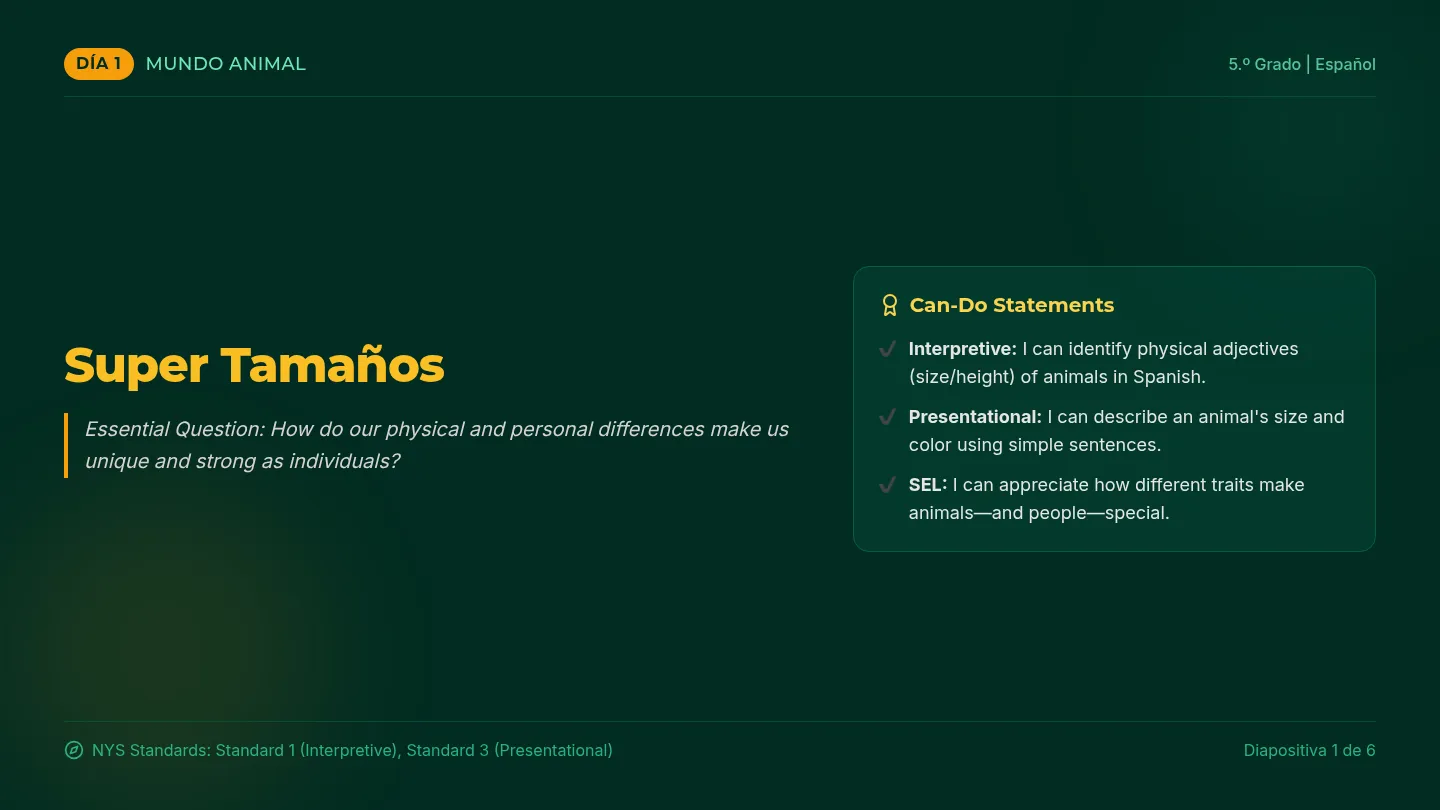
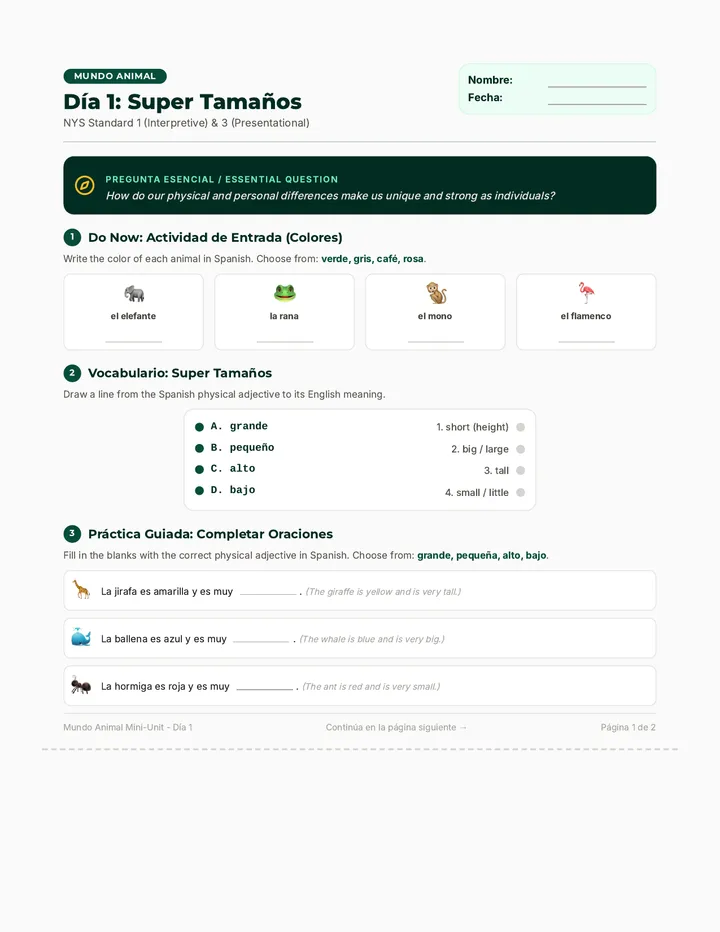
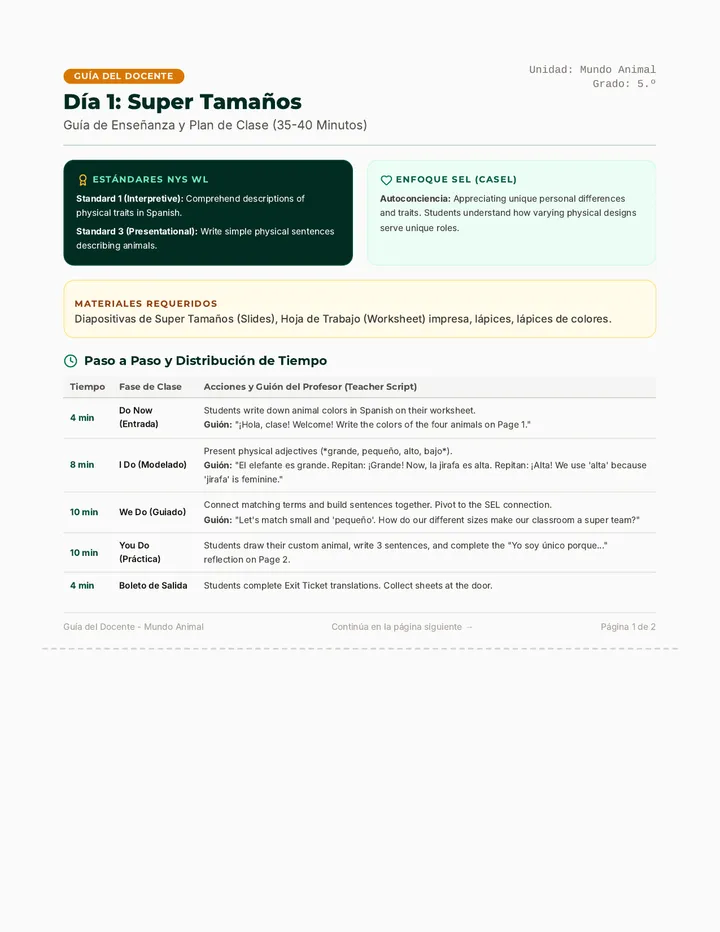
A lesson focused on animal characteristics and habitats, helping students build descriptive vocabulary.
A 30-minute Spanish phonics lesson for 2nd graders focusing on the orthographic differences between s, z, and soft c, themed around the life of Eleanor Roosevelt. Students will distinguish these identical sounds in writing through a historical lens.
An introductory Irish Gaelic (Gaeilge) lesson covering greetings, animals, colors, and basic conversational questions with a focus on pronunciation.
Une leçon interactive centrée sur les interactions sociales au restaurant, permettant aux élèves de maîtriser le vocabulaire de la commande, du service et du paiement.
A comprehensive introductory lesson to Japanese focusing on essential greetings, Hiragana basics, classroom etiquette, and everyday objects.
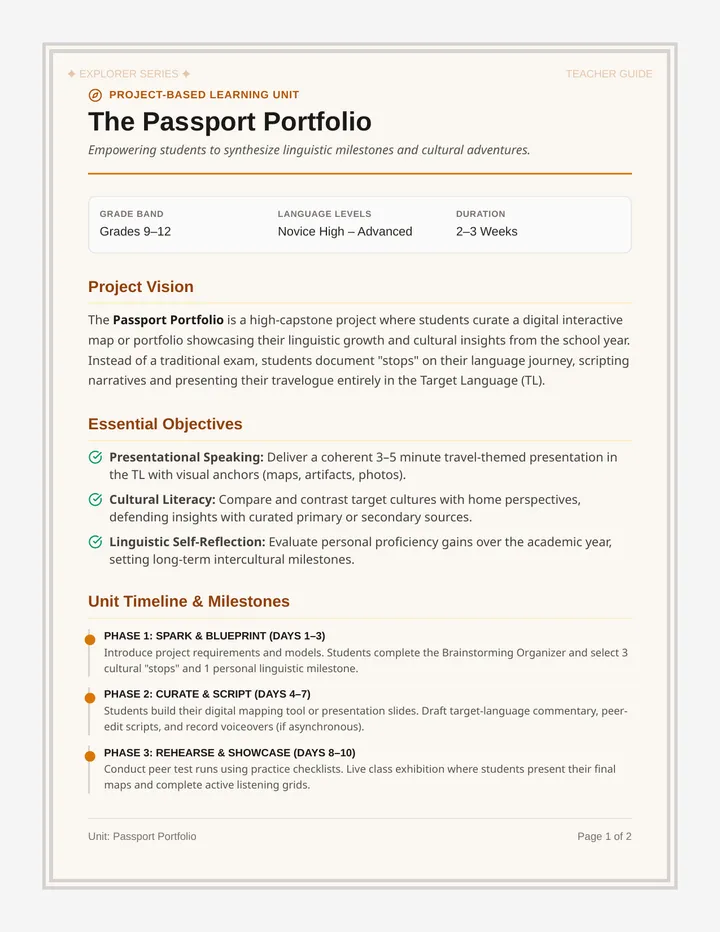
A comprehensive framework for foreign language educators to guide students through deep linguistic and cultural analysis of film, focusing on visual storytelling and advanced listening strategies.
An introductory Spanish 1 lesson focused on family vocabulary, possessive adjectives, and the verbs ser, tener, and llamarse. Students will learn to describe their family members and pets while practicing subject pronouns.
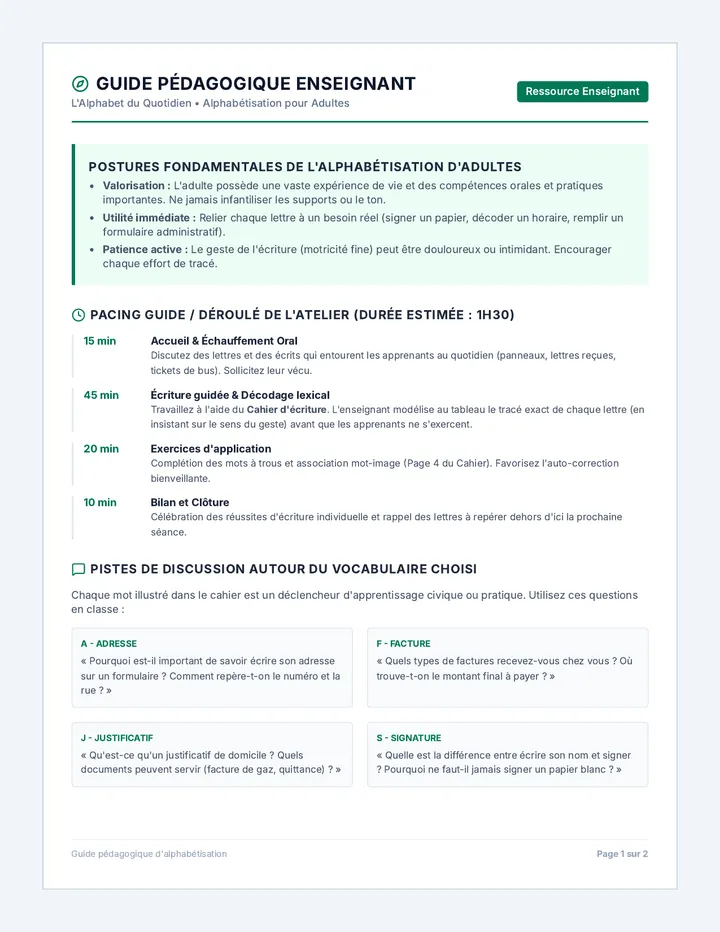
A Spanish letter formation and tracing program designed for Tier 3 students to master the alphabet, with a special focus on frequently reversed letters like b, d, p, and q.
Cette leçon porte sur la formation et l'utilisation du présent progressif (Estar + Gérondif) en espagnol pour des élèves de 5ème. Elle comprend une fiche de rappel avec exercices d'application et une fiche d'évaluation des acquis.
Cette leçon porte sur la formation et l'utilisation du présent progressif (estar + gérondif) en espagnol pour décrire des actions en cours. Elle comprend une fiche d'exercices complète avec un rappel de cours.
A fun and engaging phonics worksheet designed for 2nd-grade students to practice Spanish diphthongs, consonant blends, and nasal blends through visual activities and tracing. This resource is specifically designed to be accessible for non-readers and provides a calming activity after state testing.
A comprehensive 75-minute lesson for B2-C1 adult learners exploring the SINK and DINK lifestyles through advanced grammar (future perfect, passive, mixed conditionals) and nuanced discussion.
A lesson focused on the fundamental components of a complete sentence in Spanish: capitalization, word spacing, and ending punctuation (periods).
A creative 9th-grade lesson exploring Afro-Latino identity and culture through Spanish writing and artistic mural design. Students learn about key figures and cultural motifs before creating their own symbolic portfolio.
A foundational lesson for Level 1 English Learners to practice constructing simple Subject-Verb and Subject-Verb-Adjective sentences using visual scaffolds and word banks.
An immersive culinary language lesson for adult learners focusing on food vocabulary, restaurant interactions, and cultural dining customs.
A comprehensive toolkit for foreign language teachers to bridge the gap between rote memorization and spontaneous oral communication through interactive activities and low-stakes scaffolding.
A fun, movement-based lesson for early elementary ESL students to learn directional opposites (Up/Down, High/Low) using playground equipment and a catchy song. Students will engage in pronunciation practice, video analysis, and a partner dictation activity using character cut-outs.
A vibrant, high-energy vocabulary reinforcement lesson for 1st-grade ESL/ELL students focused on identifying and labeling body parts through song, movement, and a creative monster-building activity.
A foundational ESL lesson focused on numbers 1-10, connecting spoken words, written forms, and quantities through music, video, and movement. Students engage in choral counting, video-based handwriting practice, and a classroom-wide labeling activity.
A foundational grammar lesson for ESL/ELL students focusing on the four most common irregular verbs (be, have, do, say) and their past tense forms through video analysis and scaffolded storytelling.
A lesson for English Language Learners to identify and practice common American idioms using visual aids and video-based instruction. Students will explore literal vs. figurative meanings and practice using idioms in spoken sentences.
A 1st-grade phonics and sight word lesson focused on the word 'cut' and the 'ut' word family, featuring a catchy song and a hands-on sentence scramble activity.
This lesson focuses on helping intermediate ELL students choose the correct relative pronouns (who, that, which) based on whether the antecedent is a person or a thing, using the 'Cranky Witch' mnemonic from Khan Academy.
An intermediate ESL lesson focused on mastering the pronunciation of the most irregular English verbs, specifically targeting vowel shifts in 'said/fled' and silent 'L' in 'could/should/would'.
This culminating lesson applies the four tones to the syllable 'ma' to demonstrate how meaning changes (mother, hemp, horse, scold). Students participate in a listening game where they identify the correct image based on the tone they hear.
Students practice the sharp, falling pitch of the fourth tone, associating it with a firm 'No!' or a karate chop. The lesson focuses on energy and assertive vocalization to differentiate it from the other tones.
Students engage with the dipping pitch of the third tone, visualizing it as a roller coaster that goes down and up. Through physical bouncing movements, students practice the lower register dip required for this tone.
Learners practice the rising pitch of the second tone, associating it with the English questioning sound 'Huh?'. Students use upward arm movements to trace the sound as they practice rising vocal inflections.