El Verbo Gustar Notes
Spanish 1 • Grammar Reference & Guided Notes
The Verb GUSTAR (To Like)
How to express likes, dislikes, and preferences in Spanish
Name:
Date:
Per:
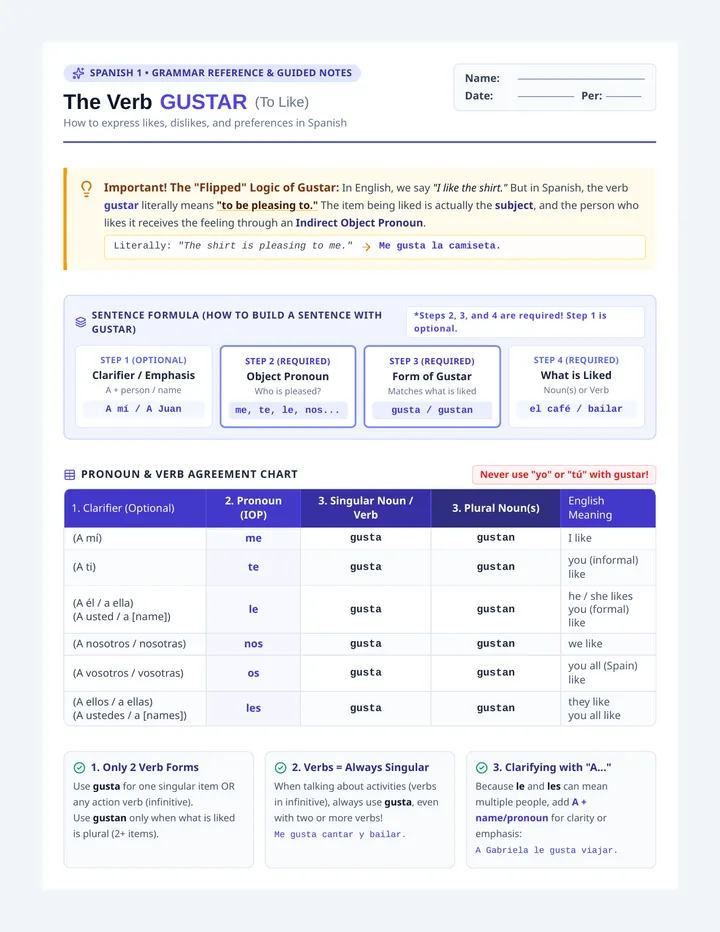
Important! The "Flipped" Logic of Gustar: In English, we say "I like the shirt." But in Spanish, the verb gustar literally means "to be pleasing to." The item being liked is actually the subject, and the person who likes it receives the feeling through an Indirect Object Pronoun.
Literally: "The shirt is pleasing to me." Me gusta la camiseta.
Sentence Formula (How to Build a Sentence with Gustar) *Steps 2, 3, and 4 are required! Step 1 is optional.
Step 1 (Optional)
Clarifier / Emphasis
A + person / name
A mí / A Juan
Step 2 (Required)
Object Pronoun
Who is pleased?
me, te, le, nos...
Step 3 (Required)
Form of Gustar
Matches what is liked
gusta / gustan
Step 4 (Required)
What is Liked
Noun(s) or Verb
el café / bailar
Pronoun & Verb Agreement Chart
Never use "yo" or "tú" with gustar!
| 1. Clarifier (Optional) | 2. Pronoun (IOP) | 3. Singular Noun / Verb | 3. Plural Noun(s) | English Meaning |
|---|
| (A mí) | me | gusta | gustan | I like |
| (A ti) | te | gusta | gustan | you (informal) like |
| (A él / a ella) | | | | |
| (A usted / a [name]) | le | gusta | gustan | he / she likes |
| you (formal) like | | | | |
| (A nosotros / nosotras) | nos | gusta | gustan | we like |
| (A vosotros / vosotras) | os | gusta | gustan | you all (Spain) like |
| (A ellos / a ellas) | | | | |
| (A ustedes / a [names]) | les | gusta | gustan | they like |
| you all like | | | | |
1. Only 2 Verb Forms
Use gusta for one singular item OR any action verb (infinitive).
Use gustan only when what is liked is plural (2+ items).
2. Verbs = Always Singular
When talking about activities (verbs in infinitive), always use gusta, even with two or more verbs!
Me gusta cantar y bailar.
3. Clarifying with "A..."
Because le and les can mean multiple people, add A + name/pronoun for clarity or emphasis:
A Gabriela le gusta viajar.
Part 2
Key Differences & Guided Practice
The Verb Gustar • Classroom Practice
What's the Difference? (The 4 "Me" Forms in Spanish)
Common beginner mistake: confusing these four words!
| Spanish Word | Grammar Function & Meaning | Example in Context |
|---|
| Yo | Subject Pronoun ("I") — performs the action | Yo como tacos. (I eat tacos.) |
| mi / mis | Possessive Adjective ("my") — shows ownership | Son mis tacos. (They are my tacos.) |
| me | Object Pronoun ("to me") — receives the liking | Me gustan los tacos. (I like tacos.) |
| A mí | Prepositional Phrase — optional emphasis ("as for me") | A mí me gustan los tacos. (I like tacos.) |
How to Form Negative Sentences
Place NO directly in front of the object pronoun:
(A mí) no me gusta llegar tarde.
How to Ask Questions
Use te (informal) or le (formal) with question marks:
¿Te gusta la geografía? — Sí, me gusta.
Activity 1: Fill in the Object Pronoun (me, te, le, nos, les) and the Correct Form of GUSTAR
Example: A mí → me gusta
-
A él andar por la tarde.
-
A nosotros la clase de matemáticas.
-
A Roberto y Elena las ensaladas.
-
A mí el café de Starbucks.
-
¿A ti las clases de ciencias?
-
A mí no llegar tarde a clase.
Activity 2: Circle the Correct Form (gusta vs. gustan)
-
A Sara le [ gusta / gustan ] bailar y cantar.
-
A Juan le [ gusta / gustan ] los libros de historia.
-
Nos [ gusta / gustan ] viajar en autobús.
-
¿A ti te [ gusta / gustan ] las frutas frescas?
Activity 3: Your Turn! (Write complete sentences about what you like and dislike)
1. One activity or thing that you like:
A mí me gusta
2. One activity or thing that you DO NOT like:
A mí no me gusta
El Verbo Gustar Slides
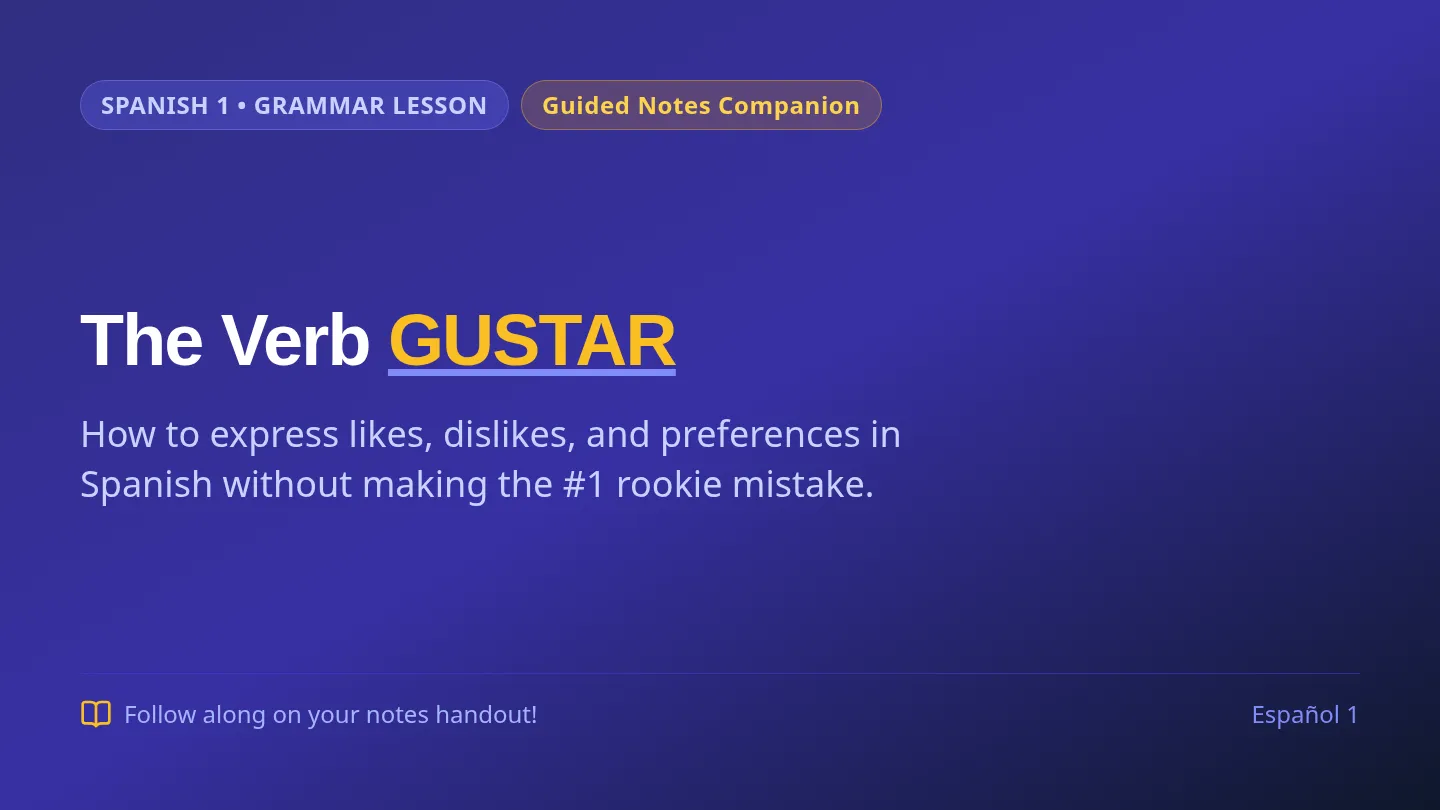
Spanish 1 • Grammar Lesson
Guided Notes Companion
The Verb GUSTAR
How to express likes, dislikes, and preferences in Spanish without making the #1 rookie mistake.
Follow along on your notes handout!
Español 1
Core Concept
The Big Secret: "Flipped" Logic
In English:
"I like tacos."
The person (I) is the subject who actively does the liking to the object (tacos).
Formula: Subject + Likes + Object
In Spanish (Gustar):
"Me gustan los tacos."
Literally translates to: "The tacos are pleasing to me."
Formula: (To me) + are pleasing + the tacos
Key Takeaway: The thing you like is actually the grammatical subject of the sentence!
Sentence Structure
Anatomy of a Gustar Sentence
Step 1 (Optional)
Clarifier
Adds emphasis or specifies who:
A mí / A Juan
"As for me..."
Step 2 (Required)
Object Pronoun
Tells who is pleased:
me, te, le...
Never use yo or tú!
Step 3 (Required)
Verb Form
Only TWO choices:
gusta / gustan
Matches the item!
Step 4 (Required)
What is Liked
Noun(s) or an action:
el café / bailar
Keep the article (el/la)
(A mí) + me + gusta + la música = "I like music."
Indirect Object Pronouns
The Pronoun Lineup: Who is Pleased?
me
I like
(A mí)
te
You like (inf.)
(A ti)
le
He / She / You (form.)
(A él / a ella / a usted)
nos
We like
(A nosotros/as)
os
You all like (Spain)
(A vosotros/as)
les
They / You all like
(A ellos / a ustedes)
CRITICAL RULE: Never say "Yo gusto" or "Tú gustas" — always use me, te, le, nos, les!
Agreement Rules
Gusta vs. Gustan: The Golden Rule
GUSTA Singular & Verbs
1. One Singular Noun