Voice Coaster Slides Voice Coasters
The Musical Secret of Mandarin Chinese
1
2
3
4
What is a Tone?
In Mandarin, HOW you say a word changes WHAT it means!
It's like singing! If you change the note, you change the word.
Can you hear the music in my voice?
Listen closely!
The Tone Paths
Tone 1
Flat Road
Tone 2
Climbing Hill
Tone 3
Valley Dip
Tone 4
Falling Star
Voice Coaster!
Use your hand to trace the path!
ā
Tone 1
á
Tone 2
ǎ
Tone 3
à
Tone 4
Tone Paths Worksheet Tone Tracks
Trace the paths of the Four Tones!
Name:
Date:
1. High & Flat
mā
2. Rising Up
má
3. The Valley Dip
mǎ
4. Falling Star
mà
Draw your own mini-coaster at the bottom!
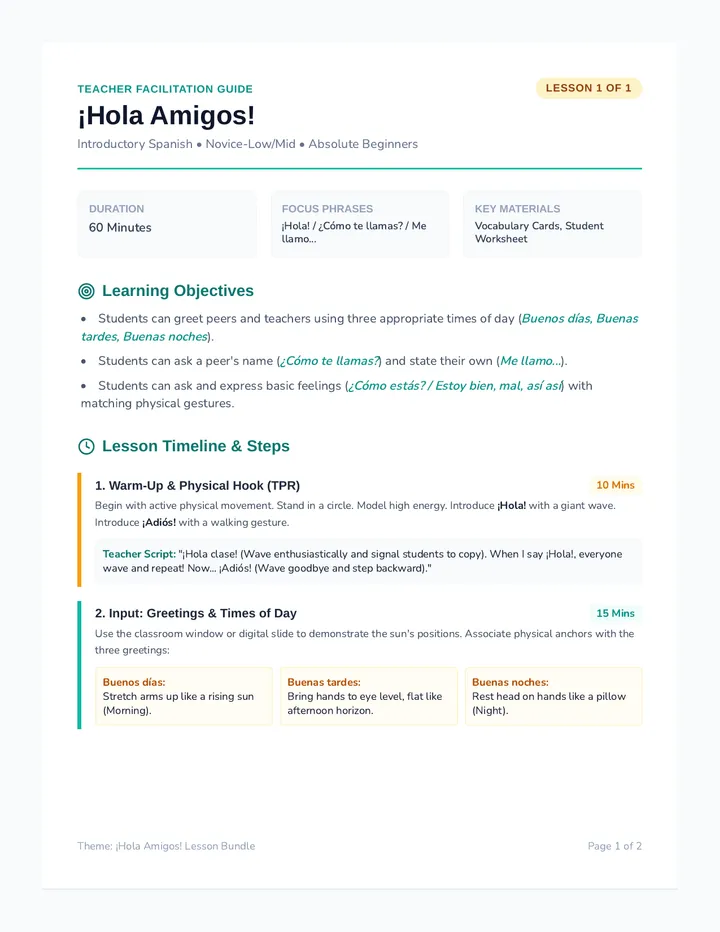
Voice Coaster Teacher Guide Voice Coaster Guide
Teacher Lesson Plan • Lesson 1
Duration
30-40 Minutes
Subject
Mandarin Pinyin
Focus
Auditory & Visual
Learning Objective
Students will be able to distinguish between four different vocal pitches (tones) and represent them using hand gestures and visual tracing.
Materials Needed
Voice Coaster Slides
Tone Paths Worksheet
Crayons / Markers
A clear space for movement
Instructional Steps
1
The Hook (5 mins)
Ask: "Can you make your voice sound like a car driving on a flat road? How about a roller coaster going up and down?" Model these sounds using "vroom" or simple vowels like "Ah."
2
The Concept (10 mins)
Show the slides. Explain that Mandarin Chinese uses "Tones" (vocal music) to tell words apart. Introduce the four shapes: Flat Line , Rising Hill , The Valley , Falling Star .
3
Hand Tracing (10 mins)
Stand up! Everyone use their "Magic Finger" in the air. As you produce a tone (e.g., Tone 1: Ahhhh), students trace a flat line in the air. Repeat for all four tones multiple times. Teacher Tip: Use exaggerated body movements (tiptoes for Tone 1, squatting for Tone 3).
4
Guided Practice (10 mins)
Distribute the "Tone Paths Worksheet." Have students trace each path with a different color. Say the tone out loud together every time they trace.
Differentiation
Support: Focus only on Tone 1 and Tone 4 (the most distinct) first.Challenge: See if they can "guess" which tone you are doing if you hide your face. Tone One and Two Slides Tone 1 & 2
The Doctor and the Question
1
2
Tone 1: The Doctor
"Open wide and say... Ahhhhh!"
Keep your voice High and Flat like a table.
mā
Sounds like: "Mom"
Tone 2: The Question
"Wait... What? Huh?"
Your voice starts in the middle and Climbs Up the hill!
má
Sounds like: "Hemp"
Let's Try Both!
mā
Keep it flat!
má
Go up high!
High and Rising Activity Sheet The Doctor & The Question
Sorting Tones 1 and 2
Student:
Date:
How to play:
Listen to your teacher say a sound. If it's Tone 1 (Flat) , color the Doctor's stethoscope RED. If it's Tone 2 (Rising) , color the Question Mark ORANGE!
Round 1
Round 2
Round 3
Round 4
Bonus: Practice writing Tone 1 and Tone 2 symbols!
—
Flat
/
Rising
Doctor and Surprise Teacher Notes Tone 1 & 2 Teaching Notes
Lesson 2 • Vocal Mimicry
The Goal
Today we focus on the high/steady pitch vs. the rising pitch. Students will use the "Doctor" and "Surprise" metaphors to anchor these abstract sounds to familiar concepts.
1
Tone 1 Gestures
Stand on tiptoes to show "high" pitch.
Keep a flat palm high above the head.
Hold the sound long: "Ahhhhhhhh."
2
Tone 2 Gestures
Tilt head up like looking at a bird.
Scoop hand from chest up to the sky.
Short, questioning sound: "What?"
The "Sound Check" Script
Round 1 (Practice)
"Say 'Ah' like the doctor wants to see your teeth!" (mā)
Round 2 (Practice)
"Say 'Ah?' like your mom just said you're having ice cream for dinner!" (má)
What to look for:
Are students' voices staying steady for Tone 1? Or are they dipping? If they dip, remind them of the "Flat Road" car. For Tone 2, look for the physical "upward" motion in their necks—this often helps the vocal cords follow.
Tone Three and Four Slides Tone 3 & 4
The Valley and the Stomp
3
4
Tone 3: The Valley
"Well... I guess!"
Your voice goes Down and then Up like a scoop.
mǎ
Sounds like: "Horse"
Tone 4: The Stomp
"NO! STOP!"
Your voice starts high and Drops Down fast like a stomp!
mà
Sounds like: "Scold"
The Big Tone Family
ā
Steady
á
Question
ǎ
Valley
à
Stomp
Scoop and Stomp Activity Sheet Scoop and Stomp
Physical Practice for Tones 3 & 4
Name:
"First we scoop the valley, then we stomp the star! Connect the dots and say the sound out loud!"
The Valley Scoop
ǎ
mǎ (Horse)
Scoop it down and back up!
The Falling Stomp
à
mà (Scold)
Fall fast and loud!
Giant Scoop Teacher Notes Giant Scoop Guide
Teacher Lesson Plan • Lesson 3
Tone 3 Strategy
The "Dip." Ensure they hit the lowest point of their vocal range before bouncing back up.
Tone 4 Strategy
The "Zap." Short, explosive, and definitive. Like a karate chop or a heavy footstep.
Movement Sequences
The Valley Scoop (Tone 3)
1 Start with hands at chest level.
2 As you say "Maaaa...", squat down low and scoop hands toward the floor.
3 Stand back up quickly as the voice rises at the end.
The Angry Stomp (Tone 4)
1 Raise one hand high in the air.
2 Bring hand down in a sharp "chopping" motion.
3 Say "Ma!" like you are a giant stomping on a bug. (Fast and loud!)
Pro-Tip: "The Head Nod"
For Tone 3, have students nod their heads down and then up. The physical motion of the chin dropping often forces the vocal folds to produce the lower pitch required for the "dip" of the third tone.
Listening Challenge Slides Tone Detectives
Listening Challenge
Get your ears ready!
How to Play
1
LISTEN
Teacher says a "Magic Word" with a secret tone.
2
CHOOSE
Find the matching Tone Card in your pocket.
3
SHOW
Hold it high when I say "REVEAL!"
Practice Round
Teacher says: mā
1
You show Card 1!
Tone Pocket Cards Tone Detective Cards
Cut these out and keep them in your Tone Pocket!
Tone 1
1
Flat
Tone 2
2
Rising
Tone 3
3
Valley
Tone 4
4
Stomp
Teachers: Print on cardstock and cut along the grid lines for durable student flashcards.
Sound Check Teacher Script Sound Check Script
Tone Detective Listening Rounds
Teacher Directions
Read the following sounds clearly and with exaggerated tones. Give students 5 seconds to find their card. When you say "Reveal!", they hold up their card.
Round 1
mā
Tone 1
Round 2
mà
Tone 4
Round 3
má
Tone 2
Round 4
mǎ
Tone 3
Challenge Rounds (Mixed Vowels)
Round 5
yī
Tone 1
Round 6
wǔ
Tone 3
Round 7
bà
Tone 4
Pro Tip: Use a "Blind" Round! Turn your back to the students when you say the sound so they can't see your mouth or facial expressions.
The Conductor Slides The Tone Choir
Conducting Our Voices
The Maestro
Today, YOU are the music leader!
The Conductor uses their hands to tell the choir which tone to sing.
Conductor's Code
1
Flat hand, high in the air
2
Finger pointing UP
3
U-shape "Scoop" with both hands
4
A sharp "karate chop" DOWN
Tone Choir Sheet Tone Choir Sheet
Your Performance Map
Maestro:
Warm Up
ā...
á...
ǎ...
à!
Your Performance Sequence
"Follow the path of the Tone Conductor!"
1
2
3
4
Conductor's Feedback
Great Energy
Perfect Tones
Teamwork
The Master of Music
Certified Tone Traveler
Performance Rubric Teacher Guide Performance Guide
Final Assessment • Kindergarten Mandarin Tones
Assessment Goals
This rubric evaluates the student's ability to produce the four tones clearly and conduct others using the established hand signals. Focus on effort, physicalization, and pitch variation rather than perfect accuracy.
Skill Needs Practice 🐢 Doing Great 🦁 Maestro! 🐲 Tone Production All tones sound flat or the same pitch. Produces at least 2 distinct tones (usually 1 & 4). Clearly distinguishes between all 4 tones orally. Hand Signals Needs help remembering the gestures. Uses hand signals correctly with some hesitation. Confident and clear hand signals as a conductor. Auditory Recognition Struggles to identify tones spoken by others. Identifies most tones correctly during games. Instantly identifies all 4 tones in isolation.
Success Stories
Next Steps
Encourage students to use "Tone Colors" (Rose for 1, Amber for 2, Emerald for 3, Indigo for 4) if they get stuck on the names.