Una ficha de trabajo interactiva sobre tsunamis para niños, que incluye una explicación sencilla, dibujo del proceso, identificación de señales de peligro y pasos de seguridad.
Guía de respuestas para el docente que acompaña la ficha "Olas Gigantes", detallando los criterios de evaluación y las respuestas correctas para las actividades de seguridad y vocabulario.
A short assessment for the 'Sleep Squad' lesson to evaluate student understanding of sleep requirements and habits. Revised for better contrast and page breaks.
A student worksheet for planning a healthy bedtime routine, identifying sleep disruptors, and calculating target sleep times. Revised to ensure all content fits on one page and improves contrast.
A visually engaging slide deck for students explaining the importance of sleep, the concept of sleep hygiene, and tips for better rest.
A detailed teacher's guide for the 'Sleep Squad' health lesson, including instructional procedures, objectives, and standards alignment. Revised to fix page break issues and orphaned headers.
A facilitator's guide for school staff to manage the restorative conversation and follow-up for a student caught vaping.
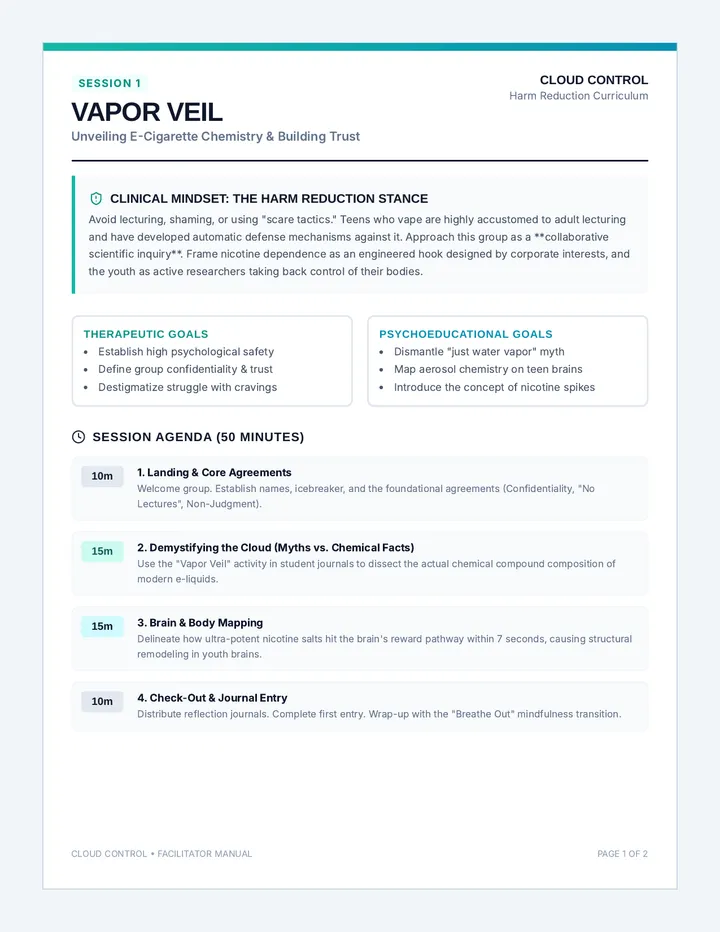
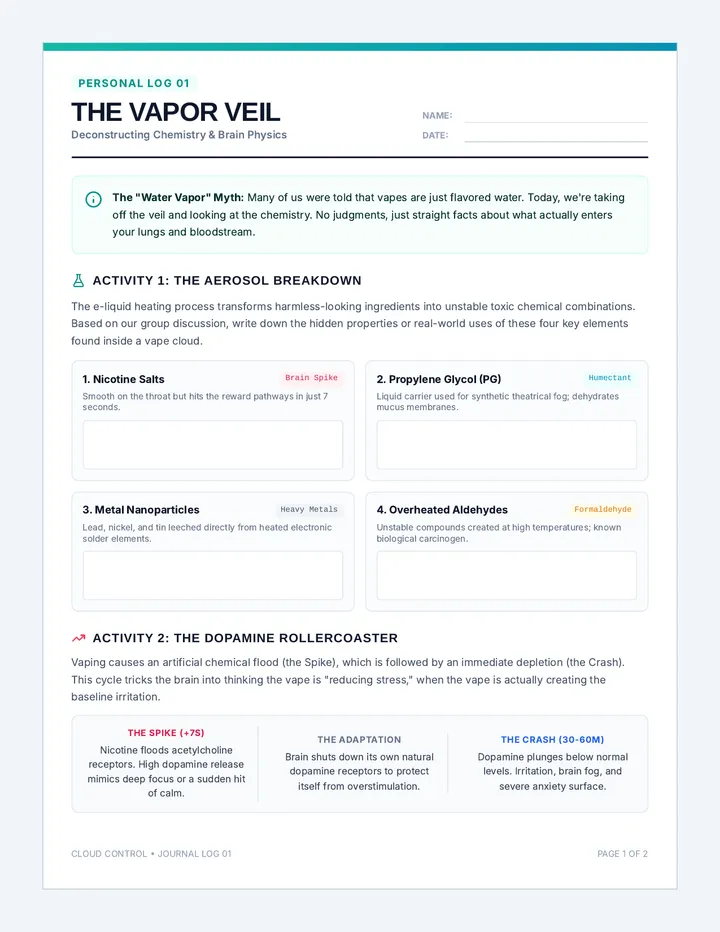
A reflective restorative justice assignment for a high school student caught vaping, focusing on health science, community impact, and personal growth.
A teacher's answer key for the Hormone Decoder worksheet, providing the correct cycle phase for each of the 10 cases along with the biological reasoning for each identification.
A practice worksheet with 10 case-study examples of hormone data where students must identify the corresponding phase of the menstrual cycle based on levels of Estrogen, Progesterone, LH, and FSH.
A teacher-facing guide and answer key for the Life Cycles lesson, providing expected research answers, discussion prompts, and clarification on common student misconceptions.
An independent research packet for 9th-grade health students to document their findings on the menstrual cycle and the three stages of childbirth, featuring structured research areas and vocabulary checks.
A visual introduction to the independent research task, outlining the goals, vocabulary, and search strategies for investigating the menstrual cycle and childbirth.
A teacher guide for the Freshness Factor lesson, including objectives, slide-by-slide talking points, scientific background on body odor, and discussion prompts to foster a positive classroom environment.
A printable weekly habit tracker for 4th graders to monitor their hygiene routines. Includes checkboxes for showering, wearing clean clothes, and applying deodorant, along with a "Pro Tip" section and goal-setting area.
A visual-heavy presentation designed for 4th graders, focusing on the science of body odor and the importance of daily showering and clean clothes. Features a clean, bright, lab-inspired aesthetic with minimal text and high-impact icons.
A coloring activity page focused on the 'Night Shift' bedtime mission. Boys can color their pajama armor and visualize their battery recharging for the next day's missions.
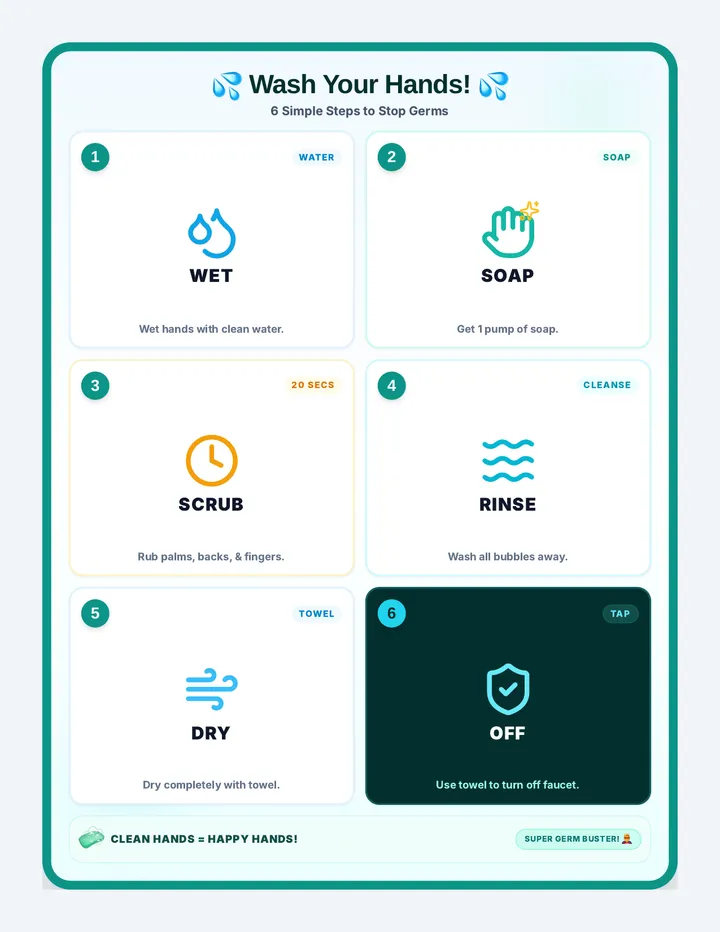
A coloring activity page focused on the 'Hand Heroics' mission. Boys can color soap bubbles and visualize washing away germs during their cleaning mission.
A coloring activity page focused on the 'Tooth Tech' mission. Boys can visualize the battle against tooth germs and the 'power-up' of their tooth armor.
A reflective mission debrief form for boys to complete at the end of the day or week. It includes a star-based success rating, an obstacle identification area, and a drawing space for younger squad members to visualize their hygiene victories.
A detailed weekly tracker for the 'Night Shift' bedtime routine, designed for five boys (ages 2-10). It features icon-based checklists for each step (Face, Teeth, PJs, Sleep) to help children visualize and track their nightly mission success.
A high-visibility instructional poster for the bathroom, framing tooth brushing as a critical 'Tooth Tech' mission. It features bold icons and step-by-step guidance for boys ages 2-10.
A high-visibility instructional poster for the bathroom, framing hand washing as a critical 'Hand Heroics' mission. It features bold icons and step-by-step guidance for boys ages 2-10.
A student-facing personal hygiene checklist that outlines daily morning routines, school refresh strategies, and nighttime preparation for 4th-grade girls.
Set of 6 printable discussion cards for small groups of 4th-grade girls to talk through hygiene scenarios, routines, and social etiquette in a safe and supportive way.
An engaging slide deck for 4th-grade girls explaining the science of sweat, the importance of daily bathing, the difference between deodorant and antiperspirant, and strategies for refreshing after recess.
A sheet of printable Master Destroyer badges for the Dirt Destroyers Squad. Each badge features a unique high-energy theme and a space for the squad member's name, designed to be cut out and awarded for hygiene consistency.
A reference sheet for parents containing categorized reward ideas for hygiene consistency. It includes daily, weekly, and monthly incentives tailored for boys ages 2-10, maintaining the 'Dirt Destroyer' mission theme.
A creative coloring and activity page for younger children to visualize germs and the 'power' of hygiene. This works as an engaging tool to keep the 2, 3, and 6-year-olds occupied while reinforcing the lesson theme.
A comprehensive facilitation guide for parents/teachers to manage hygiene routines for five boys. It provides age-appropriate strategies, psychological tips, and 'mission-based' language to reduce resistance.
A visual tracking sheet for a family of five boys to log their daily hygiene habits. Designed with age-specific columns and clear icons to make it accessible for children from ages 2 to 10.
A high-energy, mission-themed slide deck designed to motivate boys ages 2-10 to engage in daily hygiene routines. It now includes a specialized 'Night Shift' bedtime protocol slide.
A visual presentation deck for teaching healthy sleep habits, featuring one slide per habit with large icons and clear, accessible text designed for students with intellectual disabilities. This version follows the evening routines with daytime/morning habits.
A 4-page student article written at a 700L Lexile level for sustained silent reading (SSR). It uses a clean, professional magazine-style layout with integrated callout boxes, a glossary of key terms, and a final assessment page with multiple-choice and short-answer questions.
A foundational version of the Media Mindset Handout, rewritten at a 900L Lexile level for high school students. It uses even more accessible language and shorter sentences while maintaining the core structure, margin notes, and glossary of the other versions.
A teacher/therapist guide for bilateral coordination featuring 7 exercises including the new "Super Challenge" quadruped movement. Updated for better printing and layout.
A streamlined 1-page student handout for bilateral coordination exercises with 6 standard challenges and a special "Super Challenge" quadruped movement. Updated with 💂 for Ex 2 and 🧘 for Ex 3.
A high-energy slide deck for 2nd graders featuring 7 coordination exercises, culminating in a "Super Challenge" quadruped movement. Updated Slide 4 with 💂.
A simplified version of the Media Mindset Handout, rewritten at an 1100L Lexile level for high school students. It maintains the original structure while using more accessible language, clearer sentence structures, and a dedicated glossary to support reading comprehension.
A comprehensive reading handout for high school students based on a 2024 literature review of media coverage on mental health. It features the full original text with a robust float-based layout for margin notes, vocabulary sidebars, and a final assessment page with MCQ and short-answer questions.
A set of three soccer-themed break passes designed for 5th-grade students, featuring 'Substitution', 'Time Out', and 'Bench Break' styles with space for student names and destination details.
A student-friendly checklist for tracking daytime habits that influence sleep quality. Includes clear icons, two-column self-assessment, and educational tips explaining the 'why' behind each habit.
A teacher-facing guide providing instruction on how to facilitate the sleep habits lesson for students with intellectual disabilities, including discussion prompts and differentiation tips.