Pitch Perfect Slides Scenic Design 101
Stage Vision Pitch
How to organize, visualize, and deliver a compelling scenic design presentation.
Lesson 1: From Concept to Production Table
Blueprint & Pitch Series
01 / Purpose
Why Do Scenic Designers Pitch?
Share the World
Translate script ideas into a clear visual atmosphere, mood, and sense of place.
Align the Team
Give directors, lighting, and costume designers a shared spatial language to build on.
Prove It Works
Show that actors can move safely, scenes can shift on time, and the set fits the stage.
02 / Audience
Who Is Sitting at the Production Table?
The Director
Listens for: Storytellers, emotional tone, sightlines, and acting levels.
Technical Director & Crew
Listens for: Scale, materials, rigging, scene shifts, and build feasibility.
Fellow Designers & Stage Management
Listens for: Color palette, texture, entrances, and backstage traffic flow.
03 / Core Elements
The 5 Pillars of a Scenic Pitch
1
Concept & Mood
One-sentence big idea + emotional tone.
2
Visual Research
Mood board, textures, and color palette.
3
Ground Plan
Top-down layout, scale, and entrances.
4
3D View
Scale model, sketch, or digital rendering.
5
Logistics
Scene shifts, key props, and safety.
04 / Storytelling
Show, Don’t Just Tell
Lead With the Visual
Put your strongest image or model front and center. Let the audience absorb the space before you explain every detail.
Walk the Audience Through
Trace an actor’s path on the ground plan: “They enter upstage left, climb the stairs, and confront the crowd downstage.”
05 / Best Practices
Pitch Do’s & Don’ts
DO
• Connect every design choice back to the script.
• Label key areas clearly on your ground plan.
• Flag potential challenges early with solutions.
DON’T
• Apologize for rough sketches or early models.
• Read paragraphs of text off your slides.
• Skip how large set pieces enter or exit the stage.
06 / Workshop
Your Turn: Build Your Pitch Checklist
Use the Scenic Pitch Checklist to plan a 3-minute presentation for a scene of your choice.
Step 1 (5 min)
Audit what visuals and technical notes you already have.
Step 2 (10 min)
Draft your one-sentence concept and actor path on Page 2.
Step 3 (5 min)
Test your 60-second opening hook with a partner.
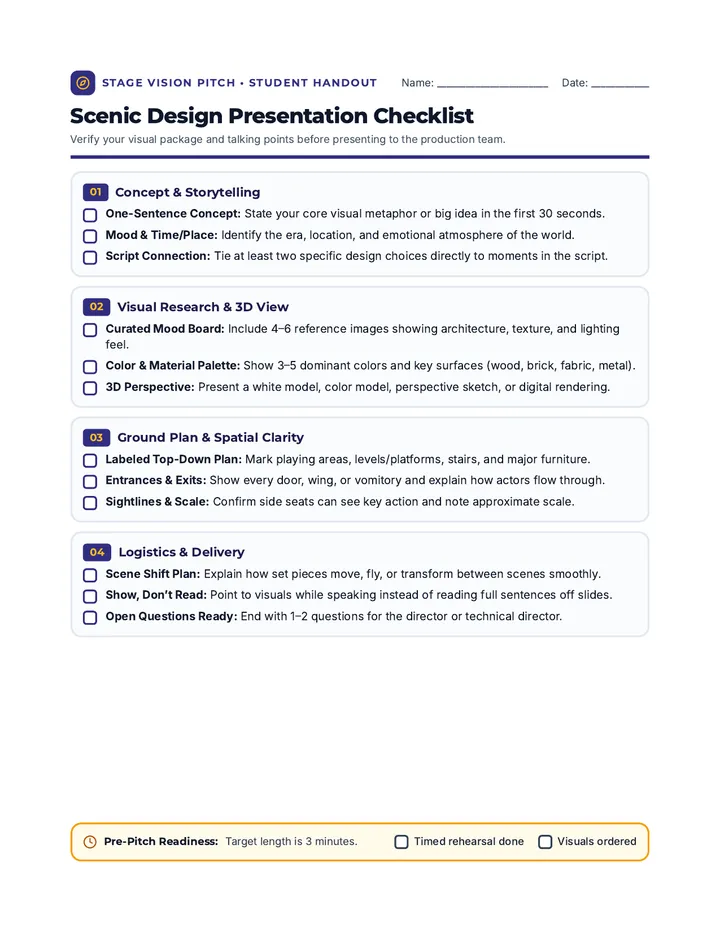
Scenic Pitch Checklist Stage Vision Pitch • Student Handout
Name: _______________________ Date: ____________
Scenic Design Presentation Checklist
Verify your visual package and talking points before presenting to the production team.
01
Concept & Storytelling
One-Sentence Concept: State your core visual metaphor or big idea in the first 30 seconds.
Mood & Time/Place: Identify the era, location, and emotional atmosphere of the world.
Script Connection: Tie at least two specific design choices directly to moments in the script.
02
Visual Research & 3D View
Curated Mood Board: Include 4–6 reference images showing architecture, texture, and lighting feel.
Color & Material Palette: Show 3–5 dominant colors and key surfaces (wood, brick, fabric, metal).
3D Perspective: Present a white model, color model, perspective sketch, or digital rendering.
03
Ground Plan & Spatial Clarity
Labeled Top-Down Plan: Mark playing areas, levels/platforms, stairs, and major furniture.
Entrances & Exits: Show every door, wing, or vomitory and explain how actors flow through.
Sightlines & Scale: Confirm side seats can see key action and note approximate scale.
04
Logistics & Delivery
Scene Shift Plan: Explain how set pieces move, fly, or transform between scenes smoothly.
Show, Don’t Read: Point to visuals while speaking instead of reading full sentences off slides.
Open Questions Ready: End with 1–2 questions for the director or technical director.
Pre-Pitch Readiness: Target length is 3 minutes.
Timed rehearsal done
Visuals ordered
Stage Vision Pitch • Planning Sheet
Pitch Planner & Rehearsal Notes
Show / Scene: ___________________________
1. One-Sentence Concept Statement
Summarize the world of the play and your central visual idea in one clear sentence.
2. Key Visuals & Quick Ground Plan Sketch
List the mood board images/colors you will show, or sketch a rough top-down layout with entrances labeled.
3. Actor Path & Scene Shift Walkthrough
Note one key character entrance/movement you will trace, plus how any major set pieces shift.
4. Partner Rehearsal Feedback & Next Revisions
After testing your 60-second opening hook with a partner, jot down what worked and what to clarify.
Keep this sheet in your production binder for your final design presentation. Ready for Production Table
Stage Vision Teacher Guide Stage Vision Pitch • Educator Resource
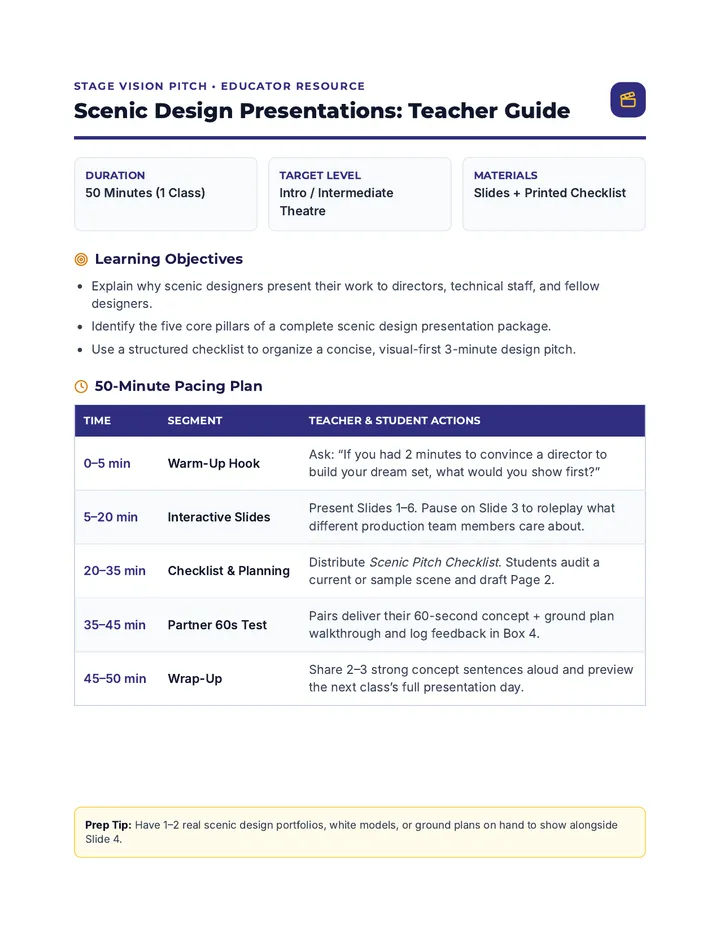
Scenic Design Presentations: Teacher Guide
Duration
50 Minutes (1 Class)
Target Level
Intro / Intermediate Theatre
Materials
Slides + Printed Checklist
Learning Objectives
Explain why scenic designers present their work to directors, technical staff, and fellow designers.
Identify the five core pillars of a complete scenic design presentation package.
Use a structured checklist to organize a concise, visual-first 3-minute design pitch.
50-Minute Pacing Plan
Time
Segment
Teacher & Student Actions
0–5 min
Warm-Up Hook
Ask: “If you had 2 minutes to convince a director to build your dream set, what would you show first?”
5–20 min
Interactive Slides
Present Slides 1–6. Pause on Slide 3 to roleplay what different production team members care about.
20–35 min
Checklist & Planning
Distribute Scenic Pitch Checklist . Students audit a current or sample scene and draft Page 2.
35–45 min
Partner 60s Test
Pairs deliver their 60-second concept + ground plan walkthrough and log feedback in Box 4.
45–50 min
Wrap-Up
Share 2–3 strong concept sentences aloud and preview the next class’s full presentation day.
Prep Tip: Have 1–2 real scenic design portfolios, white models, or ground plans on hand to show alongside Slide 4.
Facilitation Notes & Coaching
Page 2 of 2
Key Discussion Prompts (Slides 2–6)
Slides 2–3: Purpose & Audience
Ask: “How would your pitch change if you were talking only to the carpenter versus only to the director?” Emphasize translating art into actionable plans.
Slide 4: The 5 Pillars
Point out that a pitch isn’t just pretty pictures—without a ground plan and shift logistics, a set cannot be staged or built.
Slide 5: Show, Don’t Just Tell
Model tracing an actor’s path with your finger on a sample ground plan. Notice how physical movement makes the space immediately clear.
Slide 6: Do’s & Don’ts
Normalize rough process work! Remind students that apologizing for a sketch undermines confidence in their ideas.
Common Student Pitfalls & Coaching Moves
Pitfall: Spending 2 minutes summarizing the plot of the play.
Coaching Move: Remind them the director already knows the script. Redirect them to their one-sentence visual concept .
Pitfall: Reading bullet points verbatim from slides.
Coaching Move: Have students cover their notes during the 60-second partner test and narrate directly from their sketch or mood board.
Pitfall: Forgetting how actors or scenery get on and off stage.
Coaching Move: Ask “Where does that sofa go in Scene 2?” or “Which door does the hero enter through?” during planning.
Differentiation & Extensions
Support / Scaffolding
Provide a sentence frame for Box 1: “Our design treats [Setting] like a [Metaphor] using [2 Materials/Colors] to show [Mood].”
Extension / Challenge
Have advanced students add a budget/time-constraint note or prepare a 30-second Q&A defense for a tricky scene transition.
Stage Vision Pitch • Lesson 1 Teacher Guide Theatrical Design Curriculum