Root Chord & Quality:
Bass Note & Degree:
Inversion (Root / 1st / 2nd):
Voicing Beta Strings 2-3-4
String 2 (B): Fret 3 (D)
String 3 (G): Fret 2 (A)
String 4 (D): Fret 4 (F#)
Root Chord & Quality:
Bass Note & Degree:
Inversion (Root / 1st / 2nd):
Voicing Gamma Strings 1-2-3
String 1 (e): Fret 2 (F#)
String 2 (B): Fret 3 (D)
String 3 (G): Fret 2 (A)
Root Chord & Quality:
Bass Note & Degree:
Inversion (Root / 1st / 2nd):
Notes: F (Root), A (3rd), C (5th)
Root Position (Strings 1-2-3) Bass note on G string: F
e: String 1 (fret: _____) note: _____
B: String 2 (fret: _____) note: _____
G: String 3 (fret: _____) note: _____
Interval Stack: 1 - 3 - 5
1st Inversion (Strings 1-2-3) Bass note on G string: A
e: String 1 (fret: _____) note: _____
B: String 2 (fret: _____) note: _____
G: String 3 (fret: _____) note: _____
Interval Stack: 3 - 5 - 1
2nd Inversion (Strings 1-2-3) Bass note on G string: C
e: String 1 (fret: _____) note: _____
B: String 2 (fret: _____) note: _____
G: String 3 (fret: _____) note: _____
Interval Stack: 5 - 1 - 3
Critical Listening & Fretboard Analysis:
Play a standard open C Major cowboy chord (x-3-2-0-1-0). Which note is doubled? What is the lowest pitch and highest pitch? How does isolating the top 3 strings (G-B-e) change clarity in a full band mix?
Codex Lesson 1 • Chord Architecture Lab Page 2 of 2
Functional Dynamics
Guitar Music Theory Codex Reference Guide • Page 2 of 2
Tonic Family (T)
Imaj7, vim7, iiim7
State: Maximum Stability / Home
Contains no urgent tendency tones (no tritone). vim7 and iiim7 share 3 out of 4 notes with Imaj7 and act as tonal substitutes.
Subdominant / Pre-Dominant (S)
IVmaj7, iim7
State: Movement Away / Departure
Introduces the 4th degree of the scale. Creates anticipation and naturally propels harmonic motion into the Dominant chord.
Dominant Family (D)
V7, viim7b5
State: Maximum Tension / Resolution
Contains the leading tone (7) and the 4th, locking in the tritone. Energetically demands collapse back into the Tonic.
TONIC (I)Home Base
SUBDOMINANT (ii / IV)Departure
DOMINANT (V7)Tension Peak
TONIC (I)Resolution
The Jazz Standard: ii - V - I
Dm7 - G7 - Cmaj7
Root motion moves down in Perfect 5ths (D down to G, G down to C). The quintessential jazz vehicle.
The 4-Chord Axis: I - V - vi - IV
C - G - Am - F
Found in hundreds of hit songs. Features deceptive step-resolution from V to vi, followed by plagal cadence IV to I.
The Doo-Wop Turnaround: I - vi - ii - V
Cmaj7 - Am7 - Dm7 - G7
Circular turnaround progression that effortlessly loops back to the start. The harmonic basis of "Rhythm Changes".
Secondary Dominant Surge: V7 / V
Cmaj7 - D7 - G7 - Cmaj7
D7 is non-diatonic (contains F#). It acts as the dominant of G7, creating a high-energy forward propulsion.
Fretboard Application: When learning any song, translate the chords into Roman Numerals. You will instantly realize you've already played that exact progression in 10 other tunes!
L2 • PG 2
Substitute IV (Fmaj7) with its pre-dominant partner, and substitute bar 4's Cmaj7 with vim7:
Reharmonize Prompt 2 (Key of F Major):
Original progression: | Fmaj7 | Bbmaj7 | C7 | Fmaj7 |
Substitute bar 1 with iiim7, bar 2 with iim7, and bar 4 with vim7:
A secondary dominant is any major or dominant 7th chord resolving down a 5th to a diatonic chord other than I.
| Chord Sequence (Key of C) | Altered Pitch / Accidental | Secondary Dominant Symbol | Target Chord & Resolution |
|---|---|---|---|
| C → A7 → Dm | C# | V7 / ii | Resolves down 5th to Dm (ii) |
| C → E7 → Am | G# | ||
| | C → D7 → G | F# |
|
| | C → C7 → F | Bb |
|
|
Critical Ear & Fretboard Reflection:
Play Cmaj7 → A7 → Dm7 on guitar. Notice how the C# note on string 2 (fret 2) leads by half-step right into the D root on fret 3. How does voice leading explain why secondary dominants sound so natural?
Codex Lesson 2 • Harmonic Progression Analysis Page 2 of 2
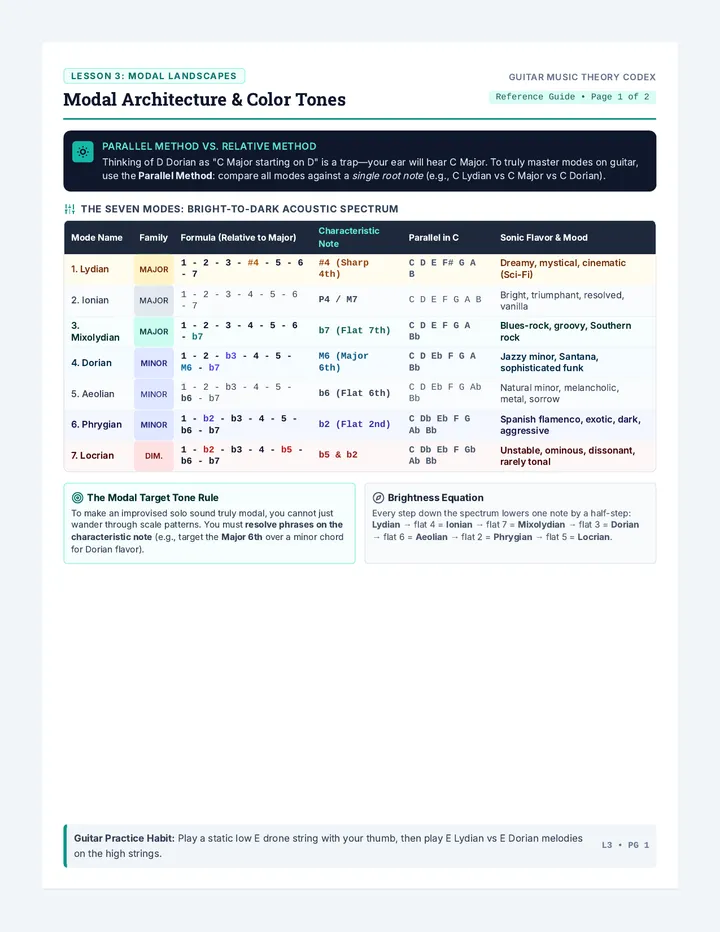
Guitar Practice Habit: Play a static low E drone string with your thumb, then play E Lydian vs E Dorian melodies on the high strings. L3 • PG 1
Harmonic Application
Guitar Music Theory Codex Reference Guide • Page 2 of 2
The Tonal Gravity Trap (Why Modal Progressions Must Be Simple)
The Major I chord exerts an irresistible gravitational pull. If you play too many diatonic chords from a key (especially a V7 chord), the listener’s ear immediately snaps to the parent major tonic! To sustain a modal atmosphere, use one static chord or a two-chord oscillating vamp featuring the modal signature note.
1. The Dorian Groove Vamp (i - IV) D Dorian: Dm7 → G7
Why it works: The G7 (or G major) contains B natural, which is the Major 6th of D! In standard natural minor (D Aeolian), the IV chord would be Gm (containing Bb). The major IV chord screams Dorian.
Fretboard Grip: Dm7 (x-5-7-5-6-5) → G7 (3-x-3-4-3-x) or G9 (x-10-9-10-10-x)
2. The Mixolydian Rock Vamp (I - bVII) A Mixolydian: A → G/A (or G)
Why it works: In A Major, chord VII is G#dim. Replacing it with a Major bVII (G Major) introduces the characteristic b7 (G natural) while keeping a bright Major 3rd (C#). Classic AC/DC, Tom Petty, and Jerry Garcia sound.
Fretboard Grip: A (5-7-7-6-5-5) → G (3-5-5-4-3-3) or G/A (x-0-5-4-3-x)
3. The Lydian Wonder Vamp (I - II) C Lydian: Cmaj7 → D/C
Why it works: Moving directly from Cmaj7 to a major triad a whole step up (D major) injects the luminous #4 (F#) directly over the C tonic bass. Unmistakable Joe Satriani / Steve Vai soundscape.
Fretboard Grip: Cmaj7 (x-3-5-4-5-x) → D/C (x-3-4-2-3-x) or Dmaj (x-5-7-7-7-x)
Playing Dorian:
Start with Minor Pentatonic (1-b3-4-5-b7). Add the Major 6th and 2nd to taste. Lean on the 6th during chord transitions.
Playing Mixolydian:
Start with Major Pentatonic (1-2-3-5-6). Add the Minor 7th to bend or emphasize as a bluesy resting point.
Playing Lydian:
Play Major Pentatonic and insert the #4 as a melodic suspension resolving up to the 5th or lingering on bar downbeats.
Fretboard Improvisation Directive: Record an 8-measure loop of Dm7 to G7. Play D Minor Pentatonic, then intentionally resolve your phrases onto the note B (fret 9 on G-string). Hear Dorian awaken!
L3 • PG 2
Improvisation Blueprint (Explain how you will phrase over the D/E chord to highlight the b7):
Locate the exact guitar coordinates.
| Mode & Key | Signature Pitch | High E String Coordinate | B String Coordinate | G String Coordinate |
|---|---|---|---|---|
| D Dorian | B (M6) | |||
|
| | G Lydian | C# (#4) |
|
|
|
Codex Lesson 3 • Modal Improvisation Lab Page 2 of 2
The Root and 5th provide acoustic mass, but the 3rd and 7th carry 95% of a chord’s harmonic identity. The 3rd defines quality (major vs minor), and the 7th defines stability (major 7th vs dominant tension). Stripping away the root and 5th leaves a two-note Guide Tone skeleton that moves like water.
When roots move down a Perfect 5th (e.g. ii → V → I): 7th → 3rd (Half-Step Drop)
Movement 1: ii to V (Dm7 → G7)
Movement 2: V to I (G7 → Cmaj7)
Chord: Dm7 → Chord: G7 → Chord: Cmaj7
G String (Voice 1): Fret 5 (C = 7th) → Fret 4 (B = 3rd) → Fret 4 (B = 7th)
D String (Voice 2): Fret 3 (F = 3rd) → Fret 3 (F = 7th) → Fret 2 (E = 3rd)
Total finger movement across 3 complete jazz harmony changes: 1 fret! This is the essence of professional voice leading.
Notice how Inversions alternate automatically: A Root Position Dm7 (1-5-b7-b3) naturally voice-leads directly into a 2nd Inversion G7 (5-1-3-b7), which then leads directly into a 1st Inversion Cmaj7 (3-7-1-5) without the hand shifting up or down the neck!
Mastery Benchmark: Play the 2-note guide tone line while singing the bass roots (D → G → C). When your fingers and ear align, you possess real harmonic fluency.
L4 • PG 2
|
|
|
| | Gmaj7 | 1st Inv (3-7-1-5) |
|
|
|
|
| | Em7 | 3rd Inv (b7-b3-5-1) |
|
|
|
|
|
Measure physical fretboard movement across the 4 chords.
Maximum Fret Range Utilized:
What is the lowest fret and highest fret touched by any finger during the entire 4-chord progression above?
Soprano Voice Contour:
Track the melody line created by the high E-string notes. Does it move by step, leap, or stay static?
Instructor Graduation Checkpoint CURRICULUM FINALE
Student demonstrated smooth voice-leading execution at tempo without pausing between chord grips, audibly tracing the guide-tone resolution line.
Fluency: [ ] Emerging [ ] Proficient [ ] Master
Tempo Metronome: _______ BPM
Instructor Signature: __________________
Codex Lesson 4 • Voice Leading & Guide Tone Lab Page 2 of 2