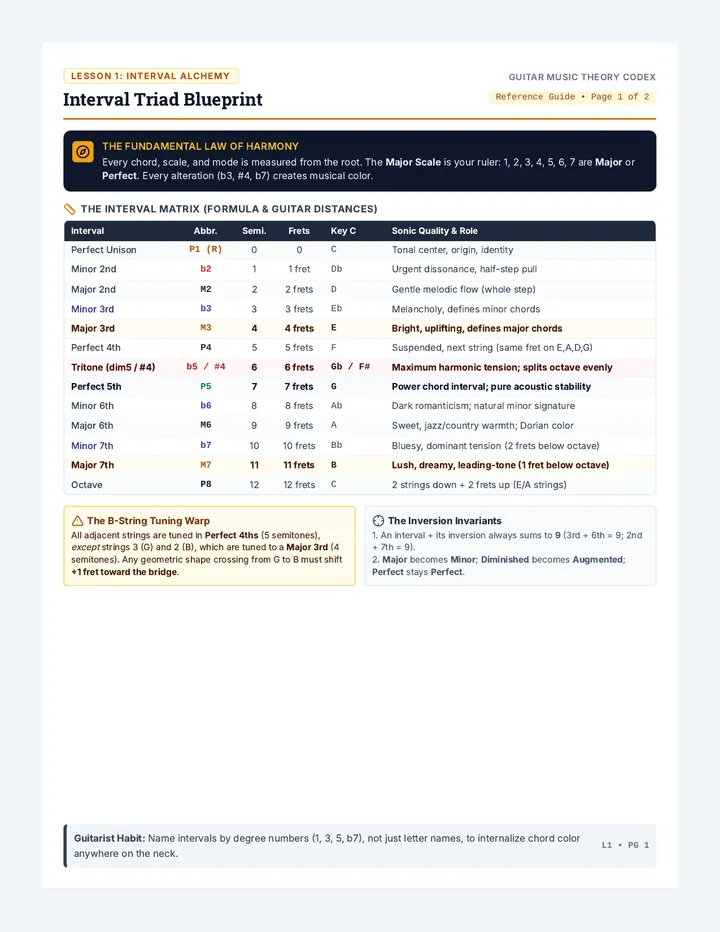
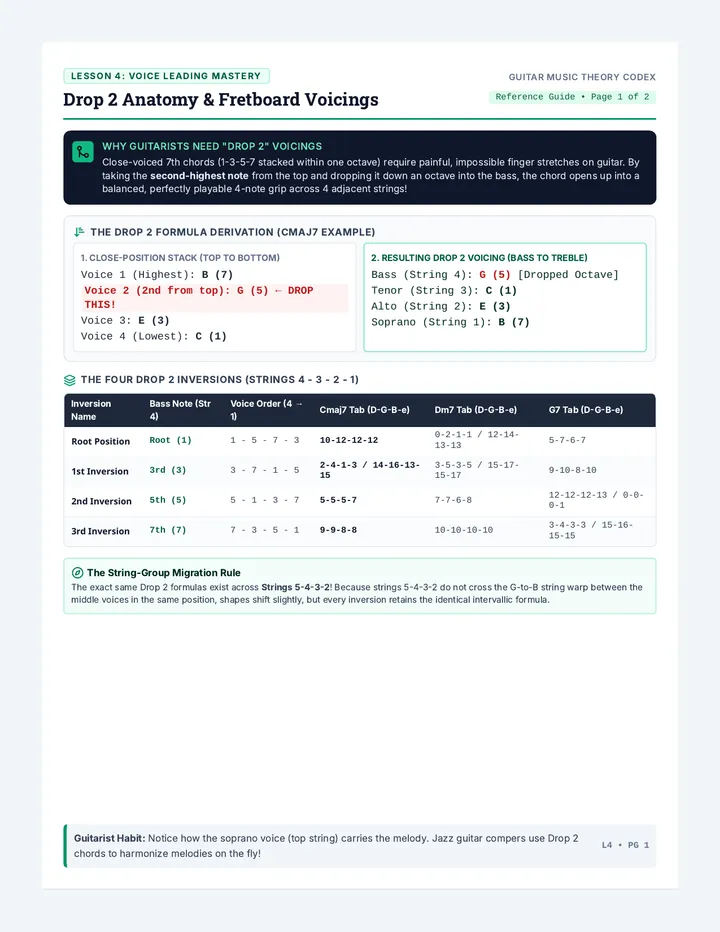
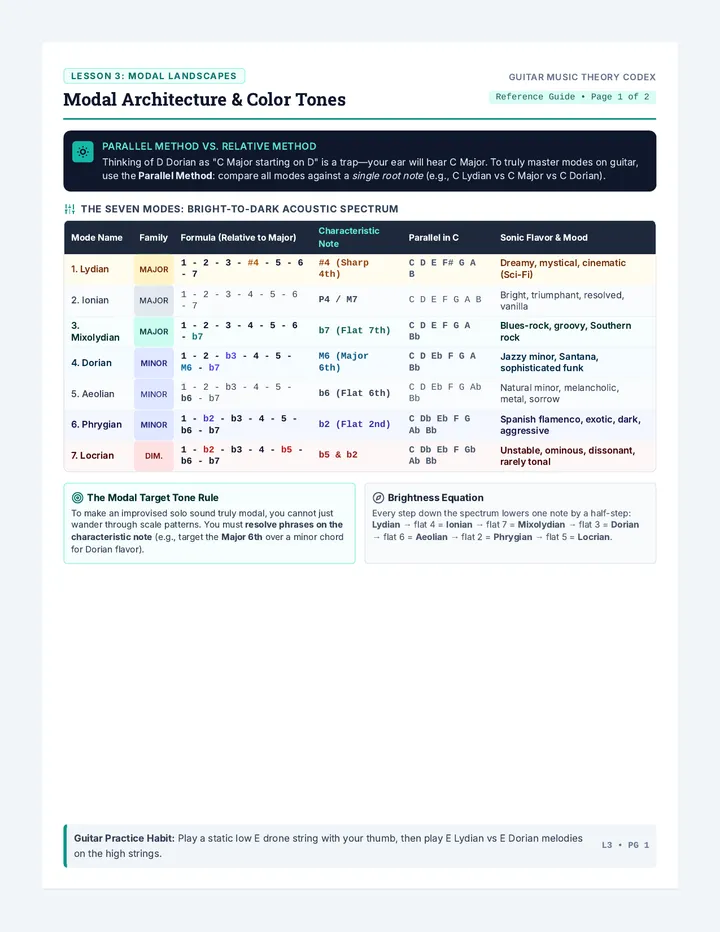
Page 1 • Triad Construction & Formulas Fretboard Harmony Guide • Educational Reference
Advanced Harmony
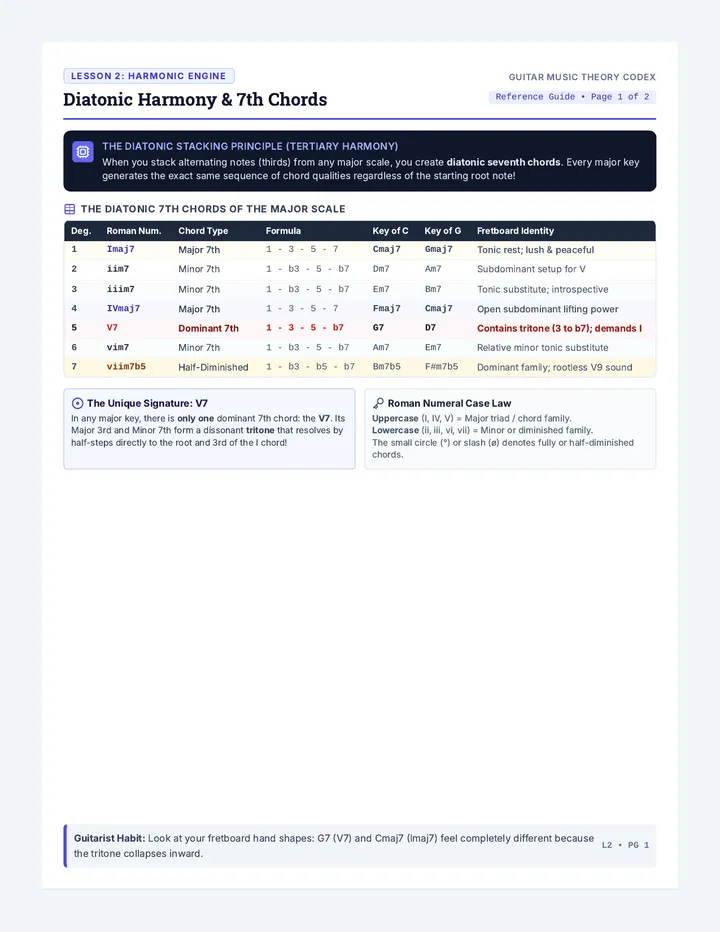
Adding the 7th interval unlocks rich jazz, blues, pop, and R&B color.
| Chord Type | Formula | Musical Character | Spelling in C | Spelling in G |
|---|---|---|---|---|
| Major 7th Cmaj7, Δ7 | 1 – 3 – 5 – 7 | Dreamy, lush, sophisticated, relaxing | C • E • G • B | G • B • D • F♯ |
| Dominant 7th G7, Dom7 | 1 – 3 – 5 – ♭7 | Bluesy, energetic; powerful pull to Tonic | C • E • G • B♭ | G • B • D • F |
| Minor 7th Am7, m7 | 1 – ♭3 – 5 – ♭7 | Mellow, smooth, soulful, funk/neo-soul | C • E♭ • G • B♭ | G • B♭ • D • F |
| Half-Diminished Bm7♭5, ø | 1 – ♭3 – ♭5 – ♭7 | Mysterious, moody minor-key transition (iiø) | C • E♭ • G♭ • B♭ | G • B♭ • D♭ • F |
When you stack thirds on each step of the Major Scale using only the notes in that key, you get an immutable chord formula that works in all 12 keys:
I
Maj7
ii
m7
iii
m7
IV
Maj7
V
Dom7
vi
m7
vii°
m7♭5
In Key of C Major:
I: Cmaj7 (C-E-G-B)
ii: Dm7 (D-F-A-C)
iii: Em7 (E-G-B-D)
IV: Fmaj7 (F-A-C-E)
V: G7 (G-B-D-F) ← Dominant!
vi: Am7 (A-C-E-G)
vii°: Bm7♭5 (B-D-F-A)
In Key of G Major (1♯):
I: Gmaj7 (G-B-D-F♯)
ii: Am7 (A-C-E-G)
iii: Bm7 (B-D-F♯-A)
IV: Cmaj7 (C-E-G-B)
V: D7 (D-F♯-A-C) ← Dominant!
vi: Em7 (E-G-B-D)
vii°: F♯m7♭5 (F♯-A-C-E)
On guitar, you only have 4 fingers and 6 strings. When playing complex 7th chords, professional guitarists often omit the 5th (which just provides generic thickness). The 3rd defines if the chord is Major or Minor, while the 7th defines if it is Maj7, Dom7, or m7. If you fret just the Root, 3rd, and 7th, your chord will sound pure, uncluttered, and professional!
Page 2 • 7th Chords & Diatonic Keys Fretboard Harmony Guide • Educational Reference
Str 6
X
Str 5
A (R)
Str 4
E (5)
Str 3
A (R)
Str 2
C (♭3)
Str 1
E (5)
Formula: 1 – ♭3 – 5 Finger Grip: X - 0 - 2 - 2 - 1 - 0
D Minor (Dm) Notes: D • F • A
Str 6
X
Str 5
X
Str 4
D (R)
Str 3
A (5)
Str 2
D (R)
Str 1
F (♭3)
Formula: 1 – ♭3 – 5 Finger Grip: X - X - 0 - 2 - 3 - 1
Fretboard Secret: The Lowest Root Note Always identify which string holds the lowest Root note. For E/Em it's String 6; for A/Am/C it's String 5; for D/Dm it's String 4. Strumming strings lower than your root creates a muddy "inversion."
Page 1 • Open Triads & String-by-String Note Map Fretboard Harmony Guide • Educational Reference
Movable Harmony
Unlock the entire neck using two movable chord foundations.
Cmaj7 1-3-5-7
C • E • G • B
Open B string provides natural Major 7th! Grip: X-3-2-0-0-0
G7 1-3-5-♭7
G • B • D • F
1st fret on high E string replaces high G with ♭7 (F). Grip: 3-2-0-0-0-1
D7 1-3-5-♭7
D • F♯ • A • C
1st fret on B string lowers doubled D to ♭7 (C). Grip: X-X-0-2-1-2
A7 1-3-5-♭7
A • C♯ • E • G
Open G string lowers middle A note to ♭7 (G). Grip: X-0-2-0-2-0
E7 1-3-5-♭7
E • G♯ • B • D
Open D string provides the ♭7 (D). Grip: 0-2-0-1-0-0
Am7 1-♭3-5-♭7
A • C • E • G
Lift 3rd finger to sound open G string (♭7). Grip: X-0-2-0-1-0
Your index finger acts as a movable guitar nut. Once you know which string plays which chord tone, shifting the shape changes the root key instantly without changing the chord formula!
6th String Root (E-Shape) Root on Low E
Major Shape (1 – 3 – 5) Str 6:R | 5:5 | 4:R | 3:3 | 2:5 | 1:R Ex: 1st Fret = F Major (F-C-F-A-C-F) • 3rd Fret = G Major
Minor Shape (1 – ♭3 – 5) Str 6:R | 5:5 | 4:R | 3:♭3 | 2:5 | 1:R Lift 2nd finger → lowered 3rd on string 3 creates Minor!
Dominant 7th Shape (1 – 3 – 5 – ♭7) Str 6:R | 5:5 | 4:♭7 | 3:3 | 2:5 | 1:R Lift pinky finger from string 4 to reveal the ♭7!
5th String Root (A-Shape) Root on A String
Major Shape (1 – 3 – 5) Str 5:R | 4:5 | 3:R | 2:3 | 1:5 (Str 6 muted) Ex: 2nd Fret = B Major (B-F♯-B-D♯-F♯) • 3rd Fret = C Major
Minor Shape (1 – ♭3 – 5) Str 5:R | 4:5 | 3:R | 2:♭3 | 1:5 Ex: 2nd Fret = Bm (B-F♯-B-D-F♯) • 5th Fret = Dm
Minor 7th Shape (1 – ♭3 – 5 – ♭7) Str 5:R | 4:5 | 3:♭7 | 2:♭3 | 1:5 Lift ring finger from string 3 to open up the ♭7!
Quick Root Note Finder for Barre Chords
6th String (Low E): F (1st) • G (3rd) • A (5th) • B (7th) • C (8th)
5th String (A): B♭ (1st) • C (3rd) • D (5th) • E (7th) • F (8th)
Page 2 • 7th Chords, Movable Barre Shapes & Fret Navigation Fretboard Harmony Guide • Educational Reference
In E Minor, the progression starts on Am7. Observe the root motion: every single chord jumps up by a 4th (counter-clockwise on the Circle of Fifths) until resolving home to Em:
A
ii
→ D
V
→ G
I (Maj)
→ C
IV
→ F♯
iiø
→ B
V7
→ E
i (Min)
Root movement: A → D → G → C → F♯ → B → E. It touches every single diatonic note of the key signature in one unbroken circular chain!
The 8-bar section effortlessly marries the bright relative major key with its somber relative minor key:
First 4 Bars: G Major (Bright)
Am7 → D7 → Gmaj7 → Cmaj7
A textbook Major ii–V–I–IV. The D7 chord establishes G as home, before floating to the IV chord (Cmaj7).
Next 4 Bars: E Minor (Dark)
F♯m7♭5 → B7(♭9) → Em7
A classic Minor ii–V–i. The half-diminished F♯m7♭5 introduces bittersweet tension resolved by B7 into Em.
The key of G Major / E Natural Minor only has an F♯ (all other notes are natural, including D natural). If we stayed strictly within natural notes, chord V would be a weak Bm7 (B-D-F♯-A) which lacks the urgency to pull to Em. To fix this, harmony borrows from the E Harmonic Minor Scale (E-F♯-G-A-B-C-D♯), raising the 7th step by a half step to D♯. This D♯ becomes the Major 3rd of B7, creating an irresistible leading tone that snaps up into E!
Guitar solos sound magical over Autumn Leaves when you connect the 7th of one chord down a half-step to the 3rd of the next:
Am7 (7th: G) → drops 1/2 step to D7 (3rd: F♯) • D7 (7th: C) → drops 1/2 step to Gmaj7 (3rd: B) • B7 (7th: A) → drops 1/2 step to Em (3rd: G)
5. Playing with Horn Players? The Capo 3 Secret! Instant Concert Gm
Horn players and jazz vocalists usually call Autumn Leaves in G Minor (starting on Cm7). Instead of learning all-new shapes under pressure, simply place a Capo on the 3rd Fret and play your E Minor chords! Your fingers play Am7, D7, Gmaj7, but the guitar will sound in concert Cm7, F7, B♭maj7.
Page 2 • Autumn Leaves in E Minor • Music Theory & Voice Leading Fretboard Harmony Guide • Educational Material