Hip Hop Roots Slides Music History
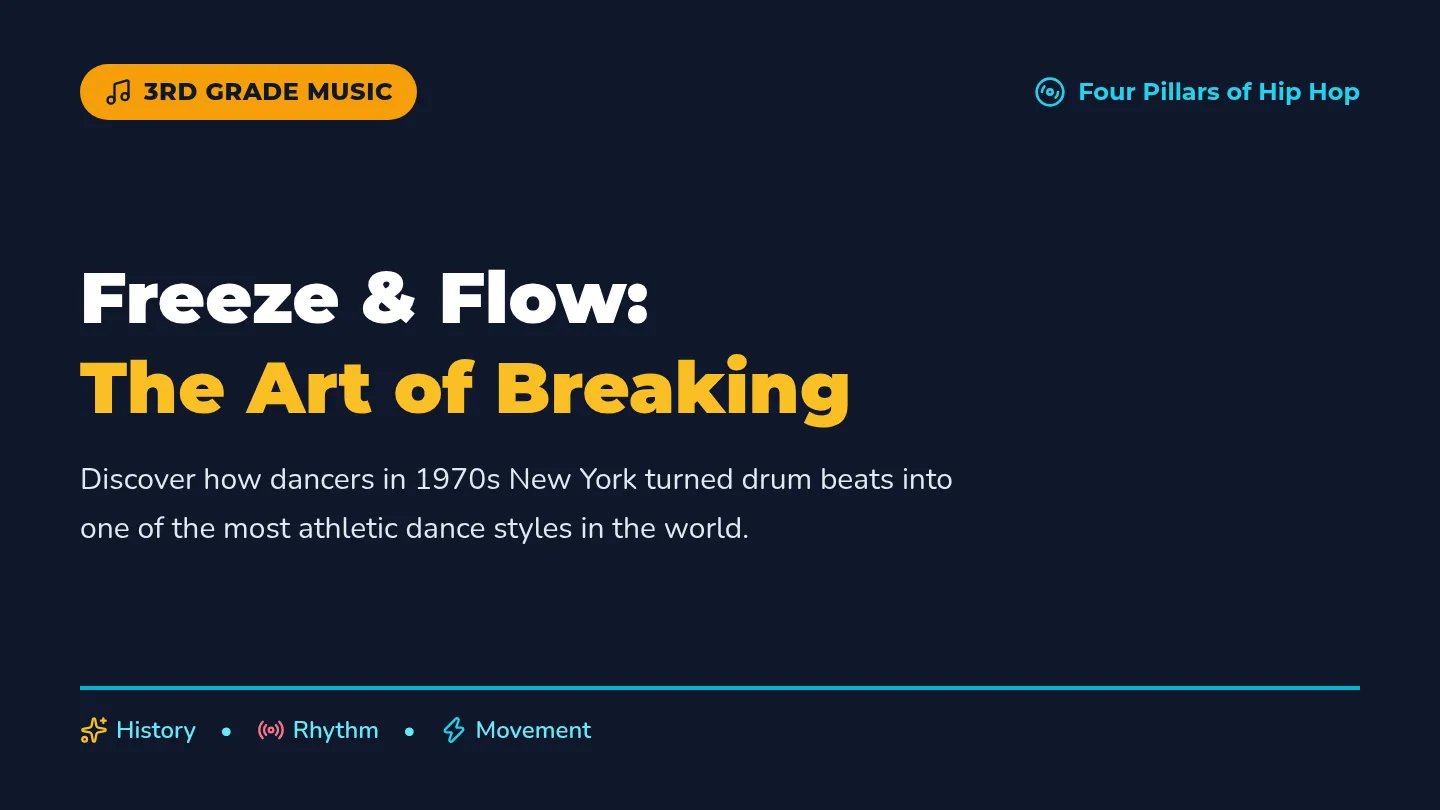
The Birth of Hip Hop
From 1970s Bronx Block Parties to "Rapper's Delight" by The Sugarhill Gang
Key Words: Steady Beat • DJ & MC • Rhythm & Rhyme • Bassline
Today's Musical Goals
1
Explore History
Discover how hip hop began at neighborhood block parties in the Bronx, New York.
2
Meet the Makers
Tell the difference between what a DJ does and what an MC does.
3
Feel the Groove
Keep a steady 4-beat pulse and spot rhyming words in "Rapper's Delight."
1973 • THE BRONX, NY
Where It All Started
In the 1970s, kids and teens in the Bronx threw outdoor block parties with giant speakers.
A creative musician named DJ Kool Herc noticed that dancers loved the "break" — the part of a record with just drums and bass!
Using two turntables, he played the same break over and over so the party never stopped.
What Is a "Break"?
The break is the rhythmic drum-and-bass section of a song where the melody pauses and the groove takes over.
Looping the break = the birth of hip hop beats!
Watch: The Birth of Hip Hop
Video 1
Embedded media
Watch & Listen For:
Where did hip hop begin?
How did DJs use turntables as instruments?
What elements made the block parties exciting?
Two Essential Hip Hop Makers
The DJ
Disc Jockey
Plays vinyl records on two turntables, mixes songs together, and keeps the steady beat going!
Job: Controls the Beat & Groove
The MC
Master of Ceremonies
Gets the crowd excited and raps words in rhythm and rhyme over the DJ's beat!
Job: Speaks in Rhythm & Rhyme
1979
"Rapper's Delight" by The Sugarhill Gang
First Big Hit
In 1979, this became the first hip hop song played on radio stations all around the world!
Groovy Bassline
The song uses a bouncy bassline borrowed from a disco hit called "Good Times."
Playful Rhymes
Three MCs trade verses with fun, fast-paced rhymes that fit right on the 4-beat pulse.
Listen: "Rapper's Delight"
The Sugarhill Gang
Embedded media
Active Listening:
• Tap the Beat: Count 1 – 2 – 3 – 4 quietly on your knees.
• Hear the Bass: Notice the low, bouncy notes repeating.
• Catch a Rhyme: Raise a hand when you hear words rhyme!
Your Turn to Be an MC!
Let's show what we learned about the DJ, the MC, and "Rapper's Delight" on our Beat Drop Worksheet!
Clap it out: 1 – 2 – 3 – 4!
Beat Drop Worksheet Beat Drop Worksheet
Music • The Birth of Hip Hop
Page 1 of 2
Name:
Date:
Part 1: Hip Hop History Check
Circle the best answer for each question.
1. Where did hip hop music begin in the 1970s?
A. At block parties in the Bronx, NY
B. Inside a quiet library
C. On a farm in Texas
D. At an ice skating rink in Alaska
2. What is the "break" that DJ Kool Herc looped on his turntables?
A. A time to turn off the speakers
B. The drum-and-bass groove dancers loved
C. A cracked vinyl record
D. The quietest note in a lullaby
3. Which group made "Rapper's Delight" a big radio hit in 1979?
A. The Beatles
B. The Marching Band
C. The Sugarhill Gang
D. The Mozart Trio
Part 2: DJ or MC?
Read each clue. Circle DJ or MC to show whose job it is.
4. Plays records on two turntables to keep the beat going.
DJ MC
5. Speaks in rhythm and rhyme into the microphone.
DJ MC
6. Loops the drum-and-bass break for the crowd to dance.
DJ MC
7. Writes clever rhyming verses to perform over the beat.
DJ MC
Beat Drop Worksheet
Page 2 of 2
Part 3: Listening Lab — "Rapper's Delight"
8. As you listen to "Rapper's Delight," count the steady 4-beat pulse (1 - 2 - 3 - 4). Draw 4 music notes or claps in the boxes below to show one 4-beat measure!
Beat 1
Beat 2
Beat 3
Beat 4
9. Name two sounds or instruments you hear in "Rapper's Delight" (for example: drums, bass, clapping, voices).
Sound 1:
Sound 2:
Part 4: Be the MC! Write a 2-Line Rap
10. Write two lines that rhyme at the end! You can use a rhyming pair from the Word Bank or make up your own.
Rhyming Word Bank
beat / feet
rhyme / time
song / strong
play / day
Line 1:
Line 2:
Beat Drop Answer Key Beat Drop Answer Key
3rd Grade Music • The Birth of Hip Hop
Teacher Reference
Part 1: Hip Hop History Check
A. At block parties in the Bronx, NY — Hip hop began at outdoor neighborhood parties in the 1970s.
B. The drum-and-bass groove dancers loved — DJ Kool Herc looped the break using two turntables.
C. The Sugarhill Gang — Their 1979 song "Rapper's Delight" was the first major hip hop radio hit.
Part 2: DJ or MC?
4. DJ — Plays records on two turntables to keep the beat going.
5. MC — Speaks in rhythm and rhyme into the microphone.
6. DJ — Loops the drum-and-bass break for the crowd to dance.
7. MC — Writes clever rhyming verses to perform over the beat.
Part 3: Listening Lab — "Rapper's Delight"
8. Steady 4-Beat Pulse: Students should draw 4 distinct symbols (quarter notes, claps, hearts, or stars)—one in each of the 4 boxes—representing beats 1, 2, 3, and 4.
9. Sounds/Instruments Heard (Accept any 2 accurate responses): Bass guitar (bouncy bassline), drum set / steady beat, hand claps, electric guitar, piano/keyboard chords, or rapping/singing voices.
Part 4: Be the MC! Write a 2-Line Rap
10. Grading Look-Fors: Both lines are complete thoughts, end with a clear rhyming pair (from the word bank or original), and can be spoken to a steady 4-beat pulse.
Sample Student Response:
Line 1: When the DJ drops the steady beat,
Line 2: Everybody starts to move their feet!
Hip Hop Roots Teacher Guide Hip Hop Roots Teacher Guide
3rd Grade Music • "The Birth of Hip Hop" & "Rapper's Delight"
45 Minutes
Learning Objectives
Identify the 1970s Bronx block-party origins of hip hop.
Distinguish between the roles of the DJ (beat) and MC (rhyme).
Keep a steady 4-beat pulse and identify instruments and rhymes in "Rapper's Delight."
Lesson Materials & Sources
Hip Hop Roots Slides (with embedded videos)
Beat Drop Worksheet & Answer Key
Birth of Hip Hop Video: youtube.com/watch?v=10C-Q3NIlzU&t=6s
Rapper's Delight Video: youtube.com/watch?v=H8yUxDOHlh8
Key Musical Vocabulary
Steady Beat: The even, ongoing pulse in music (1-2-3-4).
Break: The drum-and-bass part of a song dancers love.
Bassline: The low, repeating musical pattern under a song.
DJ: Disc Jockey who plays records and loops the beat.
MC: Master of Ceremonies who raps in rhythm and rhyme.
Rhyme: Words with the same ending sound (beat / feet).
Step-by-Step Pacing Guide
Page 1 of 2
1. Hook & History (10 mins) — Slides 1–4
Whole Class
Introduce the 1970s Bronx block party setting (Slides 1–3). Explain how DJ Kool Herc used two turntables to loop the drum-and-bass "break." Play Video 1 (Slide 4) and pause briefly to ask: "What did people use to make music at these parties?"
2. DJ vs. MC & "Rapper's Delight" (12 mins) — Slides 5–7
Guided Listening
Compare the DJ and MC (Slide 5). Introduce The Sugarhill Gang's 1979 hit (Slide 6). Play Video 2 (Slide 7) for 1.5–2 minutes while students tap a quiet 4-beat pulse on their knees and raise a hand when they hear rhyming words.
Hip Hop Roots Teacher Guide
Page 2 of 2
3. Beat Drop Worksheet (15 mins) — Slide 8
Independent / Pairs
Distribute the Beat Drop Worksheet. Complete Part 1 together if needed, then let students complete Parts 2–4. Replay a short clip of "Rapper's Delight" during Part 3 so students can draw their 4-beat pulse and list instruments they hear.
4. Mini MC Share-Out & Wrap-Up (8 mins)
Whole Class
Have the class clap a steady 4-beat groove (clap-pat-clap-pat) while 3–4 volunteers read their 2-line raps from Part 4 over the class beat!
Discussion Prompts & Teacher Notes
Turntables as Instruments: Some students think DJs only press "play." Emphasize that early hip hop DJs practiced rhythmic timing and switching records back and forth just like playing drums.
Listening Prompt: Ask, "How is rapping different from singing a melody, and how is it similar?" (Both follow a steady beat and rhythm, but rapping focuses on spoken rhythm and rhyme.)
Previewing Media: Cue "Rapper's Delight" to the opening chorus and first verse (0:00–1:45) for crisp 3rd-grade pacing.
Differentiation Strategies
Visual & ELL Support
Point to the DJ/MC icons on Slide 5 and model rhyming pairs aloud before students write in Part 4.
Kinesthetic Learners
Let students step side-to-side or tap rhythm sticks on beats 1–2–3–4 during Video 2.
Early Finishers
Challenge students to add a 3rd and 4th rhyming line on the back of their worksheet.
Classroom Extension: 4-Beat Cypher
Form a standing circle. Half the class performs a 4-beat body percussion pattern (stomp-clap-stomp-clap) while pairs take turns speaking their 2-line rhymes in the center.