Perspective Exploration Facilitator Guide Perspective Exploration
Facilitator Guide
Duration
45 Mins
Learning Objective
Students will master the principles of one-point perspective, learning how to use a horizon line and vanishing point to create the illusion of three-dimensional depth on a flat surface.
Why This Matters
One-point perspective is the foundation of realistic drawing. Beyond art, it enhances spatial awareness and observational skills that are vital in fields ranging from architecture to medical imaging and forensic analysis.
Materials
Vanishing Point Slides
Art of Observation Guide
Vanishing Point Worksheet
Drawing Paper & Pencils
Rulers & Erasers
Lesson Flow
05 Minutes
Introduction: The Big Picture
Greet students and introduce the concept. Explain that one-point perspective is a visual trick artists use to represent three-dimensional space. Introduce the key vocabulary: Horizon Line and Vanishing Point.
05 Minutes
Visual Insight: How Art Helps You Analyze
Play the featured video. Ask students to look for how the narrator describes "seeing" vs. "looking."
Link: https://auburn-ma.lennylearning.org/view/how-art-can-help-you-analyze
10 Minutes
Guided Discussion: The Art of Observation
Facilitate a class-wide conversation using the Art of Observation Discussion Guide.
Connect observation skills to real-world professions (medicine, law).
Discuss how perspective requires "slowing down" our eyes.
15 Minutes
Hands-On Studio: The Infinite Road
Guided drawing activity. Walk students through these steps:
Draw a horizontal line across the center (Horizon).
Place a single dot on that line (Vanishing Point).
Draw diagonal lines from the bottom corners to the dot (Road).
Add horizontal lines for road markers that get closer together as they approach the dot.
05 Minutes
Check for Understanding
Distribute the Vanishing Point Worksheet. Students should work independently to define terms and sketch a simple scene.
05 Minutes
Closure & Gallery Walk
Recap the "illusion of depth." Invite students to hold up their work or walk past desks to see their peers' vanishing points. Provide positive feedback on their technical execution.
Pacing Pro-Tip
The "Hands-On Studio" is the core of the lesson. If students are struggling with their rulers, extend that time by 5 minutes and skip the "Gallery Walk" at the end. Focus on ensuring everyone has a clear horizon line and vanishing point before adding details.
Vanishing Point Slides Vanishing Point
The Art of Perspective
What is One-Point Perspective?
A drawing method that shows how things appear to get smaller as they get further away.
The Secret Sauce
"All lines converge towards a single point on the horizon."
Horizon Line
How Art Can Help You Analyze
Watch closely: How does "seeing" change your perspective?
Embedded media
01
What did you find interesting?
"Encourage students to share specific parts of the video they found intriguing and relate it to how art can help improve observation skills."
Visual Acuity Deep Analysis Observation
02
Medicine & Law Enforcement?
How does observing art help professionals in fields like medicine and law enforcement? Why is visual acuity vital for diagnosis and investigation?
The Studio Session
Step-by-Step Drawing Guide
Establish the Horizon
Use your ruler to draw a perfectly horizontal line across the center of your page.
Set the Vanishing Point
Place a single, clear dot anywhere on that line. This is where your world "ends."
Connect the Corners
Draw lines from the bottom corners of your paper up to the vanishing point. You've made a road!
Art of Observation Discussion Guide Art of Observation
Discussion Facilitator Guide
Teacher Note
This discussion connects the visual training of art to high-stakes professional environments. Use these prompts to help students understand that "perspective" isn't just an art technique—it's a critical thinking tool.
1 What did you find interesting about the video?
Encourage students to share specific parts of the video they found intriguing and relate it to how art can help improve observation skills.
Facilitation Tips:
Ask: "Did any specific painting in the video stand out? Why?"
Focus on the difference between looking (passive) and seeing (active analysis).
How did the narrator describe the change in her own perception?
2 How does observing art help professionals?
Discuss the idea that art enhances visual acuity and communication skills, which can be vital for accurate diagnosis and investigations.
Key Discussion Points:
Medicine: Doctors must notice subtle changes in skin color, eye dilation, or patient movement to diagnose correctly.
Law Enforcement: Detectives must look for "the missing thing" in a crime scene—what should be there but isn't.
Communication: Describing a painting requires precise language, just like describing a medical symptom or a witness report.
3 Application to One-Point Perspective
Guide students to connect the idea of careful observation in art to the technique of one-point perspective.
Closing Thought:
"One-point perspective requires us to look past what we think we see (like parallel roads) and draw what we actually see (lines converging to a point). Accuracy in perspective is a form of truth-telling in art."
Vanishing Point Worksheet Vanishing Point
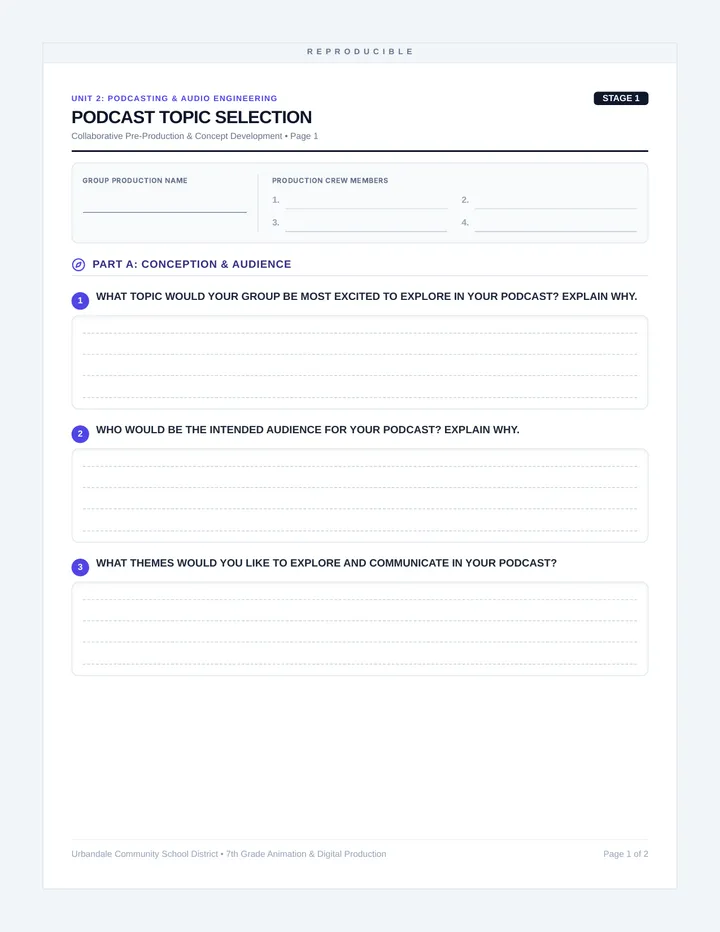
Perspective Exploration Practice
Name:
Date:
01 Define one-point perspective.
Think about how lines converge to a single point on the horizon.
02 Foundations: Horizon & Vanishing Point
Using your ruler, draw a horizon line and place a vanishing point in the space below.
03 Perspective Scene
Create a simple scene using one-point perspective (e.g., a road, a hallway, or a train track). Ensure all depth lines converge at your vanishing point.
04 Why is one-point perspective important in art?
Consider how it helps in creating realistic drawings and representing the real world.
"Everything has its own perspective."