Lyric Lab Lesson Plan
Songwriting Series • Lesson 2 of 4
Lyric Lab: Words & Rhyme
Crafting impactful imagery, choosing rhyme schemes, and writing memorable lines
Grade Band: 5–10
Duration: 45–60 mins
Focus: Lyrics & Prosody
Learning Objectives
- Identify and apply AABB and ABAB rhyme schemes.
- Build sensory word banks tailored to a central song concept.
- Draft a 4-line verse and a punchy 2-line memorable hook.
Key Vocabulary
Rhyme Scheme: Pattern of end rhymes (AABB, ABAB).
Near/Slant Rhyme: Words with matching vowel sounds (time/mine).
Hook: The stickiest, most memorable line in a song.
Materials & Setup
• Printed Songwriting Worksheets
• Audio playback device (for mentor song clips)
• Highlighters / pencils
• Optional: Rhyming dictionaries
Lesson Stages • Part 1: Exploration & Modeling
1
The "Earworm" Hook (Warm-Up & Activate)
7 mins
Play a 15-second snippet of a universally recognized song chorus (e.g., Bill Withers' Lean on Me or a popular modern pop chorus). Prompt students: "Why does this line stick in your head all day?"
Teacher Key Insight: Point out that catchy lyrics rely on simple vowel repetition, strong sensory verbs, and rhythmic cadence, not just dictionary-perfect rhymes.
2
Direct Instruction: Rhyme Types & Schemes
12 mins
Rhyme Schemes
AABB (Couplets): Immediate payoff. Great for bouncy, direct choruses and fast storytelling.
ABAB (Alternating): Builds anticipation and allows longer narrative development across lines.
Perfect vs. Slant Rhymes
Perfect: Exact sound match (night / light). Powerful, but can become predictable or cliché.
Slant (Near): Vowel match with different end consonants (home / alone, shape / late). Sounds modern and natural.
Songwriting Lesson 2 • Teacher Instructional Guide Page 1 of 2
Application, Reflection & Differentiation
Lesson Stages • Part 2
3
Guided Modeling: The "Sensory Vault" Method
8 mins
Model on the whiteboard with a sample emotion/topic: "Waking up late on a test day" or "Winning a tight championship game." Demonstrate avoiding generic words like "sad" or "happy" by collecting vivid sensory details:
Sight Blinking neon, sneakers
Sound Slamming locker, static
Touch/Physical Sweaty palms, chill wind
Internal Action Heart racing, breath held
4
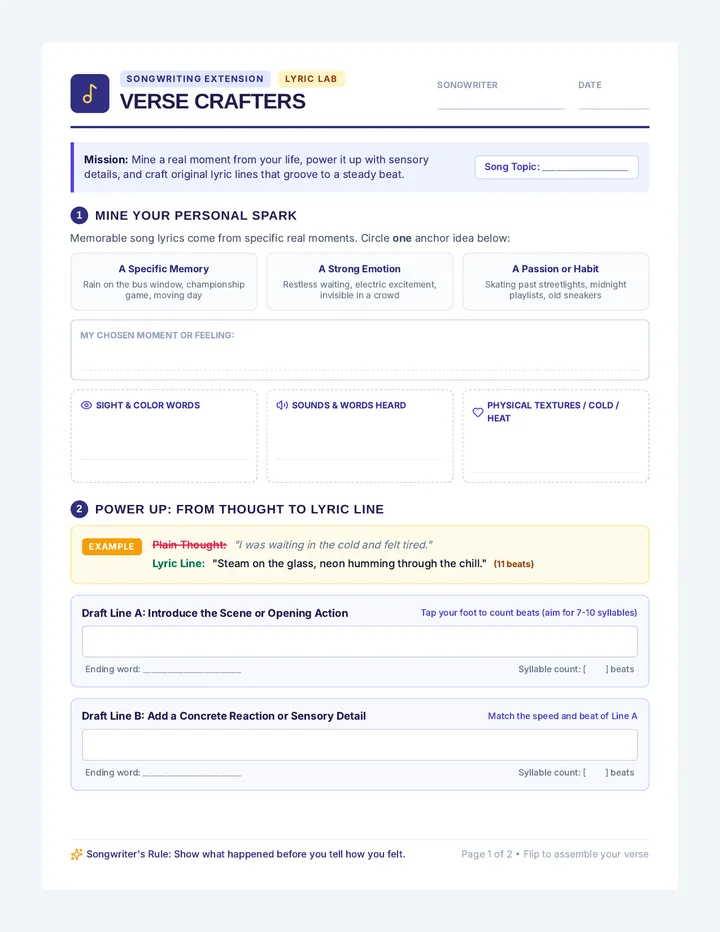
Independent Workshop: Lyric Lab Worksheet
20 mins
Distribute the Lyric Lab Songwriting Worksheet. Students independently or in pairs work through:
- Naming their song theme & filling the 4-part Sensory Vault.
- Developing rhyming pairs (testing at least 1 slant rhyme).
- Drafting a structured 4-line verse and a standalone 2-line memorable Hook.
5
Lyric Showcase & Debrief
8 mins
Have 3–4 volunteers read or chant their 2-line hook out loud. Ask listeners to snap when they hear an unexpected word choice or a slant rhyme that fits smoothly.
Differentiation Strategies
- Support (ELL / Struggling): Provide pre-paired rhyme cards; allow students to focus solely on an AABB couplet before attempting a full verse.
- Extension (Advanced): Challenge students to use internal rhymes (rhyming words inside the same line) or an ABAB scheme with multisyllabic slant rhymes.
Formative Assessment Checklist
- • Concept Consistency: Does the vocabulary clearly match the stated song theme?
- • Scheme Accuracy: Is the chosen rhyme pattern (AABB or ABAB) maintained?
- • Rhythmic Flow: Do lines have comparable syllable lengths when spoken aloud?
Songwriting Lesson 2 • Teacher Instructional Guide Page 2 of 2
Lyric Lab Songwriting Worksheet
Songwriter's Studio Notebook • Lesson 2
Topic: Lyrics & Rhyme
Lyric Lab: Words & Rhyme
Name:
Date:
Period:
1
Song Seed & Central Concept
Working Song Title
Central Story / Topic
Mood / Emotion (e.g., Hopeful, Restless)
2
The Sensory Word Vault
Collect vivid details instead of telling how you feel
Brainstorm at least 3 specific words or phrases in each category related to your song idea:
Sights & Colors (Objects, light, shadows)
Sounds & Voices (Echoes, buzz, silence)
Physical Touch / Bodily Feeling (Cold, pulse)
Strong Verbs / Actions (Shatter, drift, sprint)
3
Rhyme Generator Laboratory
Tip: Slant rhymes share vowel sounds (time/mind)
Select 3 key anchor words from your vault above. For each anchor word, find one perfect rhyme and one slant (near) rhyme to give your lyrics flexibility.
Anchor Word (From Vault)
Perfect Rhyme (Exact Sound)
Slant / Near Rhyme (Vowel Match)
Lyric Lab Songwriting Worksheet • Section 1: Brainstorm & Sound Mapping Page 1 of 2
Song Construction: Verse & Hook
Section 2: Drafting
4
Verse Architect (4-Line Stanza)
Circle Chosen Scheme: AABB (Couplets) ABAB (Alternating)
Write a 4-line verse that tells a story or paints a scene. Try to keep lines at a similar beat or syllable count when spoken aloud.
Line 1 (Rhyme Sound A) Syllable Count: [ ]
Line 2 (Rhyme Sound A or B) Syllable Count: [ ]
Line 3 (Rhyme Sound B or A) Syllable Count: [ ]
Line 4 (Rhyme Sound B) Syllable Count: [ ]
5
The "Golden Hook" (Chorus Climax)
Make it simple, sticky, and singable
Write a 2-line hook that sums up the core heart of your song. This is the phrase listeners will repeat on the drive home!
Hook Line 1 (The Setup / Core Statement)
Hook Line 2 (The Rhyme Payoff or Resolution)
6
Songwriter's Rhythm & Polish Checklist
Rhythm Spoken Aloud Read lines at regular tempo without tripping over extra syllables.
Sensory Show, Don't Tell Includes at least two concrete sensory words from your vault.
Rhyme Variety Rhyme pattern is clean and avoids cliché/forced rhymes.
Lyric Lab Songwriting Worksheet • Section 2: Composition & Polish Page 2 of 2