Rhythm Detectives Slides
Music Class
What Is Rhythm?
Discovering steady beats, long and short sounds, and how to build your own musical patterns.
Lesson: Feel the Beat
Today We Will...
1
Tell the difference between steady beat and rhythm.
2
Read and clap quarter notes, eighth notes, and rests.
3
Clap and say 4-beat rhythm patterns together as a class.
4
Compose and perform our very own 4-beat rhythm!
Steady Beat vs. Rhythm
Steady Beat
The even, unchanging pulse of music—just like your heartbeat or a ticking clock!
Rhythm
The pattern of long and short sounds (and silences) that move over the beat!
Watch & Listen: What Is Rhythm?
Video Time
Embedded media
Listen For...
-
Can you tap the steady beat on your knees?
-
How do long and short sounds change the feel?
-
What happens when there is a rest?
Meet Our Rhythm Building Blocks
Quarter Note
"ta"
1 sound on 1 beat
Eighth Notes
"ta-di"
2 fast sounds on 1 beat
Quarter Rest
"shh"
1 beat of silence
Clap & Say Together!
Pattern A
♩
ta
♫
ta-di
♩
ta
𝄽
shh
Pattern B
♫
ta-di
♫
ta-di
♩
ta
♩
ta
Worksheet Time
Now It's Your Turn!
1
Spot the difference between steady beat and rhythm.
2
Match each note to its rhythm sound.
3
Count the beats and compose your own 4-beat rhythm!
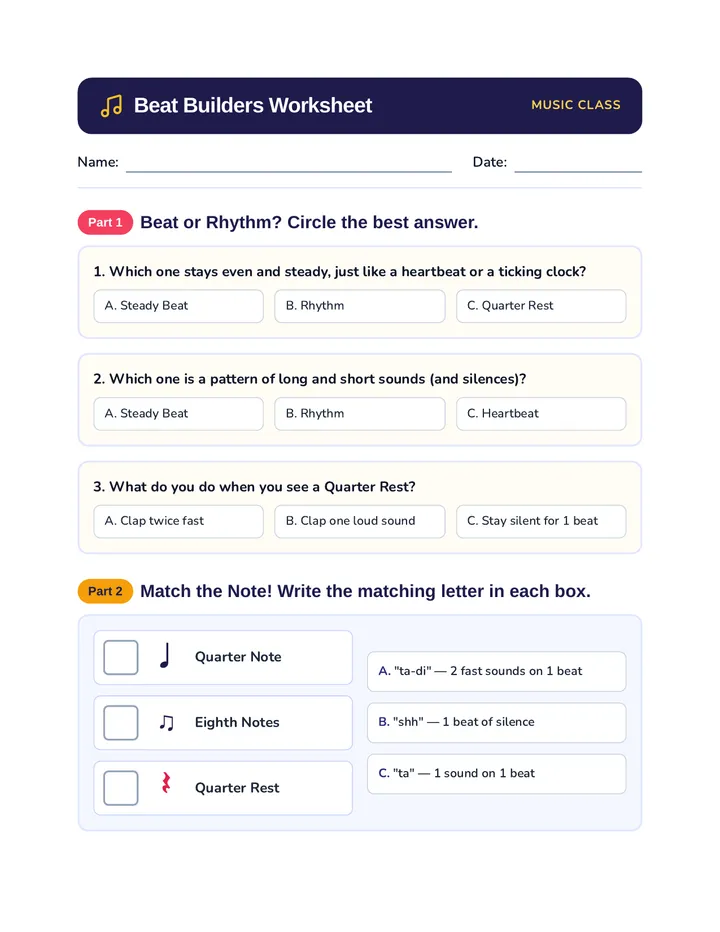
Beat Builders Worksheet
Beat Builders Worksheet
Music Class
Name:
Date:
Part 1
Beat or Rhythm? Circle the best answer.
1. Which one stays even and steady, just like a heartbeat or a ticking clock?
A. Steady Beat
B. Rhythm
C. Quarter Rest
2. Which one is a pattern of long and short sounds (and silences)?
A. Steady Beat
B. Rhythm
C. Heartbeat
3. What do you do when you see a Quarter Rest?
A. Clap twice fast
B. Clap one loud sound
C. Stay silent for 1 beat
Part 2
Match the Note! Write the matching letter in each box.
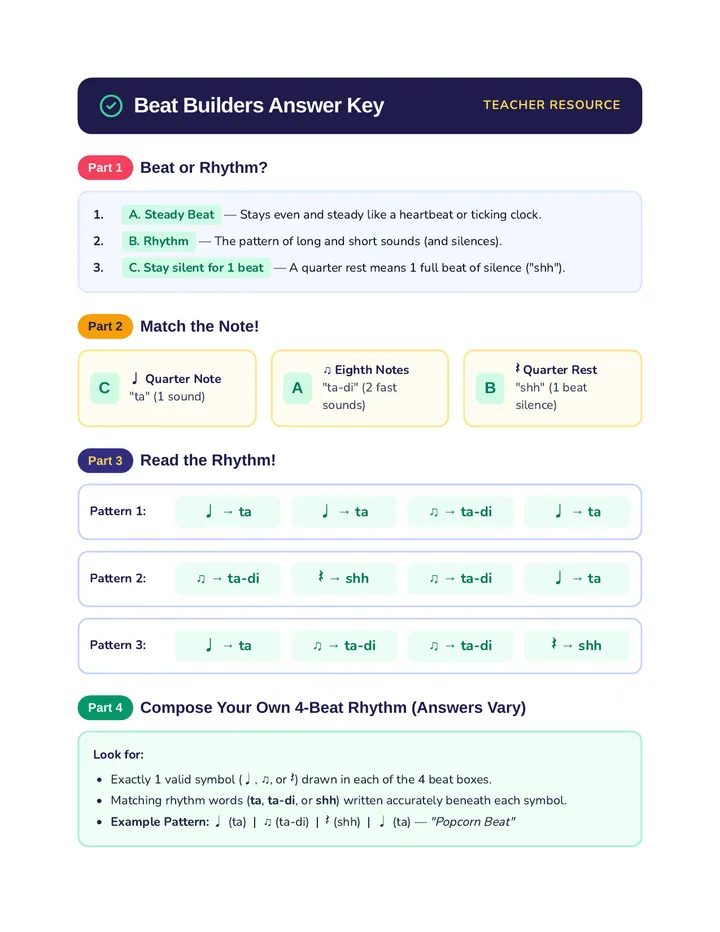
♩ Quarter Note
♫ Eighth Notes
𝄽 Quarter Rest
A. "ta-di" — 2 fast sounds on 1 beat
B. "shh" — 1 beat of silence
C. "ta" — 1 sound on 1 beat
Beat Builders Worksheet — Page 2
Word Bank: ta | ta-di | shh
Part 3
Read the Rhythm! Write ta, ta-di, or shh under each beat.
Pattern 1
♩
♩
♫
♩
Pattern 2
♫
𝄽
♫
♩
Pattern 3
♩
♫
♫
𝄽
Part 4
Compose Your Own 4-Beat Rhythm!
Draw a quarter note (♩), eighth notes (♫), or a quarter rest (𝄽) in each beat box below. Then write the rhythm words underneath!
Beat 1
Beat 2
Beat 3
Beat 4
Name your rhythm:
Feel the Beat Teacher Guide
Feel the Beat Teacher Guide
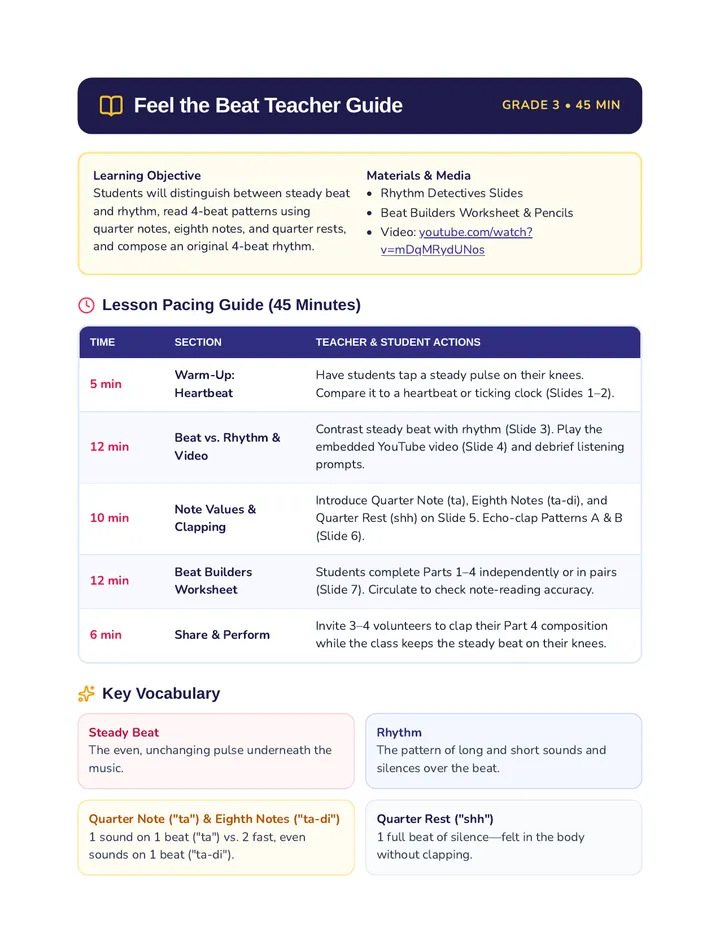
Grade 3 • 45 Min
Learning Objective
Students will distinguish between steady beat and rhythm, read 4-beat patterns using quarter notes, eighth notes, and quarter rests, and compose an original 4-beat rhythm.
Materials & Media
- Rhythm Detectives Slides
- Beat Builders Worksheet & Pencils
- Video: youtube.com/watch?v=mDqMRydUNos
Lesson Pacing Guide (45 Minutes)
| Time |
Section |
Teacher & Student Actions |
| 5 min |
Warm-Up: Heartbeat |
Have students tap a steady pulse on their knees. Compare it to a heartbeat or ticking clock (Slides 1–2). |
| 12 min |
Beat vs. Rhythm & Video |
Contrast steady beat with rhythm (Slide 3). Play the embedded YouTube video (Slide 4) and debrief listening prompts. |
| 10 min |
Note Values & Clapping |
Introduce Quarter Note (ta), Eighth Notes (ta-di), and Quarter Rest (shh) on Slide 5. Echo-clap Patterns A & B (Slide 6). |
| 12 min |
Beat Builders Worksheet |
Students complete Parts 1–4 independently or in pairs (Slide 7). Circulate to check note-reading accuracy. |
| 6 min |
Share & Perform |
Invite 3–4 volunteers to clap their Part 4 composition while the class keeps the steady beat on their knees. |
Key Vocabulary
Steady Beat
The even, unchanging pulse underneath the music.
Rhythm
The pattern of long and short sounds and silences over the beat.
Quarter Note ("ta") & Eighth Notes ("ta-di")
1 sound on 1 beat ("ta") vs. 2 fast, even sounds on 1 beat ("ta-di").
Quarter Rest ("shh")
1 full beat of silence—felt in the body without clapping.
Feel the Beat Teacher Guide — Page 2
Facilitation & Assessment
Video Facilitation Prompts (Slide 4)
Before Watching: Ask students to place one hand on their chest to feel their heartbeat, then explain they will look for how rhythm differs from that steady pulse.
During Watching: Have students silently tap the steady beat on their knees while listening for when sounds get faster or pause.
After Watching: Ask: "If everyone clapped the same steady beat the whole time, how would music sound? What did rhythm add?"
Differentiation Strategies
Support (Developing Learners)
- Use body percussion (pat knees for beat, clap hands for rhythm) before writing.
- Allow students to use rhythm cards or counters in Part 4 before drawing symbols.
- Pair students to say patterns aloud together before writing.
Extension (Ready for More)
- Challenge early finishers to write a second 4-beat rhythm and combine both into an 8-beat phrase.
- Have pairs perform their two rhythms simultaneously as a 2-part rhythm duet.
Common Misconceptions & Quick Fixes
Misconception: "Beat and rhythm are the same thing."
Quick Fix: Have half the class stomp the steady beat while the other half claps the syllables of "Happy Birthday" or "Jingle Bells," then switch.
Misconception: Skipping over a Quarter Rest without counting its beat.
Quick Fix: Teach students to open their palms outward silently (or whisper "shh") on every rest so they physically feel the full beat.
Quick Formative Assessment Checklist
Student accurately explains or demonstrates steady beat vs. rhythm (Part 1).
Student matches ♩, ♫, and 𝄽 to "ta," "ta-di," and "shh" (Parts 2–3).
Student's Part 4 composition contains 4 valid beats and is clapped accurately.