Playbook Slides
Professional Development
Session 1.1
THE ELECTIVES
PLANNING PLAYBOOK
A blueprint for K-8 specialists to design high-impact Quarter 1 curriculums, master rotating schedules, and track student growth.
Target Audience
K-8 Electives & Special Subjects Teachers
Core Framework
Backward Design & Skill Progressions
X O X
The Core Challenge
Navigating the Electives Matrix
K - 4th Grade
Weekly Rotations
Students see you for consecutive days, then rotate. Momentum is high, but retention over long breaks is the primary hurdle.
Planning Focus:
Self-contained weekly blocks with clear, achievable checkpoints before rotation.
5th - 8th Grade
A / B Day Schedules
Classes meet every other day. Deep learning occurs over weeks, but gap-day cognitive loss demands intentional retrieval practice.
Planning Focus:
Cohesive 9-week progression with built-in retrieval practices at the start of every session.
Electives Planning Playbook Slide 2 of 11
Step 1: The Destination
Starting with the End Goals
01
The Big Outcome
What will students be able to do independently at the end of Quarter 1? Focus on performance over theory.
E.g., "Students can play a standard 6v6 volleyball game using 3 contacts."
02
Acceptable Evidence
How will you prove they met this goal? What does high-quality student work or physical performance look like?
E.g., "A performance rubric assessing passing, setting, and court positioning."
03
Learning Experiences
What skill-building practices will guide them from day 1 to the final check? Break down week-by-week.
E.g., "Weekly focus on passing drills, moving to partner setting, then group play."
Electives Planning Playbook Slide 3 of 11
Step 2: The Progression
Weekly Skill Deconstructions
The Golden Rule: One Core Skill
Avoid the trap of trying to teach everything at once. Pick one foundational skill per week that compounds into the final goal.
If your end goal is complex (e.g., throwing pottery, writing a song, playing a sport), isolate its component movements and sequence them logically.
WEEK 1
Isolate & Introduce Single movement, stationary cues
WEEK 2
Dynamic & Contextualize Introduce movement & simple variables
WEEK 3
Combine & Apply Combine skills into mini-tasks/games
Electives Planning Playbook Slide 4 of 11
Weekly Rotations: K-4th Grade
Daily Skills for 1-Week Rotations
K-4 ROTATION
DAY 1
The Platform
Directly model and isolate physical mechanics. Direct instruction cues (I Do) dominate.
"Elbows locked, flat target, stationary ball contacts."
DAY 2
The Movement
Add dynamic steps to the ball. Shift heavily to partner toss/catch practices (We Do).
"Slide steps to square the body under the incoming toss."
DAY 3
The Target
Introduce directional control. Practice aiming at targets (hoops, cones, or specific lines).
"Angle the platform towards a hoop target on the floor."
DAY 4
The Application
Cooperative play challenges. Combine elements into simple, engaging active challenges (You Do).
"3v3 'Keep It Up' cooperative points challenge."
DAY 5
The Showcase
Culminating mini-tournament. Apply and assess using a simplified mastery rubric.
"Mini match play with continuous platform grading."
Electives Planning Playbook Slide 5 of 11
A / B Day Schedules: 5th-8th Grade
Daily Skills for 2-Week Blocks
5-8 A/B DAYS
CLASS 1 (W1)
The Foundation
Establish the core mechanics of a complex skill. Direct cues and static platform locks.
"Direct modeling of passing arm shape and shoulder shrugs."
CLASS 2 (W1)
Dynamic Drills
Move to dynamic steps, adding split-stance recovery and ball tracking.
"Moving side-to-side to receive and pass a soft dynamic toss."
CLASS 3 (W2)
Retrieval & Target
Retrieval drill after weekend gap. Focus on aiming and platform angles to deep targets.
"Retrieval review: students freeze mechanics, then aim to setter targets."
CLASS 4 (W2)
Combination Play
Combine forearm passing with a secondary action (e.g., set, court movement, or calling positions).
"Controlled pass-to-set loops requiring movement to transition spots."
CLASS 5 (W2)
Culmination check
A comprehensive performance check and application of the two-week block.
"3v3 dynamic game with clipboard performance evaluations."
Electives Planning Playbook Slide 6 of 11
Case Study: Physical Education
9-Week Volleyball Progression
PE FOCUS
Phase 1: Foundation
W1: Forearm Pass (Underhand)
Platform, hand grip, leg drive
W2: Overhead Set
Finger pad contact, window shape
W3: Underhand Serve
Opposite step, pendulum swing, hand shape
Phase 2: Transition
W4: The 3-Contact Flow
Combining pass-to-set sequences
W5: Overhead Serve (Intro)
Ball toss height, hand high-five
W6: Defense & Positions
Base defense, court coverage zones
Phase 3: Integration
W7: Attack & Spiking
3-step approach, contact point, snap
W8: Modified Game Play
Controlled matches with catch-to-toss
W9: Tournament & Evaluation
Performance assessment during play
Electives Planning Playbook Slide 7 of 11
Class Delivery Framework
I Do, We Do, You Do in Action
1
I DO
Modeling & Cues
Directly explain the skill cues. Keep explanation under 5 minutes. Use explicit demonstrations.
Volleyball Example:
"Wrists together, thumbs down, lock elbows, shrug shoulders. Call 'BALL!'"
2
WE DO
Guided Practice
Whole-class controlled repetition. Immediate corrective feedback loops. Scaffolded difficulty.
Volleyball Example:
Partner toss-and-catch to build platform mechanics before adding dynamic ball flights.
3
YOU DO
Independent Application
Students apply skills in a game-like or project-based environment. Teacher observes and assesses.
Volleyball Example:
3v3 "Keep It Up" cooperative target game, aiming for continuous platform contacts.
Electives Planning Playbook Slide 8 of 11
Step 3: Checking Progress
Checks for Understanding (CFUs)
Non-Verbal & Real-Time
Get 100% response rates in under 5 seconds. Perfect for performance-based classrooms before shifting tasks.
- Fist-to-Five: Self-reflection on their skill comfort.
- Platform Check: Freeze command - students show elbow lock.
- Signal Choice: High overhead toss vs floor hit body signals.
Cognitive Reflections
Confirm students understand the *why* behind their body mechanics or artistic decisions.
- 3-Second Cue: Shout out key coaching cue before dismissal.
- Physics Check: "Why do thumbs point down when passing?"
- Peer Feedback Loop: Partners call out cue misses on targets.
Electives Planning Playbook Slide 9 of 11
Step 4: Grading Tools
Creating Quick Assessment Rubrics
Keep It Observable
Do not build convoluted grading matrices. Create clear performance indicators that can be observed and marked within 15 seconds during active play or work.
Efficiency Pro-Tip:
Assess 4-5 students per game or work rotation instead of attempting to grade the entire class in one lesson.
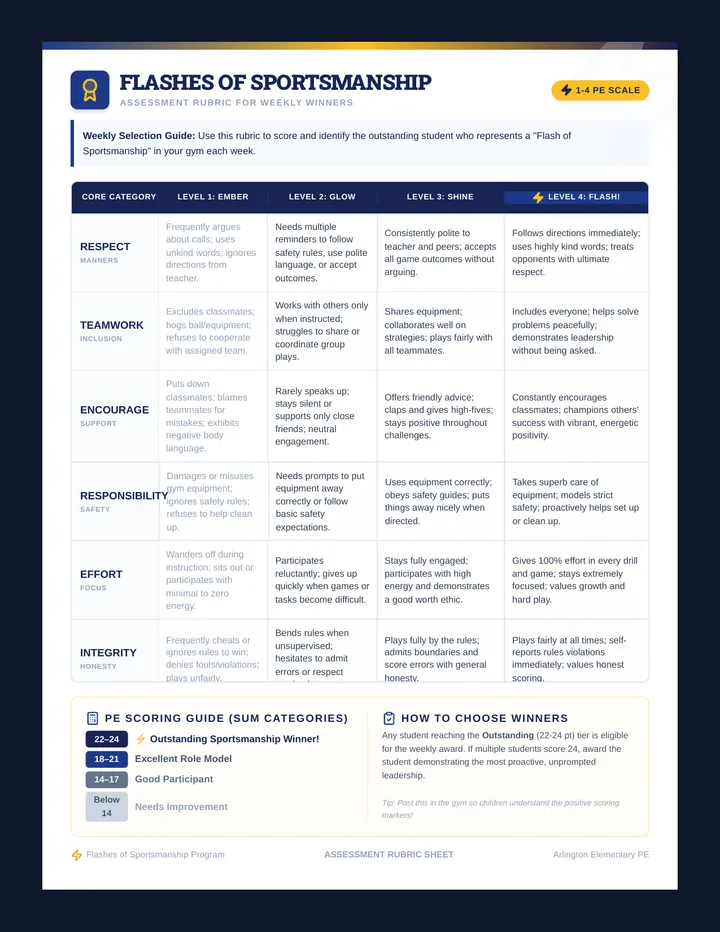
Sample Skill Proficiency Scale: Volleyball Passing
4 Excellent
Consistently Mastered: Shrugs shoulders, locks elbows, and consistently passes ball over net or directly to a setter.
3 Proficient
Generally Mastered: Right platform form; controls ball direction but height varies; calling out before hits is inconsistent.
2 Developing
Struggling Form: Swings arms wildly, elbow bend is common, ball goes sideways or backward often.
Electives Planning Playbook Slide 10 of 11
Your Strategy Session
Workshop: Draft Your Playbook
Grab Your Planning Blueprint Sheet
Open your printable planner template. Together, we are going to draft your complete Quarter 1 structure.
1 Identify your Q1 End Goal.
2 Map out 9 weekly progression milestones.
3 Deconstruct down to Daily Skills using our K-4 or 5-8 templates.
Remember...
Electives build passion through execution! Keep lectures short, practice models clean, and grading tools visible.
Teacher Goal:
Let them move, play, build, and create!
Electives Planning Playbook Slide 11 of 11
Planning Blueprint Worksheet
Teacher Blueprint
QUARTER 1 PLANNING BLUEPRINT
K-8 Electives backwards-design worksheet with built-in PE exemplar
Teacher Name:
Subject & Grade Level:
Schedule Structure:
A/B Day (5th-8th) Weekly Rotation (K-4)
Avg. Class Duration:
1 Define the End Goal (Backward Design)
Identify exactly what students must independently do or create by the end of Week 9. Make this goal active and observable.
Volleyball PE Exemplar:
Students will actively play a full 6v6 volleyball match using at least three distinct ball contacts (pass, set, spike) with correct rotation mechanics.
Your Q1 End Goal:
2 Weekly Skill Progression (Weeks 1 - 4)
Deconstruct the goal. List the week's focal skill, the direct instruction cues (I Do), and your guided practice setup (We Do).
WEEK 01
PE EX: Forearm Pass
Cues: Locked elbows, flat platform. Drill: Toss-to-partner check.
Your Skill & Cues (I Do):
WEEK 02
PE EX: Overhead Set
Cues: Head window, finger pads, leg push. Drill: Self-sets.
Your Skill & Cues (I Do):
WEEK 03
PE EX: Underhand Serve
Cues: Opposite step, pendulum swing. Drill: Underhand target reps.
Your Skill & Cues (I Do):
WEEK 04
PE EX: Pass-Set Sequence
Cues: High target pass, square up shoulders. Drill: 3-player loops.
Your Skill & Cues (I Do):
2 Weekly Skill Progression (Weeks 5 - 9)
Build up to multi-step execution, positional rotation structures, and final grading applications.
WEEK 05
PE EX: Overhead Serve
Cues: Bow & arrow, vertical toss, flat hand contact.
Your Skill & Cues (I Do):
WEEK 06
PE EX: Base Defense
Cues: Ready stance, low hips, track ball trajectory.
Your Skill & Cues (I Do):
WEEK 07
PE EX: Spiking Attack
Cues: 3-step steps, double arm swing, wrist snap.
Your Skill & Cues (I Do):
WEEK 08
PE EX: Transitions
Cues: Clockwise court rotation, line vs cross court cover.
Your Skill & Cues (I Do):
WEEK 09
PE EX: Game Tournament
Cues: Match flow, teamwork positioning, rules focus.
Your Assessment Focus:
Continued on Page 3 (Daily Drilldown & Evaluation)
Volleyball Rubric Teacher Guide
Playbook Exemplar
VOLLEYBALL PROGRESSION & CFU GUIDE
Quarter 1 Physical Education Exemplar (Grades 5-8)
9-Week Curriculum Progression
This structured progression begins with isolated hand-eye mechanics and compounds into full 6v6 positional volleyball matches by Week 9.
Week
Weekly Core Skill Focus
Coaching Cues (I Do model)
Week 1
Forearm Pass (Underhand)
Platform out, lock elbows, shrug shoulders, don't swing arms.
Week 2
Overhead Set (Setting)
Hands form a "window", finger-pad contact, push up and out.
Week 3
Underhand Serving
Hold ball low, opposite step, pendulum hand-swing, heel of hand.
Week 4
Pass-to-Set Sequence
Receiver aims high to setter, setter squares shoulders to target.
Week 5
Overhead Serving
High vertical toss, elbow back "bow & arrow", solid hand contact.
Week 6
Base Defensive Positions
"Ready position" low stance, court coverage zones, slide-stepping.
Week 7
Spiking (Free Attacks)
3-step approach (Left, Right, Left), double arm-swing, hand snap.
Week 8
Rotations & Transition
Clockwise rotation rules, front/back row boundaries, calling "MINE!"
Week 9
Tournament Match
Continuous competitive play with 3-contact emphasis. Teacher-graded.
Instant Checks for Understanding (CFUs)
Quick, non-disruptive formative CFUs to utilize during high-energy gym rotations.
Non-Verbal: "Freeze Platform"
During forearm pass repetitions, shout "FREEZE!" Students stop and lock their forearm passing platforms. Instantly scan: check for bent elbows or upright postures.
Cognitive: "Platform Placement"
Before releasing students to active play, ask: "If I swing my arms high above my shoulders while passing, where will the ball go?" Students respond: "Behind me!"
DAILY SKILL DRILLDOWN EXEMPLARY PLANS
Demonstrating consecutive daily pacing (K-4) vs gap-day pacing (5-8 A/B days) for Week 1 (Forearm Passing).
K-4 Weekly Rotation
Focus: High-momentum daily classes. Keeps lessons active, building a single skill over 5 consecutive days.
DAY 1: ISOLATE PLATFORM
"Wrists together, thumbs down." Partner holds ball on static student forearm platforms to build physical comfort.