A foundational vocabulary lesson for K-5 heritage learners focusing on nature elements and common animals through visual flashcards and practice activities.
A comprehensive lesson on Spanish present tense -AR and -ER verbs, featuring step-by-step conjugation examples, pronoun review, and plenty of practice.
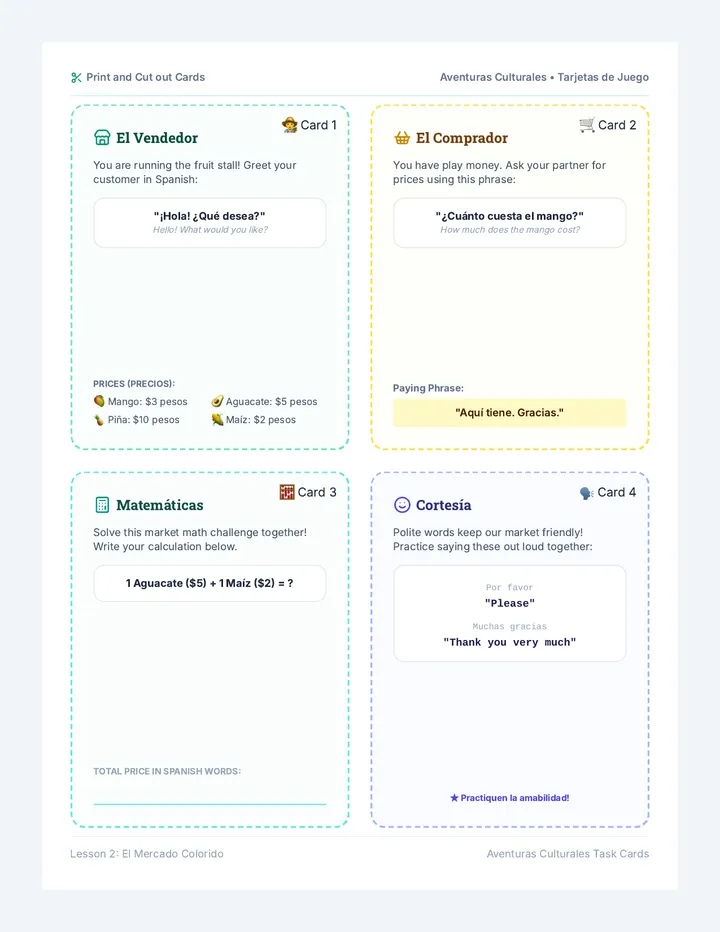
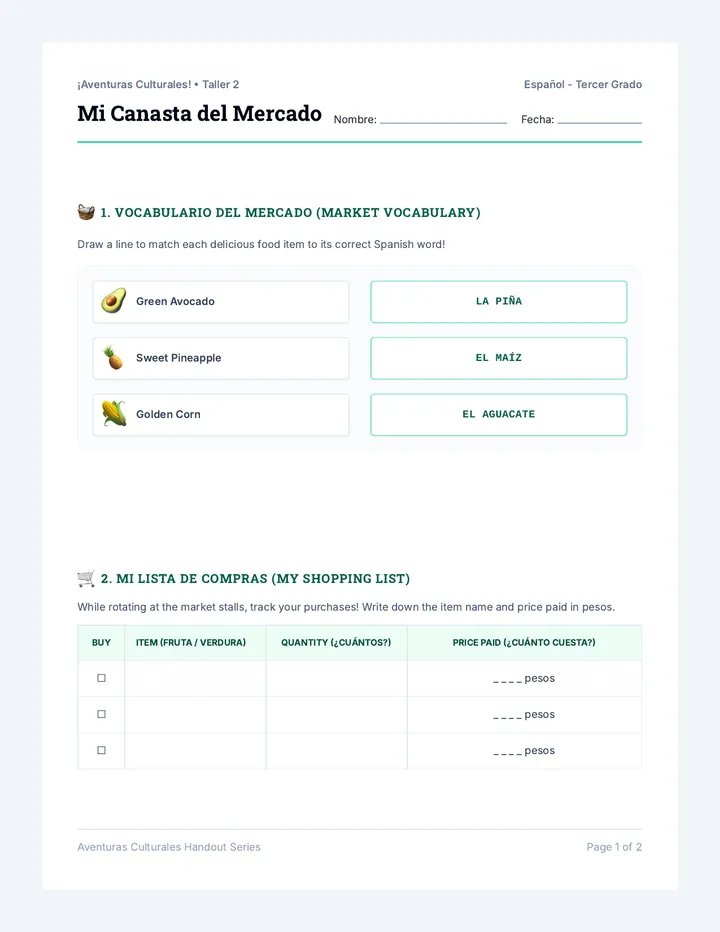
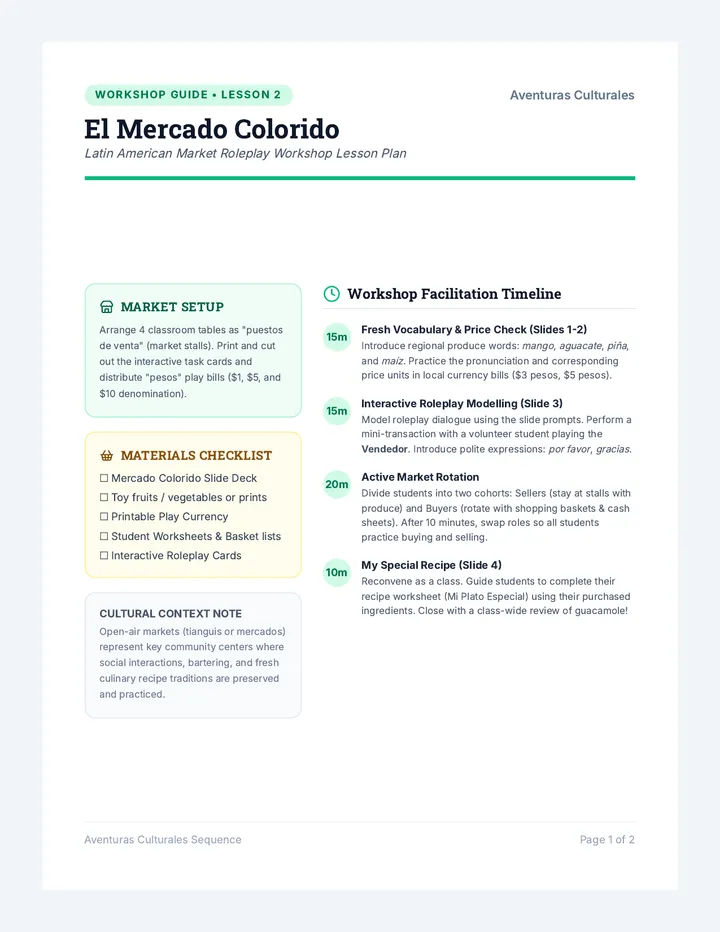
An introductory Spanish lesson for elementary students focused on food vocabulary, ordering in a restaurant, and market shopping. Students will learn essential nouns and polite phrases through interactive slides, creative menu design, and roleplay activities.
Lección completa sobre los usos avanzados del condicional simple y compuesto, incluyendo cortesía, probabilidad en el pasado, oraciones hipotéticas y estilo periodístico.
Una lección avanzada enfocada en el dominio del modo condicional (simple y compuesto) y las oraciones condicionales, contextualizada en escenarios de viaje hipotéticos y dilemas éticos globales.
Eighth lesson in the sequence, focusing on blending roots with academic suffixes and tracking the resulting shifts in syllable count and word function.
Seventh lesson in the sequence, focusing on identifying prefixes as distinct oral syllables in academic vocabulary.
Sixth lesson in the sequence, focusing on identifying and dividing syllables ending in the 'consonant-le' pattern in academic vocabulary.
Fifth lesson in the sequence, focusing on synthesizing VC/CV and V/CV patterns to divide 3-syllable academic vocabulary.
Fourth lesson in the sequence, focusing on identifying and dividing the V/CV (open syllable) pattern in academic vocabulary.
Third lesson in the sequence, focusing on identifying and dividing the VC/CV (closed syllable) pattern in academic vocabulary.
Second lesson in the sequence, focusing on identifying and manipulating primary word stress in academic vocabulary.
A comprehensive scope and sequence for teaching phonological awareness to secondary ELLs, focusing on multisyllabic academic vocabulary and phoneme manipulation.
An introductory Vietnamese language lesson for 5th graders focused on essential greetings, numbers, and common food items through a vibrant market-themed exploration.
Una lección avanzada (B2-C1) para adultos que explora la diversidad geográfica del mundo, trabajando la descripción técnica de paisajes y el uso avanzado de oraciones relativas con preposiciones.
A focused lesson on the ASL signs for black and white, featuring visual sign descriptions and teaching tips for high-contrast colors.
A collection of family invitation flyers for the English Language Education (ELE) showcase and recognition ceremonies across various grade levels. Each flyer includes specific timing, location details, and a return slip for RSVPs.
A collection of invitation forms in multiple languages for the English Language Growth Recognition Ceremony, ensuring all families can participate and celebrate student success.
A comprehensive introduction to the Spanish verbs 'ser' and 'estar' for 9th-grade beginners, focusing on conjugation and the DOCTOR/PLACE mnemonics.
This lesson focuses on the core components of an elementary English classroom, including classroom management language, lesson structuring, and game design.
Day 3 masters the /g/ sound and provides a cumulative review of all 5 letters through word building and high-frequency decoding.
Day 2 focuses on the stop sounds /d/ and /k/, introducing letter C and D with word blending for 'dad', 'mad', and 'cat'.
Day 1 introduces the /m/ and short /o/ sounds, focusing on mouth shape and initial sound recognition, concluding with reading the word 'mom'.
A lesson for 5th grade ESL students to master the use of quantifiers: many, much, few, and a little, focusing on the distinction between countable and uncountable nouns.
A comprehensive A2-level Portuguese lesson focused on food vocabulary, restaurant etiquette, and ordering phrases specifically for European Portuguese contexts. Students will practice polite requests, learn typical dishes, and engage in role-play scenarios.
A phonics-focused lesson for 4th graders targeting the prefixes un-, re-, mis-, dis-, non-, and in- through an engaging narrative and sentence-completion practice.