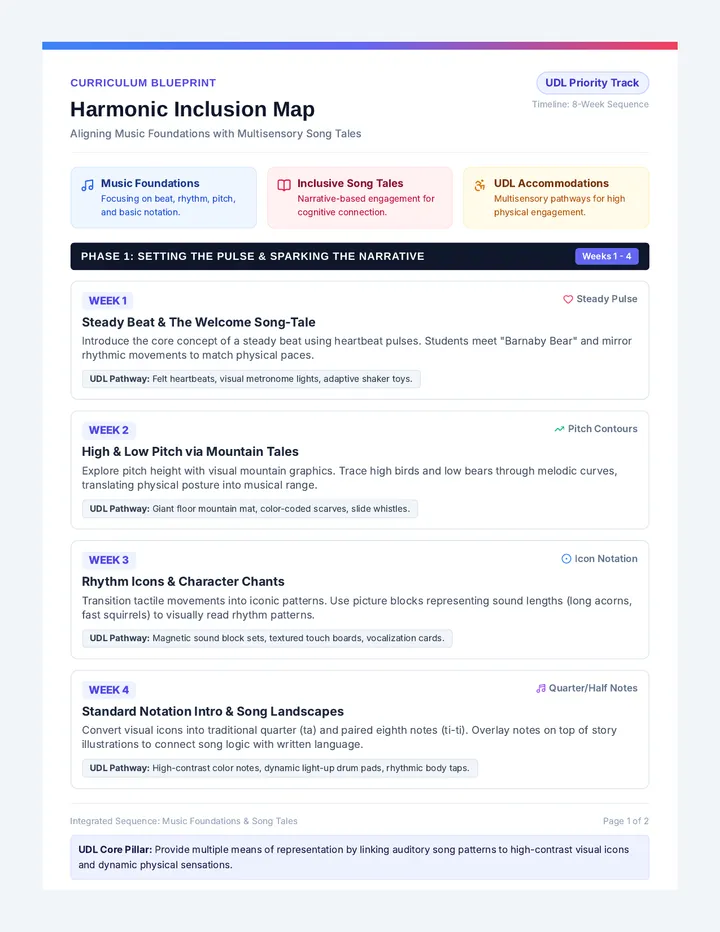
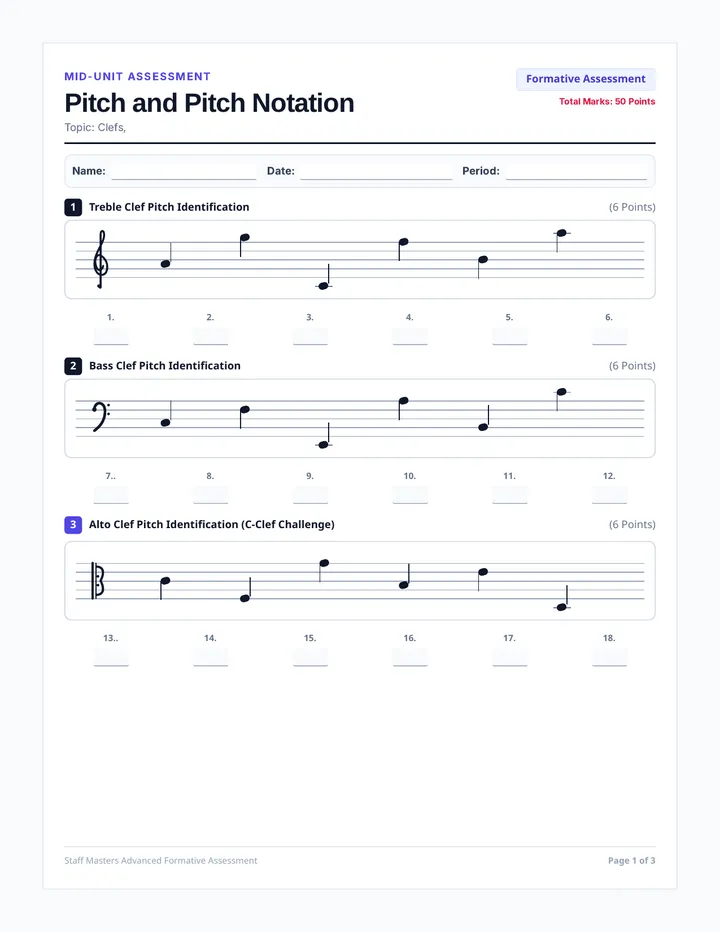
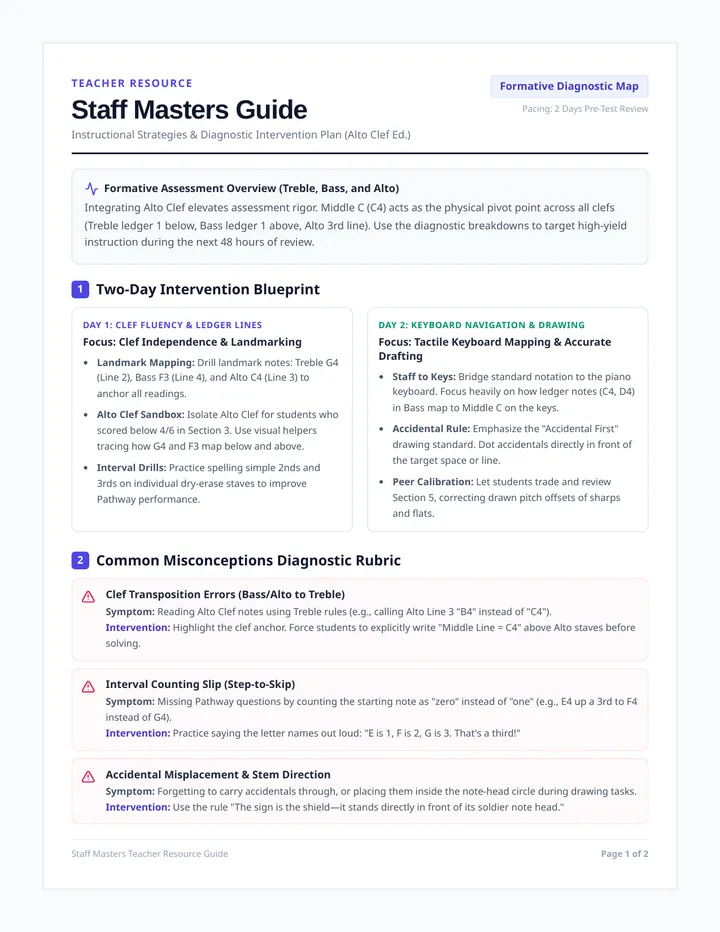
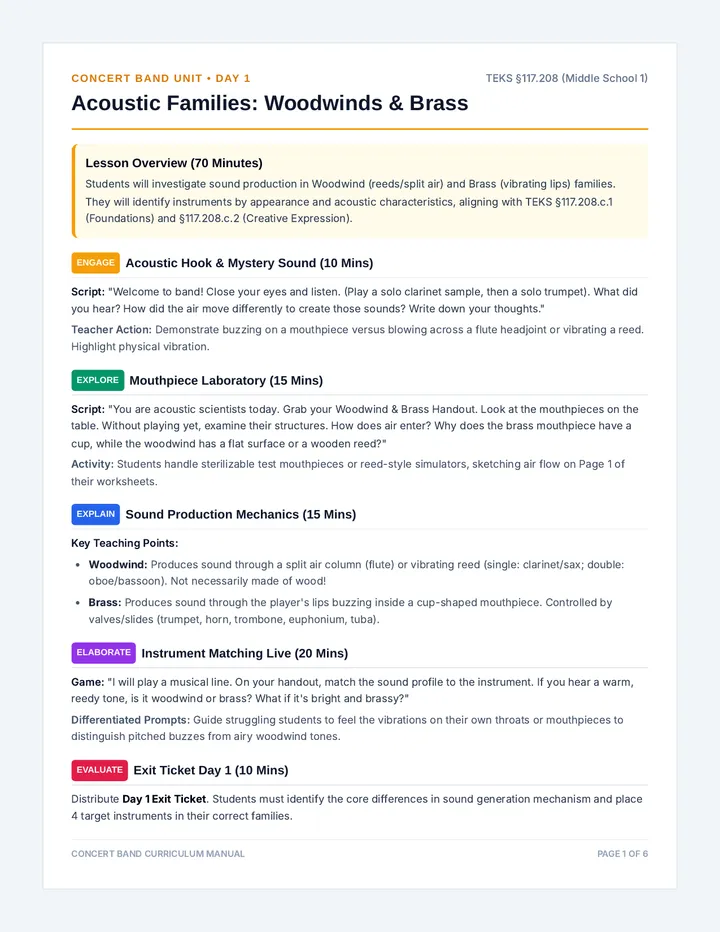
Orchestral Anatomy Teacher Guide Unit: Musical Foundations • Lesson 1
Orchestral Anatomy
Teacher Guide & Lesson Plan
Duration 50 Min
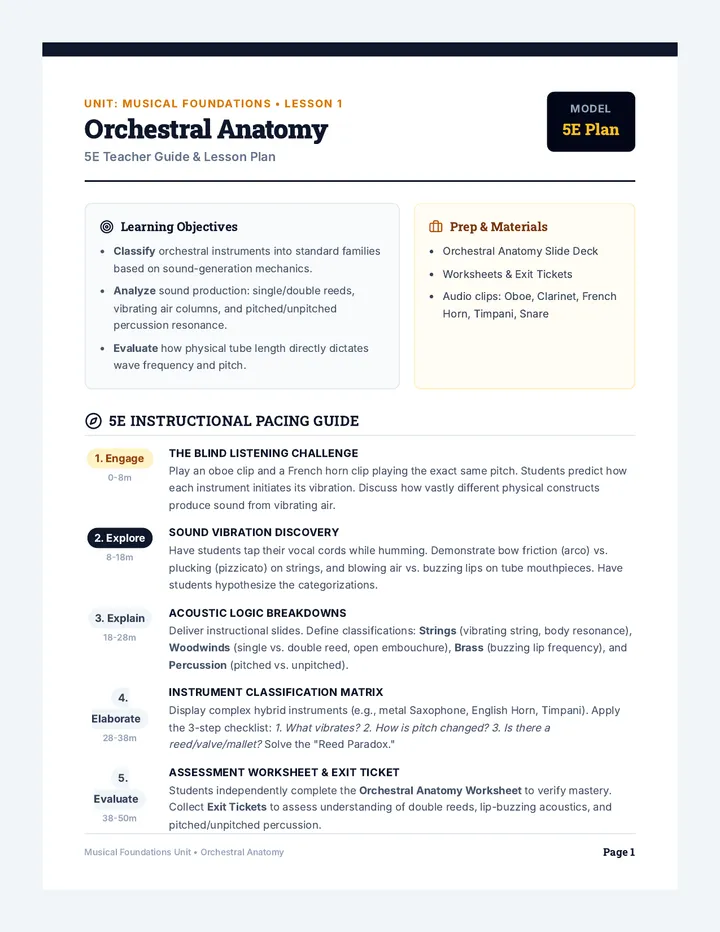
Learning Objectives
Classify orchestral instruments into standard families (strings, woodwinds, brass, percussion) based on physical attributes.Analyze sound production mechanisms: single vs. double reeds, vibrating strings/air columns, and pitched vs. unpitched resonance.Evaluate how instrument design (e.g., tube length, head size) directly influences pitch range.
Prep & Materials
Orchestral Anatomy Slide Deck
Printed Worksheets & Exit Tickets
Audio clips of: Oboe, Clarinet, French Horn, Timpani, Snare Drum
Step-By-Step Pacing Guide
0-8m
The Blind Listening Challenge (Hook)
Play a brief audio clip of an oboe (woodwind) and a french horn (brass) playing the same pitch. Have students write down what they think makes the sound. Reveal that despite looking and sounding completely different, they produce sound through vibrating air. Introduce the day's focus: Anatomy & Physics of Sound.
8-23m
Family Breakdowns (Direct Instruction)
Deliver instructional slides. Emphasize Middle School distinctions:Strings: Vibrating strings, dynamic range via bow pressure (arco) vs. plucking (pizzicato).Woodwinds: Single reed (clarinet, sax), double reed (oboe, bassoon), open hole (flute).Brass: Buzzing lips, valves vs. slides changing overall tubing length.Percussion: Pitched (timpani, xylophone) vs. unpitched (snare, cymbals).
23-35m
Interactive Classification Drill
Display obscure instruments (e.g., English Horn, Sousaphone, Tubular Bells). Guide students to classify them using a 3-step checklist: 1. What vibrates? 2. How is pitch changed? 3. Is there a reed/valve/mallet involved? Work through common pitfalls (e.g., explaining why a saxophone is not a brass instrument).
35-45m
Anatomy Assessment Worksheet
Students work independently on the Orchestral Anatomy Worksheet . Teacher circulates to support students, specifically checking their understanding of double reed mechanics and how pitched percussion differs from unpitched.
Musical Foundations Unit • Orchestral Anatomy Page 1
Discussion Prompts & Assessment Keys
Essential Discussion & Inquiry Prompts
The Reed Paradox
"Why is the saxophone made entirely of brass, yet categorized as a woodwind?" Key Answer: It uses a single wooden cane reed to initiate the sound. Materials of construction do not dictate the family; sound production mechanism does.
The Pitch-Size Relationship
"Compare a violin and a double bass. What does their physical size tell us about pitch?" Key Answer: Longer strings and larger resonating bodies create slower vibration frequencies, producing lower pitches. Smaller instruments yield higher frequencies.
Worksheet Answer Key
Question Section
Correct Responses
Common Misconceptions
1. Sound Source Matching
Oboe → Double Reed Air Embouchure Buzzing Lips
Students think flute uses a reed because it is a woodwind. Emphasize the open embouchure.
2. Percussion Pitches
Pitched: Timpani, Marimba, Glockenspiel Snare Drum, Bass Drum, Triangle
Believing snare has a pitch because it can be "high or low". Clarify that unpitched means no definite fundamental musical pitch.
3. Brass Valve Physics
Pressing valves lengthens the air path, which lowers the frequency and drops the overall pitch.
Students often reverse this: thinking more metal/tubing equals higher, faster sound. Emphasize longer tube = lower note.
Exit Ticket Answer Key
Q1: Name the double-reed woodwind instrument that plays the tuning note.
Q2: Why is piano categorized as percussion in some systems but strings in others?
Q3: Standard orchestra brass valve configuration lowers pitch. True/False?
Musical Foundations Unit • Orchestral Anatomy Page 2
Orchestral Anatomy Slides Unit 1: Musical Foundations Lesson 1
Orchestral Anatomy
An investigation into sound physical mechanics, acoustics, and the four instrument families.
The Symphony Lab
Slide 1 of 5
String & Woodwind Anatomy
Acoustics
01. String Family
• Vibration: Hair of a bow (arco) or fingers (pizzicato) frictionally excite wire or gut strings.
• Pitch Control: Finger pressure shortens active string length (shorter = higher pitch).
02. Woodwind Family
• Single Reed: Sax, Clarinet (one piece of cane vibrating against mouthpiece).
• Double Reed: Oboe, Bassoon (two reeds vibrating against each other).
Notice: Construction material does NOT determine family! Slide 2 of 5
Brass & Percussion Physics
Resonance
03. Brass Family
• Vibration: Player's lips buzz into a cup-shaped mouthpiece.
• Pitch Control: Valves or slides redirect air path. Longer tubing slows wave speed, producing lower notes .
04. Percussion Family
• Pitched: Glockenspiel, Timpani, Xylophone (produce a clear, measurable note).
• Unpitched: Bass Drum, Snare, Triangle, Cymbals (produce diffuse, non-tonal sound).
Brass players literally buzz their lips to activate the air column. Slide 3 of 5
Quick-Fire Classification
Active Check-In
Where do these oddballs belong?
Sousaphone
Valves & Brass Bell
Family: Brass
English Horn
Uses a Double Reed
Family: Woodwind
Timpani
Tuned Drum Head
Family: Pitched Perc.
Cello
Bowed Wooden Body
Family: Strings
Discuss: What makes the Timpani "pitched" but a snare drum "unpitched"? Slide 4 of 5
The Reed Paradox & Keyboard Auxiliary
Deep Dive
Why is Saxophone a Woodwind?
The entire body is made of brass metal, yet it is a woodwind because it uses a flat wooden cane reed.
The vibration source, not the outer metallic material, dictates historical acoustic classification.
Orchestral Anatomy Worksheet Name:
Date:
Class Period:
Class Worksheet
Orchestral Anatomy
Investigating the acoustics and mechanics of standard orchestral instruments
A Sound Source Matching
Match each instrument to its primary mechanism of sound production.
1. Clarinet
2. Oboe
3. Flute
4. Trumpet
A. Double cane reed vibrating together
B. Player's lips buzzing into metal cup
C. Single cane reed against mouthpiece
D. Air split across embouchure hole
B Classification Grid
Write down the classification details for each of the following instruments.
Instrument Family Name Pitched? (Y/N) Primary Material Xylophone _________________ _______ _________________ Saxophone _________________ _______ _________________ French Horn _________________ _______ _________________ Snare Drum _________________ _______ _________________
C Acoustic Analysis
1. A brass player presses a valve. Acoustically, what happens inside the instrument to make the pitch drop lower?
2. Describe the "Reed Paradox." Why is a metal saxophone categorized in the woodwind family rather than brass?
Musical Foundations Unit • Orchestral Anatomy Page 1 of 1
Orchestral Anatomy Exit Ticket Exit Ticket A
Name:
Date:
Orchestral Anatomy
Demonstrate your understanding of orchestral acoustics and instrument classifications.
1. Identify the woodwind instrument that uses a double reed to vibrate and is traditionally played to tune the entire orchestra.
2. Explain why the piano is classified as a percussion instrument rather than a string instrument in most orchestral guides.
3. Opening valves on a brass instrument redirects air into auxiliary loops, making the overall air column longer. This causes the pitch of the note to:
Go higher Go lower Stay the same
Musical Foundations • Lesson 1 Exit Ticket
Cut Here to Separate Tickets
Exit Ticket B
Name:
Date:
Orchestral Anatomy
Demonstrate your understanding of orchestral acoustics and instrument classifications.
1. Identify the woodwind instrument that uses a double reed to vibrate and is traditionally played to tune the entire orchestra.
2. Explain why the piano is classified as a percussion instrument rather than a string instrument in most orchestral guides.
3. Opening valves on a brass instrument redirects air into auxiliary loops, making the overall air column longer. This causes the pitch of the note to:
Go higher Go lower Stay the same
Musical Foundations • Lesson 1 Exit Ticket
Musical Map Teacher Guide Unit: Musical Foundations • Lesson 2
The Musical Map
Teacher Guide & Lesson Plan
Duration 50 Min
Learning Objectives
Navigate the 7-letter musical alphabet forward and backward fluently, defining "steps" and "skips."Identify pitches on the treble clef staff (E4 to F5) using lines and spaces mnemonics.Analyze the treble clef as a "G clef," recognizing that the scroll spirals around the second staff line (G4).
Prep & Materials
The Musical Map Slide Deck
Printed Worksheets & Exit Tickets
Classroom whiteboard (for drawing blank five-line staves)
Step-By-Step Pacing Guide
0-8m
The Loop-Around Challenge (Hook)
Have the class recite the standard alphabet from A to G. Then, ask them: "In music, what comes after G?" Introduce the musical alphabet loop (A-B-C-D-E-F-G-A...). Practice going backward rapidly: G-F-E-D-C-B-A-G. This prevents the common mistake of saying "H" or stopping at G.
8-23m
Treble Staff Geography (Direct Instruction)
Deliver slide content.The Staff: 5 lines, 4 spaces. Count from the bottom up .The Treble Clef: Also called the "G Clef." The target of the inner spiral marks the line G4 (line 2).Lines Mnemonic: E very G ood B oy D oes F ine.Spaces Mnemonic: spells F-A-C-E .
23-35m
Air Spelling & Steps vs. Skips
Draw a giant staff on the board. Introduce "Steps" (line to adjacent space, e.g., E to F) and "Skips" (line to next line, e.g., E to G). Have students "air write" note coordinates. Ask them to spell words using only musical letters (e.g., CAB, BEAD, CAGE, FACE) as you point to pitches on the staff.
35-45m
Worksheet Completion
Hand out The Musical Map Worksheet . Students identify lines/spaces and complete the treble clef spelling puzzles. Teacher circulates to ensure students are counting lines from the bottom up, not top down.
Musical Foundations Unit • The Musical Map Page 1
Discussion Prompts & Assessment Keys
Essential Discussion & Inquiry Prompts
Lines and Spaces Direction
Musical Map Slides Unit 1: Musical Foundations Lesson 2
The Musical Map
Decoding the 7-letter musical alphabet, treble staff lines and spaces, and navigating steps vs. skips.
Pitches & Clefs
Slide 1 of 5
The Musical Alphabet Loop
The Core Alphabet
Only Seven Letters!
Music uses only the letters A, B, C, D, E, F, G .
Once you reach G , the pattern resets immediately back to A . There is no H, I, or J!
Loop Direction
...F → G → A → B...
Backward loop is just as important:
A → G → F → E → D → C → B → A
Practice tip: Recite the alphabet backward from G to A three times. Slide 2 of 5
Staff Grid & Clef Anchor
Staff Anatomy
The Five-Line Staff
• Always count from the bottom up (Line 1 is the bottom line, Space 1 is the bottom space).
• Going UP on the staff increases the pitch.
• Going DOWN decreases the pitch.
The G Clef
The treble clef is historically a stylized gothic letter "G".
The inner loop spirals exactly around Line 2 , anchoring that line as the note G (G4).
If you forget all mnemonics, find Line 2 (G) and count up/down alphabetically! Slide 3 of 5
Treble Staff Mnemonics
Memory Aids
Staff Lines (1 to 5)
Line 1 → E Line 2 → G Line 3 → B Line 4 → D Line 5 → F
"Every Good Boy Does Fine"
Staff Spaces (1 to 4)
Space 1 → F Space 2 → A Space 3 → C Space 4 → E
"F - A - C - E" spells FACE!
Remember: Both mnemonics read from the bottom to the top. Slide 4 of 5
Horizontal Logic: Steps & Skips
Movement Dynamics
Steps (Line ↔ Space)
Moving from a **line** to the very next **space** (or space to next line) is a Step .
Examples: E (Line 1) to F (Space 1) , or A (Space 2) to B (Line 3) .
Skips (Line ↔ Line / Space ↔ Space)
Moving from a **line to the next line** (or space to next space) is a Skip .
Examples: E (Line 1) to G (Line 2) , or F (Space 1) to A (Space 2) .
Musical Map Worksheet Name:
Date:
Class Period:
Class Worksheet
The Musical Map
Mastering the musical alphabet loops, staff geography, and treble clef coordinates
A Musical Alphabet Loops
Fill in the missing letters to complete the forward and backward musical loops.
1. Forward Loop: A → B → C → → E → F → → A
2. Backward Loop: G → F → → D → → B → A → G
B Treble Staff Coordinates
Write the letter name for each coordinate of the treble staff. Remember: count from bottom to top.
1. Line 1 (Bottom Line)
2. Line 3 (Middle Line)
3. Line 5 (Top Line)
4. Space 1 (Bottom Space)
5. Space 2 (Second Space)
6. Space 4 (Top Space)
C Word Spelling Puzzles
Find the correct note names for each coordinate listed, and write the spelled word in the boxes.
Puzzle 1: Space 1 → Space 2 → Space 3 → Space 4
Puzzle 2: Line 3 → Line 1 → Space 2 → Line 4
Puzzle 3: Space 3 → Space 2 → Line 2 → Line 1
D Movement Logic: Steps & Skips
Classify each interval of pitch movement as either a Step (adjacent) or a Skip (jumps over a letter).
1. Line 1 (E) to Space 1 (F) ______________
2. Line 1 (E) to Line 2 (G) ______________
3. Space 1 (F) to Space 2 (A) ______________
Musical Foundations Unit • The Musical Map Page 1 of 1
Musical Map Exit Ticket Exit Ticket A
Name:
Date:
The Musical Map
Quick check: Verify your understanding of the musical alphabet loop and treble clef pitches.
1. Recite the musical alphabet backward starting from the pitch B. Fill in the sequence:
B → A → → F → E → → C → B
2. Explain why the Treble Clef is also known as the "G Clef." What is the anatomical secret hidden in its scroll?
3. If Note 1 is on Line 2 (G) and Note 2 is on Line 3 (B), did the note move by a STEP or by a SKIP?
Step (Adjacent) Skip (Non-Adjacent)
Musical Foundations • Lesson 2 Exit Ticket
Cut Here to Separate Tickets
Exit Ticket B
Name:
Date:
The Musical Map
Quick check: Verify your understanding of the musical alphabet loop and treble clef pitches.
1. Recite the musical alphabet backward starting from the pitch B. Fill in the sequence:
B → A → → F → E → → C → B
2. Explain why the Treble Clef is also known as the "G Clef." What is the anatomical secret hidden in its scroll?
3. If Note 1 is on Line 2 (G) and Note 2 is on Line 3 (B), did the note move by a STEP or by a SKIP?
Step (Adjacent) Skip (Non-Adjacent)
Musical Foundations • Lesson 2 Exit Ticket
Bass Ledger Teacher Guide Unit: Musical Foundations • Lesson 3
The Bass Ledger
Teacher Guide & Lesson Plan
Duration 50 Min
Learning Objectives
Identify pitches on the bass clef staff (G2 to A3) using lines and spaces mnemonics.Construct the Grand Staff visual layout, recognizing Middle C (C4) as the central ledger line bridge.Analyze the bass clef as an "F clef," identifying how the two dots frame Line 4 (F3).
Prep & Materials
The Bass Ledger Slide Deck
Printed Worksheets & Exit Tickets
Audio sample of a low cello G2 vs. middle C4
Step-By-Step Pacing Guide
0-8m
The Sound Floor (Hook)
Play a low-pitched sound (e.g., G2 on a cello). Ask students: "Can we easily write this note on our treble staff?" Show that it would require too many ledger lines below, making it unreadable. Introduce the Bass Clef as the specialized "map" for lower voices and instruments.
8-23m
Bass Staff & Grand Staff (Direct Instruction)
Deliver slide content.The F Clef: Bass clef spirals on Line 4 (F3), and its two dots frame Line 4.Lines Mnemonic: G ood B oys D o F ine A lways.Spaces Mnemonic: A ll C ows E at G rass.The Grand Staff: Combining Treble and Bass staves. Middle C (C4) sits on a ledger line exactly halfway between them.
23-35m
Middle C Bridge Activity
Draw the Grand Staff on the board. Project notes and have the class identify if they are in the high (treble) or low (bass) neighborhood. Guide them in writing Middle C with its miniature horizontal line (the ledger line) representing the physical bridge connecting the two staves.
35-45m
Worksheet Completion
Hand out The Bass Ledger Worksheet . Students identify bass clef pitches, map notes relative to Middle C, and complete spelling word challenges tailored to lower registers.
Musical Foundations Unit • The Bass Ledger Page 1
Discussion Prompts & Assessment Keys
Essential Discussion & Inquiry Prompts
Bass Ledger Slides Unit 1: Musical Foundations Lesson 3
The Bass Ledger
Exploring the F Clef, lower register notation, and the visual bridge of Middle C on the Grand Staff.
Grand Staff Geography
Slide 1 of 5
The F Clef Anchor
Clef Design
Why call it the "F Clef"?
Historically, the bass clef symbol is a stylized gothic letter F .
The clef's central spiral starts directly on Line 4 , and its two prominent dots frame Line 4 on either side. This anchors Line 4 as the pitch F3 .
Register Context
This clef is used for instruments with low registers:
• Cello & Double Bass
• Bassoon
• Trombone & Tuba
• Left hand of the Piano
If you get lost, locate Line 4 (between the dots) and count alphabetically! Slide 2 of 5
Bass Staff Mnemonics
Memory Aids
Staff Lines (1 to 5)
Line 1 → G Line 2 → B Line 3 → D Line 4 → F Line 5 → A
"Good Boys Do Fine Always"
Staff Spaces (1 to 4)
Space 1 → A Space 2 → C Space 3 → E Space 4 → G
"All Cows Eat Grass"
Warning: Do not mix these up with treble mnemonics! Bass spaces start on A. Slide 3 of 5
The Grand Staff Blueprint
Unified Grid
Unified System
The Grand Staff merges the Treble and Bass staves together into a single bracketed reading system.
This allows keyboard players and conductors to read a wide range of frequencies spanning over four octaves simultaneously.
The Neutral Zone
Between the Treble staff and Bass staff lies a narrow gap. This represents the register where high and low frequencies meet.
A thick brace on the far left visualizes that both staves are played together. Slide 4 of 5
The Middle C Bridge & Ledgers
The Pivot Note
The Pivot: Middle C
Middle C (C4) sits exactly in the middle of the neutral zone, utilizing a single temporary ledger line .
It is written just below the Treble staff, OR just above the Bass staff. It is the exact same pitch on the instrument!
Ledger Lines
Small, temporary horizontal lines drawn above or below the five-line staff, extending the map's pitch range when notes go "off-grid."
Bass Ledger Worksheet Name:
Date:
Class Period:
Class Worksheet
The Bass Ledger
Mastering the bass clef staff coordinates, Grand Staff architecture, and Middle C
A Bass Clef Coordinates
Write the letter name for each coordinate of the bass staff. Remember: count from bottom to top.
1. Line 2 (Second Line)
2. Line 4 (The Spiral/Dot Line)
3. Line 5 (Top Line)
4. Space 1 (Bottom Space)
5. Space 3 (Third Space)
6. Space 4 (Top Space)
B Bass Clef Spelling Words
Find the correct note names for each coordinate listed, and write the spelled word in the boxes.
Puzzle 1: Space 1 → Line 2 → Space 3
Puzzle 2: Line 4 → Space 1 → Space 2 → Space 3
Puzzle 3: Line 1 → Space 1 → Line 2
C Grand Staff Architecture
1. What is "Middle C" (C4), and why does it require a ledger line to be written?
2. Describe "Ledger Lines." What is their physical purpose in musical notation when notes go "off-grid"?
Musical Foundations Unit • The Bass Ledger Page 1 of 1
Bass Ledger Exit Ticket Exit Ticket A
Name:
Date:
The Bass Ledger
Quick check: Verify your understanding of the bass staff and Grand Staff coordinates.
1. Explain why the Bass Clef is also known as the "F Clef." What visual clue on the staff anchors this name?
2. Identify the specific pitch found on Space 3 of the Bass staff (remember: "All Cows...").
3. Middle C (C4) is the handshaking bridge between treble and bass clefs. How many ledger lines does it require?
Exactly 1 ledger line Exactly 3 ledger lines No ledger lines at all
Musical Foundations • Lesson 3 Exit Ticket
Cut Here to Separate Tickets
Exit Ticket B
Name:
Date:
The Bass Ledger
Quick check: Verify your understanding of the bass staff and Grand Staff coordinates.
1. Explain why the Bass Clef is also known as the "F Clef." What visual clue on the staff anchors this name?
2. Identify the specific pitch found on Space 3 of the Bass staff (remember: "All Cows...").
3. Middle C (C4) is the handshaking bridge between treble and bass clefs. How many ledger lines does it require?
Exactly 1 ledger line Exactly 3 ledger lines No ledger lines at all
Musical Foundations • Lesson 3 Exit Ticket