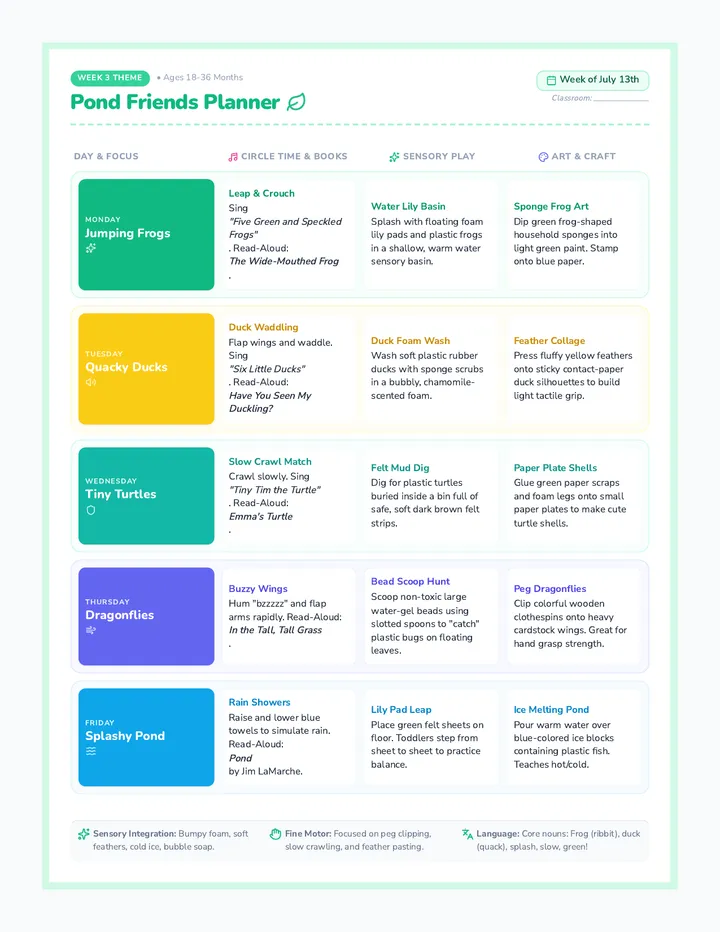
A creative exploration of winter for 5-6 year olds, featuring storytelling, a cotton ball winter scene craft, and an active Snowflake Dance movement game.
Students practice and perform five unique fractured fairy tale scripts, each featuring exactly five characters to support collaborative group work.
A 40-minute guided art lesson for grades K-3 that introduces the 7 elements of art through a single integrated drawing activity and supporting mini-tasks. Ideal for substitutes, this lesson builds a 'Creative Creature' step-by-step.
A musical exploration where students use the growth of a plant to understand crescendo and decrescendo through movement and voice.
A comprehensive substitute-friendly lesson introducing the 7 Elements of Art to students in grades K-3 through visual exploration and hands-on practice.
A beginner's guide to drawing classroom objects using basic geometric shapes. Students learn to identify and use circles, triangles, squares, rectangles, and ovals through simple step-by-step visual instructions.
In this lesson, students will identify circles, squares, rectangles, triangles, and ovals in common classroom objects. They will then follow visual, step-by-step directions to draw these objects themselves using primary colors.
A kindergarten lesson focused on identifying and using basic geometric shapes (circle, square, triangle, rectangle, oval) to draw familiar outdoor objects. Students follow three-step visual guides to build their artistic confidence through shape recognition.
A lesson for kindergarteners on how to use basic shapes to draw common outdoor settings and objects, following a step-by-step approach to build artistic confidence.
A hands-on file folder game and introductory lesson focusing on four core elements of art: line, shape, color, and texture. Students learn to identify these elements through visual examples and interactive matching.
A Gifted and Talented Kindergarten lesson exploring the life and geometric abstract art of Piet Mondrian, focusing on primary colors, grids, and artistic balance.
A guided exploration of the Harlem Renaissance exhibition at the Met Museum, designed for students with emerging reading skills to engage with art history through literal and inferential questions.
A creative exploration of colors through a word search activity, designed for young artists or those needing large print accessibility.
A fun, hands-on lesson for kindergarteners to learn how to dress basic shape-based figures using primary colors and simple patterns. Students will practice identifying shapes and making creative choices for their character's outfits.
A simple, step-by-step drawing lesson for kindergarteners to learn basic facial features. Students will follow along to draw eyes, a nose, and a mouth on a circle.
A kindergarten art and geometry lesson where students learn to construct human figures using five basic shapes: circles, triangles, squares, rectangles, and ovals.
A series of hands-on spring-themed craft activities for kindergarteners that focus on fine motor skills, shape recognition, and pre-writing strokes. Students practice cutting, gluing, and drawing through structured, visual step-by-step instructions.
A music and movement lesson for early childhood students exploring phrasing and legato through the life cycle of a butterfly. Students use scarves to interpret smooth musical lines while learning about metamorphosis.
A creative craft lesson where students color and create their own finger puppets of favorite Zootopia characters to practice storytelling and role-playing.
A primary art lesson exploring the beauty of nature and our role in keeping the Earth clean. Students observe natural wonders and create their own "Earth Treasures" using drawing and sculpting materials.
A hands-on activity for students to identify and match various line types used in art, from basic directional lines to complex decorative patterns.
A collection of three hands-on Mother's Day crafts designed specifically for preschool-aged children using paint, clay, and paper. Students will create personalized keepsakes including a handprint bouquet, a fingerprint dish, and a decorated photo frame.
Une séance complète pour apprendre à tracer des lignes obliques sur le thème de la pluie, adaptée aux élèves de Petite Section. Comprend une fiche de préparation détaillée et un support d'exercice pratique.
A collaborative Earth Day lesson where students create a class book inspired by Louis Armstrong's 'What a Wonderful World'. Includes a detailed teacher guide and presentation slides with a video embed.
The final premiere of the music video at the All-town Music Tech Showcase, followed by a live performance and student reflection on the collaborative process.
The technical phase involving on-location recordings at elementary and middle schools, followed by high school student-led mixing and video production.
Introduction to the 'Playing for Change' concept, exploring the themes of the chosen protest song, and laying the groundwork for the K-12 collaboration.
A creative arts lesson for Kindergarteners based on 'Click, Clack, Moo: Cows That Type', focusing on character expression and fine motor skills through a 'cow demand' craft.
Students explore the science and art of sound by constructing DIY instruments from recycled materials. The lesson emphasizes individual creative design followed by a collaborative team performance.
A series of rhythm reading flashcards and a teacher's guide covering basic to advanced rhythmic patterns. Activities progress from quarter notes and rests to complex sixteenth notes and triplets across multiple time signatures.
A series of music center activities for first graders to connect word syllables to rhythmic notation (Ta and Ti-Ti) through a zoo animal theme. Students will sort animal names by rhythm and create their own rhythmic patterns.
A creative art lesson inspired by 'The Dot' by Peter H. Reynolds, focusing on growth mindset and artistic experimentation. Students will learn that 'making your mark' starts with just one small step.
Learning about art galleries and preparing a final class exhibition of the week's creations.
Connecting colors to feelings and exploring how brushstrokes can express different moods.
Using geometric shapes and stamping techniques to create structured art compositions.
Exploring painting with unconventional tools like sponges, forks, and bubble wrap to create varied textures.
Introducing the building blocks of all colors: Red, Yellow, and Blue through hands-on mixing exploration.
A creative art lesson where students explore identity and diversity by creating their own mixed-up animals inspired by Eric Carle's colorful collage style. Students will learn the 'painted paper' technique to create vibrant textures.
A first-grade introduction to Australian music and culture, focusing on the didgeridoo, the folk classic 'Waltzing Matilda', and maintaining a steady beat through movement and listening.
Students create vibrant collages using geometric and organic shapes, taking inspiration from Henri Matisse's famous 'cut-outs' to tell visual stories.
Students transform 2D shapes into 3D forms using clay and secondary materials, inspired by the abstract sculptures of Barbara Hepworth and Alexander Calder.
Students explore different types of lines (straight, wavy, zig-zag) using paint, inspired by the bold compositions of Piet Mondrian and Wassily Kandinsky.
An introductory art and nature lesson for Pre-K students exploring Claude Monet's famous 'Water Lilies' through sensory observation and creative play.
Students will use various tools like pipettes, sponges, and spray bottles to explore how paint moves on paper, focusing on the motor movements of squeezing, pinching, and pressing.
Focusing on 'The Mixed-Up Chameleon,' this lesson explores the vibrant world of colors and animal traits through layered collage and mixed-media art.
Focusing on 'The Very Busy Spider,' this lesson explores the themes of hard work and persistence while teaching students how to create tactile textures in their art using mixed media.
Focusing on 'The Very Hungry Caterpillar,' this lesson teaches students about the life cycle of a butterfly through the lens of Eric Carle's signature tissue paper collage technique.
A hands-on exploration of primary color mixing using colored transparencies. Students act as 'Color Chemists' to discover how layering red, blue, and yellow creates new colors.
Students explore the wax-resist watercolor technique to create vibrant landscapes. This lesson introduces basic color mixing and the "magic" of how oil and water don't mix.
High-level planning resources and summaries for the Mother's Day unit.
Students decorate gift bags for their creations and, if time permits, bead a personalized necklace or bracelet to complete the gift set.